The Living Palette: What Impressionism Revealed and Japan Perfected
Prelude: A Confession of Light
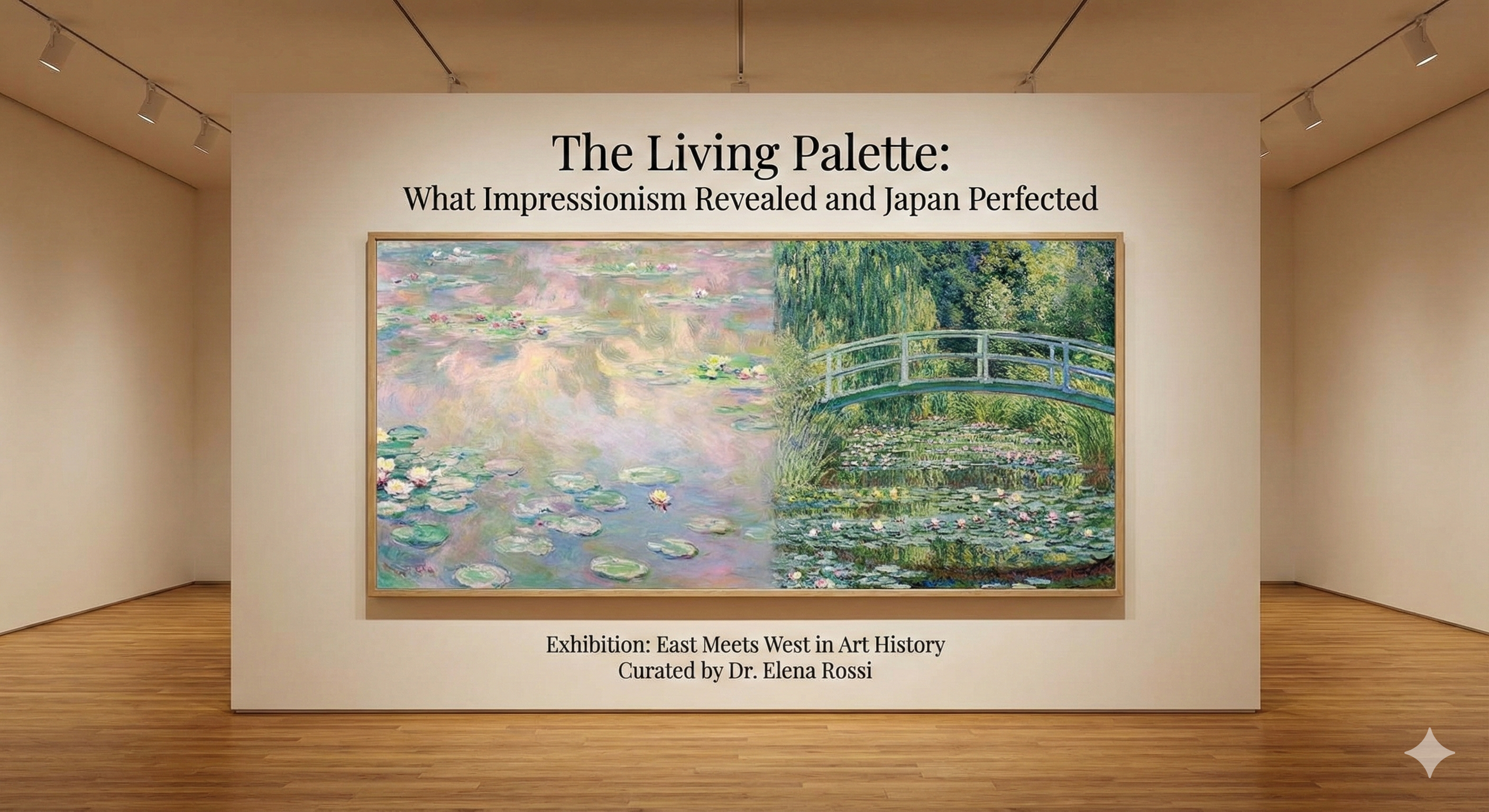
When Monet declared his desire to paint like a bird sings—instinctively, without theory, purely—he unknowingly articulated what Japanese color culture had practiced for a millennium: the art of witnessing rather than defining, of experiencing rather than classifying. The Impressionists, those rebels of the Parisian salons, thought they had discovered something revolutionary: that color exists not in objects but in the fleeting relationship between light, atmosphere, and perception.
Japan had always known this. They simply called it by different names.
I. The Democracy of Perception: Pissarro’s Humble Places
“Blessed are they who see beautiful things in humble places where other people see nothing.”
Pissarro’s benediction finds its purest expression in the Japanese response to the 17th-century color prohibitions of Edo. When the shogunate stripped away red, purple, and gold from daily life—those assertive declarations of wealth and status—they believed they had rendered the world monochrome. Instead, they accidentally triggered an optical revolution.
The Japanese descended into brown. Into gray. But they did not surrender—they subdivided.
Forty-eight browns. Not as defeat, but as insurrection of the eye.
Consider Rikyū-nezu, a gray named after the tea master Sen no Rikyū. It is not simply “gray-brown” or “taupe.” It is the specific color of humility refined into elegance, of power expressed through restraint. Or Sakura-nezu—a gray that remembers cherry blossoms, that carries within its muted surface the ghost of spring. To the untrained eye: nothing. To the trained eye: infinity.
This is Pissarro’s blessing made systematic. The Impressionists painted haystacks and water lilies, elevating the humble through obsessive attention. Japan had already elevated the spaces between colors, the gradations invisible to those who looked without seeing.
II. Emotion as Architecture: Cézanne’s Foundation
“A work of art which did not begin in emotion is not art.”
Cézanne demanded that emotion precede technique. Japanese color philosophy inverts this wisdom: emotion is embedded within the technical name itself.
When you learn the word Moegi—the yellow-green of new growth pushing through soil—you inherit its emotional content. This is not “light green” or “spring green.” This is resilience. This is the color of life that still remembers the darkness it emerged from, the yellow of the seed persisting in the green of the shoot.
Tokiwa-iro: the green that does not change, even beneath snow. This is not botanical classification. This is fidelity. Endurance. The emotional quality of permanence given chromatic form.
Or consider Uguisu-iro—not merely the color of a nightingale but the specific green-gray-brown of a bird concealed in bamboo shadow. To name this color is to name anticipation, the emotion of something beautiful that refuses full revelation. You must earn this color through patience.
The Impressionists painted their emotions onto canvas. The Japanese embedded emotion into the very vocabulary of seeing, creating an emotional grammar written in gradients.
III. The Dissolution of Line: Manet’s Revelation
“There are no lines in nature, only areas of colour, one against another.”
Manet’s observation destroyed centuries of academic drawing, the tyranny of disegno over colore. He saw what Japanese textile artists had engineered into kasane—the principle of layering.
Long before Photoshop’s layers panel, Japan understood that color is not substance but relationship.
Kasane did not mix pigments. It mixed light itself. White silk floating above red silk creates pink not through chemistry but through atmosphere, through the air trapped between fabrics. As the wearer moves, the color shifts—not because the fabric changes, but because the relationship between layers, light, and observer transforms with each gesture.
This is Manet’s vision made wearable. Color exists only at the boundary between one area and another. The “pink” of kasane is actually the conversation between white and red, mediated by space, animated by motion.
Modern digital color systems can simulate this with opacity sliders and blend modes. But they cannot replicate the fundamental truth: that these colors change with the body’s movement, with the season’s light, with the angle of viewing. The Japanese didn’t just understand that there are no lines in nature—they designed clothing that performed this truth.
IV. The Supremacy of Darkness: Renoir’s Forty-Year Journey
“I have been forty years discovering that the queen of all colours is black.”
Renoir’s late revelation—that black is not the absence of color but its sovereign—resonates with profound irony in the Japanese context. For in Japan’s palette, black barely exists as a concept. Instead, there is Kuro, but more importantly, there are the colors that approach black without surrendering to it.
Nasukon—the deepest indigo, dark as night but still carrying within it the memory of blue.
Kachi-iro—the indigo of victory, so dark it appears black to the casual glance, yet under sunlight reveals its essential blueness.
This is Renoir’s discovery inverted: the supremacy of black lies precisely in its refusal to be purely black, in its insistence on containing depth, nuance, chromatic history.
But where Renoir’s insight truly crystallizes is in the Japanese understanding of fading—not as degradation but as biography.
Japan Blue, Ai, indigo, is born deep. Nasukon dark. Over decades, through sunlight and rain, through the sweat of labor and the friction of living, it transforms. Year by year, it lightens, until finally it reaches Kame-nozoki—”a glimpse into the jar”—a blue so pale it trembles at the edge of visibility.
This color cannot be purchased. You must live it.
Renoir needed forty years to discover black’s sovereignty. Japanese indigo requires forty years to reveal its full spectrum—from queen-of-darkness to whisper-of-light. The same fabric, the same dye, transformed not by choice but by time. Every stage is beautiful. Every stage is black’s descendant.
V. The Nameless Gradient: Beyond Impressionism
The Impressionists captured moments: Monet’s same haystacks at different hours, Pissarro’s boulevards under changing weather. They painted durée, Bergson’s duration, the sense that time is not sequence but flow.
Japan’s color culture exceeds even this. Because while the Impressionists could paint the sunrise, Japan named every phase of its unfolding:
Gyōan—the first separation of night from not-night. Shinonome-iro—the color of dawn’s beginning. Akebono-iro—daybreak itself. Asagi—the pale blue-green of full morning.
These are not classifications. They are acts of attention so devoted that they become acts of love. “Not to classify it,” the text tells us, “but to capture the moment before it disappeared.”
This is the profound difference between Impressionism and Japanese color philosophy:
The Impressionists painted moments to preserve them. The Japanese named moments to release them.
By naming Akebono-iro, they acknowledged it would never be exactly this color again. The name is not a cage but a memorial, a way of honoring the ephemeral by marking its passing. Tomorrow’s dawn will be different. But you will recognize it, because you know what Akebono-iro means—not as replication, but as variation on a theme.
VI. The Algorithm of Perception
There is a quiet technological marvel hidden in this philosophy: Japanese color culture anticipated the fundamental principles of modern color science while remaining rooted in phenomenology.
Hatoba-iro—a gray that, in certain light, reveals traces of violet. This is not poetic license. This is the optical principle of metamerism, where colors appear different under different light sources, long before anyone formalized the concept in laboratories.
Beni from safflower, requiring body heat to complete its transformation, is an early understanding of thermochromism, of color as dynamic chemical reaction rather than static property.
The algorithm of kasane layering is literally the same mathematics that governs alpha compositing in digital graphics—but performed with silk and air instead of pixels and code.
Japan didn’t need the science to understand the phenomenon. They observed, they refined, and they systematized their observations into a cultural technology of seeing.
VII. What Color Is Your Silence?
The Impressionists ended with Neo-Impressionism, with Seurat’s dots and color theory, with the scientization of spontaneity. They tried to make reproducible what was meant to be unrepeatable.
Japan’s color philosophy offers a different conclusion: the most beautiful colors remain unnamed.
Eleven hundred named colors—an extraordinary vocabulary of seeing. And yet, the text insists, the unnamed colors are more beautiful still:
The color of fading memory. The color before meeting someone. The color outside your window right now.
This is not failure of language. This is the humility of language before the infinite. It is the recognition that naming is not mastery but invitation—an invitation to see more deeply, to distinguish more carefully, and finally, to acknowledge that distinction itself has limits.
When Monet wanted to paint like a bird sings, he wanted automaticity, the dissolution of the gap between perception and expression. Japan’s answer is both simpler and more demanding: Look until you must name it. Name it until others can see it. Then release it back into the unnamed.
Coda: The Screen and the Sky
“Turn off the screen and look at the world.”
The Impressionists fought against the darkness of studio painting, insisting on plein air, on direct engagement with light. They wanted to paint what they saw, not what they thought they should see.
Japanese color culture makes the same demand with greater urgency: the sixteen million colors of RGB are perfect, uniform, still—and therefore dead. They cannot fade. They cannot breathe. They cannot surprise you with a trace of violet hiding in gray.
The true palette is outside. The true palette is now. The gradient of dawn that will never repeat. The indigo that remembers forty years of wear. The green that still contains yellow because it remembers being born.
Tomorrow morning, look at the sky. You will meet a new color.
This is not mysticism. This is the opposite of mysticism—it is radical empiricism, the insistence that reality exceeds category, that every moment offers chromatic information that has never existed before and will never exist again.
Name it. Not to own it. Not to freeze it. But to honor it. To testify that you witnessed this particular intersection of light, atmosphere, and consciousness. To create a coordinate—not of space, but of experience—so that others might navigate toward their own version of this moment.
And then, like the Impressionists loading their easels, like the Japanese naming the nameless gradient, begin again.
Because the queen of all colors is not black.
The queen of all colors is attention.