Beyond Borders: Twelve Latin American Artists Redefining Contemporary Art
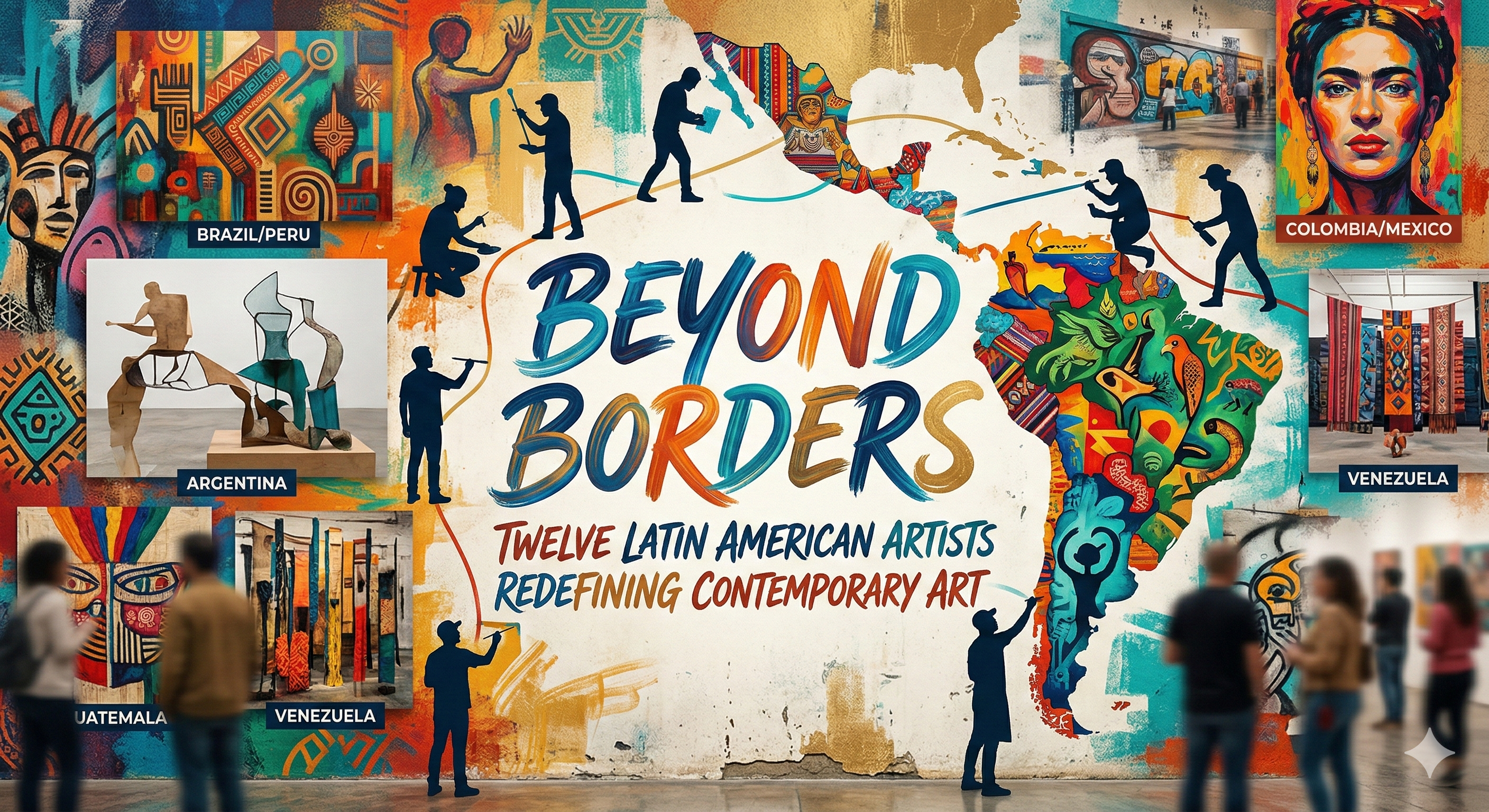
The landscape of contemporary Latin American art pulses with urgent creativity. From monumental clay vessels to delicate paper cuts, from post-apocalyptic visions to intimate memory paintings, a generation of artists is transforming how we understand material, memory, and meaning itself. These twelve practitioners—working across Argentina, Brazil, Cuba, Ecuador, Mexico, Panama, and Venezuela—demonstrate that Latin American art today is not a single story but a constellation of powerful, distinct voices reshaping the global conversation.
Material as Memory, Sculpture as Gathering
Gabriel Chaile stands at the intersection of sculpture and social practice, working with clay and adobe to create monumental forms that honor Indigenous building traditions while addressing contemporary concerns. His massive vessels and ovens—objects that might weigh hundreds of pounds—are not simply sculptures to observe but spaces designed for gathering. In Chaile’s hands, the ceramic form becomes a site of collective memory and communal ritual, transforming the white cube gallery into something closer to a plaza or ceremonial ground. The artist’s choice of materials speaks to ancestral knowledge systems, yet his work addresses present-day questions about community, sustenance, and belonging in an increasingly atomized world.
Where Chaile builds gathering spaces from earth, Ariamna Contino excavates political and social structures through an entirely different materiality. Working primarily with hand-cut paper, Contino transforms extensive research into visually intricate works that belie their devastating subject matter. Her delicate constructions confront Cuban economic policy, environmental degradation, and systemic failures with surgical precision. The contradiction between the fragility of her medium and the weight of her themes creates a productive tension—these are not works that shout but rather speak in a language of accumulated detail, demanding sustained attention to reveal their full complexity.
Urban Systems and Architectural Memory
Cisco Merel approaches the visual environment of contemporary life as a system to be decoded and remapped. His practice moves fluidly between abstraction, photography, and sculpture, treating urban architecture and popular culture not as background but as primary text. Merel’s work captures the visual language of cities—the patterns, repetitions, and fragments that structure daily experience—and reorganizes them into sharp visual systems. His approach has particular resonance in an era of globalized aesthetics, where the visual codes of one city increasingly mirror another, and local specificity exists in tension with international flows of image and style.
Néstor Jiménez similarly engages with built environments, but his focus turns explicitly political. Using painting and installation often executed on recovered or discarded materials, Jiménez excavates the relationship between architecture and ideology in Mexico. His work understands that buildings are never neutral—they encode power structures, facilitate certain behaviors while constraining others, and physically manifest political decisions. By reimagining architectural forms and working on materials salvaged from demolition or abandonment, Jiménez positions his practice as both archaeological and speculative, uncovering the political unconscious of the built environment while imagining alternatives.
Mythology, Femininity, and Symbolic Worlds
Hilda Palafox has become internationally recognized for paintings and murals that construct entire mythological systems centered on feminine power. Her stylized figures—often monumental women rendered in bold colors and clean lines—inhabit worlds drawn from Mexican folklore but reconfigured into matriarchal societies. Palafox’s visual language combines the graphic clarity of illustration with the emotional depth of fine art painting, creating images that function simultaneously as contemporary icons and ancient archetypes. Her work participates in broader conversations about reclaiming Indigenous and pre-colonial narrative traditions while asserting specifically feminist visions of power and community.
Renata Petersen takes a different approach to gender and cultural critique, wielding dark humor as her primary tool. Working across ceramics, drawing, and comic-style imagery, Petersen lampoons religion, gender norms, and popular culture with irreverent wit. Her work embraces the taboo, using satire to expose the absurdities embedded in social conventions. Where Palafox builds mythic alternatives, Petersen dismantles existing structures through mockery, demonstrating that humor can be as sharp a critical instrument as any theoretical framework.
Nature Reimagined: From Lush Vitality to Post-Human Futures
Thalita Hamaoui’s paintings present nature as an immersive, almost hallucinogenic experience. Her lush landscapes seem to breathe, with color and vegetation pulsing across the canvas as if alive. These are not documentary records of specific places but emotional environments where the distinction between interior feeling and exterior world dissolves. Hamaoui’s approach to landscape painting rejects both romantic idealization and environmental documentary, instead treating nature as a shifting psychological space—simultaneously threatening and nurturing, familiar and utterly strange.
Carolina Fusilier offers a darker ecological vision. Her cinematic paintings and films imagine post-human futures where technology and nature have merged in unsettling ways. Working with atmospheric effects that blur boundaries between organic and synthetic, Fusilier creates scenes that feel simultaneously like science fiction and documentary evidence from a future already unfolding. Her speculative worlds refuse easy moralizing about technology or nature, instead presenting eerie landscapes where the categories themselves have collapsed, forcing viewers to navigate unfamiliar terrain without clear ethical coordinates.
Traces, Absences, and the Archive
Ana Navas works with glass and collage to create what might be called portraits of absence. Her ghostly figures emerge from layered materials that suggest both transparency and obscurity, presence and disappearance. Navas explores how objects and images accumulate memory, how they carry traces of the people who made or used them, and how cultural history embeds itself in material form. Her work participates in archival practices but with an understanding that archives are never complete or neutral—they are constructed through selection and exclusion, always haunted by what they cannot or will not contain.
Adriel Visoto similarly engages with memory, though his archive is explicitly personal. Working in intimate, small-scale paintings drawn from his own photographs and recollections, Visoto transforms private moments into images with universal resonance. His quiet, emotionally charged scenes—often depicting everyday moments rendered with careful attention to light and atmosphere—demonstrate that the personal need not be confessional to be powerful. These are not grand narratives but accumulations of small observations, suggesting that meaning emerges not from spectacular events but from sustained attention to the texture of daily experience.
Language as Material, Meaning as Construction
Iván Krassoievitch occupies distinct territory in this constellation of practices, working primarily with poetry, text, and conceptual structures to interrogate language itself. His work treats words as physical materials to be arranged, deconstructed, and reimagined. Krassoievitch’s practice asks fundamental questions: How is meaning constructed? How does it erode? What happens when the systems we use to communicate are revealed as arbitrary? His conceptual approach connects to longer traditions of concrete poetry and institutional critique while remaining thoroughly contemporary in its concerns, addressing an era saturated with language yet marked by profound communicative failures.
Toward a Multiplicity of Futures
What unites these twelve artists is not a shared style or medium but a commitment to using art as a tool for thinking through the urgent questions of our moment. They work across and between traditional categories—painting, sculpture, installation, text—refusing the limitations of single disciplines. Their concerns range from the deeply personal to the explicitly political, from material traditions thousands of years old to speculative futures not yet realized.
Together, they demonstrate that contemporary Latin American art cannot be contained by simplistic narratives about “identity” or “tradition.” These artists draw on specific cultural contexts and histories, yes, but they do so in order to address questions that resonate globally: How do we build community? How do we process historical trauma? How do we imagine alternatives to existing power structures? How do we represent a world in ecological crisis? How do we find meaning when established systems have failed?
The work emerging from Latin America today demands attention not as exotic other but as essential contribution to global contemporary art. These twelve artists—and countless others working throughout the region—are not following trends established elsewhere but actively shaping the conversation, demonstrating that the most vital art being made anywhere exists in productive tension between the local and the global, the traditional and the speculative, the material and the conceptual.
In an art world still too often organized around a narrow set of geographic and institutional centers, these practices insist on a more complex, polyphonic understanding of where art happens and what it can do. They invite us not simply to look but to reconsider our assumptions about material, memory, mythology, and meaning itself.