Written By Olga Garcia-Mayoral
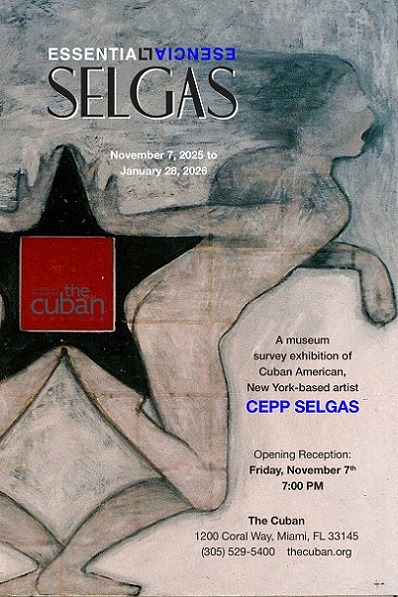
Exhibition: November 7, 2025 – January 28, 2026 • Site visit: November 26, 2025 • Interview with co-curator and historian Jesús Rosado
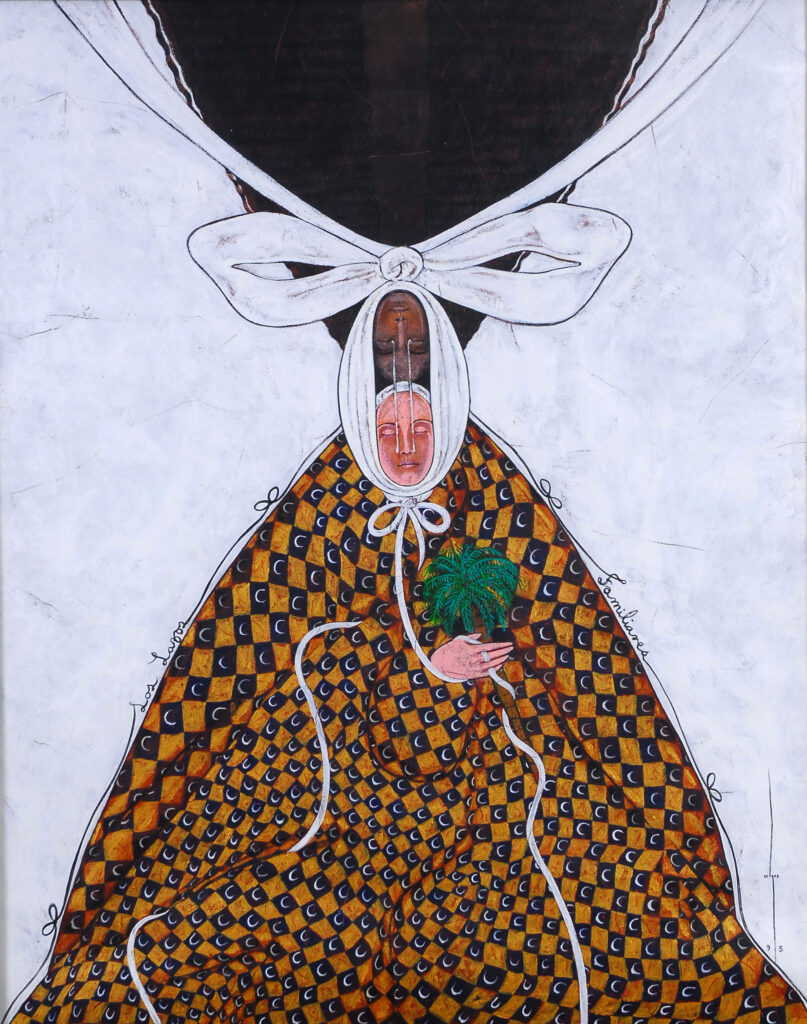
The galleries at the American Museum of the Cuban Diaspora hum with quiet voltage: twenty works by Jesús “Cepp” Selgas (Jesús Selgas Cepero)—an extract from more than four decades—arranged like facets of a single, many-sided self. It’s fitting that co-curator Jesús Rosado describes the artist’s output as “un arte especular”—a mirror art. “Él pinta en base a su experiencia… un espejo donde proyecta sus vivencias, sus visiones, sus comentarios existenciales,” Rosado told me during our walk-through. The mirror, here, isn’t vanity; it’s method. Across painting, tapestry, collage, and object-based works, Selgas turns biography into structure without letting biography swallow the art.
What’s “essential” about Selgas
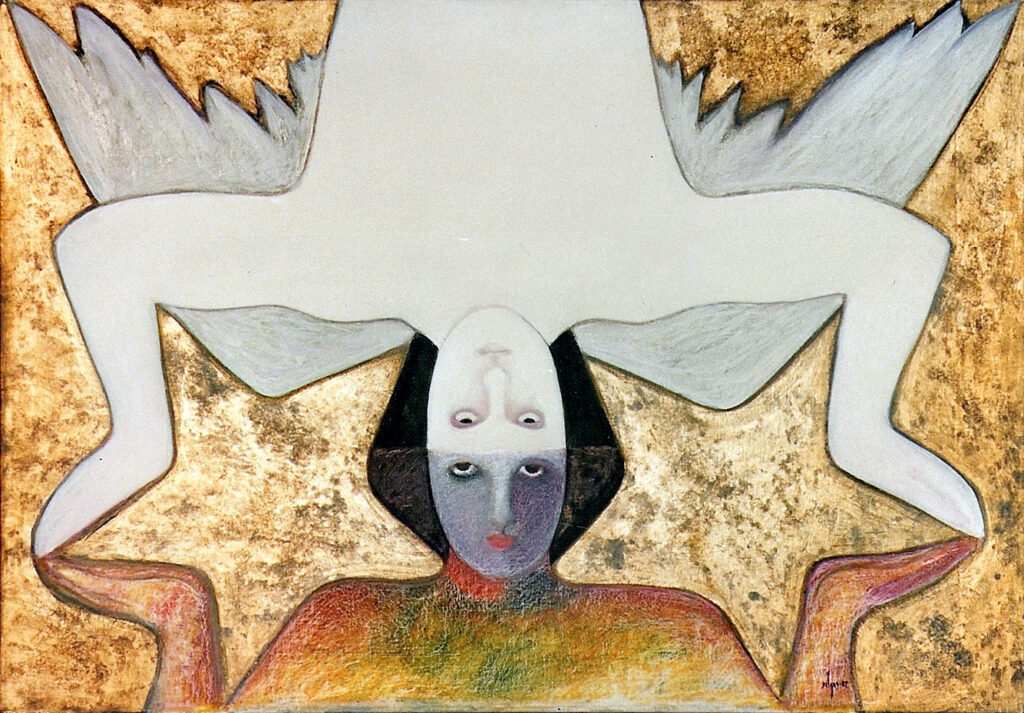
Rosado’s thesis for Selgas: Essential lands with clarity. The show foregrounds what is irreducible in Selgas’s practice: a self-authored iconography forged in flight, disciplined by design, and alive to the push-pull between European art histories and vernacular Cuban memory. “Lo esencial,” Rosado said, “es esa mirada propia que sostiene cuarenta años de trabajo—capaz de absorber influencias y, a la vez, devolver un mundo ‘celgasiano’.” You see it in the way golds and crimsons glance off Byzantium and the Renaissance without imitation; in tessellated fields that nod to modular abstraction yet feel diaristic; in the quiet symbolism that refuses propaganda even when the subject is political rupture.
The Mariel generation, as a bridge—not a label
Selgas left Cuba in 1980 during the Mariel boatlift, a biographical fact that is too often turned into a cliché. Rosado resists that flattening. “La generación del Mariel es umbilical,” he said. “Es el puente entre los maestros que llegaron antes (la diáspora de la República) y la Miami Generation de artistas que se formaron y se insertaron en el circuito angloamericano.” In Rosado’s reading, Mariel links lineages: the earlier exiles who arrived with mature bodies of work; the Miami-raised artists who cracked open markets and institutions; and the transgressive wave that emerged in Cuba in the 1980s. Selgas belongs to that connecting tissue—less a category than an infrastructure through which influences, friendships, and aesthetics kept moving.
The biography matters, but not as badge. Before exile, Selgas studied in Las Villas and Havana, where he was a student of Antonia Eiriz, a towering painter whose rigor and courage left a generation-shaping mark. He was eventually expelled from art schools for political positions and for being openly gay. “Hacía un arte comprometido con lo que tuvo que vivir… pero no hacía arte panfletario,” Rosado emphasized. The political is here—as subliminal current, as title, as allegory—not as slogan.
How do you build a survey from a life?
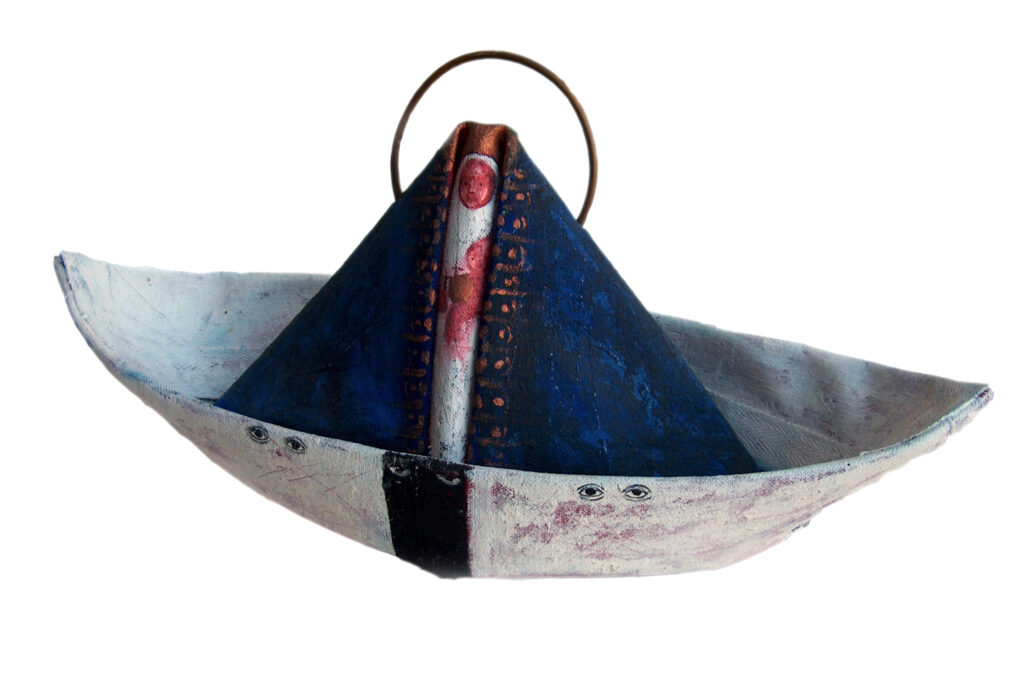
Space and logistics sharpened this show’s knife. “Son 20 obras—un extracto de más de 40 años,” Rosado said. The checklist edges across media Selgas has inhabited—painting foremost, but also tapestries, collage, and arte objetual. One modestly scaled diptych stands in for a larger textile practice that proved, this round, too cumbersome to transport. Elsewhere, a major collage—“una isla,” as Rosado put it—threads autobiographical signs into a modular, map-like field.
Selection and sequencing pivoted on two criteria: span (so each decade speaks) and syntax (so recurring strategies become legible). “Se metió en distintos medios—era multifacético—pero el mundo ‘celgasiano’ se sostiene,” Rosado said. The install keeps that world coherent: color fields guide you; long sightlines tie rooms together; graphics stay spare so surfaces breathe.
Behind the scenes, the Museum’s registrar realities were real: transport, condition reports, and environmental controls for mixed media (including older textiles and layered papers) shaped what could be promised and how long. Donations and private lenders—shepherded, Rosado noted, with crucial help from co-curator Gustavo Valdés—filled gaps and made the survey possible. Valdés also underwrote the exhibition catalogue, ensuring the scholarship travels as the works will.
Lineages and influences—absorbed, not worn
Rosado is allergic to naming influences as derivations; with Selgas, they’re metabolized. He cites Eiriz as a formative rigor, and then (with the beautiful slippages of spoken memory) points toward Klimt and a love of tessellation we might connect to artists like Escher—not as quotations, but as tools the artist keeps “a mano.” “Es un mundo muy celgasiano,” Rosado repeated—a stew (ajiaco) of Renaissance echoes, Byzantine gleams, vernacular cues, and Cuban popular culture filtered through a distinctly Eurocentric picture of distance that the artist then re-personalizes.
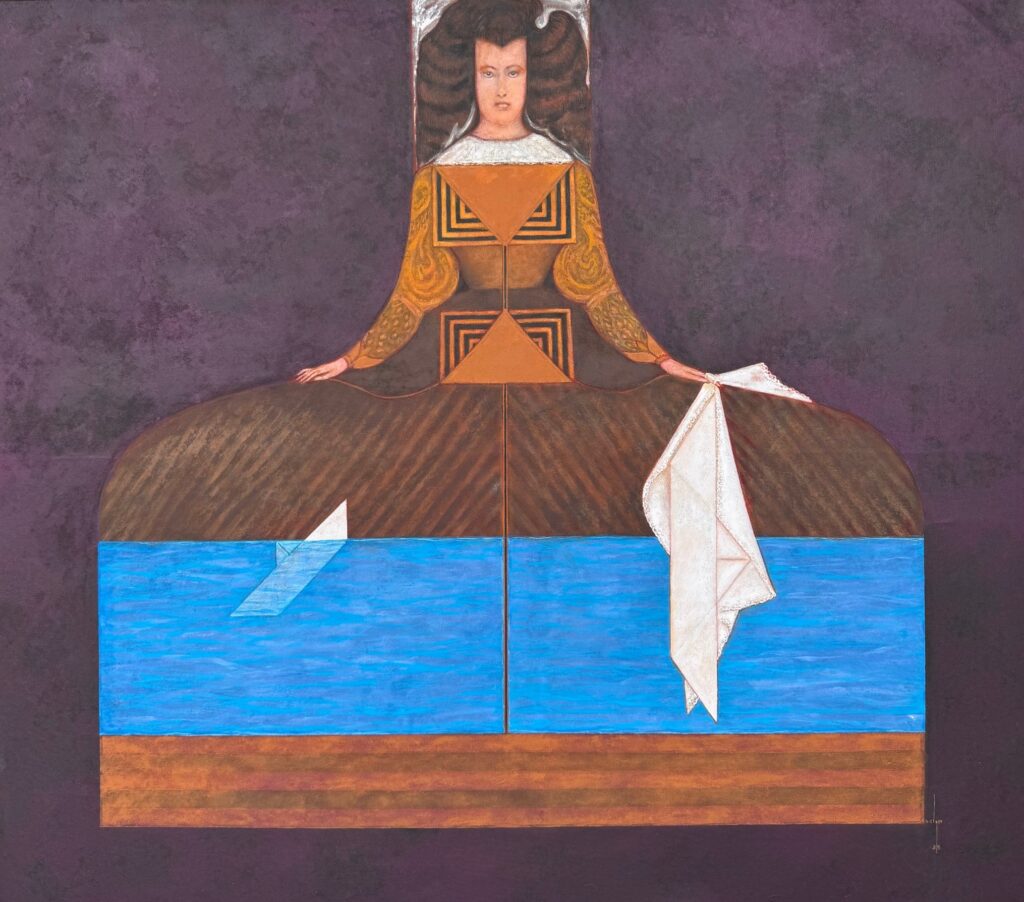
One work Rosado returned to, Escape o fuga del paraíso rojo (“Escape or Flight from the Red Paradise”), condenses the show’s argument. The surface seduces: divided fields, a symbolist undertow, chroma that stages heat without noise. The subtext is clear enough—ideological disillusion and the politics of departure—but it never shouts. “Mensajes muy subliminales, muy disfrazados,” Rosado said. When Selgas tackles history, he does it as structure—division above, figuration below; a “lago grande” holding reflection—rather than as a caption.
Graphic intelligence, serial thinking
Selgas’s parallel work as a graphic designer hums under many choices: typography when it appears; the serial logic of modules and repeats; the way a composition reads at poster scale and intimate distance. Rosado traced this sensibility back through the artist’s early collage and object experiments: parts that fit and refit; fragments that accrue sense by adjacency. It’s why the survey feels cohesive even with only twenty works: you are watching a design grammar deploy itself across formats.
Labels, voice, and the “essential” in words
How do you write labels for a life so charged? Rosado and Valdés calibrated wall texts to maintain historical context and the artist’s voice in balance. The title’s claim—“Essential”—could have tipped toward identity essentialism; here it signals irreducible craft and cosmology. The labels mark dates and places, sketch lineages, and—crucially—let images carry ambiguity. Where politics intrude, the tone stays descriptive, not prosecutorial; where sexuality and love are present, the phrasing holds the space without sensationalizing it.
The Museum’s mission: objects, archives, publics
The American Museum of the Cuban Diaspora exists to narrate Cuban exile through objects and archives; Selgas: Essential clicks cleanly into that mission while subtly expanding it. Rosado, who previously organized a poster-based “anti-biennial” in solidarity with artists detained around the July 11 protests in Cuba, understands how design becomes testimony. This survey keeps that testimony personal and formally exacting. It also lands in a city where intergenerational Cuban and hemispheric audiences are the rule, not the exception. Bilingual materials and an active network of community partners make the galleries porous; on opening night, Rosado told me, the Museum overflowed.
One work that crystallizes the show
Pressed to pick a single piece that “crystallizes” the argument, Rosado pointed to a significant canvas split, in his words, between an expressionist upper register and a more figurative lower band, cross-hatched by symbolist signs. The composition stages what the exhibition claims: a mind trained on modern European painting and Cuban vernaculars; a life split by a sea crossed in 1980; a refusal to be either/or. It’s also a terrific painting.
The names that keep the story moving
Rosado insists we read Selgas inside a constellation: peers and elders who complicate Miami’s art history at a glance. He rattled off names from memory: Carlos Alfonzo, Víctor Gómez, and Juan Boza—artists whose work stands tall in any discussion of Cuban modern and contemporary art—and invoked the so-called Miami Generation, artists who “rompen la barrera del circuito angloamericano” by entering and sustaining careers in the broader U.S. art world. The point isn’t to shelve Selgas with a label, but to see how his bridgework lets viewers walk between histories without getting stuck.
What didn’t fit—and what’s next
Asked what he would add given more time, funds, and square footage, Rosado didn’t hesitate: more tapestries, more large object-based works, and deeper dives into collage series that have rarely been shown in Miami. The catalogue—already down to the last box after a packed opening—will help scholars and publics follow that thread. “Siempre descubrimos algo nuevo cuando investigamos,” he said. That’s the promise an “essential” survey should keep: to send you out with a map and reasons to return.
What we carry out into Miami
Leaving the Museum, I kept circling Rosado’s language. “Generación umbilical,” “arte especular,” “mensajes disfrazados.” They’re good phrases because they hold movement. Selgas’s work does, too. The mirror turns out not to be a static pane but a passage—from Cuba to Miami; from graphic design to painting to textile and back; from European gold grounds to Caribbean red; from private memory to public form.
What should visitors carry into the city after Selgas: Essential? Maybe a more generous map of the diaspora—one that can hold a life that is neither emblem nor outlier; a practice built on discipline and desire; a politics that believes in the power of subtlety; and a museum willing to make room for artists whose bridges are still being crossed.
“Es un mundo muy celgasiano,” Rosado said again as we closed. After nearly an hour in those rooms, I knew what he meant: a world that recognizes itself in fragments and still assembles a whole.
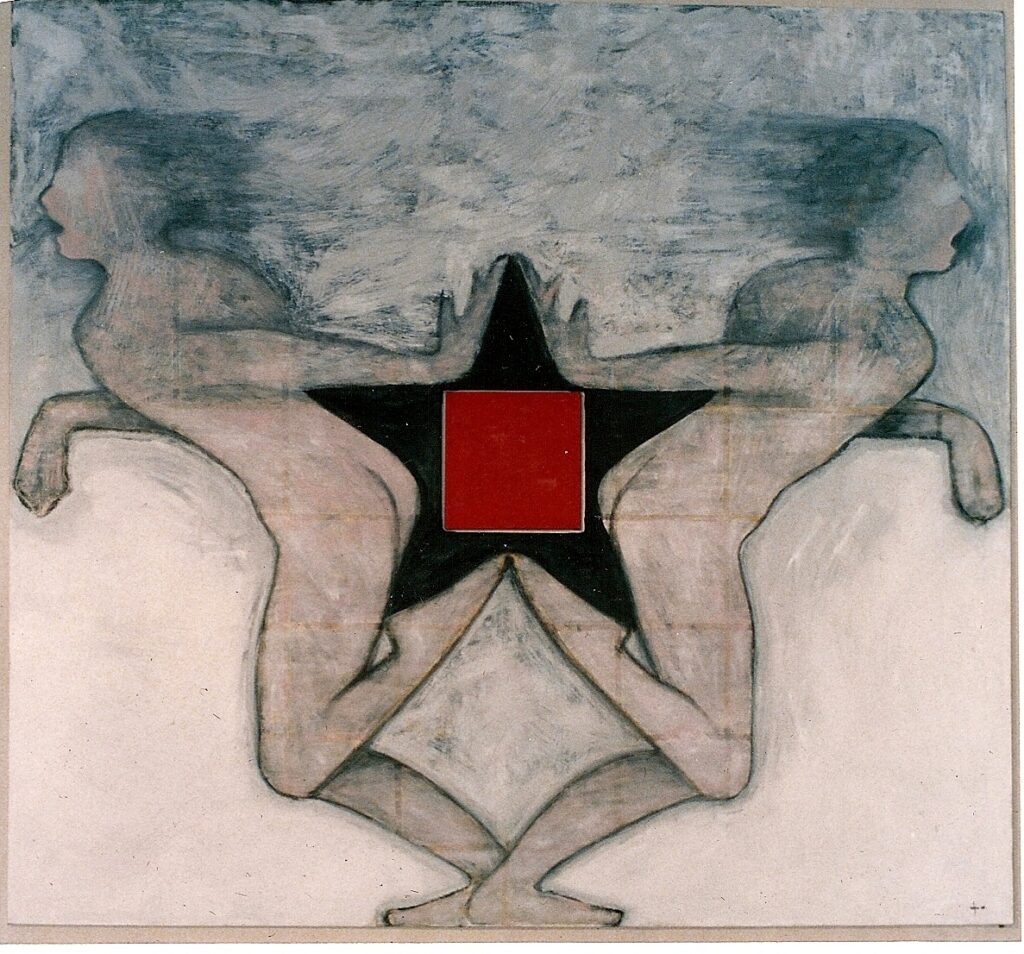
![Cepp Selgas, The Promise [Babalu Aye], 1998, acrílico sobre lienzo, 60" x 60"](https://artmiamimagazine.com/wp-content/uploads/2025/12/Cepp-Selgas-The-Promise-Babalu-Aye-1998-acrilico-sobre-lienzo-60-x-60-pulgadas-1024x846.jpg)
American Museum of the Cuban Diaspora.
(305) 529-5400
[email protected]
1200 Coral Way
Miami, FL 33145