Educational Guide — Neuroscience of Creativity
The Flow State:
Neurochemistry, Creativity & the Artist’s Mind
How to enter peak consciousness on command — a guide for visual artists
“Inspiration is for amateurs. The rest of us just show up and get to work.”— Chuck Close, painter
IntroductionThe Origin of a Theory Born in a Painter’s Studio
The concept of flow did not emerge from a laboratory. It emerged from a studio. In the late 1960s, Hungarian-American psychologist Mihály Csíkszentmihályi became fascinated by something he observed in painters: when a canvas was going well, they ignored everything else — hunger, thirst, the passage of time, even the needs of their own bodies. They persisted at significant personal cost, and only until the work was complete. The question Csíkszentmihályi asked was deceptively simple: what makes an activity intrinsically rewarding to the point of self-transcendence?
The answer became one of the most influential ideas in modern psychology. He named it flow — after the language his subjects used spontaneously to describe the experience. “It was like floating,” they said. “I was carried on by the flow.” His foundational 1975 text, Beyond Boredom and Anxiety, introduced the concept; decades of research followed. Today, flow sits at the intersection of positive psychology, neuroscience, peak performance theory, and the study of creativity.
This guide synthesises those decades of inquiry for a specific purpose: to help the working visual artist understand what flow is at the level of brain and chemistry, why it amplifies creative output so dramatically, and how to enter it on command.
IWhat Flow Is: A Precise Definition
Flow is defined as an optimal state of consciousness in which a person is completely absorbed in a challenging activity, performing at their peak capacity, while experiencing a profound sense of enjoyment and effortlessness. Csíkszentmihályi described it as “being so involved in an activity that nothing else seems to matter. The ego falls away. Time flies. Every action, movement, and thought follows inevitably from the previous one, like playing jazz.”
The phenomenology of flow is distinctive and recognisable across cultures, disciplines, and centuries. Its hallmarks include:
- Total absorptionConsciousness narrows to the task. Awareness of the body, surroundings, and self largely disappears.
- Effortless actionDecisions arise without deliberation. The hand moves before the mind consciously decides to move it.
- Temporal distortionHours collapse into minutes; in extreme states, moments can appear to slow — the “freeze-frame” effect noted in athletes and surgeons alike.
- Intrinsic rewardThe activity becomes its own justification. The painting does not need to be sold or praised — the act of painting is the reward.
- Loss of self-consciousnessThe inner critic goes silent. The hypervigilant self-monitoring that usually inhibits bold creative decisions simply ceases.
- Heightened intuitionAthletes describe “the voice” — rapid, accurate, non-verbal guidance. Visual artists describe the brush “knowing where to go.”
Research on visual artists specifically reveals an important distinction: unlike athletes or chess players, painters in flow typically do not report having clear goals. As one artist put it in qualitative research: “You don’t know where the painting is going to go. You don’t know where the understanding, the full understanding, is gonna come.” Creative flow in the visual arts is characterized by open-ended discovery rather than goal-completion — the work reveals itself in the making (Mace, 1997; Cseh, 2017).
Historically, the experience has been described across many traditions. Johann Wolfgang von Goethe used the German term rausch — “an overflowing of joy.” Friedrich Nietzsche wrote of the Dionysian creative frenzy. William James documented altered states of consciousness that enhance performance. In Eastern traditions — Zen Buddhism, Taoism, Sufi practice — the state is cultivated through disciplines like Aikido and meditation as a form of spiritual attainment. What Csíkszentmihályi achieved was the rigorous, scientific systematisation of a phenomenon humans had been experiencing for millennia.
IIThe Neuroscience: What Happens Inside the Brain
Transient Hypofrontality
The most significant neurological event during flow is the temporary suppression of the prefrontal cortex — a phenomenon researchers call transient hypofrontality. The dorsolateral prefrontal cortex (DLPFC) is the brain’s executive headquarters: the seat of self-monitoring, impulse control, analytical self-reflection, and self-criticism. It is also what causes a painter to hesitate, second-guess a mark, or freeze before the blank canvas.
During flow, this region goes quiet. Its deactivation is not a malfunction but an optimisation: without the DLPFC acting as gatekeeper, decision-making speeds up dramatically, self-consciousness dissolves, and the brain’s domain-specific networks operate with minimal interference. The painter is no longer watching themselves paint — they are simply painting.
A landmark 2024 study from Drexel University’s Creativity Research Lab, the first to use high-density EEG neuroimaging to isolate flow-related brain activity during a creative task, found that creative flow involves two essential elements: extensive domain expertise (which builds specialised neural circuits for the task) combined with the release of conscious control — allowing those circuits to operate on “autopilot.” The researchers describe this as the “expertise-plus-release” model of creative flow, with significant implications for how artists at different stages of development should approach training.
In flow, typically anti-correlated brain networks appear to be simultaneously active: the task-positive attentional networks (which maintain intense focus) co-activate with elements of the default-mode network (associated with imagination and spontaneous thought). This unusual co-activation may explain why flow feels simultaneously focused and generative — disciplined and free.
Neural Oscillations: Alpha and Theta Waves
EEG studies consistently identify specific brainwave signatures in flow states. Alpha wave activity — associated with relaxed alertness and heightened creativity — increases significantly, particularly in frontal regions. Research has shown that alpha synchronisation correlates with spontaneity and intuitive, Type-1 processing. Frontal theta oscillations also increase, reflecting the elevated cognitive engagement and absorption characteristic of flow. Musicians formally trained in improvisation show greater frontal alpha synchronisation during high-quality performances, suggesting that training can cultivate the neural conditions for flow.
The Default-Mode and Executive Networks in Creative Flow
In highly experienced artists, high-flow states are associated with reduced activity in posterior nodes of the default-mode network — suggesting that the creative “wandering mind” cedes ground to focused action. Less experienced artists show no such modulation. This finding underscores a fundamental insight: flow is not a shortcut to mastery. It is, in part, the neurological expression of mastery — the brain running a practised program without interruption.
IIIThe Neurochemistry: A Cascade of Peak-Performance Molecules
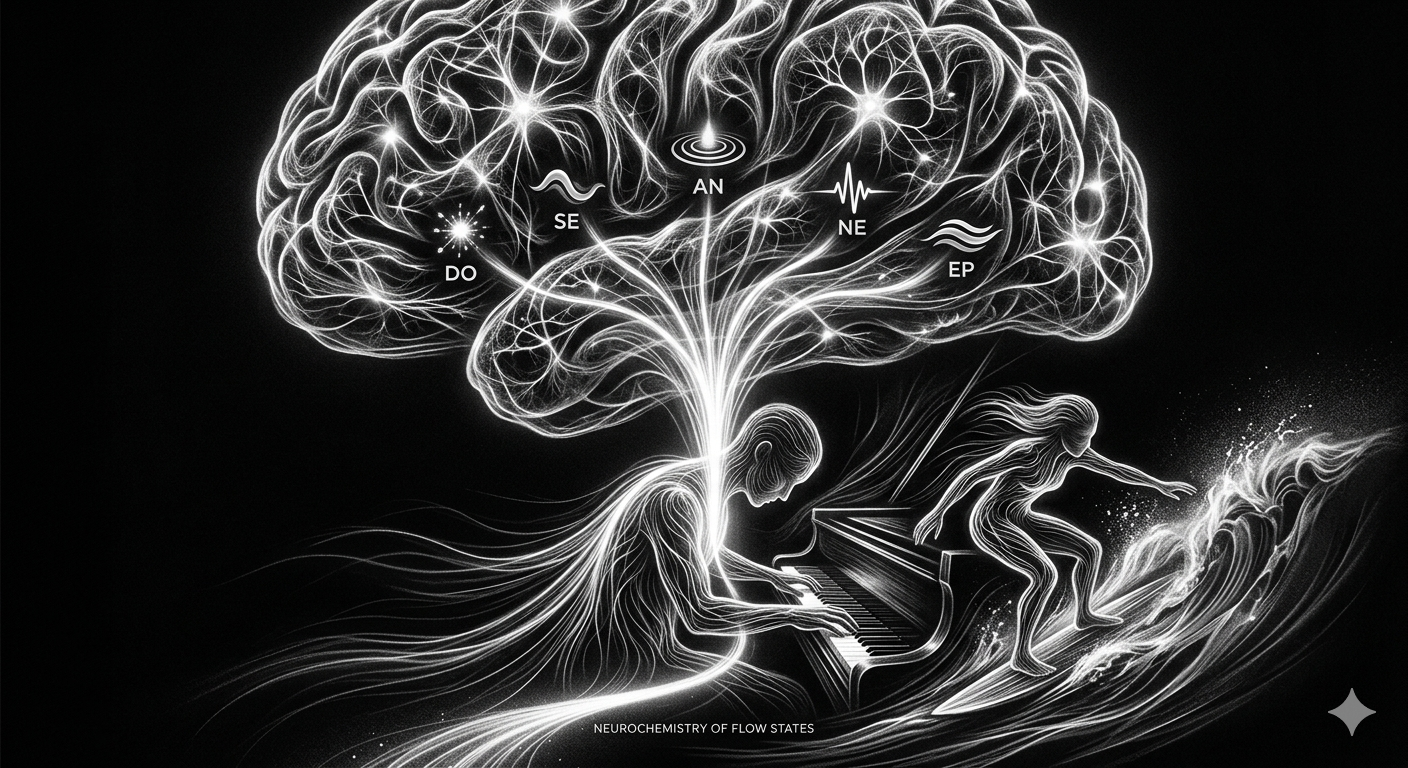
Alongside its structural neurological changes, flow triggers a dramatic neurochemical cascade. The brain releases five key substances simultaneously — a cocktail that has no pharmaceutical equivalent and whose combined effect on cognition, creativity, and performance is profound.
Neurotransmitter
Norepinephrine
Amplifies attention, narrows focus, and heightens sensory acuity. Acts as the brain’s alerting signal — the reason everything in flow feels vivid and precisely perceived.
Neurotransmitter
Dopamine
Drives motivation, pattern recognition, and the signal-to-noise ratio in the prefrontal cortex. Reduces distracting neural “noise,” making it easier to detect meaningful connections between ideas.
Endocannabinoid
Anandamide
The brain’s native analogue of cannabis. Promotes lateral thinking — the capacity to connect ideas that appear unrelated. Named from the Sanskrit word for bliss.
Neurotransmitter
Serotonin
Regulates mood, confidence, and the sense of emotional stability. Provides the serene, grounded quality of deep flow — the absence of anxiety amid intense engagement.
Neuropeptide
Endorphins
The brain’s endogenous opioids. Produce the sense of physical ease and pain suppression that allows sustained effortful activity — the same molecules responsible for the “runner’s high.”
These are not simply pleasure chemicals. Each one is a potent performance enhancer. Norepinephrine and dopamine together increase the volume and depth of information processing: more data comes in, it is processed at greater speed and depth, and more cortical areas are recruited simultaneously. This is why flow states consistently produce the report of intensely sharpened senses — colour appears more vivid, spatial relationships appear more clear, the brush feels more responsive.
The autotelic quality of flow — the fact that it functions as its own reward — is produced by this neurochemical profile. These are among the most intensely pleasurable substances the brain can produce. Once experienced, the organism is strongly motivated to recreate the conditions that generated them. Flow is, in the most accurate scientific sense, the neurological foundation of intrinsic motivation.
IVFlow and Creativity: Amplification, Not Coincidence
Creativity, at its most fundamental, is a recombinatory process: new information meets old associations to produce novel connections. Flow does not merely accompany creativity — it systematically amplifies every stage of the creative process.
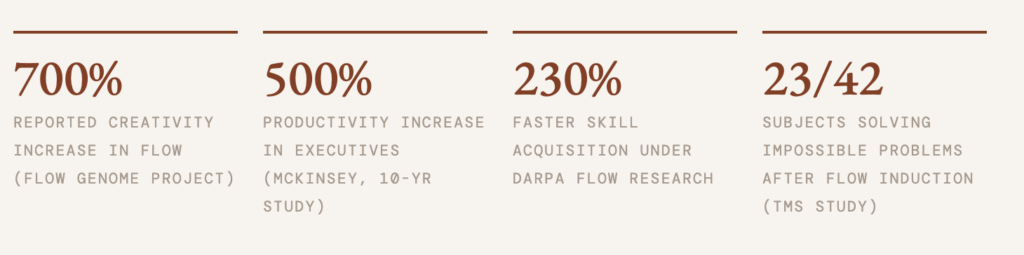
700%Reported creativity increase in flow (Flow Genome Project)
500%Productivity increase in executives (McKinsey, 10-yr study)
230%Faster skill acquisition under DARPA flow research
23/42Subjects solving impossible problems after flow induction (TMS study)
Norepinephrine and dopamine together increase the density of incoming information — more signal per second. The same molecules reduce neural noise, improving the brain’s capacity to detect faint patterns and weak associations that would otherwise be missed. Anandamide specifically promotes lateral thinking: the willingness and capacity to make non-obvious connections, to see the relationship between things that convention keeps separate. It is anandamide that is most directly responsible for the quality of creative insight — the sudden synthesis that feels, in the moment, like revelation.
The deactivation of the DLPFC removes the inner critic at precisely the moment it would most impede creative risk. The visual artist who hesitates before a bold mark, who repaints over a gesture that was actually alive, who edits the work toward safety — this is the DLPFC at work. In flow, the critic is offline. What remains is responsiveness: action arising directly from perception without the censoring intermediary of self-judgment.
“In a recent study, 40 subjects were presented with an exceptionally tricky problem that required creative insight to solve. No one solved it. But when flow was induced artificially using transcranial magnetic stimulation, 23 subjects got the answer right — in record time.”— Steven Kotler, Flow Research Collective
Research from Harvard’s Teresa Amabile adds a further dimension of significance: people are not only more creative during flow — they report elevated creativity the following day. Flow does not merely facilitate creative performance in the moment; it trains the brain toward greater creative capacity over time. The experience of flow literally restructures the neural architecture of creativity.
Creative flow in the visual arts has a distinctive phenomenology compared to flow in other domains. Interviews with painters and sculptors reveal that creative flow often unfolds through a process of discovery rather than execution — the artist responds contingently to what has emerged on the canvas, as each mark becomes the condition for the next. This is formally analogous to jazz improvisation: what the theorist Keith Sawyer calls “contingent co-creation,” except that here the dialogue is between the artist and the evolving work itself. The canvas speaks; the artist answers.
VThe Golden Rule: Challenge–Skill Balance
Flow does not occur randomly, nor does it arise from mere relaxation or enthusiasm. Its most fundamental precondition is a precise balance between the difficulty of the task and the capability of the practitioner. Csíkszentmihályi’s original model places this balance at the center of everything.
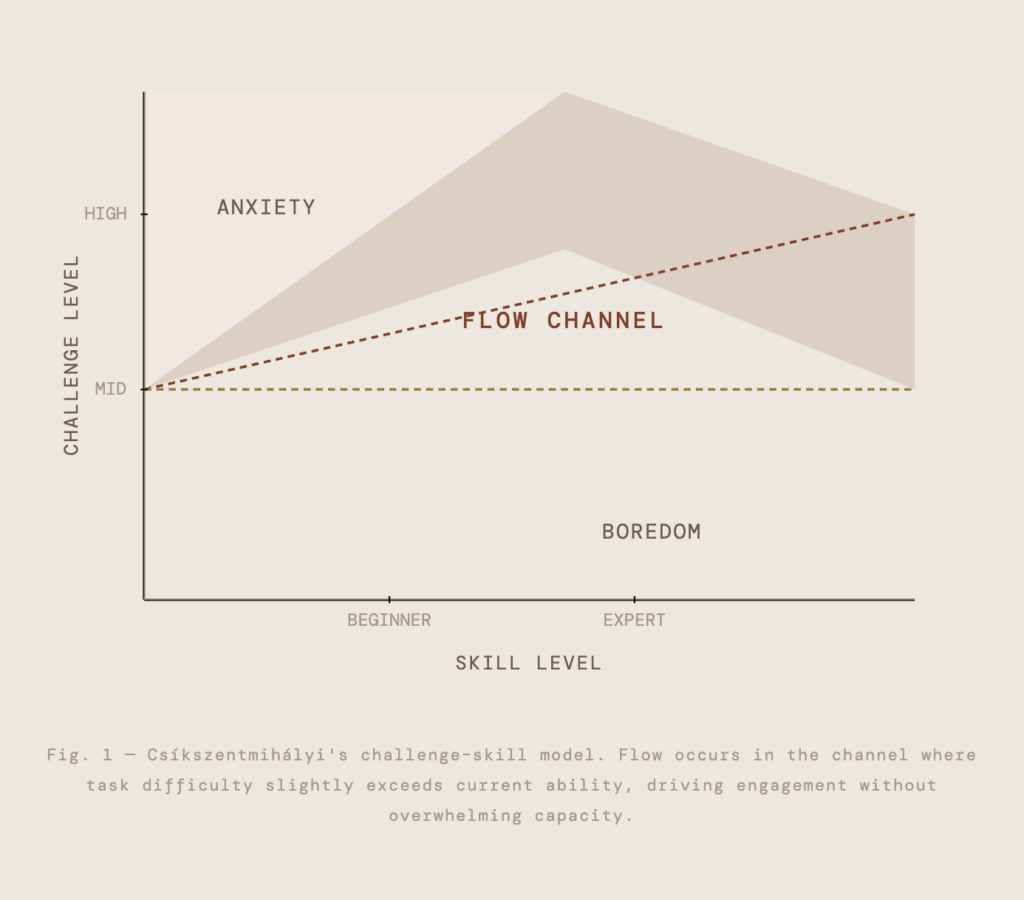
The implications for artistic practice are direct and practical. A painter who works only in a familiar style, on familiar subjects, with familiar materials, will slide toward boredom: the work becomes mechanical, the neurochemical signal weakens, attention drifts. A painter who attempts a technically impossible challenge — a commission far beyond their current skill, a medium they have never touched — will slide toward anxiety: the mismatch between aspiration and capacity becomes inhibiting rather than galvanising.
Flow lives in the narrow band between these extremes — what researchers describe as the “sweet spot” of optimal challenge. The practical discipline is learning to calibrate tasks to operate in this zone deliberately: to stretch, but not to break. As skill grows, so too must the challenge. Flow is not a destination but a dynamic equilibrium, always requiring recalibration as the practitioner develops.
VIFlow Triggers: Entering the State on Command
Research conducted by Steven Kotler and colleagues at the Flow Research Collective has identified at least 22 specific environmental, psychological, and social conditions that reliably increase the probability of entering flow. These are called flow triggers. For the visual artist, the following are most directly applicable.
Psychological Triggers
- Undivided concentrationFlow requires the total withdrawal of attention from everything outside the task. Researchers recommend working in uninterrupted blocks of 90–120 minutes. A single interruption can take up to 15 minutes to recover from — if recovery occurs at all during that session.
- Clear proximate goalsNot final outcomes, but immediate next actions. In painting: not “finish the work” but “resolve the value relationship in the upper left quadrant.” Clarity of near-term intention focuses attention and feeds the dopamine reward system.
- Immediate feedbackThe activity must offer rapid, legible signals about performance. Painting provides this inherently — each mark is immediately visible. Cultivating sensitivity to this feedback loop, without suppressing it through excessive planning, is a key flow skill.
- Challenge–skill balanceAs established above: calibrate task difficulty to sit slightly above current comfortable capability. Deliberately introduce constraints, new materials, unfamiliar scales, or time limits to sustain the productive tension.
Neurochemical Triggers (Dopamine-Activating)
Many flow triggers operate by stimulating dopamine release — the neurotransmitter that drives focused motivation. The following are particularly effective:
- NoveltyNew subject matter, new materials, new locations, or new formal problems. The brain rewards exploration with dopamine. Working in the same mode indefinitely depletes the novelty signal and blunts flow accessibility.
- ComplexityTasks that require the integration of multiple systems — colour, form, space, gesture, concept — activate broader cortical networks and sustain the high-engagement state that precedes flow.
- RiskNot physical danger, but the willingness to make marks that might fail — to paint over a passage that is “safe,” to work larger than is comfortable, to use irreversible media. The presence of genuine stakes elevates neurochemical arousal.
- Deep embodimentPhysical engagement — working standing, large-scale, with the whole arm — recruits proprioceptive systems that support the action-awareness merger characteristic of flow. The body’s participation in painting is not incidental to the experience of flow; it is constitutive of it.
- Awe and aesthetic inspirationExposure to work that produces a sense of overwhelming beauty or scale generates a distinctive neurochemical response involving norepinephrine and awe-related default-mode activation. Time spent looking at great works before or during a session is not indulgence — it is preparation.
Environmental Triggers
- Controlled environmentPrepare everything before beginning: materials, surfaces, reference, lighting. Environmental friction — searching for a brush, waiting for something to dry, negotiating poor light — interrupts absorption before it can develop into flow.
- Biological alignmentIdentify your peak cognitive window (morning, afternoon, or late night, depending on chronotype) and protect it exclusively for studio work. Flow is physiologically easier during periods of natural neural alertness.
- Ritual and transitionConsistent pre-work rituals — a specific sequence of actions before beginning — train the nervous system to transition from ordinary consciousness to creative readiness. The ritual becomes a neurological signal, not a superstition.
· · ·
The Hierarchy of Intrinsic Motivation
Flow is not simply a technique — it is the natural expression of a life organised around intrinsic motivation. Research identifies a developmental sequence of motivational drivers that, when cultivated in order, create the conditions from which flow reliably emerges:
- CuriosityThe primary attractor. Curiosity generates effortless attention — the prerequisite for every subsequent stage. Following genuine curiosity, rather than market trends or institutional expectations, is the beginning of sustainable creative practice.
- PassionThe intensification of curiosity into sustained engagement. Passion produces the directed, energetic focus that makes long hours in the studio feel short.
- PurposeMeaning that extends beyond the individual work or individual practitioner. Purpose sustains practice through difficulty and failure, and provides the directional context within which individual works find significance.
- AutonomyThe freedom to pursue purpose on one’s own terms. External control — institutional, commercial, or social — is one of the most reliable suppressors of intrinsic motivation and flow access.
- MasteryThe development of sufficient technical skill to execute at the level the imagination demands. Mastery is what transforms curiosity into capability and makes the “expertise-plus-release” neurological model of flow available.
VIIA Practical Protocol: Flow on Command for the Visual Artist
The following protocol synthesises the scientific literature into actionable studio practice. It is not a rigid formula — it is a set of conditions that, consistently maintained, dramatically increase the probability and depth of flow states.
The Studio Flow Protocol
- Protect the window. Identify your peak alertness period. Block it in the calendar as non-negotiable studio time. 90–120 minutes minimum. Longer sessions deepen the state but require sufficient preparation.
- Eliminate access to distraction. Phone off or in another room. Notifications disabled. Communicate unavailability before beginning. The cost of a single interruption to flow recovery is 15 minutes — three per session destroys the session entirely.
- Prepare completely before beginning. Canvas primed, palette mixed, brushes clean, reference assembled, music (if used) selected. Friction after beginning breaks the absorption arc before it becomes flow.
- Set a proximate goal, not a final one. “Resolve the sky” not “finish the painting.” Specificity of near-term intention focuses the dopamine system without the anxiety of distant, contingent outcomes.
- Introduce calibrated difficulty. If the session feels routine, impose a constraint: time limit, palette restriction, unfamiliar scale, or medium. Novelty and challenge re-engage the neurochemical trigger system.
- Begin physically, not mentally. Start with gestural mark-making before analytical decisions. The body enters flow faster than the analytical mind. Physical initiation bypasses the DLPFC gatekeeper.
- Extend the session past resistance. The initial 15–20 minutes of a session are often difficult — the DLPFC is still active, self-monitoring is elevated, the work looks wrong. The capacity to push through this window is the single most reliable determinant of whether flow is accessed.
- After the session: protect the afterglow. Research shows that creative elevation persists for 24 hours post-flow. Avoid cognitively demanding administrative work immediately after a studio session. The residue of the state is itself a creative resource.
VIIIFlow and Accelerated Learning: Mastery in Compressed Time
The neurochemical environment of flow does not merely enhance performance in the moment — it dramatically accelerates the process of skill acquisition. The mechanism is straightforward: memory consolidation is proportional to the neurochemical intensity of the experience. When an experience occurs under the combined influence of norepinephrine, dopamine, endorphins, anandamide, and serotonin, the brain treats the experience as urgent and important. What is learned under these conditions moves from working memory to long-term memory with exceptional efficiency.
Research conducted under DARPA’s Advanced Brain Monitoring programmes found that soldiers in induced flow states learned marksmanship skills 230% faster than control groups. Comparable results with beginners in archery and precision sports suggest that expert-level performance timelines can be compressed by up to half when training consistently incorporates flow states. These are not marginal improvements — they represent a fundamental reconception of what is required to reach mastery in a demanding craft.
For the visual artist, this has a specific implication: the quality of a session matters far more than its quantity. An hour in deep flow, processing new problems with full neurochemical engagement, produces greater skill development than a week of mechanical practice in a comfortable routine. The goal is not simply more time in the studio — it is more quality of consciousness in the studio.
IXThe Philosophical Dimension: Art as a Technology of Consciousness
From a philosophical perspective, flow invites us to reconceive artistic practice not merely as the production of objects but as the cultivation of a particular mode of being. The visual arts have long been understood as a discipline of attention — of learning to see before learning to depict. Flow theory confirms this at the level of neuroscience: the deepest creative states are states in which perception, cognition, and action become unified in a single, continuous, unself-conscious process.
Csíkszentmihályi explicitly links flow to the question of happiness — not as a consequence of external success, but as a quality of consciousness cultivated through voluntary engagement with challenging, meaningful activity. “Happiness is not something that happens,” he wrote. “It does not depend on outside events, but on how we interpret them.” Flow is the experiential substrate of this claim: a state in which the human capacity for attention is fully expressed, and in which that expression is itself the source of wellbeing.
The philosopher and art critic might note that this resonates with Kant’s analysis of the aesthetic experience: the disinterested attention to form for its own sake, independent of desire or utility. It resonates with Nietzsche’s Dionysian principle — the creative force that dissolves the boundaries of the individual self in the act of making. It resonates with the phenomenological tradition’s account of skilled embodied action, in which the practised body knows before the conscious mind decides.
What flow science contributes to these traditions is not an explanation that reduces them, but a mapping that illuminates the biological substrate of experiences that art has always known were real. The painter who says the brush seemed to move on its own, the sculptor who says the form emerged from the stone, the printmaker who says the press produced something they did not consciously intend — these are not mystical claims. They are accurate descriptions of what happens when transient hypofrontality releases the specialised, practised circuits of expert artistic cognition from the inhibitory oversight of deliberate self-monitoring.
The state that artists have always known as the deepest form of creative engagement turns out to be, at the neural level, exactly what it feels like: the self, temporarily set aside, in service of something larger than itself.
ConclusionThe Creative Imperative
Flow is not a luxury available only to exceptional artists working in ideal conditions. It is a neurological capacity latent in every practitioner, accessible through the consistent application of the conditions that science has now precisely mapped. The triggers are learnable. The chemistry is real. The creative amplification is measurable and reproducible.
Chuck Close’s aphorism — “Inspiration is for amateurs. The rest of us just show up and get to work” — is not a rejection of inspiration. It is a description of the protocol that makes inspiration available. Showing up, preparing the conditions, eliminating distraction, calibrating the challenge: these are the actions that open the neurological door. What comes through that door is not manufactured. It is what the brain produces when given the conditions it needs to operate at its deepest level of capacity.
For the visual artist, the implications are both liberating and demanding. Liberation: the creative states you have occasionally experienced accidentally can be approached intentionally. Demanding: reaching and sustaining those states requires discipline, not merely inspiration. The science of flow does not make the work easier. It makes the path to the best work clearer.
Flow is where the brain is most alive, most productive, and most creative. It is where the greatest work is made. And increasingly, we understand precisely how to get there.
References & Further Reading
- Csíkszentmihályi, M. (1975). Beyond Boredom and Anxiety. San Francisco: Jossey-Bass.
- Csíkszentmihályi, M. (1990). Flow: The Psychology of Optimal Experience. New York: Harper & Row.
- Csíkszentmihályi, M. (1996). Creativity: Flow and the Psychology of Discovery and Invention. New York: Harper Perennial.
- Gold, J., & Ciorciari, J. (2020). A review on the role of the neuroscience of flow states in the modern world. Behavioral Sciences, 10(9), 137. doi:10.3390/bs10090137
- Rosen, D., Oh, Y., Chesebrough, C., Zhang, F., & Kounios, J. (2024). The brain in flow: Neural correlates of creative flow in jazz improvisation. Creativity Research Journal, 36(3), 469–490. Drexel University Creativity Research Laboratory.
- van der Linden, D., et al. (2021). The first few seconds for flow: A comprehensive proposal of the neurobiology and neurodynamics of state onset. Neuroscience & Biobehavioral Reviews, 132, 1335–1368. ScienceDirect
- Ulrich, M., Keller, J., & Grön, G. (2016). Neural signatures of experimentally induced flow experiences identified in a typical fMRI block design with BOLD imaging. Social Cognitive and Affective Neuroscience, 11(3), 496–507.
- Limb, C. J., & Braun, A. R. (2008). Neural substrates of spontaneous musical performance: An fMRI study of jazz improvisation. PLoS ONE, 3(2), e1679.
- Beaty, R. E., Benedek, M., Silvia, P. J., & Schacter, D. L. (2016). Creative cognition and brain network dynamics. Trends in Cognitive Sciences, 20(2), 87–95.
- Kotler, S. (2014). Flow states and creativity. Psychology Today. Flow Research Collective. Link
- Kotler, S., & Wheal, J. (2017). Stealing Fire: How Silicon Valley, the Navy SEALs, and Maverick Scientists Are Revolutionizing the Way We Live and Work. New York: Dey Street Books.
- Dietrich, A. (2004). Neurocognitive mechanisms underlying the experience of flow. Consciousness and Cognition, 13(4), 746–761.
- Perry, S. K. (2009). Writing in Flow: Keys to Enhanced Creativity. Writer’s Digest Books.
- Banfield, J. F., & Burgess, M. (2013). A phenomenology of artistic doing: Flow as embodied knowing in 2D and 3D visual artists. Journal of Phenomenological Psychology, 44(1), 60–91.
- Sawyer, R. K. (2003). Group Creativity: Music, Theater, Collaboration. Mahwah, NJ: Lawrence Erlbaum.
- Hart, Y., & Di Blasi, Z. (2015). Combined flow in musical improvisation: A pilot study. Psychology of Music, 43, 530–541.
- Mace, M. A. (1997). Toward an understanding of creativity through a qualitative appraisal of contemporary art making. Creativity Research Journal, 10, 265–278.
- Cseh, G. M. (2017). The creative flow experience in visual arts education: A qualitative study. International Journal of Education and the Arts, 18(42).
- Tana, J., Di Bernardi Luft, C., & Bhattacharya, J. (2024). The after-glow of flow: Neural correlates of flow in musicians. Creativity Research Journal, 36(3), 469–490.
- Lopata, J., Nowicki, E., & Joanisse, M. (2017). Creativity as a distinct trainable mental state. Neuropsychologia, 99, 1–9.
- Ryan, R. M., & Deci, E. L. (2000). Self-determination theory and the facilitation of intrinsic motivation, social development, and well-being. American Psychologist, 55(1), 68–78.
- Amabile, T. M. (1996). Creativity in Context. Boulder, CO: Westview Press.