Sol LeWitt: the line, the cube, and expanded consciousness
A reading of LeWitt’s influence on a contemporary artistic practice where the cube, technology, and artificial intelligence converge as extensions of thought
Rafael Montilla’s Artist Statement — Extract
“The Cube becomes a central structure within my practice, holding both internal and external dimensions, individual and collective awareness. Through the coexistence of natural and synthetic materials, I explore the language of our evolution, where technology and consciousness intersect. Artificial intelligence extends this inquiry as an expansion of thought — another layer of perception.”
I. The Inheritance That Goes Unseen — How LeWitt Remains Alive in Art Today
There are artists whose influence operates like mathematical axioms: it is not cited in every work derived from them, yet without them none of those works would be possible. Sol LeWitt (Hartford, Connecticut, 1928 – New York, 2007) is one such artist. The simultaneous founder of conceptual art and minimalism — though he rejected both labels as insufficient — LeWitt built over four decades a body of work that cannot be understood as a collection of objects, but as a system of thought. A system whose center of gravity is the line and whose supporting architecture is the cube. These two entities — the most elementary form in plane geometry and the most elementary form in three-dimensional geometry — are not, for LeWitt, decorative shapes or references to the visible world. They are the instruments through which thought materializes without betraying itself.
For the artist whose statement accompanies this text, LeWitt is not a historical reference but an active presence. The cube appears in their practice as a “central structure,” as that which “holds both internal and external dimensions, individual and collective awareness.” This description resonates directly with the Lewittian ontology of the cube: a form chosen precisely because, as LeWitt himself explained to the National Gallery of Art, it was “relatively uninteresting in itself… and lacked the expressive force of more interesting forms and shapes.” The neutrality of the cube was its power: it allowed the idea — and not the form — to take center stage. In that sense, the choice of the cube is always a philosophical decision before it is an aesthetic one.
II. “The Idea Becomes the Machine That Makes the Art” — The Founding Texts
In the summer of 1967, Artforum published “Paragraphs on Conceptual Art,” the text in which LeWitt first articulated his principles with precision. The most quoted sentence of that essay is also its most radical: “When an artist uses a conceptual form of art, it means that all of the planning and decisions are made beforehand and the execution is a perfunctory affair. The idea becomes the machine that makes the art.” This declaration is not a nihilistic provocation: it is a statement about the very nature of creative thought. LeWitt was not saying that execution does not matter; he was saying that the intelligence which designs the system is, in itself, the work.
Two years later, in “Sentences on Conceptual Art” (1968–69) — now in MoMA’s permanent collection — LeWitt was even more explicit about the paradoxical nature of his practice. The first sentence asserts: “Conceptual artists are mystics rather than rationalists. They leap to conclusions that logic cannot reach.” And the fifth, equally crucial: “Irrational thoughts should be followed absolutely and logically.” These two propositions together describe with precision the territory in which LeWitt operated: a space where formal rigor and irrational intuition do not oppose each other but feed one another. It is the same space in which the artistic practice this essay accompanies operates: where technology — synthetic, calculated — coexists with consciousness — organic, intuitive — neither one erasing the other.
“Irrational thoughts should be followed absolutely and logically.” — Sol LeWitt, Sentences on Conceptual Art, 1969
III. The Wall Drawings — The Line as System, as Language, as Inhabitable Space
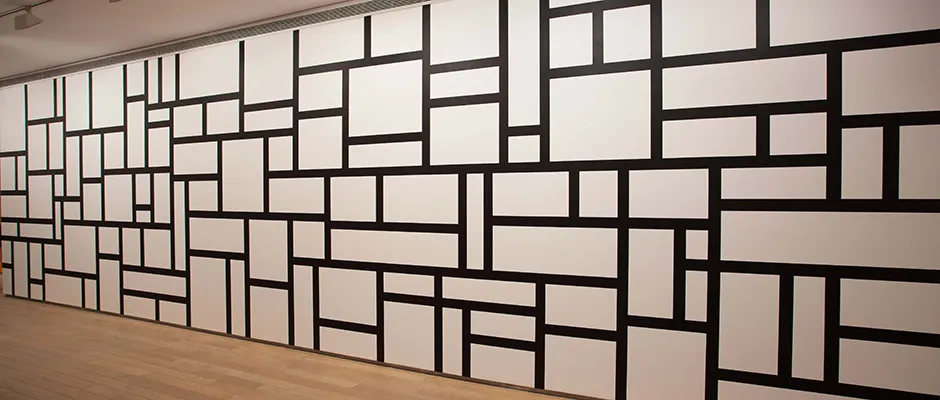
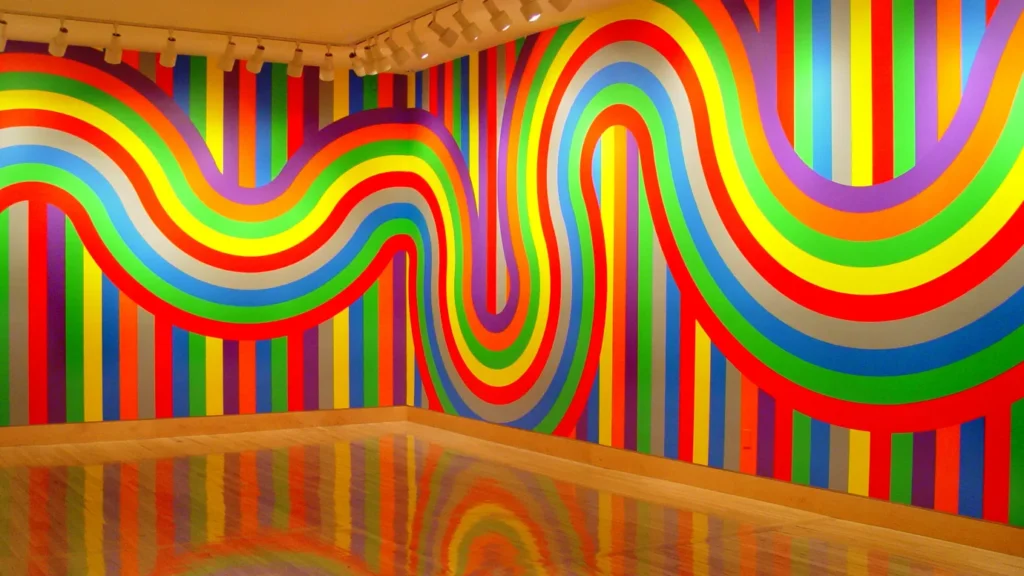
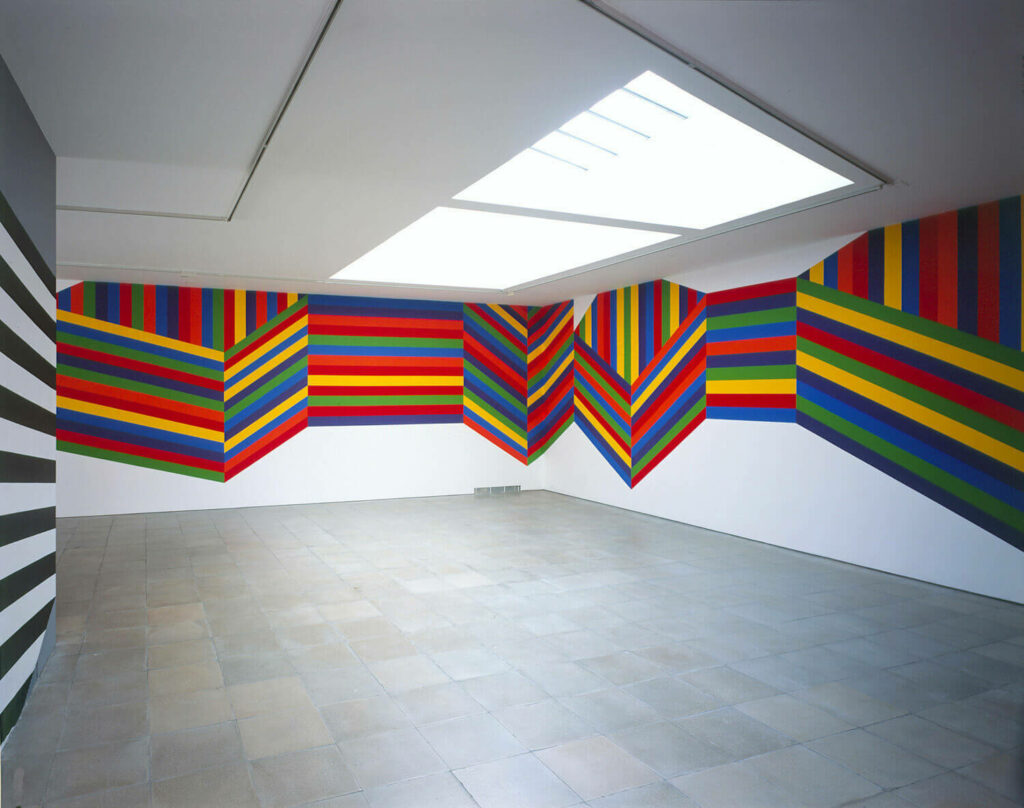
Between 1968 and 2007, LeWitt created 1,274 wall drawings. The number is itself a declaration: these are not isolated works but a permanently expanding system, each piece a variation on the same structural principles. The first wall drawing was exhibited at Paula Cooper Gallery in New York in 1968 — a network of pencil lines drawn directly on the wall — and from that first instance it established the conditions for everything that would follow: the written instruction as origin, the hands of others as execution, the wall as support and as activated space.
Art historian Carmen Juliá, in her essay “Ideas in Transmission: LeWitt’s Wall Drawings and the Question of Medium” (published in Tate Papers), argues that LeWitt’s wall drawings “problematised notions of autonomy, materiality and medium-specificity” in a way that no conventional painting or sculpture could achieve. The instruction as artwork implied a radical separation between the intelligence that generates the system and the hand that executes it — a separation that in the contemporary work this text accompanies acquires a new dimension when artificial intelligence enters as “another layer of perception.” If LeWitt delegated execution to assistants and specialist technicians, the contemporary artistic practice that integrates AI performs an analogous — and more radical — delegation: to algorithms. The distance between concept and materialization has shifted, but the question LeWitt posed remains the same: where does authorship reside, and where is the boundary between conceiving and making?
LeWitt’s instructions for the wall drawings were deliberately open. Wall Drawing #118 (1971) reads: “Place fifty points at random. The points should be evenly distributed over the area of the wall. All of the points should be connected by straight lines.” This instruction, as curator Gary Garrels observed when organizing LeWitt’s 2000 retrospective at the San Francisco Museum of Modern Art, could take — and has taken — many different forms. LeWitt “didn’t dictate,” Garrels recalled. “He accepted contradiction and paradox, the inconclusiveness of logic.” This controlled openness is precisely what makes the wall drawings more than exercises in applied geometry: they are generative systems that produce variation within order, difference within repetition. In the most contemporary vocabulary, they anticipate the logic of machine learning systems: rules that produce results that are not fully predetermined.
“Sol LeWitt: A Wall Drawing Retrospective” — a permanent installation at MASS MoCA, North Adams, Massachusetts — opened in 2008 in collaboration with the Yale University Art Gallery and the Williams College Museum of Art. It presents 105 wall drawings for 25 years, through 2033.
IV. The Incomplete Cube — Structure, Absence, and Perceptual Consciousness
In 1974, LeWitt exhibited at the John Weber Gallery in New York the work many consider his most exhaustive and philosophically richest investigation: Variations of Incomplete Open Cubes. The project consists of 122 frame structures, each a cube from which between one and nine of its twelve edges have been removed, on the condition that the resulting structure remains three-dimensional and connected. Each variation exists in three simultaneous forms: as a three-dimensional model, as a two-dimensional perspective drawing, and as a photograph. The complete installation occupies a platform so wide it cannot be taken in at a single glance.
Art critic and theorist Rosalind Krauss, in her landmark essay “LeWitt in Progress” (published in The Originality of the Avant-Garde and Other Modernist Myths, MIT Press, 1985), wrote about the incomplete cubes with a penetration that has never been surpassed. For Krauss, the work produces “an experience that is obsessional in kind.” She identified in it what she called “the system of compulsion, of the obsessional’s unwavering ritual, with its precision, its neatness, its finicky exactitude, covering over an abyss of irrationality.” This description, seemingly cryptic, illuminates something crucial: LeWitt had followed his own instruction — “irrational thoughts should be followed absolutely and logically” — to its ultimate consequences. The result is a system perfectly closed in its formal logic that simultaneously produces an experience of disorientation, of vertigo, of opening toward the immeasurable.
SFMOMA, in the documentation of the work held in its permanent collection, offers a description that captures another essential dimension. LeWitt explained the visual nature of the cubes in these terms: “With some of the three-dimensional open cube pieces, the idea part is simple, but the visual perception is complex. If you make a drawing of each side, for instance, it’d be a square grid. But when it becomes three-dimensional, you look at it, it becomes chaos. And then you walk around it again and you see it in different lines of sight, it becomes orderly again.” This alternation between order and chaos, between structure and disorientation, is not a side effect of the work: it is its central subject. The incomplete cube is a meditation on the limits of perception.
A mathematical study published in the Nexus Network Journal (Springer, 2015) computationally verified LeWitt’s 122 variations using graph theory, concluding that the artist arrived at the correct number of structures — though the researchers identified a minor error in the presentation of one specific pair of cubes. This fact carries philosophical weight: LeWitt had produced an exhaustive inventory, a complete taxonomy of every possible way to make a cube without making it fully. The title of the work — Variations of Incomplete Open Cubes — contains a paradox within itself: completeness is achieved precisely through systematized incompleteness. For the artist whose statement declares that “the Cube becomes a central structure holding both internal and external dimensions,” LeWitt’s investigation offers a powerful conceptual precedent: the cube not as a finished form but as a field of possibilities, as a structure that can be inhabited in multiple ways without exhausting itself.
“The idea part is simple, but the visual perception is complex… you look at it and it becomes chaos. You walk around it again and it becomes orderly.” — Sol LeWitt on Incomplete Open Cubes, SFMOMA
V. From Instruction to Algorithm — LeWitt and Artificial Intelligence
There is a continuity worth naming with precision between LeWitt’s practice and the incorporation of artificial intelligence as a tool in contemporary artistic practice. LeWitt defined conceptual art as a system in which “all of the planning and decisions are made beforehand.” The resulting art does not depend on the artist’s manual skill or on the contingencies of the moment of execution: it depends on the quality of the instructions, on the internal coherence of the generative system. In the terms of contemporary computer science, what LeWitt was describing was an algorithm: a finite sequence of well-defined instructions that produces a result from a set of initial conditions.
The difference between LeWitt’s instructions and a machine learning algorithm is real but gradual, not categorical. LeWitt’s instructions are deterministic: given the same space and conditions, they will produce similar though not identical results. Generative AI algorithms are stochastic: they incorporate controlled randomness that produces systematic variation. But in both cases the founding gesture is the same — a rule system that generates outcomes exceeding the complete foresight of whoever designed the system. LeWitt formulated this with his characteristic precision in the “Paragraphs”: “To work with a plan that is preset is one way of avoiding subjectivity… The plan would design the work. Some plans would require millions of variations, and some a limited number, but both are finite. Other plans imply infinity.”
For the artist whose statement describes artificial intelligence as “an expansion of thought — another layer of perception,” LeWitt’s legacy is directly operative. If LeWitt separated the intelligence that conceives from the body that executes, the contemporary practice that integrates AI performs an analogous but more radical separation: between the artist’s intention and the machine’s generative process. This separation is not an abdication of authorship but its redefinition. As LeWitt wrote in his “Sentences”: “The artist’s will is secondary to the process he initiates from idea to completion. His willfulness may only be ego.” In this context, AI is not a threat to artistic practice but a tool that continues the investigation LeWitt initiated: what happens when execution is entrusted to a process that is not the artist’s hand?
VI. Natural and Synthetic Materials — Coexistence as Evolutionary Language
The artist’s statement declares that “through the coexistence of natural and synthetic materials, I explore the language of our evolution, where technology and consciousness intersect.” This proposition finds in LeWitt a resonance that may seem unexpected, given that LeWitt worked predominantly with industrial materials — painted aluminum, concrete blocks, graphite on plaster. Yet the conceptual operation is homologous: LeWitt transformed the most “neutral” materials, those most stripped of organic or sentimental connotation, into structures that produced deeply phenomenological experiences. The material denied its own materiality in order to become the pure support of the idea.
The practice this essay accompanies inverts — or rather, complicates — that operation: rather than neutralizing the material, it places it in tension. The natural and the synthetic do not cancel each other out; they speak to one another, producing between them a space of meaning that neither could generate alone. This is a strategy closer to post-minimalist art than to LeWitt himself — nearer to Eva Hesse, whose work LeWitt admired and encouraged in his celebrated letter of 1965, than to LeWitt’s own practice. But the underlying question is the same: what does the choice of materials say about our understanding of ourselves as beings in time, in evolution, in history?
VII. The Cube as Structure of Consciousness — Critical Convergence
We arrive at the heart of the relationship between LeWitt and the artistic practice this text accompanies. The cube — for LeWitt, the most neutral form, the one most “without expressive character,” most useful precisely because of its semantic emptiness — becomes, in the artist’s statement, “a central structure holding both internal and external dimensions, individual and collective awareness.” This transformation of the Lewittian cube is significant: what in LeWitt was an empty container becomes here a full one — not filled with subjective emotion, but with structural consciousness. The cube is not neutral: it is the space in which experience organizes itself, where the individual and the collective meet, where the internal and the external confront each other.
This reading of the cube has roots in Maurice Merleau-Ponty’s phenomenology, for whom any geometric structure perceived by a body in space is always already a structure of lived experience, not an abstract object. LeWitt arrived at a similar conclusion by entirely different means — through serial logic, through the systematic exhaustion of possibilities — when he observed that the cube “becomes chaos” when you look at it, and then “becomes orderly again” when you walk around it. The perception of the cube is always a process, a movement, a negotiation between the observer and the form. It is, in the terms of the artist’s statement, a form of consciousness.
What this artist has added to LeWitt’s legacy — and what makes their practice genuinely original with respect to that precedent — is precisely the evolutionary and technological dimension. If LeWitt exhausted the possibilities of form to reveal the structure of thought, this artist uses form as a meeting point between distinct natures: the organic and the calculated, the historical and the computational, human consciousness and artificial intelligence. The cube, in this context, is not the endpoint of a formal investigation but the starting point of an inquiry into what it means to think, to perceive, and to exist at a moment when the boundaries between natural and artificial mind grow ever less distinct.
“Conceptual artists are mystics rather than rationalists. They leap to conclusions that logic cannot reach.” — Sol LeWitt, Sentences on Conceptual Art, 1969
Coda — The Line That Connects
Sol LeWitt died in 2007. He left behind 1,274 wall drawings, 122 incomplete cubes, dozens of structures, hundreds of works on paper, and two texts — “Paragraphs” and “Sentences” — that remain the most lucid documents conceptual art produced about itself. He also left something harder to catalogue: the demonstration that the line — that elementary mark, that length without breadth — is capable of sustaining a complex thought about the nature of space, time, perception, and authorship.
For the artist whose work this essay accompanies, LeWitt is above all that: evidence that the line is not a decorative instrument but an instrument of thought. That the cube is not a form but a question. And that intelligence — whether human, collective, or artificial — can find in the simplest forms the vastest contents. This artist’s practice continues that investigation from a present radically different from LeWitt’s, yet faithful to the principle LeWitt first formulated: the idea is the machine that makes the art. And today, the machine can also be an intelligence that learns.
Academic and Institutional References
LeWitt, S. (1967). “Paragraphs on Conceptual Art.” Artforum, Summer 1967. Reprinted in Sol LeWitt: Critical Texts, ed. Ada-chiara Zevi. Rome: Libri de AEIUO, 1995.
LeWitt, S. (1969). “Sentences on Conceptual Art.” Art-Language, vol. 1, no. 1. [Original manuscript at MoMA, New York, Gift of Herman J. Daled, 574.2011.a-s].
Krauss, R. E. (1985). “LeWitt in Progress.” The Originality of the Avant-Garde and Other Modernist Myths, pp. 244–258. Cambridge / London: MIT Press.
Juliá, C. (2011). “Ideas in Transmission: LeWitt’s Wall Drawings and the Question of Medium.” Tate Papers, no. 14. London: Tate Research Publications.
Garrels, G. (2000). Sol LeWitt: A Retrospective. San Francisco Museum of Modern Art / Yale University Press.
SFMOMA. (2018). “Incomplete Open Cubes (1974).” Collection documentation. San Francisco: SFMOMA. [sfmoma.org/artwork/97.516.A-KKKKKKKKKK]
National Gallery of Art. (2023). “Sol LeWitt’s Concepts and Structures.” Educational Resources. Washington D.C.: NGA. [nga.gov]
Art Basel. (2023). “Sol LeWitt: Incomplete Open Cube 8/25, 1974.” Gallery documentation. Art Basel, Galleries sector.
Wierzbicka, M. & Milošević, A. (2015). “Is the List of Incomplete Open Cubes Complete?” Nexus Network Journal: Architecture and Mathematics, 17(3). Springer Nature.
Artforum. (1973). “Sol LeWitt: Modules, Walls, Books.” Artforum, vol. 12. New York.
Artforum. (2001). “Sol LeWitt: Incomplete Open Cubes” [exhibition review, Wadsworth Atheneum]. Artforum, June 2001.
Art Gallery of New South Wales. (2011). John Kaldor Family Collection: Sol LeWitt, pp. 100–131. Sydney: AGNSW.
Legg, A., ed. (1978). Sol LeWitt. New York: Museum of Modern Art.
Bloom, L. (2019). Sol LeWitt: A Life of Ideas. Middletown, CT: Wesleyan University Press.