Sheila Hicks: The Revolutionary Textile Artist Who Transformed Fiber into Fine Art
For over six decades, Sheila Hicks has been quietly revolutionizing the art world, proving that textile art deserves equal standing with painting and sculpture in contemporary practice. Born in 1934 in Hastings, Nebraska, this American-born artist—who has lived and worked in Paris since 1964—has created a body of work that fundamentally challenges the boundaries between craft and fine art, between decoration and conceptual rigor, between the monumental and the intimate.
Today, at nearly 90 years old, Hicks remains one of the most influential contemporary textile artists working globally, with installations in major museums worldwide and a legacy that has paved the way for generations of artists working in fiber art.
Early Formation: From Painting to Thread as Medium
Sheila Hicks’s journey into textile art began somewhat unexpectedly. She studied painting at Yale University under Josef Albers, the legendary Bauhaus master known for his rigorous investigations of color theory. Albers’s influence—his emphasis on experimentation, his belief that materials themselves generate meaning—would prove foundational to Hicks’s development.
However, the pivotal moment came during a 1957-58 Fulbright Fellowship to Chile. There, Hicks encountered pre-Columbian textiles and observed indigenous weaving traditions still practiced in Andean communities. This exposure transformed her understanding of what thread as medium could accomplish. She saw that weaving techniques in art carried millennia of cultural knowledge, that fabric as narrative had been central to human expression long before the Western fine art tradition emerged.
Unlike many artists who merely appropriate indigenous techniques, Hicks engaged deeply with the communities she encountered. She learned traditional methods, understood their cultural context, and began interweaving tradition and innovation in textile practices in ways that honored source materials while developing her own distinctive voice.
The Minimes: Intimate Investigations in Fiber Art
One of Hicks’s most significant contributions to contemporary textile artists is her “Minimes”—small-scale hand-stitched artwork pieces, typically no larger than a few inches, that she has created daily since the 1960s. These intimate works function as a kind of visual diary, exploring color relationships, material properties, and structural possibilities with the same rigor Albers brought to his color studies.
The Minimes demonstrate how embroidery in fine art and wrapped thread techniques can achieve the conceptual density of any modernist painting. Each piece investigates fundamental questions: How does one color interact with another? What happens when different fibers—linen, silk, wool, synthetic materials—encounter each other? How does the direction of wrapping affect visual perception?
These small textile-based sculptures also challenge art world hierarchies that privilege large scale and public display. By insisting on the significance of intimate, portable works, Hicks asserts that monumentality isn’t the only measure of artistic importance. The Minimes are tactile art at its most concentrated—objects that invite close looking, that reward sustained attention, that cannot be fully grasped in a glance.
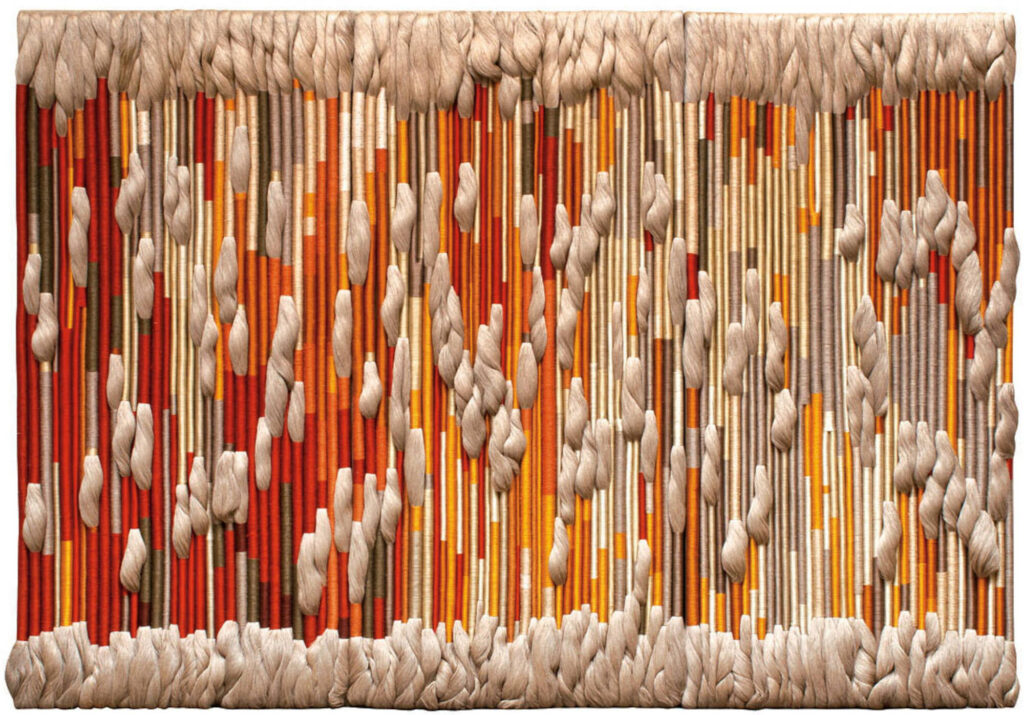
Monumental Installations: Redefining Textile Installation
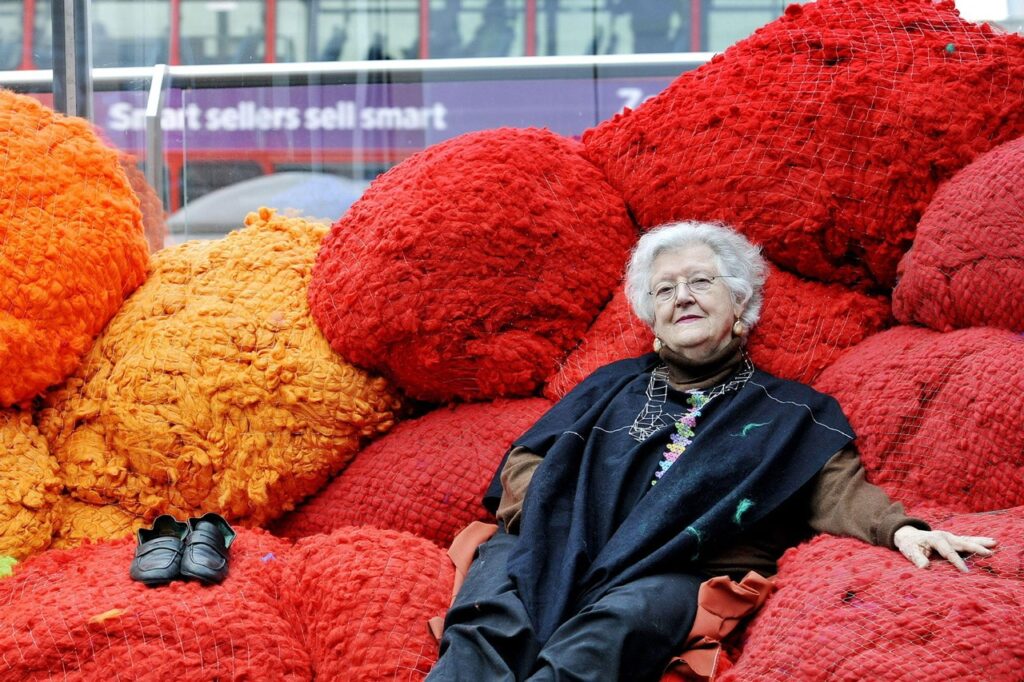
While the Minimes work at the scale of the hand, Hicks has simultaneously created room-filling textile installations that demonstrate the spatial and architectural possibilities of fiber art. Works like “The Evolving Tapestry: Escalade Beyond Chromatic Lands” (1967-68) or her 2018 installation at the Hayward Gallery in London show how woven art can activate entire environments.
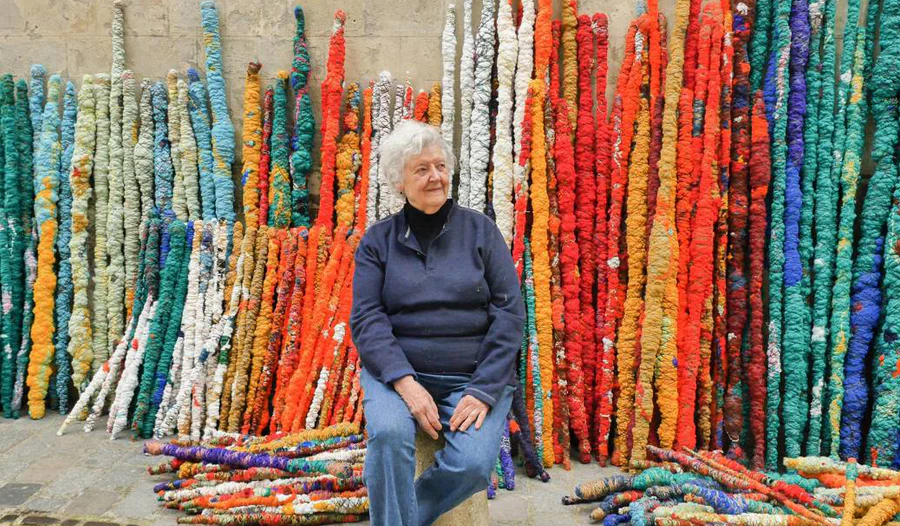
These large-scale pieces often involve mixed media textiles, combining natural and synthetic fibers, incorporating found materials, and employing diverse techniques from wrapping to knotting to weaving. The installations create immersive experiences where viewers don’t just look at art with fabric and thread—they move through it, around it, experiencing how light filters through fiber, how color relationships shift from different angles, how texture operates at architectural scale.
Hicks’s monumental works demonstrate what she calls “the language of thread and fiber in contemporary art”—a vocabulary as sophisticated and expressive as any traditional medium. Her installations for corporate headquarters, hotels, and public spaces prove that textile art can command the same gravitas and spatial presence as large-scale painting or sculpture.
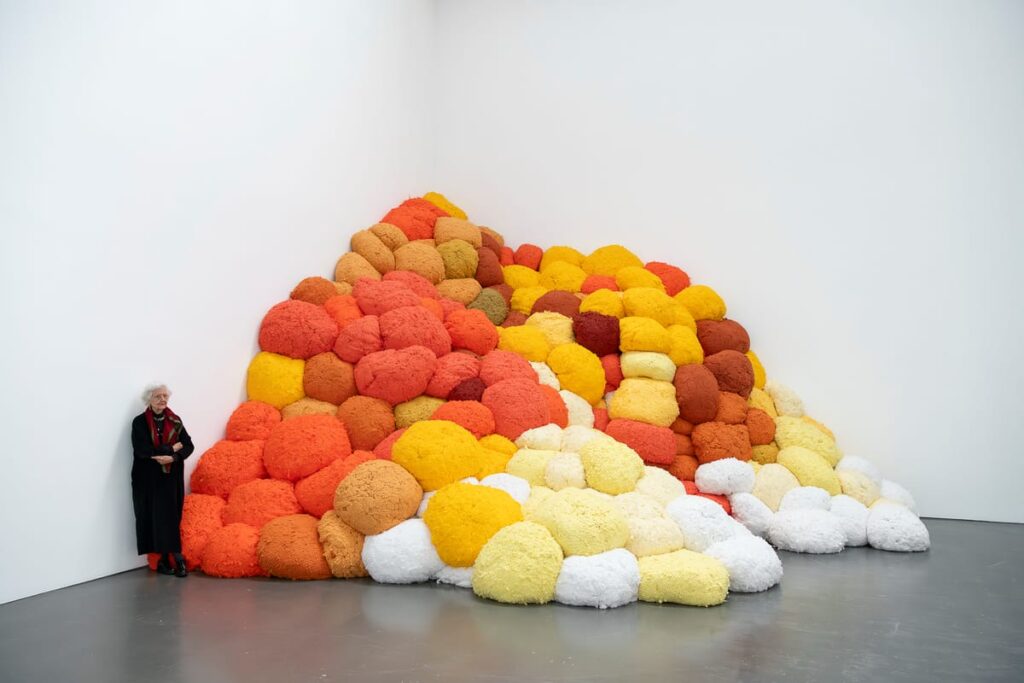
Color as Material: Exploring Identity Through Textile Art
Color has always been central to Hicks’s practice. Her woven narratives often develop through chromatic progressions—vibrant reds bleeding into oranges, cool blues transitioning to purples, unexpected juxtapositions that create visual electricity. This approach reflects her training with Albers but extends it into three dimensions and tactile experience.
Unlike paint, where color sits on a surface, Hicks’s color is structural—it’s the fiber itself. This means color has physical properties: weight, texture, reflectivity, the way it catches or absorbs light depending on the material. A red in silk performs differently than a red in wool. This textural language adds layers of meaning unavailable to painting.
Her color investigations also connect to cultural memory and place. Hicks’s extensive travels—throughout Latin America, India, Morocco, and beyond—exposed her to diverse chromatic traditions. Her work engages textile materials as vessels of cultural memory, channeling the saturated pinks of Mexican textiles, the intricate color work of Moroccan weaving, the earth tones of Peruvian cloth, while never simply replicating these traditions.
Technique and Innovation: The Resurgence of Handcraft in Conceptual Art
Sheila Hicks exemplifies the resurgence of handcraft in conceptual art. She masters traditional weaving techniques in art—backstrap looms, frame looms, tapestry techniques—but refuses to be bound by them. Her innovations include:
Wrapping and Bundling: Rather than traditional flat weaving, Hicks often wraps fiber around cores, creating cylindrical forms that can stand, lean, or accumulate into larger structures. This technique appears in works like “The Principal Wife Goes On” (2015-16), where wrapped bundles in jewel tones cascade down gallery walls.
Modular Construction: Many of Hicks’s large installations consist of individual wrapped or woven units that can be configured differently in each installation. This modularity means the same elements can create different spatial experiences, making the work inherently adaptable and responsive to site.
Material Hybridity: Hicks freely combines luxury fibers like silk with industrial materials, synthetic threads with natural ones. This mixed media textiles approach refuses hierarchies that privilege certain materials over others, instead focusing on what each material can contribute visually and structurally.
Spontaneous Structure: Unlike traditional tapestry, which follows predetermined patterns, much of Hicks’s work develops intuitively. She responds to the materials as they accumulate, making decisions about color placement, density, and form in the moment. This process-driven approach brings the improvisational energy of action painting into fiber art.
Fabric as a Living Archive: Textiles and Memory
Throughout her career, Hicks has understood fabric as a living archive. Her work engages threads of memory both personal and cultural. The Minimes, created almost daily over decades, form an autobiography in fiber—a record of sustained looking, making, and thinking. When exhibited together, they reveal patterns in her thinking, returns to certain color combinations or structural solutions, the evolution of her practice over time.
Her larger works similarly engage memory, though often cultural rather than personal. By employing techniques learned from indigenous weavers or referencing textile traditions from various cultures, Hicks creates woven connections across time and geography. This isn’t appropriation but rather what we might call “textile cosmopolitanism”—a practice that honors diverse making traditions while synthesizing them into something new.
This approach demonstrates how exploring identity through textile art can work. Hicks’s identity as an artist is itself woven from multiple threads: her American origins, her decades in France, her deep engagement with Latin American cultures, her training in European modernism. Her work doesn’t resolve these multiple positions into false unity but rather holds them in productive tension, much like the different fibers in her wrapped bundles maintain their distinct qualities while creating coherent form.
The Symbolic Weight of Fabric and Stitching in Feminist Art
Though Hicks herself has sometimes resisted being classified primarily as a feminist artist, her work inevitably participates in broader conversations about the symbolic weight of fabric and stitching in feminist art. By choosing materials historically associated with women’s domestic labor and insisting on their seriousness as artistic media, Hicks challenges deep-seated hierarchies in the art world.
Her career trajectory itself represents a form of resistance. Beginning in the 1960s when textile art was almost entirely excluded from fine art institutions, Hicks persisted. She didn’t abandon fiber to work in more “acceptable” media—she proved that contemporary textile artists could achieve the same level of critical and commercial success as painters or sculptors.
This persistence has created space for subsequent generations of artists working in fiber. The current prominence of textile installation, the acceptance of hand-stitched artwork in major museums, the critical attention paid to embroidery in fine art—all of this builds on groundwork that Hicks and a few peers laid decades ago.
Tactile Poetics: The Return of Touch in Visual Arts
Hicks’s work powerfully exemplifies tactile poetics and the return of touch in visual arts. In an increasingly dematerialized, screen-based culture, her insistence on physical presence, on material weight and texture, offers essential counterbalance. Her installations are emphatically three-dimensional, occupying space in ways that demand bodily engagement rather than just optical consumption.
The soft sculpture quality of much of her work creates unique spatial experiences. Unlike the hardness of bronze or the rigidity of stretched canvas, Hicks’s fiber works often have a yielding quality. They might sag slightly under their own weight, shift subtly in air currents, change appearance as viewers move around them. This mutability—this responsiveness to physical conditions—makes the work feel alive in ways that static media cannot achieve.
Even when viewers cannot touch the work directly (museum protocols generally forbid it), the visual texture is so pronounced that it activates haptic visuality—we see with our sense of touch, our bodies remembering what such materials feel like. This sensory dimension adds layers of meaning and affect unavailable to purely optical art.
Global Influence and Contemporary Relevance
Today, Sheila Hicks’s influence on contemporary textile artists is impossible to overstate. Artists like Olga de Amaral, Magdalena Abakanowicz, and countless younger practitioners working in fiber art build on foundations she helped establish. Major exhibitions in recent years—at the Centre Pompidou (2018), Hayward Gallery (2018), The Hepworth Wakefield (2022)—have introduced her work to new audiences and cemented her place in art history.
Her relevance extends beyond the textile world. Hicks demonstrates how sustained commitment to material investigation can generate endless formal and conceptual possibilities. Her practice model—maintaining both intimate daily work (the Minimes) and monumental public commissions—offers alternatives to the boom-bust cycle that dominates much contemporary art production.
Moreover, her emphasis on direct material engagement, on hand knowledge, on the intelligence embedded in making processes, speaks powerfully to current concerns about craft knowledge, embodied learning, and alternatives to purely digital or conceptual practices. In this sense, Hicks’s work participates in the resurgence of handcraft in conceptual art that characterizes much 21st-century practice.
Legacy: Weaving the Future
As we consider Sheila Hicks’s extraordinary seven-decade career, several achievements stand out:
Material Mastery: She has proven that thread as medium offers expressive possibilities equal to any traditional fine art material, that weaving techniques in art can generate work of profound visual and conceptual sophistication.
Scale Flexibility: From the palm-sized Minimes to room-filling installations, Hicks demonstrates that textile-based sculpture can operate at any scale, each with its own expressive potential.
Cultural Bridge-Building: Through interweaving tradition and innovation in textile practices, she has created dialogues between indigenous making traditions and contemporary art discourse, between craft knowledge and conceptual investigation.
Institutional Transformation: Her success has helped shift how museums, galleries, and critics understand textile art, contributing to broader acceptance of fiber art as legitimate contemporary practice.
Generative Influence: She has inspired countless artists to work in mixed media textiles, to take hand-stitched artwork seriously, to investigate tactile art and woven art as vehicles for contemporary concerns.
Conclusion: The Enduring Power of Fiber
Sheila Hicks’s career reminds us that the most profound innovations sometimes come not from abandoning tradition but from engaging it deeply enough to transform it. Her work demonstrates that textile materials as vessels of cultural memory can speak to the most pressing contemporary questions, that fabric as narrative remains powerfully relevant, that the patient, embodied work of making—wrapping thread, building color relationships, responding to materials—generates knowledge and meaning that cannot be achieved any other way.
For students, collectors, and anyone interested in contemporary textile artists, Hicks’s work offers inexhaustible study. Each installation, each Minime, each wrapped bundle invites sustained looking and reveals how exploring identity through textile art, how woven narratives and embodied storytelling, how the language of thread and fiber in contemporary art can articulate experiences and ideas that language alone cannot capture.
In Sheila Hicks, we find not just a master craftsperson but a profound visual thinker whose chosen medium happens to be fiber. Her legacy ensures that textile art will continue evolving, that new generations will discover what becomes possible when thread becomes sculpture, when color becomes structure, when patient handwork becomes radical artistic vision.
For those wishing to experience Sheila Hicks’s work directly, her pieces are held in major collections including the Museum of Modern Art (New York), Centre Pompidou (Paris), Tate Modern (London), and the Metropolitan Museum of Art. Her ongoing production ensures that new work continues appearing in galleries and exhibitions worldwide.