Regina Durante Jestrow: Solo Show – Curious Geometries – Miami International Airport
Between Tradition and Innovation: Regina Durante Jestrow’s “Curious Geometries” at Miami International Airport
- Miami International Airport – Gate D31 – 2100 Northwest 42nd Avenue Miami, FL, 33142 United States
A Textile Exhibition in Transit Space
Running from September 18, 2025, through March 9, 2026, at Miami International Airport’s Gates D31 Gallery, Curious Geometries transforms a liminal space of perpetual motion into an unexpected site of contemplation. Regina Durante Jestrow’s exhibition of large-scale sewn and quilted artworks occupies Concourse D, post-security—a location that positions art within the daily flow of thousands of travelers. This institutional choice by MIA Galleries proves remarkably astute, as Jestrow’s work speaks directly to themes of movement, layering, and the collision of cultural narratives that airports inherently embody.
The Quilting Continuum: Craft, Activism, and Contemporary Practice
Jestrow’s artistic lineage is both deeply rooted and deliberately progressive. Her work exists in conversation with the legendary Gee’s Bend quilters, whose improvisational geometric compositions have been recognized as significant contributions to American abstract art. The influence of mid-twentieth-century textile innovator Anni Albers—who elevated weaving to the realm of fine art at the Bauhaus and Black Mountain College—resonates in Jestrow’s commitment to material experimentation and structural rigor. Additionally, the artist acknowledges Rosie Lee Tompkins, whose explosive color sensibility and spiritual intensity redefined contemporary quilting, and Venezuelan sculptor Gego, whose linear abstractions in metal share surprising kinship with Jestrow’s sewn geometries.
This constellation of influences positions Jestrow within a crucial lineage of artists who have challenged hierarchies separating craft from fine art, domestic labor from intellectual production, and feminine traditions from the masculine-dominated canon of geometric abstraction.
Material Culture and Urban Ecology
What distinguishes Curious Geometries from purely formal exercises in pattern-making is Jestrow’s profound engagement with material culture and place-specificity. The artist sources repurposed fabrics from throughout Miami, including—in a gesture both practical and conceptually resonant—from Miami International Airport’s Interior Design Department itself. This self-referential loop transforms the exhibition site into both venue and collaborator, as materials that once functioned within the airport’s infrastructure return as art objects for contemplation.
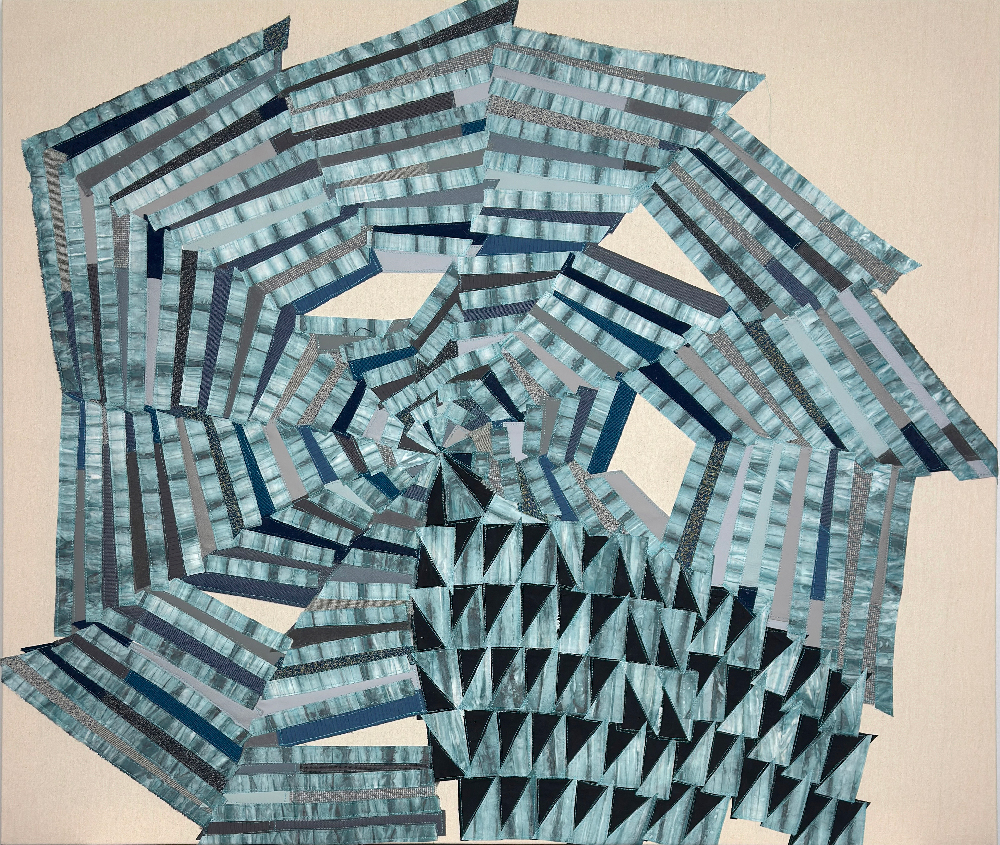
The Italian-American artist, who relocated to Miami from Queens, New York, demonstrates a sophisticated understanding of her adopted city’s layered ecologies and multicultural textures. Her vibrant color palettes—described as tropical and bold—reflect Miami’s specific light, architecture, and cultural vibrancy. The incorporation of unconventional materials including repurposed neoprene, sequins, and faux leather offers what the artist describes as “part homage to Miami’s pop culture pulse, part playful experimentation with texture and shine.”
Technical Innovation and Improvisational Precision
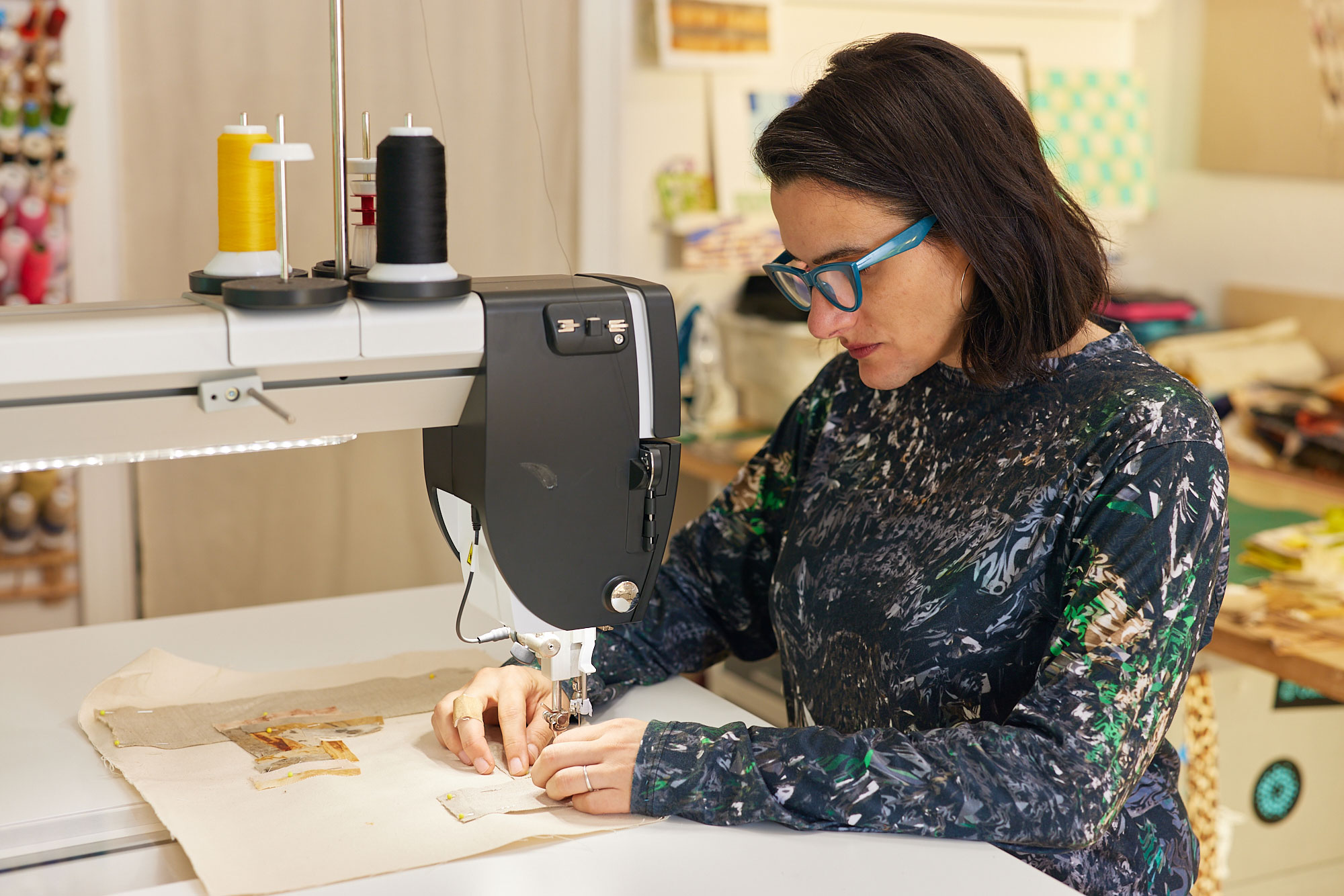
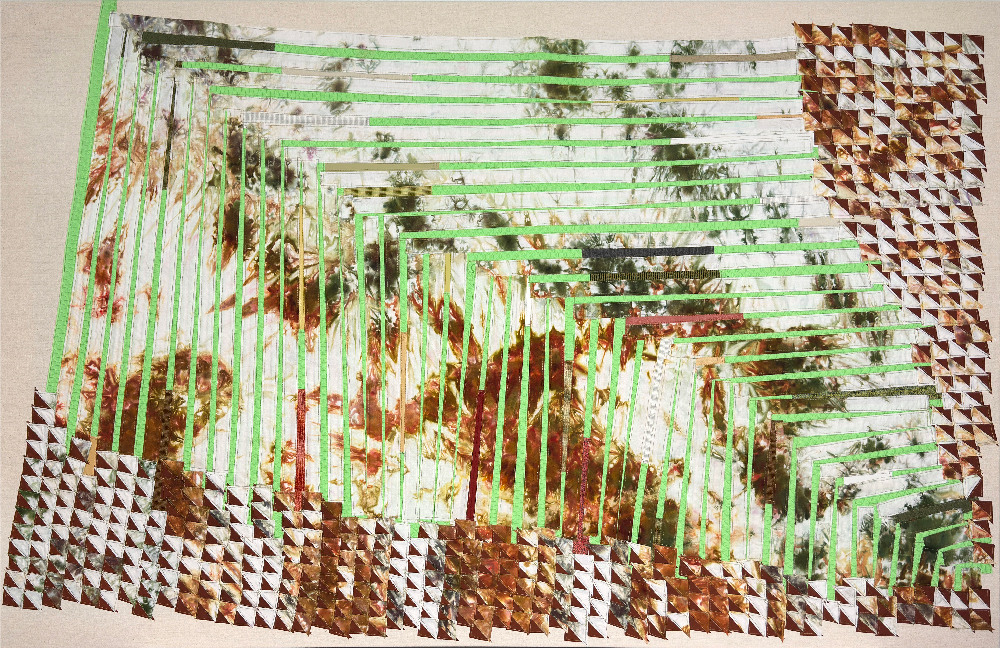
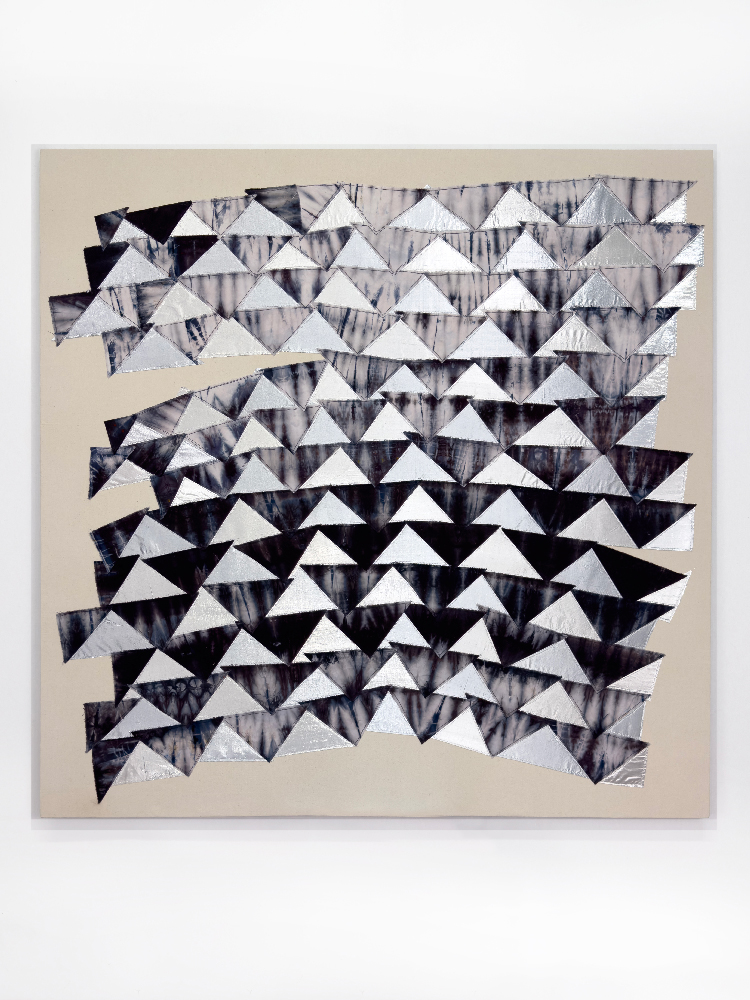
Jestrow’s technical methodology merges precision with improvisation, structure with spontaneity. She constructs her textile-based works by stitching together long fabric strips and hundreds of triangles, employing repetition as both formal strategy and meditative practice. Her process incorporates hand-dyeing techniques using natural and reactive dyes, inks, and acrylics, creating richly varied surfaces that carry both personal and cultural resonance.
The exhibition includes stretched compositions—works pulled taut across canvas stretchers that read as paintings from a distance—and free-form art quilts that hang with the fluid dimensionality inherent to unstretched fabric. This format variation creates visual dialogue between containment and freedom, between the pictorial tradition of stretched canvas and the sculptural qualities of textile arts.
Aerial Perspectives and Pattern as Place
One of the exhibition’s most compelling conceptual dimensions emerges in the relationship between Jestrow’s geometric patterns and aerial views. For travelers moving through an airport—people who will soon view cities and landscapes from above—the works offer patterns that “mimic aerial views,” transforming abstract geometry into cartographic suggestion. The irregular, organic relationships between geometry and gesture that characterize the series evoke both urban grids and natural formations, the planned and the spontaneous, the mapped and the wild.
This tension between structure and flow runs throughout the exhibition. Jestrow’s compositions pulse with energy, their accumulations and repetitions creating rhythm that echoes both urban patterns and natural systems. The artist’s statement that her work explores “the irregular, organic, and often playful relationships between geometry and gesture” proves evident in pieces that refuse the rigidity of pure geometric abstraction while maintaining clear structural intelligence.
Activist Traditions and Contemporary Concerns
Jestrow’s practice engages seriously with the activist values that historically shaped quilt-making traditions. From abolitionist-era quilts that may have served as Underground Railroad signals to the AIDS Memorial Quilt that transformed collective grief into public testimony, quilting has functioned as a medium for social commentary and community building. The artist’s incorporation of thrift shop finds and repurposed clothing addresses contemporary concerns about textile waste—an industry responsible for massive environmental impact.
Her artistic exploration is explicitly rooted in women’s rights and history, acknowledging the generations of women whose creative labor in textile arts was dismissed as mere craft or domestic necessity. By exhibiting large-scale textile works in a major public art venue, Jestrow participates in the ongoing project of validating women’s creative traditions within institutional contexts historically reserved for painting and sculpture.
The Exhibition in Context: Public Art and the Traveling Audience
MIA Galleries’ presentation of Curious Geometries at Gate D31 represents a sophisticated understanding of airport art programming. Unlike static museum audiences who choose to engage with specific exhibitions, airport viewers encounter art during transitional moments—often stressed, distracted, or preoccupied with travel logistics. Jestrow’s work proves ideally suited to this context: visually arresting enough to capture attention amid environmental chaos, yet layered with sufficient complexity to reward sustained contemplation for those with time before boarding.
The exhibition includes more than a dozen pieces, most created in 2025, combined with selected earlier works from 2020-2022. This chronological range allows viewers to perceive Jestrow’s evolving relationship with patterns, textures, colors, and shapes—her consistent interrogation of geometry rendered “always curious,” as exhibition materials note.
Career Trajectory and Institutional Recognition
Born in 1978, Jestrow has built an impressive exhibition record that demonstrates growing institutional recognition of her work. Recent solo projects include “Everything Mixing Always” at Baker-Hall (2025) and “Lots of Little Pieces (aka My Favorite Color is Glitter)” at Miami-Dade College Kendall Gallery (2025). Her work has entered significant public and private collections including the Beth Rudin DeWoody Collection, the Miami-Dade County Department of Cultural Affairs, and Miami International Airport’s MIA Galleries.
The artist has received numerous grants and awards, including the South Florida Cultural Consortium award (2023), multiple Miami Individual Artists (MIA) Grants (2022-2025), The Ellies Visual Arts Award from Oolite Arts (2021), and Artist Access Grants from Miami-Dade County and FUNdarte (2021-2025). Her residencies at The Sam and Adele Golden Foundation (2024), The Jentel Foundation (2022), and as Artist in Residence in the Everglades (2014) have provided crucial time and space for experimentation and development.
Fiber as Paint, Pattern as Narration
The exhibition materials note that in Curious Geometries, “fiber mimics paint”—a crucial observation about Jestrow’s relationship to art historical traditions. Her stretched compositions employ textile techniques to achieve effects associated with painting: color field interactions, compositional balance, gestural energy. Yet the works simultaneously assert their textile identity through visible stitching, fabric texture, and dimensional layering impossible in traditional painting.
This productive ambiguity—the way Jestrow’s works oscillate between categories—enacts the exhibition’s stated goal of spaces “where the boundaries between craft and fine art quietly unravel.” The qualifier “quietly” proves significant; this is not aggressive boundary-dissolution but rather a gentle, confident assertion that such boundaries need not exist, that quilting can operate as fully within the realm of contemporary abstract art as any painted canvas.
Conclusion: Contemplation in Transit
Curious Geometries succeeds on multiple registers: as formal investigation of geometric abstraction, as engagement with textile traditions and innovations, as site-specific response to Miami’s cultural ecology, and as intervention in the utilitarian space of airport infrastructure. For the hurried traveler, the works offer moments of visual pleasure and unexpected pause. For those with time to contemplate, they reveal sophisticated material intelligence, historical consciousness, and conceptual depth.
Regina Durante Jestrow’s exhibition demonstrates that quilting—often dismissed as domestic craft—can carry the full weight of contemporary art discourse while maintaining connections to activist traditions and community practices. In an airport, a space defined by departures and arrivals, her works create what the exhibition description aptly terms “a site of contemplation and curiosity”—a space where pattern and material collide with memory, where personal and collective histories accumulate into something both structurally rigorous and emotionally resonant.
As fiber mimics paint and handmade patterns suggest aerial views, Jestrow’s Curious Geometries invites us to reconsider both what quilting can be and where serious contemporary art can meaningfully exist. The answer, it turns out, might just be Gate D31, Concourse D, where travelers pause between destinations and discover that the boundaries we draw around art forms are as permeable and improvisational as Jestrow’s vibrant geometric compositions.