Performance Art: A Contemporary Artistic Chronicle
Performance art emerged as a radical rupture in the fabric of traditional aesthetics, a living declaration that art need not be static, precious, or confined to gallery walls. It is art that breathes, bleeds, and vanishes—existing fully only in the ephemeral present, in the charged space between artist and witness.
Origins and Early Provocations
The seeds were planted in the early twentieth century, when Futurists stormed Italian theaters with their serate, evenings of calculated chaos designed to provoke bourgeois audiences into apoplexy. Marinetti and his compatriots hurled insults and manifestos with equal fervor, transforming the stage into a battleground where art confronted complacency.
The Dadaists at Cabaret Voltaire in Zurich continued this assault on convention during World War I. Hugo Ball appeared in his Cubist costume—a towering assemblage of cardboard cylinders that rendered him barely human—chanting his nonsensical Karawane sound poem. Here was art stripped of meaning’s tyranny, reduced to pure sonic gesture, the artist’s body becoming both instrument and artwork.
The Body as Canvas and Statement
By the 1960s, performance art crystallized into something recognizable yet indefinable. The body itself became the primary medium—vulnerable, political, and irreducibly present. Yoko Ono’s Cut Piece (1964) placed the artist on a stage, inviting audience members to approach with scissors and cut away pieces of her clothing. Each snip revealed not just fabric but power dynamics, voyeurism, gender, and the violence lurking beneath social interaction.
Marina Abramović pushed further into territories of endurance and risk. In Rhythm 0 (1974), she stood passive for six hours beside a table of seventy-two objects—roses, perfume, a loaded gun—instructing visitors to use them on her body however they wished. The performance became a terrifying experiment in human nature, demonstrating how quickly civility dissolves when accountability vanishes.
Ritual, Identity, and the Political Body
Performance art became a vessel for exploring identity when other forms felt inadequate. Ana Mendieta pressed her body into earth and sand, creating silhouettes filled with blood, fire, and flowers—ephemeral Siluetas that spoke of displacement, belonging, and the female body’s relationship to landscape and violence.
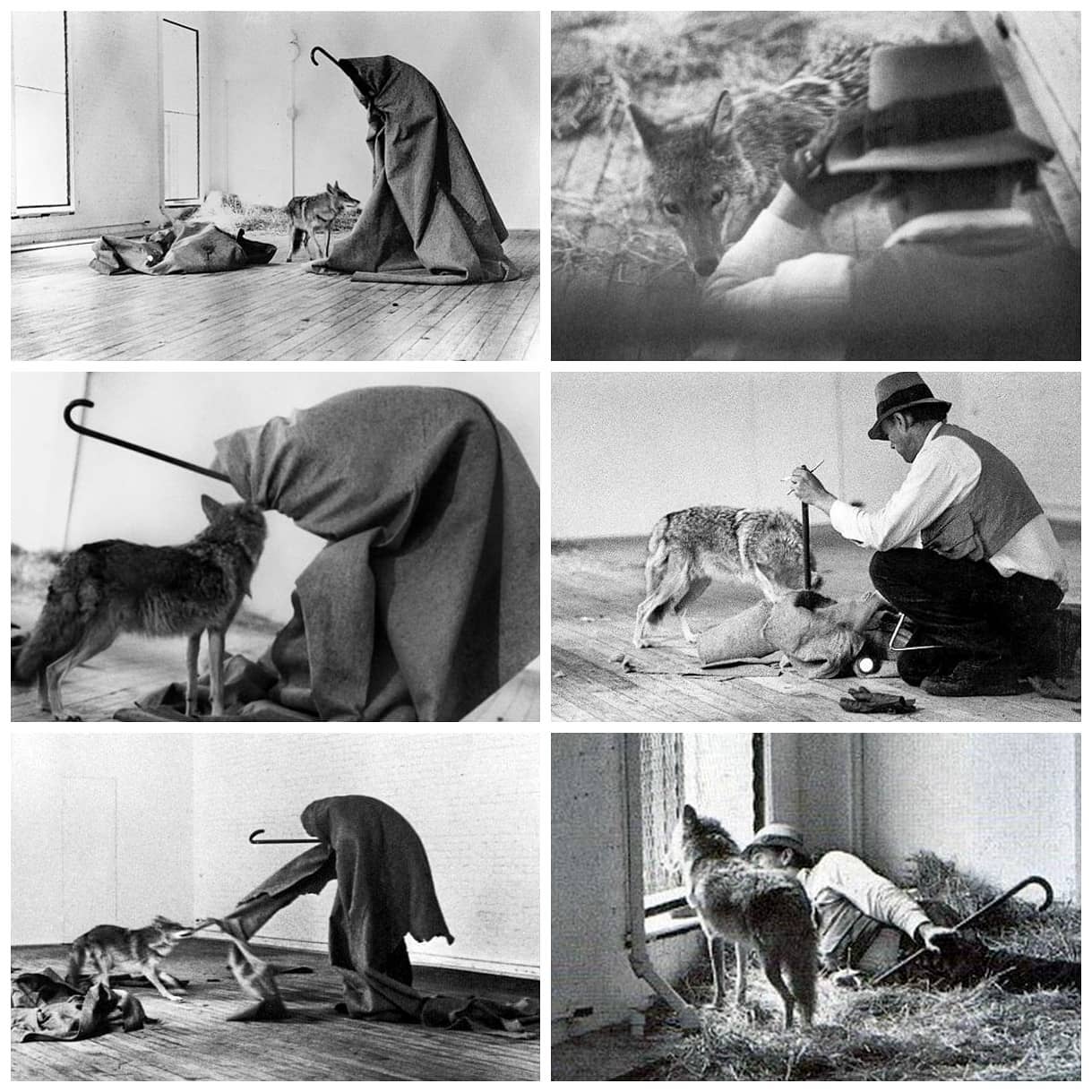
Joseph Beuys transformed his performances into shamanic rituals. In I Like America and America Likes Me (1974), he spent three days caged with a wild coyote, wrapped in felt, enacting a mysterious ceremony of reconciliation between human and animal, colonizer and colonized land. His performances carried the residue of personal mythology—his claimed rescue by Tartars during wartime—whether factual or not, this narrative became inseparable from the work.
Carolee Schneemann’s Interior Scroll (1975) confronted the art world’s discomfort with the female body. Standing nude, she slowly extracted a rolled paper scroll from her vagina and read from it—a text about the dismissal of women’s bodily experience in art discourse. The performance was visceral proof that women’s bodies could be subjects, not merely objects, of artistic investigation.
Confronting Systems and Structures
Chris Burden’s Shoot (1971) lasted mere seconds: in a California gallery, a friend shot him in the arm with a .22 rifle. The documentation—photographs, the artist’s bandaged wound—became more widely known than the act itself, raising questions about violence as spectacle, art’s limits, and the commodification of extreme experience.
Tehching Hsieh created performances of almost incomprehensible duration. For Time Clock Piece (1980-1981), he punched a time clock every hour for an entire year, remaining in his studio, his hair growing wild in time-lapse photographs that documented each punch. These year-long performances explored confinement, discipline, and time’s passage with monastic intensity.
The Relational and the Intimate
In the 1990s, artists like Tino Sehgal created performances that left no material trace—no photographs, no videos, no objects. Trained dancers and performers enacted scripted yet improvised encounters with museum visitors, transforming the gallery into a space of pure human exchange. These “constructed situations” existed only in memory and lived experience.
Tania Bruguera developed “Arte de Conducta” (Conduct Art), emphasizing art’s capacity to affect behavior and social relations. Her performances often placed audiences in uncomfortable political situations, making them complicit participants rather than passive observers.
Documentation and Its Discontents
Performance art lives in paradox: it happens once, unrepeatable, yet we know it through photographs, videos, and testimonies. This documentation becomes a kind of ghost, evidence of an absence. We see Abramović’s exhausted face, Burden’s wound, Ono’s tattered clothing—but we weren’t there. We didn’t breathe that air or feel that tension.
Some artists embrace this secondary life; others resist it. The photograph of a performance is never the performance, yet it shapes how the work travels through time and enters art history.
Legacy and Living Practice
Performance art’s influence permeates contemporary practice. It opened doors for relational aesthetics, social practice art, and institutional critique. It demonstrated that art could be gesture, duration, presence—that the artist’s body could be both medium and message.
Today’s practitioners continue exploring presence and liveness in our hypermediated age. How does performance function when everything is recorded, streamed, going viral? Artists grapple with attention economies, surveillance, and the screen’s mediation of experience, finding new urgencies in the live and the ephemeral.
The Vanishing Act
Performance art remains stubbornly anti-commodity in a world obsessed with ownership. You cannot possess it, only witness or miss it entirely. It insists on the moment’s primacy, on bodies in space, on the unrepeatable now. In an era of infinite reproduction and digital persistence, performance art’s disappearance becomes its most radical gesture—a reminder that some experiences refuse to be captured, archived, or sold.
It is art that knows it will die, and performs that death as its final, defiant act.