Overcoming Creative Block: Resilience and Critical Thinking as Essential Tools
This is a profound topic that moves beyond standard advice like “take a walk” or “try a new medium.” While those tactical shifts can help, true, persistent creative blocks are often rooted in deeper psychological and intellectual hurdles.
Framing the solution through the lenses of resilience (emotional stamina) and critical thinking (intellectual rigor) turns overcoming a block into a skill that can be developed, rather than a magical moment of inspiration you have to wait for.
Here is an exploration of how resilience and critical thinking serve as essential tools for overcoming creative block.
The Nature of the Beast: What is Creative Block?
Creative block is rarely a simple lack of ideas. More often, it is a complex cocktail of fear (of failure, of judgment), perfectionism, mental fatigue, or a lack of clarity about the project’s direction.
When blocked, the brain’s limbic system (responsible for fight-or-flight responses) often takes over, viewing the creative task as a threat. This shuts down the prefrontal cortex, where complex planning and idea generation happen.
To overcome this, we need tools that soothe the emotional brain (resilience) and re-engage the logical brain (critical thinking).
Tool 1: Resilience – The Emotional Engine
Resilience in creativity is not just about “toughing it out.” It is the capacity to recover quickly from difficulties; it is emotional elasticity. When blocked, resilience is what allows you to stay at the desk when every instinct is screaming at you to flee.
1. Decoupling Self-Worth from Output
The most paralyzing element of a creative block is the belief that “if I make something bad right now, I am bad.” This intense pressure makes starting impossible.
- The Resilient Shift: Resilience allows an artist to recognize that a day of bad work is just a day of bad work. It is not a verdict on their talent or future. By accepting that failure is an inevitable part of the process, the stakes are lowered, making it easier to begin.
2. Tolerating Discomfort and Uncertainty
Creativity is inherently uncertain. You are bringing something new into existence, which means you don’t know if it will work. This uncertainty causes anxiety, which fuels blocks.
- The Resilient Shift: Instead of trying to eliminate the anxiety, a resilient person learns to sit with it. They recognize that the feeling of “I don’t know what I’m doing” is actually a sign that they are doing real work, not just repeating past successes.
3. The “Bounce Back” Mechanism
Blocks often occur after a setback—a rejection, harsh feedback, or a project that flopped.
- The Resilient Shift: Resilience is the speed at which you process that setback. Instead of spiraling for weeks, resilience helps you acknowledge the pain, learn what you can, and return to the work. It turns a full stop into a comma.
Tool 2: Critical Thinking – The Intellectual Navigator
If resilience provides the fuel to keep going, critical thinking provides the steering wheel. Often, a block isn’t emotional; it’s structural. You are blocked because you don’t know how to solve the problem in front of you.
Critical thinking is the ability to step back from the work, detach from it emotionally, and analyze it objectively.
1. Diagnosing the Problem (The “Why”)
When blocked, we often generalize: “I’m stuck. I can’t do this.”
- The Critical Shift: Critical thinking demands specificity. It asks: Why am I stuck? Is the scope too big? Do I lack a necessary technical skill? Is the concept flawed at its core? By interrogating the block itself, you transform a vague, overwhelming feeling into a concrete set of problems to be solved.
2. Breaking Down Overwhelm
A massive project often causes a freeze response because the brain cannot compute the entire path to the finish line.
- The Critical Shift: Critical thinking allows you to deconstruct the whole into manageable parts. Instead of trying to “write a novel,” critical thinking suggests, “Today, I only need to figure out why the protagonist walks into that room.” It turns a mountain into a series of climbable steps.
3. Objective Evaluation vs. Inner Critic
The “inner critic” is an emotional bully that says, “This is garbage.” The critical thinker is an objective editor that says, “This paragraph isn’t working because the transition is abrupt.”
- The Critical Shift: When you apply critical thinking, you stop judging the work morally (good/bad) and start evaluating it functionally (working/not working). This reduces the emotional sting and provides a clear path for revision. It allows you to run strategic experiments rather than flailing randomly hoping for inspiration.
Synthesis: How They Work Together
Resilience and Critical Thinking are most effective when used in tandem. One without the other is insufficient for long-term creative health.
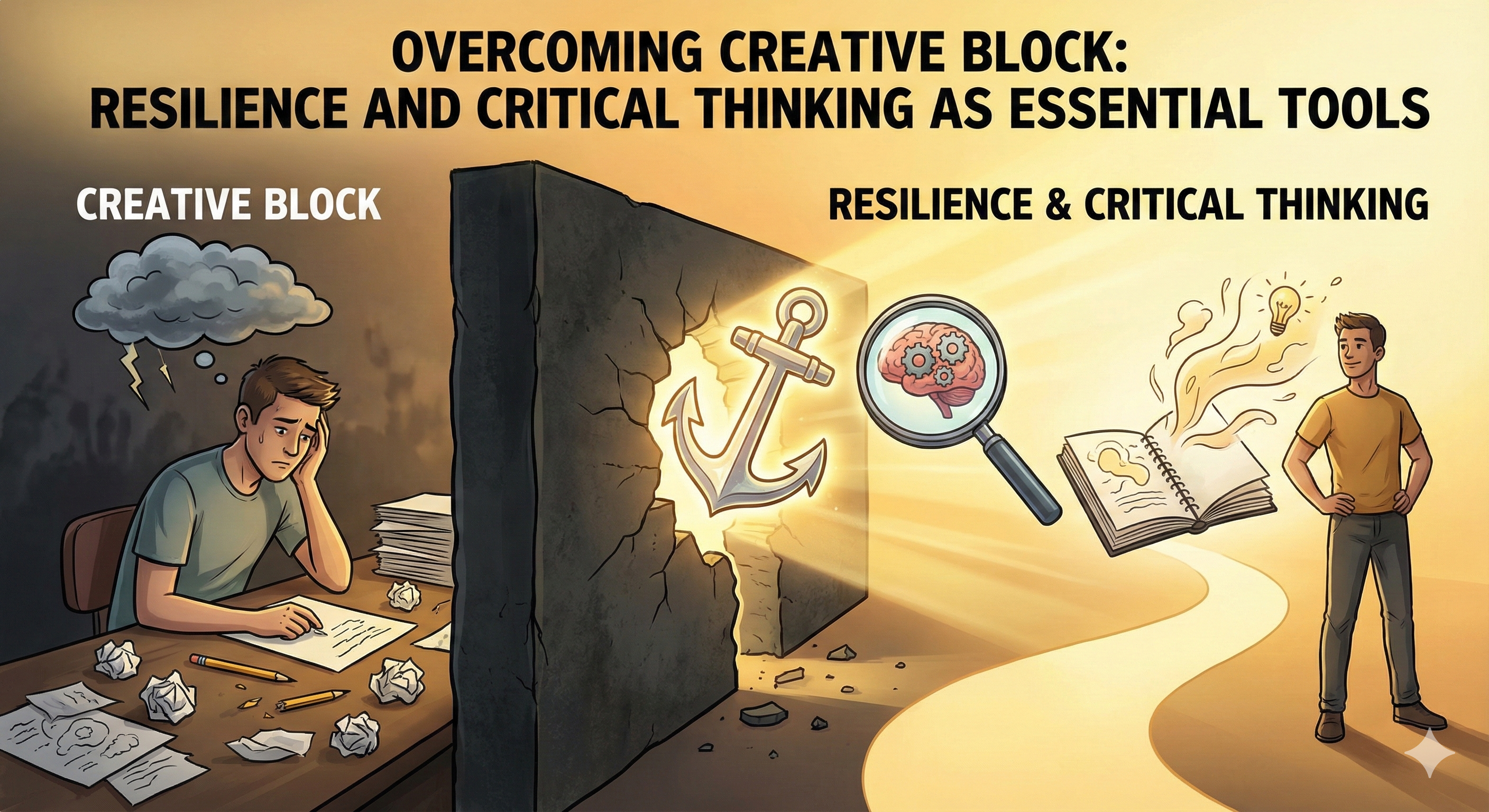
- Resilience without Critical Thinking leads to burnout. You keep banging your head against the wall, showing up every day, but you never step back to analyze why the wall isn’t breaking. You have stamina, but no strategy.
- Critical Thinking without Resilience leads to paralysis by analysis. You can perfectly diagnose every flaw in your work and every reason why it might fail, but you lack the emotional courage to push through that knowledge and create anyway.
The Synergistic Approach to a Block:
When you hit a wall, the process should look like this:
- Activate Resilience: Acknowledge the frustration without judgment. Tell yourself, “This feels terrible, and that’s okay. I can handle this discomfort. I will not quit today.”
- Activate Critical Thinking: Step back from the canvas/page/screen. Ask, “What is the specific friction point? Is it the concept, the execution, or my energy levels? What is the smallest possible problem I can solve right now?”
- Execute: Use the small solution identified by critical thinking, supported by the emotional stamina provided by resilience.
By cultivating these two traits, we stop viewing creative blocks as insurmountable failures of talent, and instead see them as inevitable, manageable parts of the creative process that require specific intellectual and emotional tools to navigate.