Orlando Urdaneta: Diagrams of Turbulent Linearity
By Milagros Bello, PHD
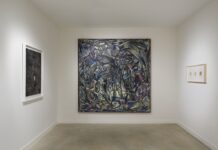
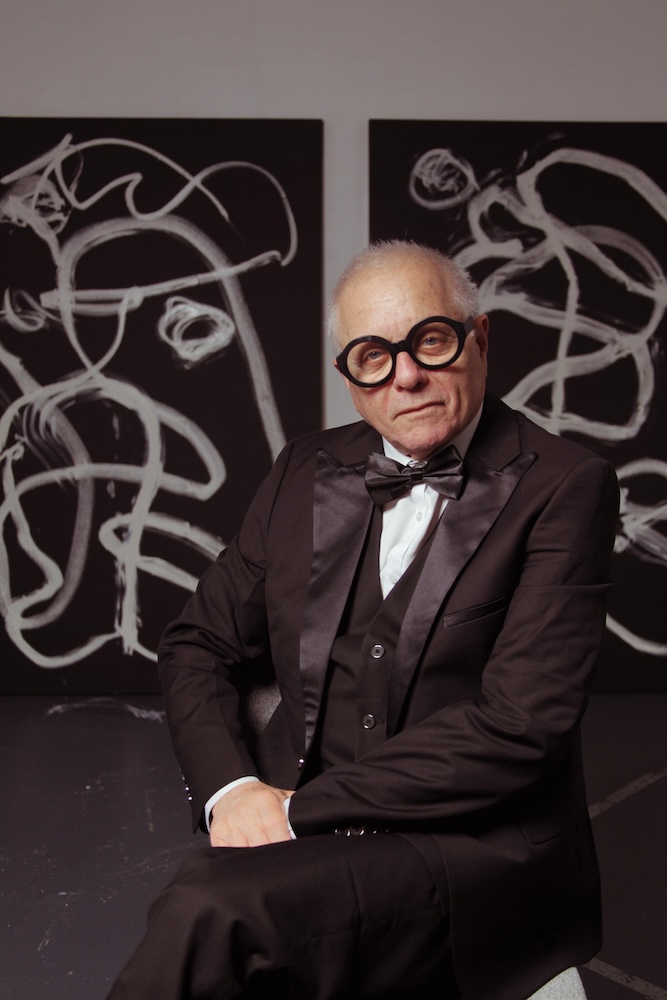
Orlando Urdaneta’s works unfold as territories of turbulent linearity, where drawing ceases to function as representation and instead becomes an energetic event. Against the density of the black ground, white strokes emerge as impulses that trace an architecture in perpetual instability: form is generated, suspended, and dissolved within a single gesture. The purpose is not to depict the world but to activate the material force of the line as something that precedes image-making.

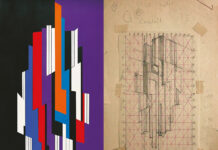
Each composition operates as a topography of excess, constructed through recurring movements, interlaced trajectories, and rhythms that sustain their own internal vibration. Sensation overtakes representation, transforming the surface into a space where intensity circulates freely. The lines participate in an open relational system: they intersect, deviate, create friction, and produce meaning through the tension and contact of their paths.
Urdaneta’s tracings evoke a script without alphabet, a form of writing that assumes the role of visible thought. The lines advance, break, tighten, retreat, and reappear, leaving the imprint of a mind thinking through energy rather than narrative. They function as ephemeral presences—merging and dissolving simultaneously—inhabiting the threshold between inscription and erasure.
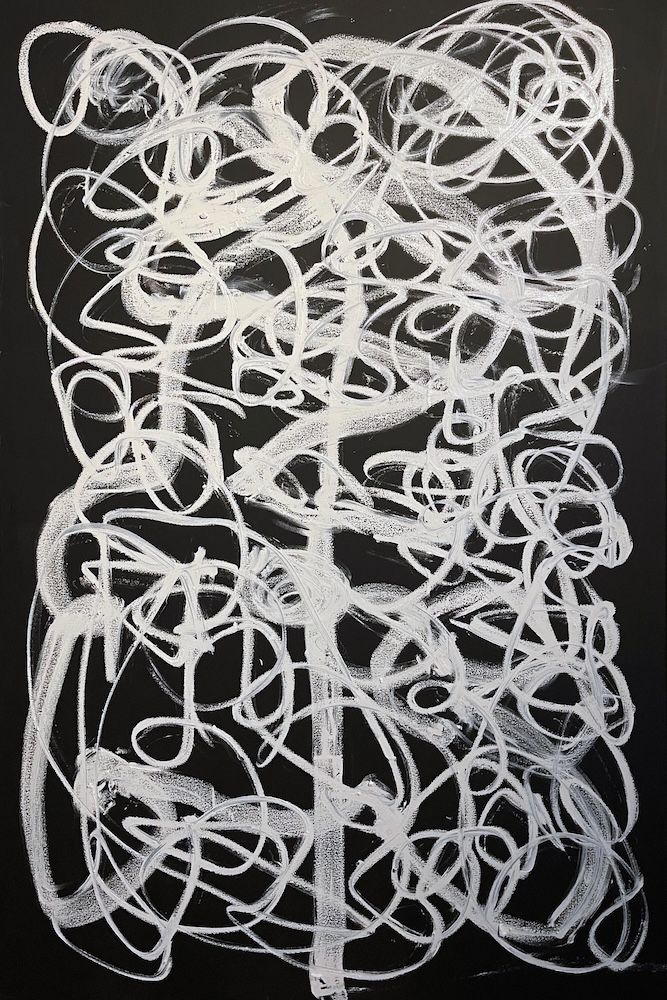
Within a framework of peripheral aesthetics, the work enacts a conceptual shift by elevating what is often dismissed as marginal: raw line, repetition, turbulence, and instability. Urdaneta transforms these elements into sites of expressive and conceptual density, proposing a poetics of dislocation in which form remains mutable, dynamic, and perpetually in transit. This instability opens a field of microforces and resonances that reshape perception and invite viewers into an active sensory encounter.
Urdaneta’s paintings—articulated as diagrams of affective turbulence—summon viewers to navigate shifting intensities, to experience vision as movement, and to understand drawing as an inquiry into the deep architectures of sensation and the internal vibrations that sustain thought itself.
Milagros Bello, PHD
Curator
[email protected]