Olga de Amaral: Cuerpo textil
Exhibition Information
Olga de Amaral: Cuerpo textil
February 27 – May 11, 2026 · Level 2
Opening: Thursday, February 26, 2026, 7:00 PM
MALBA — Museo de Arte Latinoamericano de Buenos Aires
Av. Figueroa Alcorta 3415, C1425CLA, Buenos Aires, Argentina
[email protected]
https://malba.org.ar
Curators: María Amalia García and Marie Perennès
Catalogue: Bilingual (Spanish / English), with archival materials
Developed in collaboration with: Casa Amaral and Marie Perennès
There is a particular category of artistic encounter that refuses to resolve itself into mere appreciation. Standing before Olga de Amaral’s monumental weavings — horse-hair catching the light, gold leaf trembling with the breath of a nearby visitor, cotton threads hanging like an arrested monsoon — one does not simply look. One inhabits. Cuerpo textil, the ambitious retrospective now on view at MALBA in Buenos Aires, offers precisely this order of experience: six decades of an artist who dismantled the very grammar of what a textile could be, and rebuilt it as something closer to cosmology.
A Retrospective Long Overdue
The exhibition arrives in Buenos Aires with extraordinary institutional momentum. Cuerpo textil follows the critical triumph of Amaral’s first major European retrospective at the Fondation Cartier pour l’art contemporain in Paris (October 2024 – March 2025), curated by Marie Perennès, who co-curates the MALBA presentation alongside the museum’s chief curator, María Amalia García. The Buenos Aires iteration has been developed in close collaboration with Casa Amaral, the artist’s Bogotá studio-foundation, and it represents, crucially, the first large-scale retrospective of Amaral’s work on Latin American soil in more than thirty years — the last being her 1993 survey at the Museo de Arte Moderno de Bogotá.
More than fifty works drawn from public and private collections in Bogotá, Medellín, and New York are assembled across Level 2 of the museum. The installation traces a chronological and conceptual arc from the formal experiments of the 1960s through to the serene monumentality of the early 2000s. For Buenos Aires audiences encountering Amaral’s full creative range for the first time — or rediscovering it after decades — the experience carries the unmistakable charge of a historical corrective.
“As I build these surfaces, I create spaces of meditation, contemplation and reflection. Every small unit that forms the surface is not only significant in itself, but is also deeply resonant of the whole.”
— Olga de Amaral, Metropolitan Museum of Art lecture, 2003
Formation: Cranbrook, the Bauhaus Ghost, and the Andean Inheritance
Born Olga Ceballos Vélez in Bogotá on June 14, 1932, Amaral trained first in Architectural Drafting at the Colegio Mayor de Cundinamarca before departing for the United States in 1952. At the Cranbrook Academy of Art in Michigan — an institution suffused with the ethos of the Bauhaus — she found her medium in the weaving atelier of Marianne Strengell, a Finnish-American designer who had redirected the pedagogical attention of the loom from decorative pattern toward structural grid and material truth. This encounter between a Latin American sensibility steeped in the visual culture of pre-Columbian textiles and a modernist institution premised on the unity of art and craft would define everything that followed.
Returning to Colombia in 1955, Amaral refused to make the binary choice that lesser careers might have demanded: either the inherited traditions of Andean weaving or the international grammar of postwar abstraction. Her genius resided precisely in her refusal of that false dichotomy. She held both inheritances simultaneously and let them pressure each other into something unprecedented. The natural fibers — horse-hair, wool, linen, cotton — that form the physical substance of her works are not picturesque references to folkloric craft. They are load-bearing elements of her visual argument, freighted with the anthropological depth of civilizations that understood weaving not as decoration but as the fundamental technology of social cohesion and spiritual meaning.
A Pioneer Among Pioneers: The Fiber Art Revolution
The 1960s situate Amaral within a generation of artists — among them Magdalena Abakanowicz and Sheila Hicks — who were collectively dismantling the assumption that textiles occupied a decorative, subordinate register below painting and sculpture. Amaral was the first Latin American artist to participate in the Lausanne International Tapestry Biennial in 1967. She taught at the Haystack Mountain School of Crafts and was included in the landmark exhibition Wall Hangings at the Museum of Modern Art in New York — an event that announced, with institutional authority, the elevation of fiber art into the contemporary discourse. Her 1970 solo exhibition Woven Walls at what is now the Museum of Arts and Design in New York consolidated this positioning.
What distinguished Amaral within even this distinguished company was the philosophical ambition she brought to the structural question of where a textile lives in space. Her works were never flat. They pulled away from the wall. They accumulated weight and shadow. They created chambers of light and suspended architectures. The designation “wall hanging” always felt like a category error applied to her output: these works do not hang from walls so much as they generate their own gravitational fields.
Gold, Alchemy, and the Pre-Columbian Imaginary
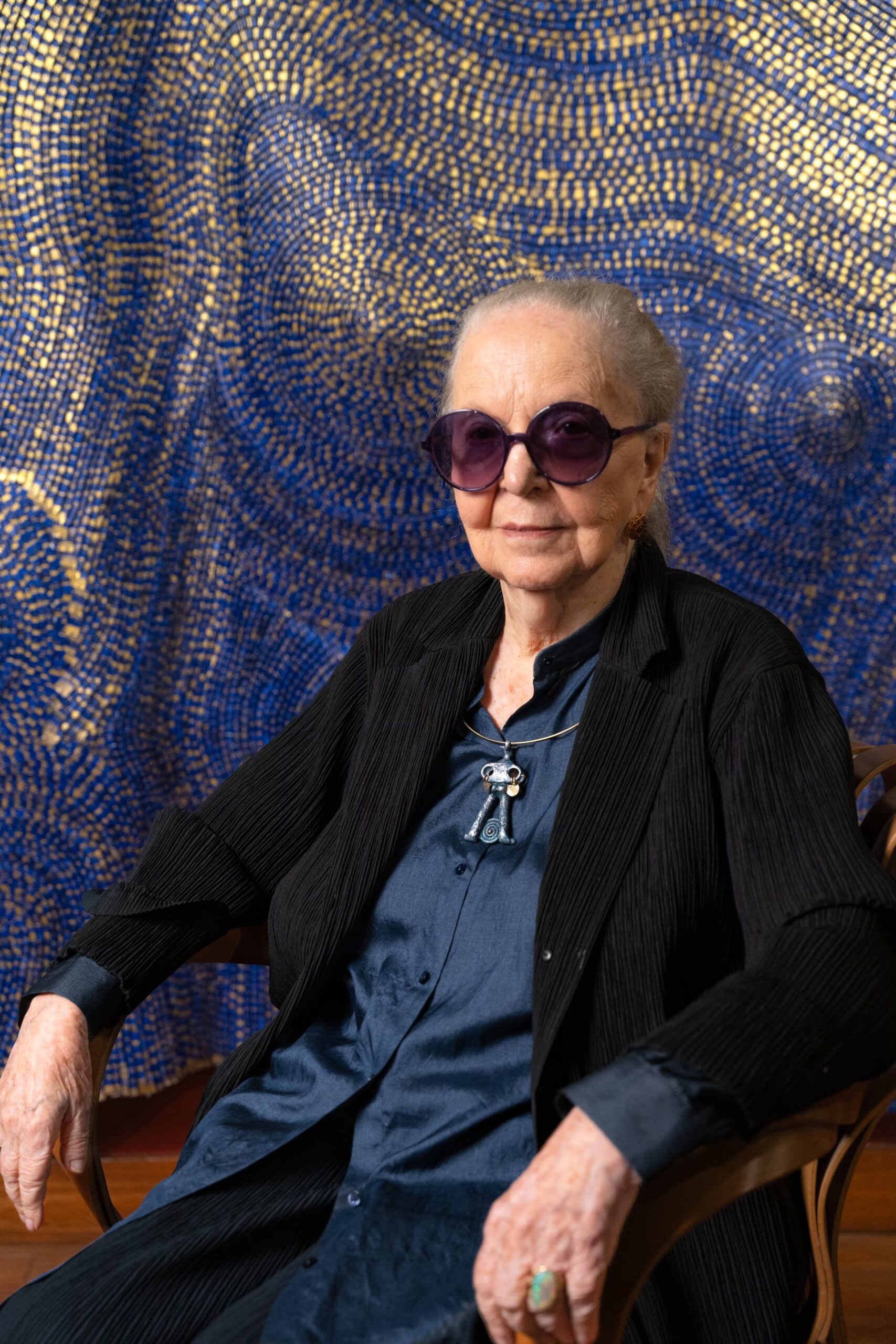
Among the most arresting works in Cuerpo textil are those from the Alquimia (Alchemy) series, begun in 1984, and the later Estelas (Stelae) series from 1996. Both deploy gold leaf — applied over gesso-coated cotton — with a logic that is simultaneously material and symbolic. The gold here is not ornamental gilding. It carries the entire weight of a colonial history: gold plundered from Colombia over centuries by European powers, gold venerated by pre-Columbian cultures as the terrestrial emanation of the sun. To apply gold to a textile — to the most fundamentally human of materials, the woven surface that covered bodies and sealed dwellings and marked social status since before recorded history — is to perform a kind of cultural restitution. The material is reclaimed, reintegrated, returned to a relational context.
The Estelas are perhaps the series in which Amaral’s synthetic achievement is most concentrated. Their name invokes the monumental funerary stelae of pre-Columbian archaeology — the carved upright stones marking place and sovereignty. Amaral’s woven versions are gilded towers of compressed time: the cotton structure, the gesso ground, the acrylic medium, and the gold leaf form a stratigraphy analogous to geological deposit, to sedimentary memory. They are simultaneously utterly contemporary and unmistakably ancient.\
The Brumas and the Phenomenology of Atmosphere
The exhibition’s treatment of the Brumas (Mists) series — begun in 2013 — represents one of the most phenomenologically rewarding passages in the entire retrospective. Here, thousands of cotton threads coated with gesso and finished with acrylic paint are suspended from overhead structures, falling in cascades of saturated color that move almost imperceptibly in the slightest air current. The effect is categorically different from anything achieved in the gold series: where the Estelas are concentrated, architectonic, and declarative, the Brumas are diffuse, atmospheric, and conditional. They suggest rainfall, cloud, the interior of a breath. Standing within them, one becomes aware of the body as a porous thing — susceptible to environment, continuous with climate.
The curatorial decision to include twenty-four works from the Brumas series — a significant concentration — reflects an astute reading of how Amaral’s late work has expanded the spatial ambition of her practice toward something approaching environmental installation. These are not objects to be looked at so much as conditions to be experienced.
Kintsugi, the Grid, and Global Resonances
The curatorial apparatus of Cuerpo textil is attentive to the international circulation of Amaral’s ideas and influences. After encountering the Japanese ceramic practice of kintsugi — the art of repairing broken objects with gold, making the repair visible rather than concealing it — at the studio of British potter Lucie Rie in 1970, Amaral began her Fragmentos Completos (Complete Fragments) series, embedding gold leaf within the fabric of her weavings in a logic that paralleled kintsugi’s philosophy: that fracture and repair are not failures to be hidden but truths to be honored.
This episode illuminates something structurally important about Amaral’s creative method: she is a synthesizer of a very high order, capable of absorbing influences from Japanese ceramic philosophy, Andean textile tradition, Bauhaus structural formalism, and pre-Columbian iconography, and producing from their encounter a language that belongs to none of these sources individually but could not have existed without all of them.
Curatorship: Archive, Context, and Institutional Argument
The curatorial approach of García and Perennès merits specific attention. The exhibition is accompanied by an extensive bilingual catalogue (Spanish/English) that makes available, for the first time, archival material documenting Amaral’s career trajectories, her interventions in architectural contexts, and the international circulation of her work. This archival ambition is itself an argument: it positions Amaral not as a recovered figure needing rescue from obscurity, but as an artist whose institutional footprint — the Banco de la República, the MoMA, the Metropolitan Museum of New York, the Musée d’Art Moderne de Paris, the Kyoto National Museum of Modern Art — was always already substantial, yet whose full significance within the history of contemporary art has been incompletely processed.
The exhibition also recuperates a dimension of Amaral’s practice largely invisible to the gallery circuit: her collaborative work in fashion and interior textiles through Telas Amaral, the studio she founded with the artist Jim Amaral. The inclusion of the mantas guajiras — textiles in dialogue with the weaving traditions of the Wayuu people of the Guajira Peninsula — opens the retrospective onto questions of cultural exchange and artistic responsibility that the curatorial team handles with appropriate nuance.
The Dissolution of Category as Artistic Achievement
The most radical claim embedded in Cuerpo textil — and in Amaral’s oeuvre as a whole — is epistemological. By creating works that are simultaneously paintings (they carry chromatic arguments of breathtaking sophistication), sculptures (they occupy three-dimensional space with the authority of cast bronze), environments (they alter the conditions of the rooms they inhabit), and architectures (they structure human movement and visual attention), Amaral exposes the art historical category system as an artifact of institutional convenience rather than a description of what art actually does.
The question of whether textile art is “really” art — a question that has haunted fiber practitioners since the medium was exiled from the academy centuries ago, relegated to the domestic sphere as women’s work — becomes, in Amaral’s hands, simply unanswerable. Not because it is too hard, but because the premises that generate it have been dissolved. Her works do not argue for the elevation of textile to the status of fine art. They demonstrate, materially and irrefutably, that the category distinction was always incoherent. Thread is as capable of meaning as paint. The loom is as capable of argument as the chisel.
The ancient textile traditions of Andean communities and the vernacular dimension of materials such as wool and horse-hair are integrated into her work from a contemporary perspective that interrogates spatiality and the body.
— MALBA Exhibition Statement, 2026
Global Momentum and Historical Significance
It is worth situating Cuerpo textil within the exceptional institutional momentum that has gathered around Amaral’s work in recent years. Following the European retrospective at Fondation Cartier (2024–2025) and its subsequent presentation at ICA Miami (2025), the MALBA exhibition completes a circuit that has introduced Amaral’s practice to audiences who encountered it, if at all, only through isolated works in permanent collections. Her presence in Woven Histories: Textiles and Modern Abstraction — the major traveling exhibition that moved through LACMA, the National Gallery of Art, the National Gallery of Canada, and MoMA between 2023 and 2025 — further consolidated her position within the revised historiography of postwar abstraction that has been one of the defining scholarly projects of this decade.
Amaral represented Colombia at the Venice Biennale in 1986 and received a Guggenheim Fellowship in 1973. She was named Visionary Artist by the Museum of Arts and Design in New York in 2005 and received the Women’s Caucus for Art Lifetime Achievement Award in 2019. She has realized close to one hundred solo exhibitions and participated in more than one hundred group shows over seven decades. These numbers sketch the outline of a career of extraordinary sustained commitment.
A Body of Work, a Body of Knowledge
Cuerpo textil — the body of the textile, the textile as body — is a title that carries multiple registers. It names the corporeal dimension of Amaral’s materials: wool and horse-hair are literally animal, carrying the trace of living bodies. It names the spatial dimension of her works: they take up room in the way that bodies do, displacing air, creating shadow, demanding proximity and distance. And it names the anthropological dimension that underlies her entire practice: the understanding, shared across cultures and millennia, that the woven surface is not merely functional but symbolic — that to weave is to make meaning, to bind community, to inscribe time.
At ninety-three, Olga de Amaral continues to work from Bogotá. The vitality of this retrospective — its refusal to feel elegiac, its insistence on the contemporary urgency of works made across six decades — is the most compelling testimony possible to the endurance of her vision. Cuerpo textil is not a farewell. It is a reckoning, long overdue, with an artist who has been quietly, monumentally reshaping what we understand art to be.
Olga de Amaral
Bogotá, Colombia, 1932
She studied Architectural Drafting at the Colegio Mayor de Cundinamarca and, in 1952, moved to the United States to pursue textile studies at the Cranbrook Academy of Art in Michigan. During the 1960s, she taught at the Haystack Mountain School of Crafts and participated in significant exhibitions, including Wall Hangings at the Museum of Modern Art (MoMA) in New York, before presenting her solo exhibition Woven Walls at the Museum of Arts and Design in 1970.
After living in Barcelona and Paris in the early 1970s, she returned to Colombia, represented the country at the 1986 Venice Biennale, and held her first major retrospective at the Museum of Modern Art in Bogotá in 1993. She has presented nearly one hundred solo exhibitions and participated in more than one hundred group shows.
Her work is included in the permanent collections of major institutions such as the Banco de la República, the Museum of Modern Art (MoMA) and the Metropolitan Museum of Art in New York, the Musée d’Art Moderne de Paris, and the Kyoto National Museum of Modern Art.