
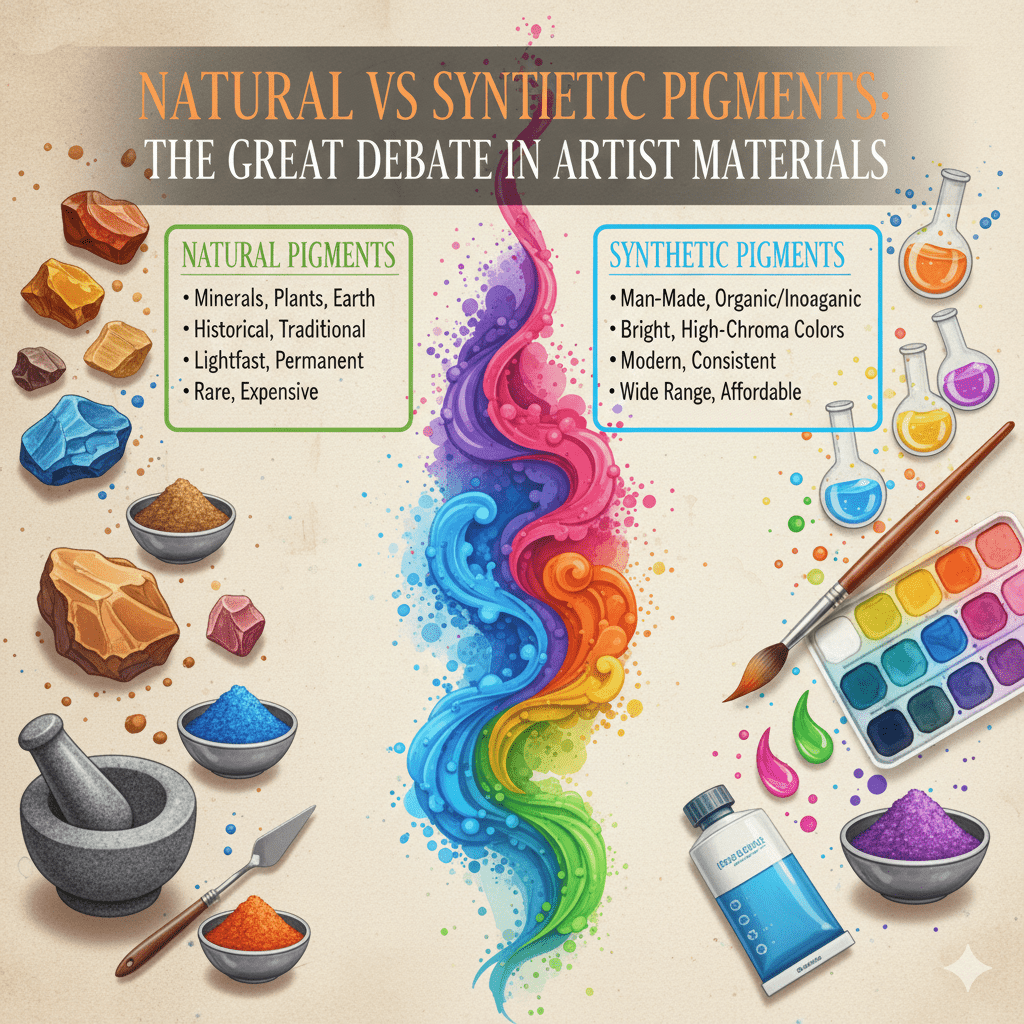
Natural vs Synthetic Pigments: The Great Debate in Artist Materials
The shelves of art supply stores present a seemingly simple array of colorful tubes and jars, but behind each product lies a fundamental choice: natural or synthetic pigments. This distinction goes far beyond mere origin stories—it encompasses questions of performance, safety, sustainability, cost, historical authenticity, and artistic philosophy. For centuries, artists had no choice but to use natural pigments ground from minerals, plants, and animals. The advent of synthetic pigments in the 18th and 19th centuries revolutionized artistic practice, but also sparked debates that continue today. Understanding both types empowers artists to make informed decisions aligned with their values and creative needs.
Defining Natural and Synthetic Pigments
Natural pigments are derived directly from the earth and living organisms with minimal chemical processing. Earth pigments like ochres, siennas, and umbers come from colored clays and mineral deposits containing iron oxides, manganese, and other naturally occurring compounds. Mineral pigments are ground from rocks and gemstones—lapis lazuli for ultramarine, malachite for green, azurite for blue. Historical organic pigments came from plants (madder root, indigo), animals (cochineal insects, cuttlefish ink), and even stranger sources like Indian yellow from cattle urine.
Synthetic pigments are manufactured through chemical processes, creating compounds that may or may not exist in nature. Some synthetics replicate natural pigments’ chemistry at lower cost—synthetic ultramarine matches natural lapis lazuli’s chemical structure. Others represent entirely new molecules impossible to find in nature, like phthalocyanine blues and greens or quinacridone reds and violets. The line sometimes blurs: are calcined (heat-treated) earth pigments still “natural”? Is synthetic iron oxide fundamentally different from mineral iron oxide? These questions reveal the complexity beneath simple categorizations.
The Case for Natural Pigments
Natural pigments connect artists to ancient traditions stretching back to prehistoric cave painters. Using the same ochres and earth colors employed for 40,000 years creates tangible links to artistic heritage. For artists interested in historical techniques—egg tempera icon painting, fresco, traditional watercolor—authentic natural pigments offer period accuracy impossible to achieve with modern synthetics.
The environmental argument for natural pigments appeals to sustainability-minded artists. Earth pigments require minimal processing: extraction, washing, grinding, and drying. No complex chemical synthesis, no petroleum feedstocks, no toxic byproducts requiring special disposal. When sourced responsibly, earth pigments represent genuinely renewable resources. Small-scale pigment makers harvest ochres from local deposits, creating regionally distinctive colors while supporting traditional practices and local economies.
Natural earth pigments offer unmatched permanence for certain colors. Yellow ochre, red ochre, raw and burnt sienna, raw and burnt umber, and similar earth colors have proven their lightfastness and stability over millennia. Cave paintings retain their color after tens of thousands of years. Renaissance frescoes still glow with earth-toned vitality. This tested longevity surpasses laboratory accelerated aging tests for synthetic pigments with mere decades of real-world exposure.
The subtle, complex character of natural pigments attracts many artists. Earth colors contain multiple mineral components creating nuanced, slightly textured colors that avoid synthetic flatness. Natural ultramarine’s subtle violet undertone and granulating texture differ from synthetic ultramarine’s smoother character. These variations—once limitations—now represent desirable qualities distinguishing handmade from industrial materials.
For certain applications, natural pigments remain unmatched. Fresco painting traditionally uses only lime-proof earth and mineral pigments that bond chemically with wet plaster. Icon painters seeking authentic Byzantine techniques require natural pigments prepared according to historical methods. These specialized uses keep traditional pigment makers in business and ancient knowledge alive.
The Limitations of Natural Pigments
Despite their appeal, natural pigments present significant challenges. Availability and consistency vary considerably. Natural ultramarine from lapis lazuli costs hundreds of dollars for tiny amounts—genuine lapis suitable for pigment grows rarer as Afghan mines deplete. Even earth pigments vary between deposits and within single sources, making consistent color matching difficult for artists requiring uniformity.
Many historical natural pigments are highly toxic or environmentally destructive. Orpiment and realgar, stunning yellow and orange arsenic sulfides, can release deadly arsenic compounds. Vermilion contains mercury. Lead white, despite its beautiful handling properties, causes severe poisoning. Extracting cinnabar for vermilion devastated mercury mining regions. While these pigments are “natural,” they’re hardly safe or sustainable.
The limited color range of truly permanent natural pigments restricts palettes significantly. Ancient artists lacked bright, permanent yellows beyond ochres, clear magentas, intense violets, or clean, bright greens. The reason ultramarine was so precious wasn’t just its beauty but its rarity—few natural sources provided intense, permanent blues. Natural pigments typically offer excellent earth tones, acceptable reds and blues, but poor yellows, greens, violets, and oranges, with many options being fugitive (prone to fading).
Performance issues plague many natural organic pigments. Madder lake, buckthorn berries, and sap green fade rapidly in light. Natural indigo requires complex preparation and behaves differently from modern pigments. Dragon’s blood resin and gamboge, while creating gorgeous colors, lack permanence for serious artwork. These limitations explain why artists enthusiastically adopted synthetic alternatives when they became available.
Cost prohibits natural pigments for many artists. Beyond ultramarine’s astronomical price, even earth pigments from specialty producers cost considerably more than synthetic equivalents. Hand-harvested, artisanally prepared pigments support traditional practices but price out students, emerging artists, and those working on large scales.
The Case for Synthetic Pigments
Synthetic pigments democratized color, making brilliant, permanent hues available to all artists regardless of wealth. The 1826 synthesis of ultramarine blue transformed painting by providing affordable access to a color previously reserved for the most important commissions. Cadmium yellows, oranges, and reds—introduced in the early 20th century—gave artists warm, opaque brilliance impossible to achieve with natural pigments. Modern quinacridones, phthalocyanines, and other organic synthetics expanded the palette to include colors never seen in nature.
Consistency represents a major advantage of manufactured pigments. Each batch of cadmium red medium from a reputable manufacturer matches previous batches within tight tolerances. Artists can confidently specify colors knowing they’ll receive identical material for years or decades. This standardization enables reproducible results and simplifies color matching across works or series.
Performance characteristics of modern synthetics often surpass natural equivalents. Phthalocyanine blue and green offer extraordinary tinting strength—a tiny amount colors large volumes—with perfect lightfastness and chemical stability. Quinacridone pigments provide transparent, vibrant reds and violets with none of madder’s fugitivity. Titanium white delivers covering power and brightness impossible with natural alternatives. These performance advantages aren’t mere conveniences but fundamental capabilities enabling techniques and effects impossible with historical palettes.
The safety profile of many synthetics represents genuine progress. Modern azo yellows replace toxic chrome and lead yellows without performance sacrifice. Pyrrole reds substitute for mercury-laden vermilion. While not all synthetics are safe—cadmiums and cobalts require careful handling—chemical synthesis allows designing pigments with specific properties including reduced toxicity. As understanding of health hazards grows, manufacturers reformulate products using safer alternatives.
Cost-effectiveness makes synthetic pigments accessible to artists at all levels. Students can afford full palettes of permanent, high-quality colors. Muralists can cover large surfaces without financial ruin. The economy of synthetic production doesn’t necessarily indicate inferior quality—it reflects industrial efficiency and economies of scale.
Modern synthetic pigments undergo rigorous testing unavailable for historical materials. Lightfastness ratings, chemical stability data, and compatibility information help artists make informed choices. While thousand-year-old frescoes prove natural ochres’ permanence, accelerated aging tests confirm that quality synthetic pigments will last centuries under proper conditions. This scientific validation provides confidence about archival quality.
The Limitations of Synthetic Pigments
Environmental concerns about synthetic pigment production are substantial and growing. Manufacturing requires significant energy, often from fossil fuels. Many organic synthetics derive from petroleum. Chemical synthesis creates waste streams requiring treatment and disposal. Heavy metal pigments like cadmiums and cobalts raise concerns about mining impacts and eventual disposal of paint waste. While earth pigment extraction also affects landscapes, the scale and nature of industrial chemical production presents different challenges.
Toxicity issues affect certain synthetic pigments despite overall safety improvements. Cadmium pigments, widely considered essential for certain colors, contain a toxic heavy metal linked to kidney damage and cancer. Proper handling minimizes risks, but concerns persist, especially regarding environmental accumulation. Cobalt pigments present similar issues. Some modern organic synthetics, while less acutely toxic, lack long-term health and environmental impact data. The “unknown unknowns” of newly developed chemicals worry some artists and environmentalists.
The overwhelming variety of synthetic pigments paradoxically complicates choices. Manufacturers offer dozens of yellows, blues, and reds with subtle distinctions and varying quality. Marketing terms like “hue” indicate synthetic substitutes formulated to approximate other colors, sometimes poorly. Navigating this abundance requires expertise many artists lack, potentially leading to poor choices like fugitive pigments marketed as permanent or unnecessarily expensive specialty colors.
Loss of traditional knowledge accompanies reliance on industrial pigments. As fewer artists prepare pigments from raw materials, understanding of these fundamental skills diminishes. The sensory experience of grinding pigments, understanding their textures and behaviors, and developing intimate material knowledge becomes rare. While this specialization allows artists to focus on creating rather than materials preparation, something valuable disappears when ancient crafts fade.
Some artists find synthetic pigments lack natural pigments’ subtle complexity. Machine-ground synthetic ultramarine, while chemically identical to natural, may exhibit different texture and granulation. Earth pigments’ slight variations and impurities create visual richness some find absent in precisely formulated synthetics. Whether this represents genuine difference or romanticization remains debated, but perception matters in subjective domains like art.
Cultural and philosophical objections arise for artists committed to traditional practices, natural materials, or opposition to industrial production. Using synthetic pigments feels wrong to those viewing art as communion with natural materials or continuation of pre-industrial traditions. These concerns, while perhaps not practical, reflect legitimate values about what art-making should be and represent.
Comparative Performance: Specific Colors
Examining specific colors reveals where each type excels. For earth tones, natural pigments generally equal or exceed synthetics. Natural yellow ochre, siennas, and umbers offer permanence, subtle complexity, and proven longevity matching synthetic iron oxides while often exhibiting more interesting texture. Synthetic Mars colors (Mars yellow, Mars orange, Mars red, Mars violet) provide consistent, economical alternatives with good performance but arguably less character.
In blues, synthetic ultramarine perfectly replicates natural lapis at a fraction of the cost with identical permanence and similar behavior, making it arguably the most successful synthetic substitute ever created. Phthalocyanine blues offer colors impossible from natural sources—intense, clean, extraordinarily strong—representing synthetic pigments at their best. Prussian blue, while historically significant, is less stable than modern phthalos. Natural azurite’s granulation and unique color are beautiful but the pigment is expensive, toxic, and less permanent than modern blues.
For reds, the comparison is complex. Cadmium reds provide warm, opaque brilliance no natural pigment matches, though toxicity concerns are real. Quinacridone reds offer transparent, permanent alternatives to fugitive madder lake, vastly superior in lightfastness. Natural red ochres remain excellent for earth reds but can’t match cadmium’s intensity. The verdict: modern synthetics decisively win for bright, permanent reds.
Yellows strongly favor synthetics. Natural permanent yellows are limited to ochres—beautiful but muted. Historical bright yellows (orpiment, chrome yellow, Naples yellow) are toxic. Indian yellow was made through animal cruelty and is fugitive. Modern cadmium yellows, despite toxicity concerns, provide unmatched warm, opaque brilliance. Azo yellows like Hansa offer permanent, bright, economical alternatives. For yellows, synthetics represent almost pure advantage.
Greens historically came from toxic minerals (verdigris, emerald green) or were simply mixed from blues and yellows. Viridian, a 19th-century synthetic, provides permanent, transparent blue-green impossible to achieve naturally. Phthalocyanine greens offer intense color with incredible tinting strength. Natural malachite is expensive and less permanent. Synthetics win decisively.
Violets and purples barely existed in permanent natural pigments. Synthetic dioxazine violet, cobalt violet, and quinacridone violets provide colors largely absent from historical palettes, dramatically expanding artistic possibilities. This represents synthetics enabling rather than replacing.
Whites present interesting comparison. Titanium white’s opacity and brightness surpass natural alternatives, representing synthetic advantage. However, lead white’s handling properties and flexibility keep it in production despite toxicity, suggesting natural pigments can remain superior for specific qualities even when synthetics excel in other measures.
Best Practices: Choosing Between Natural and Synthetic
Rather than declaring one type universally superior, practical artists evaluate pigments individually based on specific needs. The following framework helps navigate choices:
Prioritize performance and permanence. Regardless of origin, choose pigments rated lightfast (ASTM I or II), suitable for your medium, and proven stable. A permanent synthetic outperforms a fugitive natural pigment every time. Both natural ochres and synthetic phthalos can be excellent if they meet performance criteria.
Consider safety for your situation. Artists with health vulnerabilities, those working in home studios without proper ventilation, or those concerned about environmental exposure might avoid toxic pigments whether natural (lead, arsenic) or synthetic (cadmium). Others with proper facilities and precautions may accept these risks for performance benefits.
Match pigments to purpose. Historical reproduction work requires period-appropriate natural pigments. Contemporary experimental work might embrace the brightest synthetics. Murals and student work benefit from economical synthetics. Small-scale, artisanal work might justify expensive natural pigments.
Evaluate environmental impact holistically. Local earth pigments minimally processed may have lower environmental footprint than synthetics, but toxic natural pigments like cinnabar are environmental disasters. Some synthetics use less material and energy than extracting and transporting natural equivalents. Consider the complete lifecycle, not just the “natural” label.
Don’t assume natural equals safe or synthetic equals dangerous. Arsenic is natural. Many modern organic pigments are far safer than historical natural pigments. Evaluate specific pigments’ safety profiles, not categories.
Quality matters more than category. Poorly processed natural pigments perform badly; cheap synthetic pigments may be fugitive or adulterated. High-quality pigments of either type from reputable suppliers generally outperform low-quality alternatives regardless of origin.
Consider combining both types. Many professional palettes mix natural earth tones with synthetic blues, reds, and yellows, exploiting each type’s strengths. This pragmatic approach prioritizes results over ideology.
The Future: Convergence and Innovation
The boundary between natural and synthetic continues blurring. Biotechnology enables microorganisms to produce traditional organic pigments sustainably—”natural” pigments from fermentation rather than plants or animals. Are these natural or synthetic? Nanotechnology allows precise control of mineral pigment properties, enhancing natural materials through high-tech processing. Synthetic biology might create entirely new pigment-producing pathways in engineered organisms.
Environmental pressure drives development of truly sustainable synthetics: replacing petroleum feedstocks with plant-based alternatives, reducing manufacturing energy through better chemistry, and designing pigments that safely degrade rather than accumulate in ecosystems. Meanwhile, renewed interest in traditional techniques sustains artisanal natural pigment production, preserving knowledge while supplying niche markets.
The future likely holds not triumph of one category but increasingly sophisticated understanding of specific pigments’ properties, impacts, and appropriate applications. As analytical techniques improve, we better understand why certain pigments perform as they do, enabling targeted improvements whether through refined natural processing or designed synthetic molecules.
Conclusion: Beyond Binary Thinking
The question “which is better, natural or synthetic pigments?” has no single answer because it asks the wrong question. Both categories contain excellent, mediocre, and poor options. Natural earth pigments offer permanence, tradition, and sustainability for certain colors. Synthetic phthalocyanines and quinacridones provide intense, permanent hues impossible from natural sources. Toxic natural arsenic compounds and toxic synthetic cadmiums both require careful handling. Cheap, fugitive pigments of either type waste artists’ time and compromise archival quality.
The best approach evaluates each pigment individually: Is it permanent? Safe to handle? Appropriate for the intended medium and application? Environmentally acceptable? Available at reasonable cost? Consistent in quality? These practical questions matter more than romantic notions about “natural” purity or faith in “scientific progress.”
Ultimately, artists serve their work by understanding materials deeply—knowing not just that a color is blue, but which blue, from what source, with what properties and limitations. Whether grinding earth pigments collected from local cliffs or squeezing the latest synthetic from industrial laboratories, the goal remains the same: creating enduring art that expresses vision while respecting materials, health, and environment. Both natural and synthetic pigments offer paths toward this goal, and wise artists walk both paths selectively, choosing each step based on where they want to go rather than ideology about how they should travel.