Natural Canvas vs. Synthetic Canvas: A Comprehensive Analysis
Introduction
Canvas has served as one of the most enduring and versatile materials in both artistic and practical applications for centuries. Traditionally made from natural fibers such as cotton or linen, canvas has long been prized for its durability, texture, and receptiveness to various media. However, the twentieth and twenty-first centuries have witnessed the emergence of synthetic alternatives, primarily composed of polyester and other petroleum-based polymers. This article examines the comparative advantages and disadvantages of natural and synthetic canvas across multiple dimensions, including material properties, environmental considerations, economic factors, and suitability for specific applications.
Material Composition and Properties
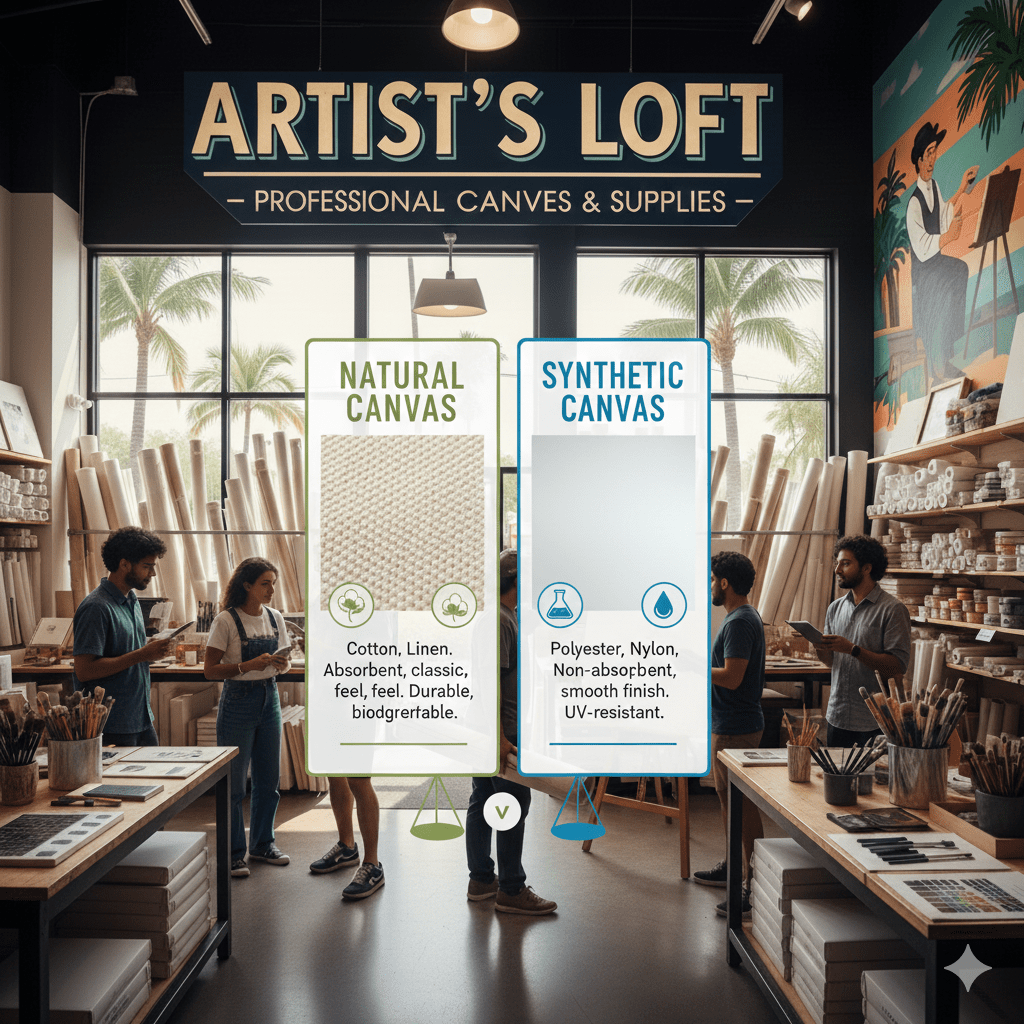
Natural canvas derives primarily from two sources: cotton and linen. Cotton canvas, obtained from the cotton plant’s seed fibers, offers a softer, more flexible surface with moderate strength. Linen canvas, produced from flax plant fibers, provides superior tensile strength and a distinctive texture characterized by irregular weave patterns that many artists find aesthetically appealing. Both materials consist of cellulose-based natural polymers that exhibit hygroscopic properties, meaning they absorb and release moisture in response to environmental conditions.
Synthetic canvas, conversely, is manufactured predominantly from polyester fibers—long-chain polymers derived from petrochemical sources. These materials can be engineered to specific tolerances, allowing manufacturers to control thread thickness, weave density, and surface characteristics with precision. Polyester canvas exhibits hydrophobic properties, resisting water absorption while maintaining dimensional stability across varying humidity levels.
The structural differences between these materials manifest in several observable characteristics. Natural fibers possess inherent irregularities that contribute to their unique aesthetic qualities but also introduce variability in strength and behavior. Synthetic fibers can be produced with uniform properties, yielding consistent performance but sometimes lacking the organic character valued in traditional applications.
Advantages of Natural Canvas
Aesthetic and Traditional Qualities
Natural canvas offers distinctive aesthetic properties that remain difficult to replicate synthetically. Linen canvas, in particular, displays an irregular weave pattern resulting from the variable thickness of flax fibers. This irregularity creates a textured surface that many artists consider essential to traditional painting techniques. The slight variations in the weave contribute to the visual depth and character of finished works, qualities particularly valued in fine art contexts.
The historical precedent for natural canvas cannot be understated. Masters from Titian to Rembrandt to contemporary artists have worked on linen or cotton supports, creating an unbroken tradition spanning centuries. For conservation purposes, the use of materials consistent with historical practices facilitates restoration and ensures compatibility with established conservation methodologies.
Paint Adhesion and Absorbency
Natural fibers exhibit superior initial absorbency compared to synthetic alternatives, a property particularly relevant when applying sizing and ground layers. The cellulose structure of cotton and linen readily accepts aqueous sizing solutions, creating a mechanical bond as the sizing penetrates the fiber structure. This absorption facilitates strong adhesion between the canvas support, ground layer, and paint film—a critical consideration for the long-term structural integrity of paintings.
The slightly rougher surface texture of natural canvas, especially linen, provides additional mechanical grip for paint layers. This texture allows artists to achieve certain effects, particularly in alla prima painting techniques, that prove more challenging on the smoother surface typical of many synthetic alternatives.
Breathability and Environmental Response
Natural canvas breathes, allowing air and moisture vapor to pass through the material. While this hygroscopic behavior introduces certain conservation challenges, it also prevents the accumulation of moisture behind the paint film, which could lead to delamination or mold growth in certain conditions. The material’s ability to expand and contract with environmental changes, though sometimes problematic, represents a natural adaptation that has proven viable over centuries of use.
Disadvantages of Natural Canvas
Dimensional Instability
The primary technical limitation of natural canvas stems from its hygroscopic nature. Cotton and linen fibers absorb atmospheric moisture, causing them to swell, then release moisture and contract as relative humidity fluctuates. This cyclic expansion and contraction subjects the paint film to mechanical stress, potentially leading to cracking, particularly in oil paintings where the paint layer is relatively inflexible.
This dimensional instability poses significant challenges for conservation. Paintings on natural canvas require careful environmental control to minimize fluctuations in temperature and relative humidity. Even with optimal storage conditions, the inherent responsiveness of natural fibers to atmospheric moisture creates ongoing mechanical stresses that synthetic alternatives largely avoid.
Susceptibility to Biological Degradation
Cellulose-based natural fibers serve as nutrient sources for various microorganisms, including fungi and bacteria. In conditions of elevated humidity or inadequate ventilation, natural canvas becomes vulnerable to mold growth, which can cause discoloration, weakening of fibers, and irreversible damage to both support and paint layers. Additionally, insects such as silverfish may feed on natural canvas, particularly if sizing contains protein-based materials like animal glue.
This biological vulnerability necessitates additional protective measures, including the use of biocides in sizing formulations and careful environmental monitoring. Even with these precautions, natural canvas remains fundamentally more vulnerable to biological attack than synthetic alternatives.
Cost Considerations
High-quality linen canvas commands premium prices, reflecting both the agricultural requirements for flax cultivation and the labor-intensive processing required to transform flax stems into textile fibers. While cotton canvas proves more economical, both natural options generally cost more than synthetic alternatives of comparable size and weight. For artists, students, or commercial applications requiring large quantities of canvas, this cost differential can prove significant.
Variability and Quality Control
Natural fibers exhibit inherent variability in their properties. Flax and cotton crops vary in quality depending on growing conditions, harvesting practices, and processing methods. This variability extends to the finished canvas, where fiber quality, weave consistency, and surface characteristics may differ between production runs or manufacturers. While experienced users learn to accommodate these variations, they introduce unpredictability that may prove problematic in applications requiring consistent, standardized materials.
Advantages of Synthetic Canvas
Dimensional Stability
The foremost technical advantage of synthetic canvas lies in its dimensional stability. Polyester fibers exhibit minimal hygroscopic behavior, neither absorbing significant atmospheric moisture nor expanding and contracting with humidity fluctuations. This stability protects the paint film from the mechanical stresses associated with substrate movement, potentially reducing cracking and other forms of mechanical damage over time.
For paintings subject to variable environmental conditions, particularly those in uncontrolled spaces or transit between locations with different climates, synthetic canvas offers substantial protective benefits. The material maintains consistent tension on its stretcher bars regardless of humidity levels, eliminating the need for periodic adjustments to maintain proper tautness.
Resistance to Biological Degradation
Synthetic fibers resist biological degradation effectively. Polyester does not serve as a nutrient source for microorganisms, rendering it essentially immune to mold, mildew, and insect damage under normal conditions. This resistance simplifies storage requirements and reduces the need for biocidal treatments, offering particular advantages in humid climates or situations where environmental control proves difficult.
The biological stability of synthetic canvas extends its potential useful life considerably, particularly in challenging environmental conditions. While this does not guarantee permanence—synthetic materials face their own degradation mechanisms—it eliminates one major category of deterioration that affects natural materials.
Cost Effectiveness and Availability
Synthetic canvas generally costs less than natural alternatives, particularly when compared to linen. The industrial production of polyester fibers allows for economies of scale that reduce material costs significantly. Additionally, synthetic canvas can be manufactured in large, continuous rolls with uniform properties, simplifying inventory management and reducing waste.
This cost advantage makes synthetic canvas attractive for students, emerging artists, commercial applications, and any situation where budget constraints limit material choices. The lower cost also reduces the psychological barrier to experimentation, potentially encouraging more adventurous creative exploration.
Uniformity and Predictability
Manufacturing processes for synthetic canvas allow precise control over fiber dimensions, weave density, and surface characteristics. This engineering capability produces materials with highly consistent properties, both within individual pieces and across production runs. Users can rely on predictable behavior in terms of stretch, strength, and surface texture, facilitating standardization in commercial or educational settings.
The uniform weave of synthetic canvas creates a smooth, regular surface that some artists prefer, particularly for photorealistic techniques or applications where the texture of the support should remain visually neutral. Digital printing on canvas, increasingly common in both fine art reproduction and commercial signage, often benefits from the uniform surface of synthetic materials.
Strength and Durability
Synthetic fibers typically exhibit higher tensile strength than natural alternatives of equivalent weight. Polyester resists tearing, puncturing, and abrasion effectively, offering advantages in applications where physical durability takes priority. This strength proves particularly valuable in outdoor applications, such as banners or architectural textiles, where materials face wind loading, weather exposure, and potential physical impact.
Disadvantages of Synthetic Canvas
Reduced Paint Adhesion
The hydrophobic nature of polyester creates challenges for paint adhesion. Unlike natural fibers that readily absorb sizing and provide mechanical grip through their irregular surface structure, synthetic materials present a relatively smooth, non-absorbent surface. While manufacturers address this through surface treatments and specialized primers, achieving optimal adhesion on synthetic supports requires more careful surface preparation than natural canvas typically demands.
Some artists report that certain painting techniques, particularly those involving lean initial layers or highly diluted paint, behave differently on synthetic supports. The reduced absorbency can cause paint to remain mobile longer, affecting working properties and potentially requiring adjustments to established techniques.
Environmental and Sustainability Concerns
Synthetic canvas derives from petroleum-based resources, contributing to dependence on fossil fuels and the associated environmental impacts of extraction, refining, and manufacturing. The production of polyester generates greenhouse gas emissions and consumes non-renewable resources, raising sustainability concerns increasingly relevant to both individual artists and institutions.
Unlike natural fibers that biodegrade over time, polyester persists in the environment for extended periods. While this durability proves advantageous during the useful life of the material, it creates end-of-life disposal challenges. Synthetic canvas cannot be composted and contributes to accumulating plastic waste unless specifically recycled—a process that requires dedicated facilities and economic incentives often lacking in practice.
Lack of Traditional Aesthetic Qualities
Many artists and connoisseurs value the distinctive visual and tactile qualities of natural canvas, particularly linen. The regular, uniform weave of synthetic alternatives, while advantageous for certain applications, lacks the organic character and textural variation of natural materials. This difference may prove aesthetically significant, particularly in traditional fine art contexts where the choice of support carries both practical and symbolic weight.
The absence of historical precedent for synthetic materials raises questions about their suitability for works intended to participate in established artistic traditions. While this concern may seem conservative, the continuity of materials and techniques represents a meaningful consideration for many practitioners and institutions.
Uncertain Long-Term Behavior
Natural canvas benefits from centuries of documented use, providing extensive empirical evidence regarding its behavior, aging characteristics, and appropriate conservation approaches. Synthetic alternatives lack this historical perspective. While accelerated aging studies suggest polyester canvas exhibits good long-term stability, the relatively brief period of actual use limits certainty regarding behavior over centuries.
Synthetic materials may face degradation mechanisms—such as photodegradation from ultraviolet exposure or gradual chain scission in polymer structures—that only manifest over extended timeframes. Until works on synthetic supports have survived for periods comparable to those documented for natural canvas, questions about their true permanence remain partially unanswered.
Heat Sensitivity
Polyester exhibits lower heat resistance than natural fibers. While this rarely presents problems under normal conditions, synthetic canvas can be damaged by excessive heat during mounting, framing, or certain conservation procedures. The material may melt, deform, or lose tension if exposed to temperatures that natural canvas would tolerate safely, requiring additional caution in handling and processing.
Application-Specific Considerations
The choice between natural and synthetic canvas often depends heavily on specific application requirements. In fine art painting, particularly where historical techniques and aesthetic traditions remain paramount, natural canvas—especially linen—continues to dominate. The material’s established performance, traditional aesthetic qualities, and compatibility with centuries of accumulated knowledge support its ongoing use despite technical limitations.
Conversely, commercial applications, outdoor installations, and situations requiring maximum dimensional stability often favor synthetic alternatives. Digital printing, in particular, benefits from the uniform surface and dimensional stability of polyester canvas. Applications where biological resistance, water resistance, or physical durability take priority similarly point toward synthetic materials.
Educational settings face competing considerations. The lower cost of synthetic canvas appeals to institutions operating under budget constraints, while the goal of teaching traditional techniques argues for natural materials. Many programs employ both, introducing students to synthetic canvas for practice and experimentation while reserving natural canvas for more advanced work.
Conservation contexts demand particularly careful consideration. For restoration of historical works, matching original materials proves essential, necessitating natural canvas for relining or repair. For new works intended for museum collections, curators increasingly engage in dialogue with artists regarding material choices, weighing the technical advantages of synthetics against traditional preferences and established conservation methodologies.
Final
The comparison between natural and synthetic canvas reveals no universally superior option but rather materials suited to different priorities and contexts. Natural canvas offers aesthetic qualities, traditional authenticity, superior initial absorbency, and the reassurance of centuries of documented use. These advantages come at the cost of dimensional instability, biological vulnerability, higher prices, and inherent variability.
Synthetic canvas provides dimensional stability, biological resistance, cost effectiveness, uniformity, and superior physical strength. These technical advantages are offset by reduced paint adhesion, environmental sustainability concerns, lack of traditional aesthetic character, uncertain long-term behavior, and heat sensitivity.
Informed material selection requires careful consideration of specific requirements, priorities, and constraints. Artists working within traditional media and seeking connection to historical practice will likely continue favoring natural canvas, particularly linen. Those prioritizing technical performance, environmental stability, or cost effectiveness may find synthetic alternatives more suitable. Commercial applications, digital printing, and outdoor installations frequently benefit from the specific properties of synthetic materials.
As both materials continue to evolve—with improvements in synthetic surface treatments and efforts to develop more sustainable synthetic alternatives—the landscape of available options will expand further. The ongoing dialogue between tradition and innovation, between aesthetic preference and technical optimization, ensures that the choice between natural and synthetic canvas will remain nuanced, context-dependent, and worthy of careful consideration by all who work with these foundational materials.