Material Logic: A Review of Jason Galbut’s Ivy
By Anna Vickers
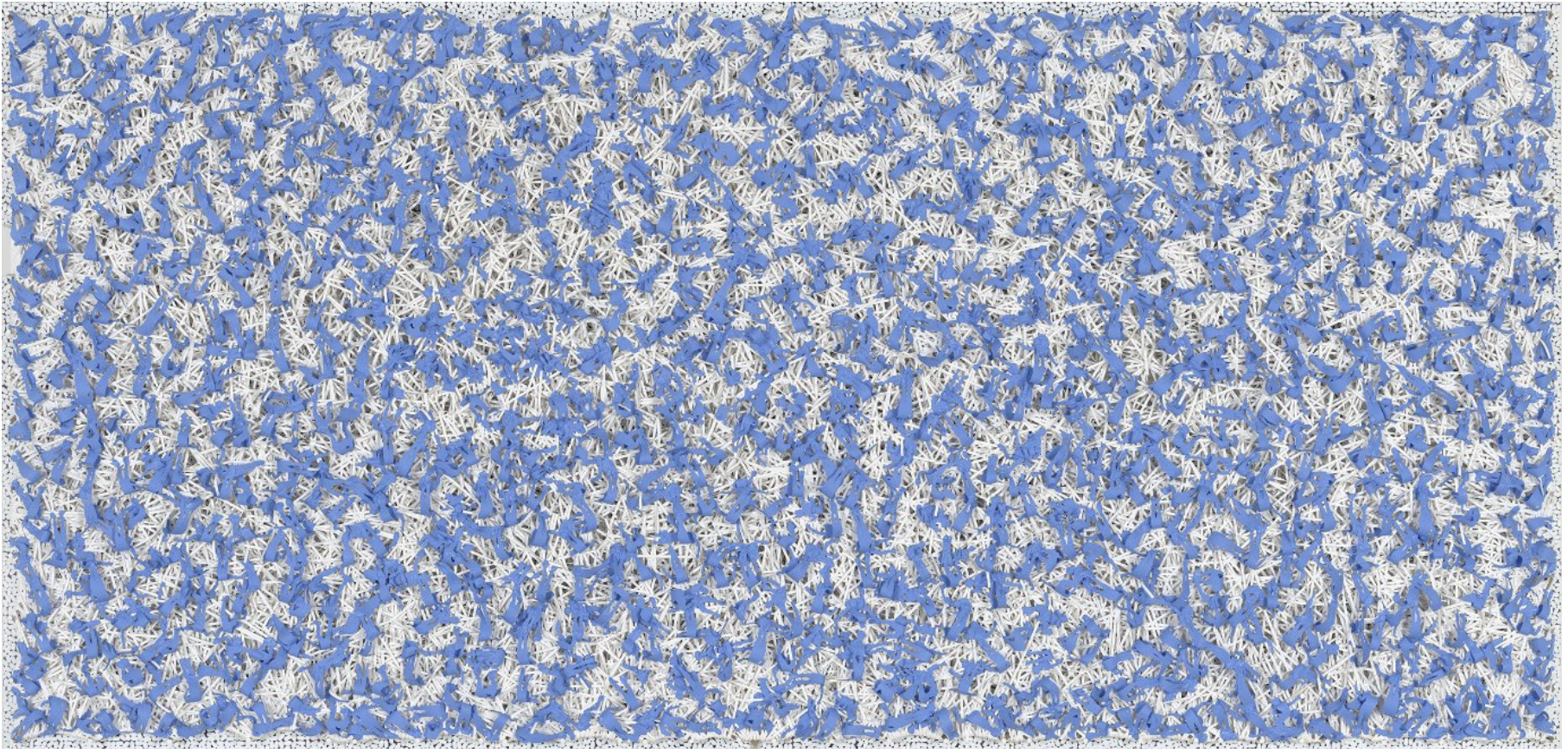
Jason Galbut’s large-scale works approach painting through a materially grounded yet seemingly incoherent logic. His practice registers both painting’s past and present, constructing surfaces through deliberate, methodical processes while navigating a maze of contradictions and uncertainties.
Tension Between Structure and Perception
Across the four works presented in the exhibition, Galbut establishes a dynamic tension between material rigor and perceptual ambiguity. Intricate surfaces—resolute in their deployment—conceal earlier decisions that remain partially visible. This layering reflects what might be called decisive uncertainty: a condition mirrored in procedural contradictions such as order and cacophony, precision and excess, vast scale and detailed gesture.
Through this push and pull between methodical construction and disjunctive process, the works resist linear engagement. They are not paintings to be “read” sequentially, but to be experienced as fields of accumulated decisions.
Procedure vs. Lived Experience
Galbut’s paintings unfold through deliberative procedure and embodied perception, holding structural clarity in tension with Maurice Merleau-Ponty’s assertion: “The world is not what I think, but what I live through.”
In Galbut’s work, procedure does not resolve into lived experience, nor does embodiment resolve into structure. Instead, each complicates the other. Confident procedural action, sustained labor, and elaborate construction anchor the work physically, yet the perceptual field remains indeterminate. The paintings are stable objects that resist stable meaning.
“Painting Beside Itself”
David Joselit’s concept of “painting beside itself”—where meaning unfolds through networks extending beyond the canvas—is folded back into the picture plane in Ivy. Rather than projecting outward into social or institutional systems, Galbut internalizes these networks through material and structural interdependencies.
Multiple discrete components negotiate with one another to form a unified structure, signaling a drive toward cohesion. Yet while Galbut’s procedures physically reinforce the work’s fractured fragility, its internal networks invite engagement without demanding full deciphering.
Ivy raises epistemological questions not only through depiction, but through presence:
What is this? Why is it here? What is it doing?
Meaning emerges through accumulated material decisions—construction, revision, fastening, layering—rather than through symbolic narrative.
Couture, The Grid, and Material Rebellion
In works such as Parade, Season, and Medal, the body is implied precisely through its absence. These paintings become visually electrified costume dramas, with structure functioning like tailoring—shaping and containing expressive gestures radiating with color, texture, and materiality.
- Parade features brightly colored straps harnessed around a reflective platinum-leaf grid, evoking Alexander McQueen’s metallic couture. Here, the grid—once a reductive modernist device—becomes a site of affect and material rebellion.
- Season, composed of yellow, red, and orange painted straps intersected by diagonal 24-karat gold leaf, conjures opulence and theatrical transformation.
- Medal, with interlocking pink and blue straps laid over gold leaf, pushes couture into gilded excess.
Unlike early modernist grids that aimed for purity and self-reflexivity, Galbut re-coutures the grid as a tactile, emotional field. These strategies foreground the felt dimension of experience, emphasizing both the embodied impulse behind the work and the persistent gap between language and painting.
Knowledge Without Resolution
Galbut’s one-word titles project certainty and confidence—mirroring the boldness of his material processes. Yet despite meticulous construction, the paintings remain elusive.
T. S. Eliot’s question—“Where is the knowledge we have lost in information?”—echoes through these works. Their material logic accumulates without resolving, layering sense until synthesis becomes impossible. Knowledge does not arrive at clarity; it expands only to reveal its own limits.
Painting as Slow Presence
In an era defined by the erosion of physical contact, Galbut’s insistence on material engagement resonates deeply. The care and precision embedded in each work reflect a striving for resolution amid human turbulence.
Though demanding to make, these paintings do not demand from the viewer. They embody an understanding that painting is a slow medium—one that does not need to be fully understood to be fully experienced.
255 NE 69th Street Unit D
Miami, Florida 33138
+786-566-0542
[email protected]