
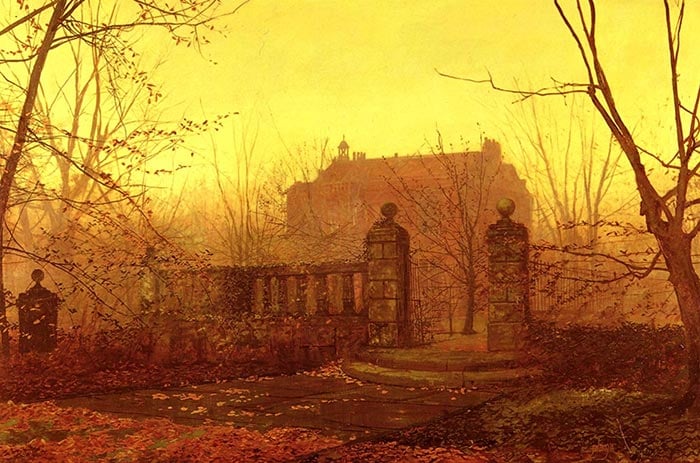
John Atkinson Grimshaw. He Fixed the Moon Forever
He did not just depict night — he elevated it.
He didn’t just paint the moon — he made it stay.
Born in 1836 in Leeds, England, John Atkinson Grimshaw was a self-taught painter who emerged as one of the most evocative visual poets of the Victorian era. While many of his contemporaries chased grand historical themes or bright pastoral scenes, Grimshaw turned his gaze toward the quiet majesty of moonlight, transforming city streets, fog-drenched harbors, and rainy avenues into luminous dreamscapes. His legacy? He didn’t just paint the moon — he fixed it forever in the cultural imagination.
A Self-Taught Master of Atmosphere
Grimshaw had no formal art education. Originally working as a clerk for the Great Northern Railway, he abandoned his job in the 1860s to pursue painting full-time — a bold leap into an uncertain world. But within a few years, his talent became undeniable. Drawing early inspiration from the Pre-Raphaelites, he shared their fascination with detail, precision, and rich atmosphere.
However, Grimshaw charted a path all his own. While the Pre-Raphaelites focused on medieval themes and floral symbolism, he brought their intense realism to Victorian city life, capturing the subtle magic of gaslight, moonshine, and mist on the everyday.
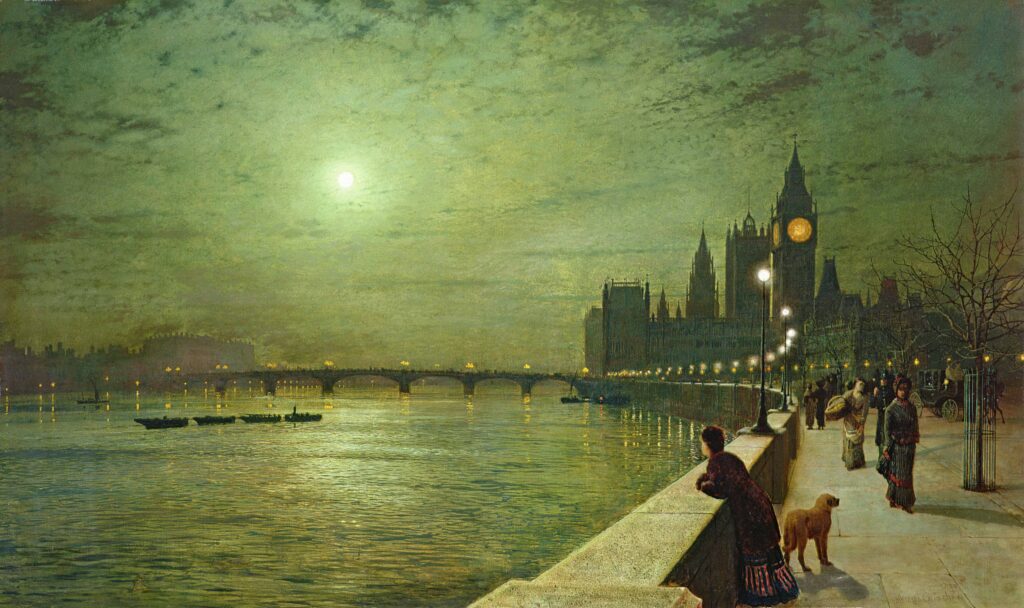
Painting Light, Fog, and Time Itself
Grimshaw’s work is instantly recognizable. He had an uncanny ability to paint humidity, reflections, and the invisible chill of fog. His scenes of cobbled streets slick with rain, ships at silent docks, and shopfronts glowing under gaslight evoke a haunting stillness — a kind of timeless suspension that feels more dream than document.
Working with painstaking technique — often believed to be assisted by camera obscura methods — he achieved a level of photorealism rare in his time. Yet there’s nothing clinical about his work. Each painting is imbued with emotion: nostalgia, melancholy, quiet wonder.
His moonlit urban scenes in places like Leeds, Liverpool, Glasgow, and London turned the industrial city into a thing of beauty. The grime and gloom of Victorian England became, under his brush, a theater of light and shadow.
A Singular Vision No One Could Imitate
Despite his success and growing popularity during his lifetime, Grimshaw was never fully embraced by the Royal Academy — likely due to his self-taught status and the unconventional subject matter of his work. But his collectors and admirers were unwavering, including artists like James McNeill Whistler, who once remarked: “I considered myself the inventor of nocturnes until I saw Grimshaw’s moonlit pictures.”
Grimshaw painted a world few others could see. And no one since has truly matched the precision, mood, and atmospheric mastery of his nocturnes.
The Enduring Glow
John Atkinson Grimshaw died in 1893, but his work continues to glow with life. His paintings feel both historical and eternal — windows into a Victorian world as intimate as it is spectral. Whether it’s a lone figure walking under gaslights or the hush of a harbor at night, Grimshaw painted silence, solitude, and the sublime beauty of darkness.