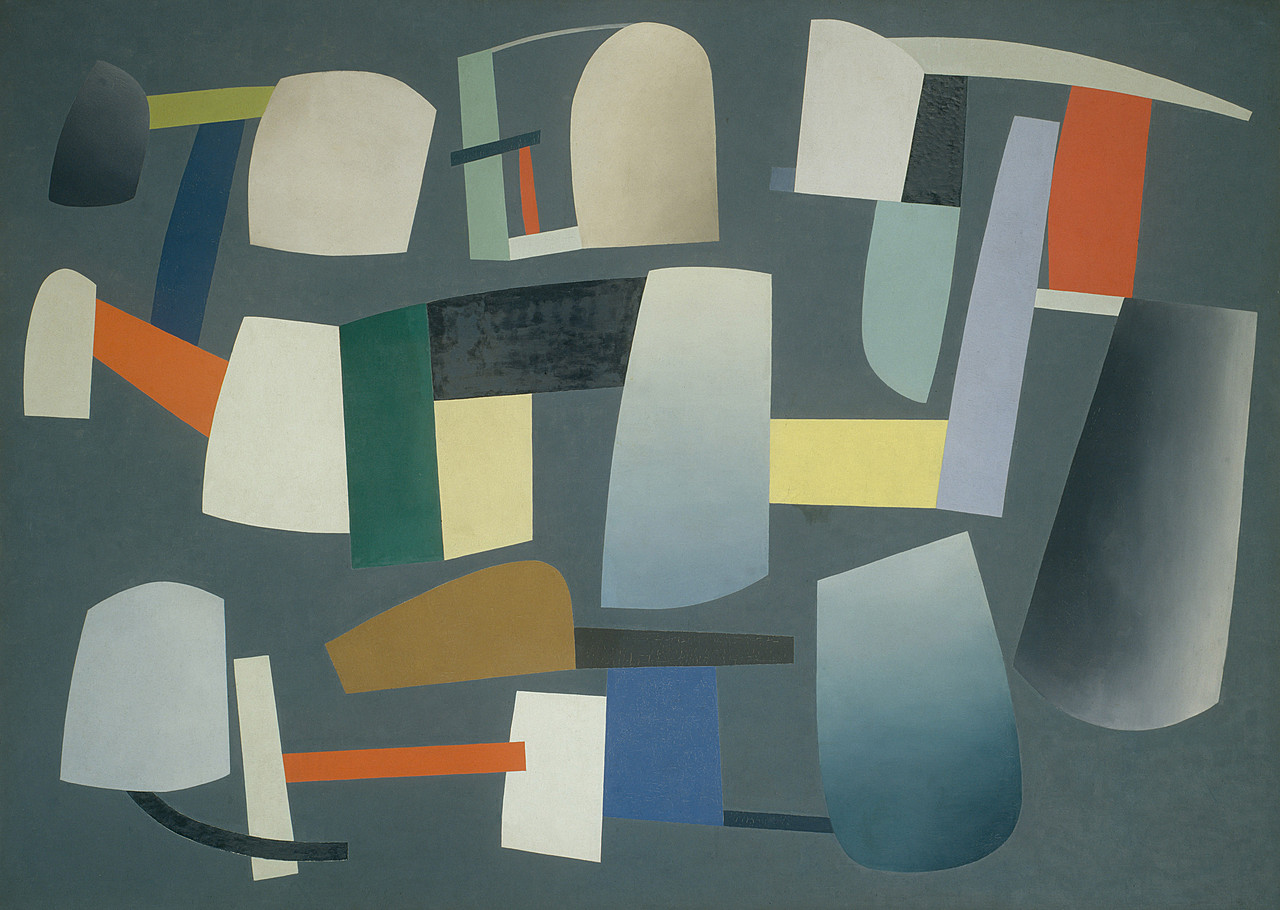
Jean Hélion was a pioneering figure in 20th-century modernism whose career encompassed radical abstraction and a profoundly personal return to figuration. Born in Couterne, Orne, in 1904, he initially pursued chemistry. However, he was soon drawn to art, captivated by the interplay of shape, color, and essence, and his early years in Paris immersed him in the avant-garde movements of the 1920s and 1930s, where he emerged as a leading voice in abstract painting. Alongside artists such as Piet Mondrian and Theo van Doesburg, he engaged with geometric abstraction, co-founding the influential group Abstraction-Création in 1931. His work from this period featured bold, dynamic compositions emphasizing structure, rhythm, and formal purity, placing him at the forefront of European modernism.
However, Hélion’s trajectory took a dramatic turn in the late 1930s when he began reintegrating figuration into his work, rejecting the strict non-representational approach that had defined his earlier years. This shift, considered controversial by his avant-garde peers, reflected his growing interest in the human condition and everyday life. His wartime experiences—including his capture and escape from a German prisoner-of-war camp during World War II—further deepened his commitment to depicting human figures, often rendered in exaggerated, almost surreal forms that echoed his abstract roots.
Hélion’s postwar paintings, infused with vibrant color and a sense of poetic realism, positioned him as a unique figure bridging abstraction and figuration. His ability to move fluidly between these modes reflected artistic rebellion and an evolving philosophy that embraced both the intellectual rigor of modernism and the visceral immediacy of lived experience. Beyond painting, he was an astute critic and writer, authoring several books examining art’s philosophical underpinnings and its role in society.
His legacy is one of duality and defiance. He was an artist who refused to be confined by a singular style. Whether through the rigorous structures of his early abstractions or the enigmatic figures of his later years, Hélion’s work remains a testament to the ever-shifting dialogue between form and meaning in modern art.