James Ensor: The Visionary Master of Masks and Modernity
In the shadowy attic studio above a seaside souvenir shop in Ostend, Belgium, James Sidney Edouard Ensor created some of the most provocative and influential artworks of the late 19th and early 20th centuries. Born on April 13, 1860, and living until November 19, 1949, this Belgian painter and printmaker would become a pivotal figure in the development of modern art, profoundly influencing movements from Expressionism to Surrealism with his grotesque fantasies, carnival masks, and biting social commentary.
Early Life and Artistic Formation
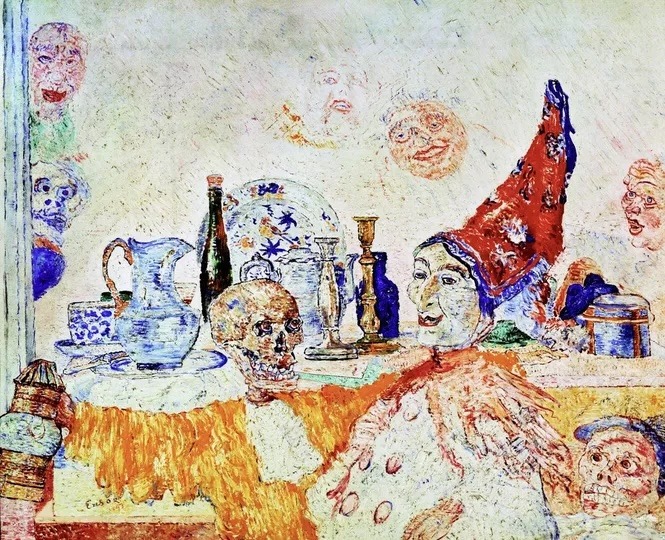
Ensor’s unconventional artistic vision was shaped by his unusual childhood environment. His father, James Frederic Ensor, was an Englishman born in Brussels who studied engineering, while his mother, Maria Catherina Haegheman, was Belgian. Together they operated a souvenir and curio shop in Ostend that sold carnival masks, shells, and other curiosities. These masks would become the defining motif of Ensor’s career, symbols he returned to repeatedly to explore themes of identity, hypocrisy, and the grotesque nature of human society.
A poor student with little interest in academic study, Ensor left school at fifteen to pursue artistic training with local painters. From 1877 to 1880, he attended the Académie Royale des Beaux-Arts in Brussels, where fellow student Fernand Khnopff was among his classmates. Upon his return to Ostend in 1879, Ensor established his studio in the attic of his parents’ home, where he would work from 1880 until 1917. Remarkably reclusive, he traveled little throughout his life—just three brief trips to France, two to the Netherlands in the 1880s, and a four-day journey to London in 1892.
Les XX and Early Rebellion
When the Brussels Salon rejected Ensor’s works in 1883, he joined a group of progressive Belgian artists known as Les Vingt (The Twenty) or Les XX. This avant-garde collective aimed to transform European art by promoting Post-Impressionism and Symbolism in Belgium. Ensor was instrumental in establishing the group, which sought to challenge the conservatism of official art establishments and introduce innovative artistic ideas throughout Europe.
During this period, Ensor began developing his signature style. Works like Scandalized Masks (1883) marked his shift toward depicting grotesque fantasy—skeletons, phantoms, and hideous masks that would become his trademark. Initially influenced by Rembrandt, Peter Paul Rubens, and the French Impressionists, Ensor quickly moved beyond these traditions to forge his own radical path.
The Revolutionary Years: 1888-1892
The four years between 1888 and 1892 represent the pinnacle of Ensor’s creative output and his most significant contribution to art history. In 1888 alone, he produced forty-five etchings alongside his most ambitious painting, Christ’s Entry Into Brussels in 1889 (also known as Entry of Christ into Brussels). This monumental work is now recognized as a forerunner of twentieth-century Expressionism.
The painting depicts a vast carnival mob advancing toward the viewer, their faces hidden behind grotesque masks. Within this teeming throng, Belgian politicians, historical figures, and members of Ensor’s own family can be identified. Nearly lost amid the chaos is Christ on his donkey—a figure with whom the atheist Ensor identified as a fellow victim of mockery and persecution. The work elaborated on themes he had explored in his 1885 drawing Les Aureoles du Christ, presenting religious imagery not as devotion but as personal commentary on the inhumanity of the world.
The painting’s chaotic imagery and garish colors provoked such indignation that Ensor was expelled from Les XX. Critics were scandalized by what they perceived as blasphemy and artistic madness. One contemporaneous etching, Le Pisseur (1887), shows Ensor’s sardonic response to such criticism: the artist depicted himself urinating on a graffitied wall declaring “Ensor est un fou” (“Ensor is a madman”).
During this intensely productive period, Ensor also created highly political etchings. Doctrinal Nourishment (1889) depicted key Belgian figures—bishops, the king, and others—defecating on the masses. Another 1889 etching, Belgium in the XIXth Century or King Dindon, showed King Leopold II watching as military figures violently suppressed protest. These works demonstrated Ensor’s willingness to use his art as a weapon of social criticism.
Printmaking and Technical Innovation
Ensor was not only a groundbreaking painter but also an accomplished and prolific printmaker. Over his career, he created 133 etchings and drypoints, with 86 of them produced between 1886 and 1891 during his most creative period. He recognized the importance of printmaking to his artistic legacy, writing in 1934 that he thought of prints as a means to ensure his survival: “I think of the solid copper plate, the unalterable ink, easy reproduction, faithful prints, and I adopt etching as a means of expression.”
Artistic Style and Philosophy
Michael Govan, CEO of the Los Angeles County Museum of Art, has described Ensor’s signature approach as featuring “radical distortion of form, ambiguous space, riotous color, muddled surfaces, and a proclivity for the bizarre.” This distinctive style both anticipated and influenced modernist movements from Symbolism and German Expressionism to Dada and Surrealism.
Ensor’s use of masks served multiple symbolic purposes. Growing up surrounded by carnival masks in his parents’ shop, he transformed these objects into metaphors for the superficiality, hypocrisy, and hidden evil within society. The masks allowed him to explore the deceptive roles people play and the gap between public personas and private realities.
His approach to color was equally revolutionary. Ensor employed bold, expressionistic colors that adhered to the surface of the canvas, refusing to recede in traditional spatial relationships. This technique affected later artists including Henri Matisse, Pierre Bonnard, and the German Expressionists. His willingness to break with reality and traditional representation placed him in a category of his own, paving the way for numerous avant-garde movements.
Recognition and Later Years
Despite—or perhaps because of—the shocking nature of his work, Ensor gradually gained recognition. In 1895, his painting The Lamp Boy (1880) was acquired by the Royal Museums of Fine Arts of Belgium in Brussels, and he held his first solo exhibition. By 1920, he was the subject of major exhibitions. In 1929, King Albert of Belgium conferred a barony upon him, making him Baron Ensor. That same year, Belgian composer Flor Alpaerts created the James Ensor Suite in his honor. In 1933, he received the band of the Légion d’honneur.
Alfred H. Barr Jr., the founding director of the Museum of Modern Art in New York, declared Ensor the boldest painter of his time after considering his 1887 painting Tribulations of Saint Anthony (now in MoMA’s collection). Despite this acclaim, Ensor’s production of new works diminished significantly after 1900. He increasingly devoted his time to music, becoming a gifted improviser on the harmonium despite having no formal musical training, and spending much time performing for visitors.
As criticism of his work had grown more abusive in earlier years, Ensor became increasingly cynical and misanthropic, feelings expressed in works like Portrait of the Artist Surrounded by Masks. He became something of a recluse, appearing in public so seldom that rumors of his death circulated during his lifetime.
Influence and Legacy
Ensor’s impact on modern art cannot be overstated. His explorations, independence from tradition, and purposeful break with reality influenced a remarkable range of artistic movements and individual artists. The Symbolists, Fauves, Expressionists, Dadaists, and Surrealists all drew inspiration from different aspects of his work.
His willingness to critique society influenced artists including André Derain, Edvard Munch, and Pablo Picasso. His use of distorted forms and vivid colors profoundly impacted German Expressionists such as Emil Nolde, Paul Klee, George Grosz, Alfred Kubin, and Felix Nussbaum. Later, the COBRA group would also find inspiration in his fantastic, symbolist, and satirical imagery.
When Ensor died in 1949, his funeral became a spectacle throughout Belgium. Cabinet ministers, generals, judges, bishops, and artists came to pay their respects to a man who had spent much of his life as an outsider and provocateur. He was buried in the cemetery of Notre-Dame des Dunes in Mariakerke.
Collections and Museums
Today, Ensor’s works are held in major public collections worldwide. Notable repositories include the Modern Art Museum of the Royal Museums of Fine Arts of Belgium in Brussels, the Royal Museum of Fine Arts in Antwerp, and Mu.ZEE in Ostend. International collections housing his works include the Museum of Modern Art in New York, the Musée d’Orsay in Paris, the J. Paul Getty Museum in Los Angeles, and the Wallraf-Richartz Museum in Cologne. The Flemish fine art museums’ Ensor collections can be viewed online at the James Ensor Online Museum.
Conclusion
James Ensor remains a singular figure in art history—a visionary who transformed personal obsessions and childhood memories into a revolutionary artistic language. His carnival masks, grotesque figures, and satirical vision challenged conventional aesthetics and paved the way for the radical experimentation of twentieth-century modernism. By wedding technical innovation to social criticism and refusing to compromise his vision despite harsh rejection, Ensor created a body of work that continues to resonate with its psychological depth, visual intensity, and unflinching examination of the human condition. In the attic above his parents’ shop in Ostend, this reclusive Belgian artist changed the course of modern art.
Official Museums & Collections:
- James Ensor Online Museum (Flemish Art Collection)
- https://jamesensor.vlaamsekunstcollectie.be/
- Official online museum with comprehensive collection
- KMSKA (Royal Museum of Fine Arts Antwerp)
- https://kmska.be/en/james-ensor
- Houses the largest Ensor collection in the world
- James Ensor House in Ostend
- https://www.ensorhuis.be/en
- The artist’s former home, now a museum
- Museum of Modern Art (MoMA), New York
- https://www.moma.org/artists/1739-james-ensor
- Major collection and 2009 retrospective
- J. Paul Getty Museum
- https://www.getty.edu/art/collection/person/103JT2
- Houses Christ’s Entry Into Brussels in 1889
- Art Institute of Chicago
Reference Sources:
- Wikipedia – James Ensor
- https://en.wikipedia.org/wiki/James_Ensor
- Comprehensive biographical information
- Britannica
- https://www.britannica.com/biography/James-Baron-Ensor
- Scholarly encyclopedia entry