Inventionist Manifesto: Argentina’s Radical Rejection of Representation
Manifiesto Invencionista Exposición de la Asociación Arte Concreto-Invención, Buenos Aires, March 1946 Asociación Arte Concreto-Invención
In March 1946, at an exhibition in Buenos Aires, a group of young Argentine artists issued one of Latin America’s most radical artistic declarations: the Manifesto Invencionista. Published by the Asociación Arte Concreto-Invención (Concrete Art-Invention Association), this document rejected not only representational art but also the very notion of abstraction, proposing instead an art of pure invention—objects constructed from concrete materials that represented nothing but themselves.
This manifesto emerged in a specific historical moment: postwar Buenos Aires, a cosmopolitan city engaged with international modernism yet seeking its own distinct voice. While European Constructivism and Concrete Art provided inspiration, the Invencionistas pushed these ideas further, creating a uniquely Argentine avant-garde that would influence Latin American art for decades.
Historical Context: Buenos Aires 1946
A City in Transformation
Buenos Aires in the mid-1940s was a city of contradictions. Argentina had remained neutral through most of World War II, becoming an economic beneficiary while Europe destroyed itself. The city absorbed European refugees—artists, intellectuals, architects—fleeing fascism, bringing avant-garde ideas to the Southern Hemisphere. Simultaneously, Juan Perón’s rise to power was transforming Argentine politics, polarizing society between populist nationalism and cosmopolitan modernism.
In this charged atmosphere, young Argentine artists grappled with fundamental questions:
- How could they be modern without merely imitating Europe?
- What role should art play in a society undergoing radical political transformation?
- Could geometric abstraction—which seemed universal—actually express something specifically Argentine?
The Buenos Aires Avant-Garde
Several groups competed for leadership of Argentine modernism:
Grupo Artistas Modernos de la Argentina (1952, but precursors earlier): Promoted geometric abstraction and constructive art
Asociación Arte Concreto-Invención (founded 1945): The most radical, rejecting even the term “abstract” in favor of “concrete invention”
Movimiento de Arte Concreto (founded 1945): Rival group, also committed to concrete art but with different emphases
This competitive environment produced manifestos, exhibitions, and intense theoretical debates about what art should be and do in postwar Argentina.
The Manifesto Invencionista: Core Principles
The Manifesto Invencionista, though brief, made several revolutionary declarations:
1. Against Representation
The manifesto declared: “We repudiate the existence of any kind of imitation of natural reality… The representative work of art has no place in contemporary aesthetic.”
This wasn’t new—European artists had rejected representation decades earlier. But the Invencionistas went further, rejecting even the concept of “abstraction.”
Their reasoning: “Abstraction” implies starting with something (a landscape, a figure, an emotion) and abstracting from it. This maintains representation’s logic—just several steps removed. True modernity required eliminating this chain entirely.
2. Invention, Not Abstraction
Core concept: Art should be invention—the creation of new objects that never existed before and don’t derive from pre-existing forms.
A painting wasn’t an abstraction from reality; it was a new reality—a concrete object made of paint, canvas, wood, existing in actual space alongside tables, chairs, and other manufactured things. It represented nothing. It simply was.
Key distinction:
- Abstract art: Reduces, simplifies, or eliminates recognizable forms (but retains referential relationship to world)
- Concrete/Inventive art: Creates entirely new forms with no referential relationship to anything outside themselves
3. Material Concreteness
The manifesto emphasized: Art objects should be understood as concrete materials arranged according to the artist’s will, not as windows onto other realities (representational) or expressions of inner states (expressionist).
This aligned with European Concrete Art (Max Bill, Theo van Doesburg’s late work) but was pushed to more radical conclusions:
- Paintings could be non-rectangular shapes (irregular frames)
- Canvases could be cut, perforated, three-dimensional
- Materials could include wood, metal, plastic—anything constructible
- Works could move, hang, stand, or interact with architecture
The goal was eliminating any trace of illusion—no pictorial space, no depth, no atmosphere. Only actual materials in actual space.
4. The Shaped Canvas
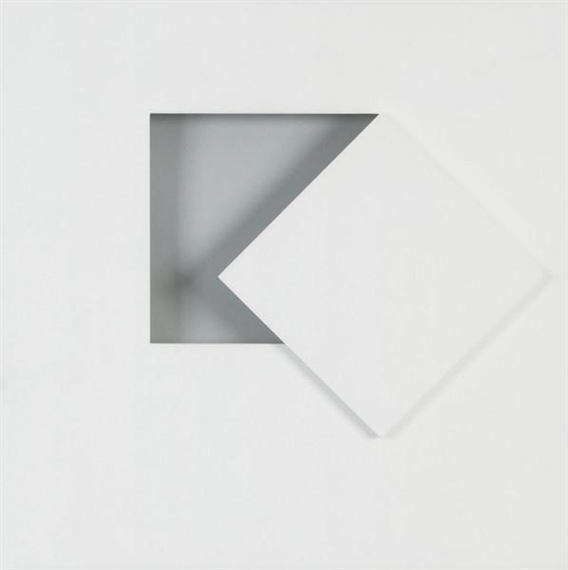
One of Arte Concreto-Invención’s most distinctive contributions was the marco recortado (cut frame or shaped canvas)—paintings on irregular, non-rectangular supports.
Reasoning: The rectangular frame is a window—a convention inherited from Renaissance perspective that implies looking through the canvas into illusionistic space. An irregularly shaped canvas asserts itself as object, not window. It exists in the viewer’s space, not pointing to imaginary space behind its surface.
Artists created:
- Paintings on triangular, trapezoidal, or freely curved supports
- Canvases with holes or cutouts
- Multi-panel works with gaps between elements
- Three-dimensional relief constructions
5. Function and Integration
Like Constructivists and Bauhaus artists, the Invencionistas believed art should integrate with life, not remain isolated in museums. They proposed:
- Architectural integration—works designed for specific spaces
- Functional objects that were also art
- Collaboration with architects and designers
- Rejection of “art for art’s sake” in favor of art serving social function
This aligned with leftist politics many members held—art should serve society, not aristocratic collectors.
Key Artists of Arte Concreto-Invención
Tomás Maldonado (1922-2018)
Theoretical leader of the group, Maldonado wrote extensively about Concrete Art’s philosophical foundations. His works featured:
- Geometric compositions of extreme rigor
- Mathematical relationships between elements
- Shaped canvases exploring frame as object
- Later career at Ulm School of Design in Germany, influencing international design theory
Maldonado’s importance transcended his paintings—his theoretical writings gave Arte Concreto-Invención intellectual weight, positioning it within international modernist discourse.
Gyula Kosice (1924-2016)
Perhaps the group’s most inventive artist, Hungarian-born Kosice (Ferdinandy Fallik) created:
Hydrospatial sculptures: Works incorporating water as structural element—not representing water but using actual water in motion. These anticipated kinetic art and anticipated environmental concerns.
Shaped paintings: Irregular canvases exploring the frame’s role in creating pictorial space
Theoretical writings: Contributed to manifestos and journals, articulating Concrete-Invention principles
“Röyi” (1944): Considered one of first artworks incorporating water as integral element—a transparent structure with water circulating through tubes, lit from within.
Kosice later proposed “Ciudad Hidroespacial” (Hydrospatial City)—a utopian vision of floating cities in space, showing Concrete-Invention’s connection to utopian futures.
Rhod Rothfuss (1920-1969)
Uruguayan artist Rothfuss was crucial in developing the shaped canvas concept. His theoretical essay “The Frame: A Problem of Contemporary Art” (1946) argued:
- Traditional rectangular frame creates illusionistic space
- Irregular frame destroys this illusion
- Art object becomes thing in real space, not window into imaginary space
His works featured bold geometric shapes on irregular supports, demonstrating theory in practice.
Enio Iommi (1926-2013)
Iommi worked primarily in sculpture, creating:
- Geometric steel constructions
- Works exploring mathematical relationships
- Pieces integrating with architectural space
- Mobile sculptures responding to movement and light
His sculptures embodied Concrete-Invention principles in three dimensions—not representing anything, but existing as concrete arrangements of materials in space.
Lidy Prati (1921-2008)
One of few women prominently involved, Prati created:
- Geometric compositions of great clarity
- Works exploring color relationships
- Contributions to theoretical discussions
- Later career in graphic and industrial design
Her inclusion reminds us that these movements, despite male-dominated narratives, included significant female artists whose contributions are being increasingly recognized.
The Shaped Canvas: Revolutionary Form
The marco recortado (shaped canvas) deserves special attention as Arte Concreto-Invención’s most distinctive innovation.
Breaking the Rectangle
For centuries, paintings had been rectangular (with occasional circular or oval exceptions). This format seemed natural, neutral, given. Arte Concreto-Invención recognized it was neither.
What the rectangle does:
- Creates window-like frame separating art from world
- Establishes edges that feel like boundaries of represented space
- Provides stable, predictable format viewers unconsciously interpret as frame around illusion
What irregular shapes do:
- Destroy window metaphor—obviously objects, not portals
- Eliminate stable relationship between edge and interior composition
- Force viewer to see work as thing in their space, not separate illusory realm
- Make frame part of composition, not neutral boundary
Examples and Variations
Artists created extraordinary variety:
Simple geometric shapes: Triangles, trapezoids, parallelograms—geometric but non-rectangular
Organic curves: Freely drawn edges creating biomorphic forms
Cutouts and holes: Canvases with interior voids, creating positive and negative space simultaneously
Multi-part compositions: Several shaped canvases hung together with gaps between, making wall itself part of composition
Three-dimensional reliefs: Shapes projecting from wall, existing partly in painting space, partly in sculpture space
These experiments questioned fundamental assumptions about what paintings could be.
Theoretical Foundations: Philosophy of Invention
The Manifesto Invencionista rested on philosophical principles worth examining:
Against Mimesis
Since Plato, Western aesthetics often assumed art’s purpose was representing reality—either imitating appearances (Plato’s “copies of copies”) or revealing deeper truths beneath surfaces. Arte Concreto-Invención rejected this entire tradition.
Their position: Art doesn’t represent, express, or reveal. It invents—creates new objects with no prior existence. A painting is as real as a table, existing in the same ontological category as other manufactured things.
Materialist Aesthetics
Like Russian Constructivists, the Invencionistas embraced materialist philosophy:
- Art is material arranged in space
- Materials have properties (color, texture, weight, reflectivity) that can be organized
- Organization follows principles (mathematical, visual, structural) but doesn’t symbolize or represent
- Meaning emerges from relationships between concrete elements, not reference to absent things
This aligned with Marxist materialism many members espoused—reality is material, not ideal; thought emerges from matter, not vice versa.
Mathematical Relationships
Many Concrete-Invention works employed mathematical principles:
- Geometric progressions
- Proportional systems (golden section, Fibonacci sequences)
- Symmetries and asymmetries
- Modular structures
These weren’t decorative choices but philosophical statements: mathematical relationships are objective, universal, concrete—exactly what Concrete Art aspired to embody.
The Social Function
Despite formal rigor, Arte Concreto-Invención maintained political dimension:
Art should:
- Be accessible—geometric forms are universal, requiring no specialized cultural knowledge
- Serve society—integrate with architecture, design, daily life
- Point toward future—embody rationality, progress, scientific thinking
- Reject bourgeois individualism—work collectively, subordinate personal expression to objective principles
This utopianism connected them to European Constructivism and to leftist politics of 1940s Argentina.
Conflicts and Divisions
The Buenos Aires Concrete Art scene was fractious, with competing groups and personalities:
Arte Concreto-Invención vs. Madí
In 1946, some members split to form Grupo Madí (the name’s etymology is disputed—possibly from “Madrid” + “París,” possibly from “materialismo dialéctico,” possibly meaningless).
Differences:
- Madí was more playful, incorporating humor and chance
- Madí emphasized mobility—works that moved, changed, could be rearranged
- Madí was less rigid theoretically, more open to experiment
- Personal conflicts between leaders (Arden Quin led Madí, Maldonado led Arte Concreto-Invención)
Similarities:
- Both rejected representation
- Both used shaped canvases
- Both sought integration of art and life
- Both operated in overlapping social circles
International Connections and Isolation
Arte Concreto-Invención positioned itself within international Concrete Art movement, corresponding with:
- Max Bill (Swiss Concrete artist and theorist)
- European Concrete artists
- International constructivist journals
Yet geographic isolation limited their impact outside Latin America initially. Only decades later would international art history fully recognize their contributions.
Legacy and Influence
Immediate Impact (1940s-1950s)
- Influenced younger Argentine artists toward geometric abstraction
- Provided theoretical foundation for Latin American Concrete Art
- Connected Argentine avant-garde to international modernism
- Challenged Buenos Aires art establishment
Long-term Influence
In Latin America:
- Brazil: Influenced Concrete Art movement (Grupo Ruptura, 1952) and Neo-Concrete movement (1959)
- Venezuela: Informed geometric abstraction of Jesús Soto, Carlos Cruz-Diez, Alejandro Otero
- Uruguay: Influenced Constructive Universalism of Joaquín Torres-García followers
Internationally:
- Anticipated Minimalism’s emphasis on actual objects rather than representations
- Influenced installation art’s integration with architectural space
- Contributed to expanded definition of painting beyond rectangle
- Shaped canvas became recurring strategy in contemporary art
Recovered History
For decades, Arte Concreto-Invención remained relatively obscure outside Argentina. Recent scholarship has:
- Positioned them as crucial link between European Constructivism and Latin American modernism
- Recognized their theoretical sophistication
- Acknowledged shaped canvas as significant innovation
- Integrated their work into global modernist narrative
Major exhibitions (Museo Nacional Centro de Arte Reina Sofía, Madrid, 2017; Museum of Modern Art, New York exhibitions) have introduced their work to international audiences.
Conclusion: Invention as Radical Act
The Manifesto Invencionista proposed something radical even within avant-garde contexts: that art should abandon not only representation but abstraction itself in favor of pure invention—the creation of concrete objects that represented nothing, expressed nothing, symbolized nothing, but simply existed as new realities constructed by human will and intelligence.
In 1946 Buenos Aires, as Europe reconstructed itself after war’s devastation and Argentina navigated between populism and cosmopolitanism, these artists asserted that art could build futures rather than represent pasts. Their shaped canvases, their geometric rigor, their theoretical manifestos all insisted that geometry wasn’t escape from politics but engagement with it—that rational, objective, universal visual languages could help construct more just societies.
Whether that utopian vision succeeded is debatable. What’s undeniable is that Arte Concreto-Invención expanded what art could be and do, creating works of austere beauty that remain challenging, rigorous, and surprisingly contemporary. Their insistence that “nothing is more concrete than a line, a color, a surface”—echoing van Doesburg across continents—continues resonating wherever artists question representation, embrace materials’ concreteness, and understand making as inventing rather than imitating.
The Manifesto Invencionista stands as testament to a moment when young artists in Buenos Aires believed geometry could change the world, when shaped canvases were revolutionary acts, and when invention—pure, material, concrete—seemed not just aesthetic strategy but political necessity.