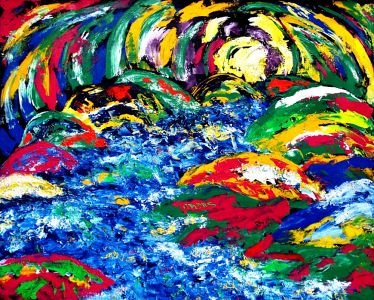
Interdisciplinary Artist vs. Multidisciplinary Artist
Beyond Mediums: How Contemporary Artistic Thinking Is Constructed
In contemporary art, the terms multidisciplinary and interdisciplinary are often used interchangeably. However, while both describe practices that operate across multiple mediums, the difference between them is not technical but conceptual. It is not about how many languages an artist uses, but how they are articulated.
Multidisciplinary: The Coexistence of Languages
A multidisciplinary artist works across different mediums—painting, sculpture, photography, video—but each can remain relatively autonomous. It is an expansive practice, where the artist moves between disciplines according to the expressive needs of each work.
Here, knowledge is accumulative: each discipline contributes a different tool, but they do not necessarily merge into a single system of thought. The result can be diverse, versatile, and technically broad, but it does not always imply deep integration between languages.
From a curatorial perspective, the multidisciplinary artist presents a constellation of practices, rather than a unified body of work.
Interdisciplinary: Integration as Thought
The interdisciplinary artist, by contrast, does not simply use multiple mediums—they interconnect them. Disciplines cease to be separate territories and instead become a hybrid field where boundaries dissolve.
Here, the work could not exist within a single medium. Photography becomes installation, sound becomes space, science enters into dialogue with poetry. There are no hierarchies between disciplines, but rather a conceptual synthesis in which each language transforms the others.
Knowledge is no longer accumulative, but relational. The interdisciplinary artist works from complex questions—about perception, memory, identity, technology, or nature—that require multiple systems of thought to be addressed.
From a curatorial standpoint, this practice generates ecosystems of meaning, rather than isolated objects.
Key Difference: Structure vs. System
The distinction can be summarized as follows:
- The multidisciplinary artist works across mediums.
- The interdisciplinary artist works across ideas that move through mediums.
One organizes a diversity of tools; the other constructs a system in which those tools become inseparable.
Why Does This Distinction Matter?
In a context where contemporary art increasingly shifts away from the object and toward experience, this distinction becomes crucial. The market may still categorize by medium—painting, sculpture, photography—but artistic practice today responds to questions that exceed those divisions.
The interdisciplinary artist does not simply expand the language of art: they redefine its conditions of possibility.
Toward an Expanded Practice
Today, many artists move fluidly between both categories. The distinction is not rigid, but evolutionary. A practice may begin as multidisciplinary and, over time, become interdisciplinary as the connections between mediums grow more organic and necessary.
Ultimately, the question is not what the artist does, but how the artist thinks.
Because in contemporary art, mediums are no longer the limit.
They are the point of departure.