Hilma af Klint: Art as Spiritual Practice and Visionary Communication
Hilma af Klint’s artistic journey represents one of the most remarkable intersections of spirituality and visual art in modern history. Working in near secrecy in early twentieth-century Sweden, af Klint created a body of abstract paintings that predated the recognized pioneers of abstraction by several years, yet her motivations differed fundamentally from those of her male contemporaries. Where Kandinsky, Malevich, and Mondrian sought to express spiritual truths through formal innovation, af Klint understood her art as a form of mediumship—a channel through which higher spiritual beings communicated messages intended for humanity’s spiritual evolution.
Born in 1862 into an upper-middle-class Swedish family with naval connections, af Klint received formal artistic training at the Royal Academy of Fine Arts in Stockholm, one of the first women to do so. She established herself as a competent painter of landscapes, botanical studies, and portraits—work that provided modest income and respectability. Yet this conventional artistic practice concealed a parallel engagement with spiritualism that would ultimately transform her understanding of art’s purpose and her own role as an artist.
The late nineteenth and early twentieth centuries witnessed an extraordinary flourishing of interest in spiritualism, theosophy, and occult practices throughout Europe and America. This was not merely superstition or fringe belief but a serious intellectual and spiritual movement that attracted scientists, artists, writers, and social reformers. The spiritualist movement emerged partly in response to the perceived failures of both orthodox religion and materialist science to address fundamental questions about consciousness, the soul, and humanity’s place in the cosmos. For many, including af Klint, spiritualism offered a third way—a path that acknowledged both empirical investigation and transcendent experience.
In 1896, af Klint joined with four other women—Anna Cassel, Cornelia Cederberg, Sigrid Hedman, and Mathilda Nilsson—to form a group called “The Five” (De Fem). These women met regularly to conduct séances during which they served as mediums, receiving messages and communications from spiritual entities they called the “High Masters.” The group kept detailed records of their séances, documenting the messages received and the various spiritual beings who communicated through them. For af Klint and her companions, these sessions were not entertainment or dabbling but serious spiritual practice aimed at accessing higher knowledge and understanding.
The séances of The Five involved automatic writing and drawing—practices in which the medium’s hand moved without conscious direction, supposedly guided by spiritual entities. Af Klint’s early automatic drawings show abstract forms, symbols, and text that she understood as communications from the spirit world. These drawings are remarkable for their confident execution and complex symbolic vocabulary, suggesting that even at this early stage, af Klint was developing a visual language quite distinct from her conventional artistic work.
In 1904, af Klint reported receiving a communication from a High Master named Amaliel, who would become her primary spiritual guide. Amaliel informed her that she had been chosen to execute a series of paintings on the “astral plane”—works that would visualize spiritual truths and contribute to humanity’s spiritual development. This commission would culminate in “The Paintings for the Temple,” a series of 193 works created between 1906 and 1915 that represents the heart of af Klint’s spiritual-artistic practice.
The circumstances surrounding the creation of “The Paintings for the Temple” reveal af Klint’s understanding of herself as instrument rather than autonomous creator. She claimed that these paintings were dictated to her by spiritual beings, that her hand was guided, and that she often did not understand the full meaning of what she was creating. This assertion challenges fundamental assumptions about artistic authorship, creativity, and intention that have dominated Western art since the Renaissance. Where the Romantic tradition celebrated the artist as individual genius, af Klint positioned herself as medium and servant to higher purposes.
Yet to accept af Klint’s self-understanding entirely would be to overlook the considerable agency, skill, and decision-making evident in the paintings themselves. The works demonstrate sophisticated compositional sense, color theory, and symbolic development. They evolve across series, showing experimentation and refinement. Af Klint may have believed she was receiving guidance, but she was also bringing her own artistic training, visual intelligence, and interpretive framework to bear on whatever visions or intuitions she experienced.
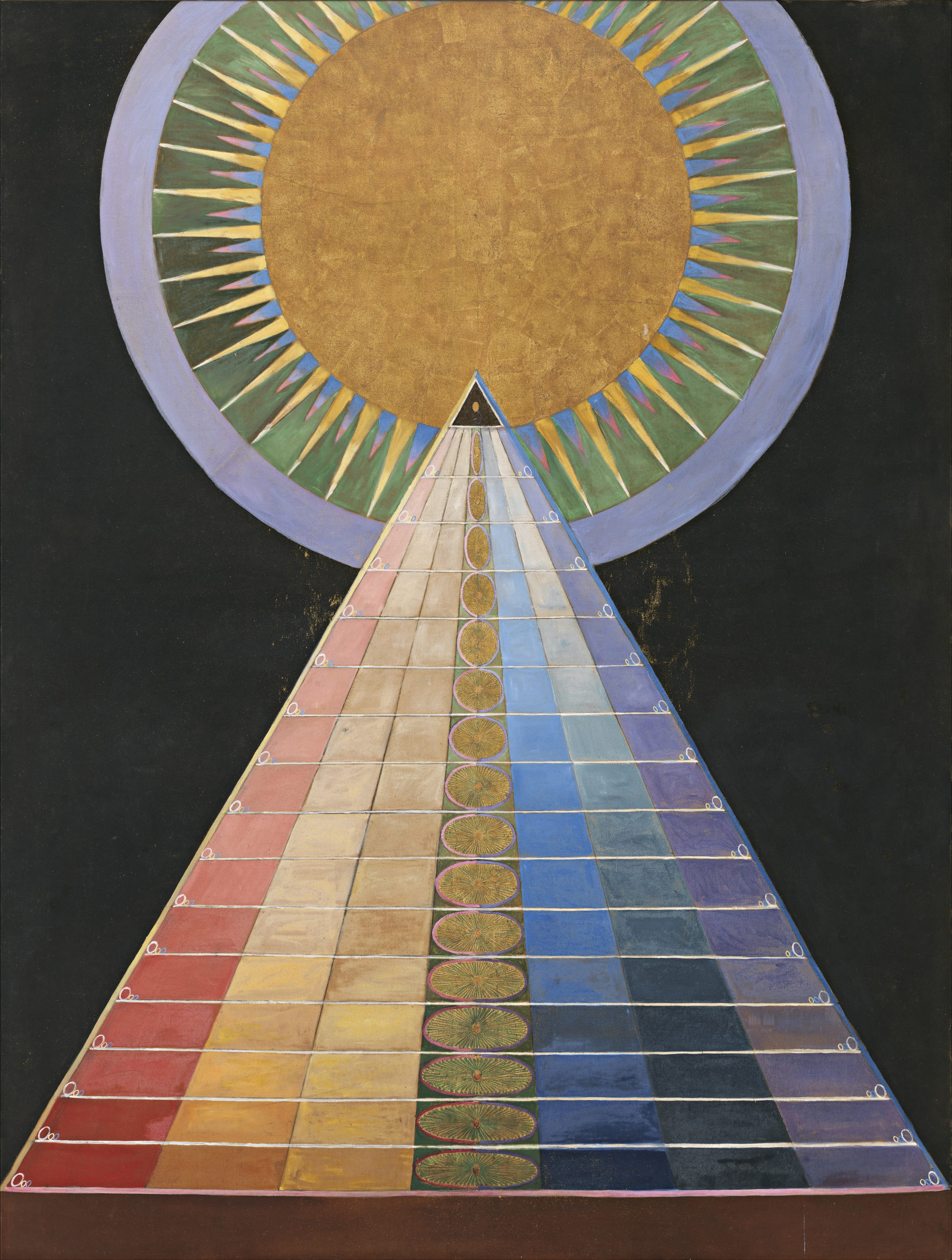
The paintings themselves are visually stunning and conceptually complex. The early works in “The Paintings for the Temple” series, particularly “Primordial Chaos” and the “Group I, The WU/Rose Series,” feature large-scale canvases dominated by spirals, botanical forms, and abstract shapes rendered in luminous colors. These images draw on multiple symbolic systems: theosophy’s understanding of spiritual evolution, botanical growth as metaphor for spiritual development, and geometric forms as expressions of cosmic principles. The spirals suggest cycles, evolution, and the relationship between microcosm and macrocosm. The biomorphic forms evoke both cellular structures visible through microscopes and vast cosmic formations, collapsing distinctions between the infinitely small and the infinitely large.
Af Klint’s color theory reflected both her academic training and her spiritual beliefs. She understood colors as carrying specific spiritual meanings and vibrations. Blues represented the spiritual and masculine principle, yellows and pinks the material and feminine. Her use of color was not decorative but functional—colors were chosen for their spiritual properties and their ability to communicate specific ideas and energies. This approach parallels but differs from Kandinsky’s color theory, which also attributed spiritual properties to colors but emerged from different philosophical and spiritual frameworks.
The symbolic vocabulary af Klint developed across “The Paintings for the Temple” is remarkably consistent and complex. Recurring motifs include the letter “U” (representing the spiritual realm) and “W” (representing the material world), snails (suggesting spiritual evolution and the soul’s journey), swans (representing purity and transcendence), and various geometric forms (circles, triangles, squares) that carried specific theosophical meanings. These symbols were not arbitrary but drawn from theosophy, Rosicrucianism, and other esoteric traditions that af Klint studied intensively.
The scale of af Klint’s ambition becomes clear when we consider the intended context for these paintings. She envisioned them being displayed in a spiral temple, a circular or spiral-shaped building where visitors would encounter the works in a specific sequence designed to facilitate spiritual development and understanding. The paintings were not meant for conventional gallery or museum display but for a sacred architectural setting that would itself embody spiritual principles. This vision was never realized in af Klint’s lifetime, and the paintings remained largely unseen, stored in her studio and later in storage facilities, for decades after her death.
Af Klint’s spiritual sources were diverse and syncretic. She drew heavily from theosophy, the spiritual movement founded by Helena Blavatsky in the late nineteenth century, which combined elements of Eastern religions (particularly Hinduism and Buddhism), Western esotericism, and claims of direct spiritual revelation. Theosophy proposed that all religions contained partial truths pointing toward a universal spiritual reality, and that humanity was evolving spiritually through successive incarnations toward higher consciousness. These ideas profoundly shaped af Klint’s understanding of her artistic mission as contributing to humanity’s spiritual evolution.
She also engaged with Rosicrucianism, an esoteric Christian tradition emphasizing mystical knowledge, alchemical transformation, and the hidden spiritual dimensions of reality. Rosicrucian symbolism—particularly the rose and cross—appears throughout her work, often combined with theosophical and other symbolic systems. This syncretism was characteristic of turn-of-the-century occultism, which freely combined elements from different traditions in pursuit of universal spiritual truth.
Anthroposophy, the spiritual philosophy developed by Rudolf Steiner after his break with the Theosophical Society, also influenced af Klint’s later work. She attended Steiner’s lectures and corresponded with him, though he reportedly discouraged her from showing her abstract spiritual paintings, advising that the world was not yet ready for them. This response must have been disappointing for af Klint, yet she appears to have taken it seriously, including in her will a stipulation that her abstract paintings should not be shown publicly until at least twenty years after her death.
The relationship between af Klint’s spiritual beliefs and her artistic practice raises profound questions about the nature of creativity, inspiration, and artistic authority. Modern art history has generally been uncomfortable with af Klint’s claims of spiritual guidance, preferring to explain her work through formal innovation, unconscious expression, or cultural context while bracketing her explicit spiritual intentions. Yet to fully appreciate af Klint’s achievement, we must take her spirituality seriously as both motivation and methodology.
Af Klint’s practice challenges the modern Western distinction between religious/spiritual experience and artistic creation. In many spiritual traditions, art-making is itself a spiritual practice—whether in Tibetan sand mandalas, Islamic calligraphy, or icon painting. Af Klint worked within this understanding, approaching painting as spiritual discipline, her studio as sacred space, and her works as objects of spiritual power and pedagogical tools for spiritual development.
The question of whether af Klint’s spiritual experiences were “real” in any objective sense misses the point. What matters is that she experienced them as real, structured her life and work around them, and produced extraordinary art as a result. Whether we understand her visions as genuine communications from spiritual entities, expressions of unconscious creative processes, or some combination thereof, the paintings themselves remain as evidence of a remarkable consciousness engaged in sustained exploration of non-ordinary states and their visual expression.
Af Klint’s gender is inseparable from her spiritual practice and its reception. Spiritualism and theosophy offered women opportunities for religious authority and leadership that conventional churches largely denied them. Women served as mediums, founded spiritual movements, and claimed direct access to divine knowledge without requiring male intermediaries. The Five’s practice was entirely woman-centered, creating space for spiritual exploration free from male authority or skepticism. Yet this same association with women and femininity contributed to the marginalization and dismissal of spiritualism by male-dominated institutions, both religious and scientific.
The fact that af Klint’s work remained unknown for decades reflects not only her own wishes but broader patterns of gender exclusion in art history. Male abstract pioneers were celebrated, theorized, and canonized while af Klint’s earlier and arguably more radical abstractions languished in storage. When her work finally began to receive attention in the 1980s and particularly after a major 2013 exhibition in Stockholm, it necessitated significant revision of modernism’s standard narratives.
Contemporary reception of af Klint’s work varies considerably. Some viewers are drawn precisely to the spiritual dimensions, finding in her paintings visual expressions of transcendent truths or non-ordinary states of consciousness. Others appreciate the formal qualities while remaining agnostic or skeptical about the spiritual content. Still others are primarily interested in how af Klint’s example disrupts art historical narratives and raises questions about gender, authorship, and the definitions of abstraction.
The current popularity of af Klint’s work coincides with renewed interest in spirituality, consciousness studies, and non-Western epistemologies in contemporary culture. In an era skeptical of both religious orthodoxy and purely materialist worldviews, af Klint’s synthesis of spiritual seeking and artistic innovation resonates with many who are exploring alternative frameworks for understanding consciousness and reality.
Af Klint’s legacy extends beyond art history to broader conversations about women’s spiritual authority, the relationships between art and spirituality, and the nature of creativity itself. Her practice suggests that artistic innovation need not emerge from individual genius alone but can arise from practices of receptivity, surrender, and collaboration—whether with other humans, as in The Five, or with whatever forces or dimensions of consciousness she accessed through mediumship.
The paintings themselves, regardless of their origins, reward sustained attention. They are visually complex, emotionally resonant, and intellectually provocative. Their combination of geometric precision and organic flow, their luminous colors and symbolic density, their monumental scale and intimate detail—all create viewing experiences that are genuinely transformative for many who encounter them. Whether one attributes this power to spiritual forces, artistic genius, or some interplay of conscious and unconscious processes, the effect remains.
Hilma af Klint died in 1944 at age 81, having spent her final years organizing her archive, writing extensively about her spiritual experiences and artistic process, and ensuring that her wishes regarding the eventual display of her work would be honored. She left behind not only the paintings but extensive notebooks, writings, and documentation that provide remarkable insight into her spiritual development and artistic intentions.
Her story reminds us that the history of art contains many suppressed narratives, that genius takes forms unrecognized by dominant institutions, and that the boundaries between artistic practice and spiritual seeking are more porous than modern secularism acknowledges. Af Klint pursued her vision with remarkable dedication, creating a body of work that challenges, inspires, and continues to generate new understandings of what art can be and do. In treating her art as spiritual practice and spiritual practice as art, she achieved a unity of purpose that remains rare and exemplary, inviting us to consider the deepest sources of creativity and the highest aspirations of artistic endeavor.