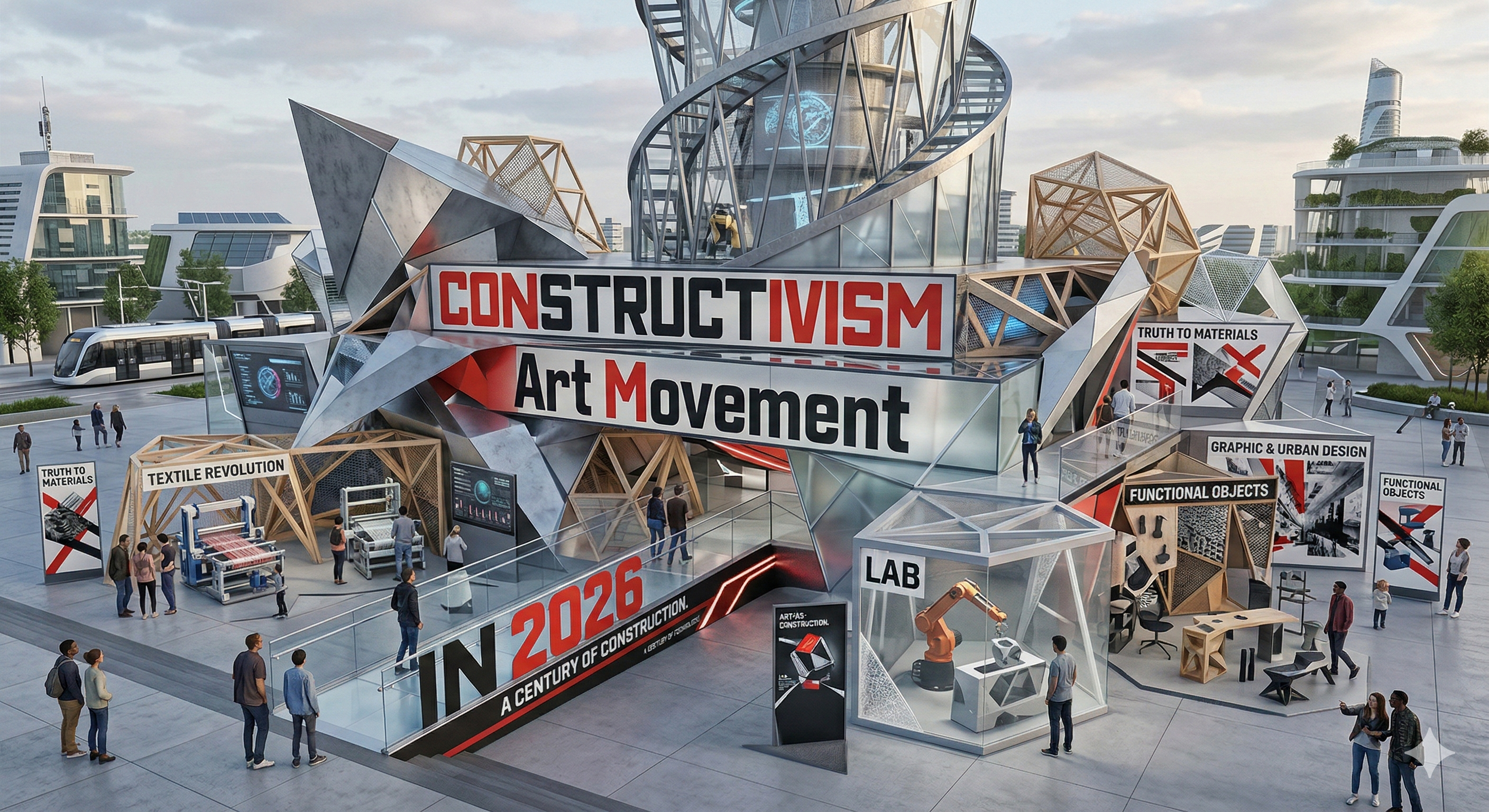
CONSTRUCTIVISM IN 2026
A Movement Forged in Revolution, Enduring in Modernity 1915 – 1935
“The streets are our brushes, the squares our palettes.”
— Vladimir Mayakovsky
I. The Problem of Purity: Suprematism and Its Discontents
To understand Constructivism, one must first reckon with the movement it grew from and ultimately against. Suprematism, that austere programme of geometric transcendence inaugurated by Kazimir Malevich around 1915, proposed a radical rupture with representation. The Black Square of 1915 — famously installed in the corner of a room, occupying the traditional sacred space of the Orthodox icon — declared that painting had shed its obligation to the visible world and ascended to pure sensation, pure form, pure spirit.
And yet, for all its radical beauty, Suprematism addressed itself to an elite consciousness. Its mysticism was rarefied; its communicative apparatus depended upon a viewer capable of engaging its philosophical underpinnings. In a Russia where peasant illiteracy remained widespread, where the Bolshevik revolution had promised art for the masses, Suprematism’s geometric reveries floated untethered from lived social reality. One might appreciate a Malevich canvas as an initiation into a higher order of perception. But what did it say to the factory worker? What did it demand of the collective farm labourer standing before it, if indeed she ever found herself in front of it at all?
The question that animated the young Constructivists was not whether such experiments had intrinsic value — many of them believed, with great intensity, that they did — but whether art could afford to remain the property of those with the cultural capital to decode it. The answer, for Alexander Rodchenko, Varvara Stepanova, El Lissitzky, and their comrades, was unambiguous: it could not.
II. From Mysticism to Materialism: The Constructivist Turn
The Constructivists did not so much abandon Suprematist geometry as redirect it. Where Malevich had oriented his squares and circles toward the metaphysical, the Constructivists turned them toward the instrumental. Form was no longer a portal to some transcendent realm; it was a tool for communication, organisation, and transformation. Art, they insisted, must be useful.
This reorientation was codified through a series of debates and institutional struggles in the early 1920s. The Working Group of Constructivists, formed at INKhUK (the Institute of Artistic Culture) in Moscow in 1921, drew a sharp distinction between ‘composition’ — the arrangement of forms in purely aesthetic terms — and ‘construction,’ which implied function, purpose, and social integration. Rodchenko went so far as to declare the ‘death of painting,’ offering his triptych of pure red, yellow, and blue monochrome canvases in 1921 as the logical terminus of easel painting, a final gesture before turning entirely to design, photography, and typography.
“Art into life! This was not a slogan but a programme, a method, a moral imperative.”
— Varvara Stepanova, 1922
What distinguished this turn from mere propagandism — and it is essential to make this distinction — was that the Constructivists genuinely believed in the intrinsic power of formal experimentation. They were not sacrificing aesthetic rigour at the altar of ideology; they were insisting that rigour and accessibility were not mutually exclusive. The diagonal thrust, the dynamic asymmetry, the tension of colour against negative space: these were not decorative add-ons to a political message but the very means by which a message could pierce through to a viewer who had never visited a gallery.
III. The Expanded Field: Architecture, Typography, Film
Architecture and the Social Body
Nowhere was the Constructivist ambition more legible than in architecture. The visionary projects of Alexander and Viktor Vesnin, of Moisei Ginzburg, and above all the unrealised but enormously influential designs by figures such as Ivan Leonidov proposed a built environment conceived as a machine for living — not in Le Corbusier’s somewhat chilly, technocratic sense, but in the sense that architecture could actively produce new forms of social solidarity. Workers’ clubs, communal housing blocks, cultural palaces: these were not buildings designed for aesthetic contemplation but spatial programmes intended to reshape how people inhabited collective life.
Tatlin’s Tower — Monument to the Third International, designed 1919-1920 — stands as perhaps the most potent emblem of this ambition. Had it been built, it would have soared over three hundred metres above Petrograd, its twin helical spirals rotating at different speeds, housing governmental and cultural functions within its revolving chambers. That it was never constructed is both a practical footnote and a poetic truth: Constructivism’s grandest proposals often existed most powerfully as images, as provocations, as measures of what an art fully committed to social transformation might aspire to become.
Typography and the Revolution of the Page
If architecture operated at the scale of the city and the collective body, typography operated at the scale of the eye and the instant. El Lissitzky’s Proun compositions — those extraordinary diagonal worlds hovering between painting and architectural drawing — fed directly into a revolutionary approach to the printed page. His 1920 children’s book About Two Squares used pure geometric narration to tell a story comprehensible without literary fluency. This was Constructivist logic made exquisite: the image sequence as democratic text, the shape as its own grammar.
Rodchenko’s photomontage work and his advertising posters for state enterprises such as Gosizdat and the Rezinotrest rubber company demonstrated that commercial communication need not be aesthetically impoverished. Working with the poet Mayakovsky, Rodchenko produced advertising copy and visual material that crackled with formal energy while directing the viewer toward specific acts of consumption or civic participation. The diagonal, the close-cropped photograph, the bold sans-serif text block: these were instruments of persuasion that also constituted a coherent visual language — one legible to anyone, learned or unlearned, who encountered it on a kiosk, a tram, a factory wall.
Cinema and the Kinetic Image
Dziga Vertov’s Kino-Pravya newsreels and his masterwork Man with a Movie Camera (1929) extended Constructivist principles into time. The edit was the fundamental Constructivist gesture transposed to the temporal register: the collision of shots producing meaning through contrast and juxtaposition rather than narrative continuity. Vertov’s ‘theory of intervals’ — the relationship between images as the carrier of cinematic meaning — was as rigorous a formal proposition as anything produced on canvas. And yet it played in workers’ clubs and open-air screenings, reaching audiences for whom the idea of visiting a gallery remained entirely foreign. The moving image was, for the Constructivists, perhaps the most perfect medium: dynamic, reproducible, collectively experienced, formally complex, and accessible all at once.
IV. The Ambiguities of Political Service
It would be intellectually irresponsible to celebrate Constructivism without examining the profound ambiguities of its relationship to political power. The movement developed in lockstep with the Bolshevik state, and many of its practitioners genuinely believed that Soviet communism offered the material conditions for the utopian fusion of art and life they had envisioned. The party, for its part, found in Constructivism a visual identity of remarkable potency: its posters were arresting, its typography authoritative, its imagery capable of projecting revolutionary modernity to domestic and international audiences alike.
But the relationship was never simply one of patronage and service. The Constructivists maintained a consistent commitment to formal experimentation that frequently chafed against the demands of those who preferred legibility — in the most literal, propagandistic sense — over formal invention. By the late 1920s, and with increasing ferocity into the 1930s, Socialist Realism emerged as the state-mandated aesthetic doctrine, insisting on narrative representation, heroic figuration, and immediate accessibility in terms entirely foreign to the Constructivist programme. By 1932, the independent artistic organisations that had fostered avant-garde work were dissolved; by 1934, Socialist Realism was formally codified as the only permissible aesthetic for Soviet artists.
Some Constructivists accommodated themselves to the new regime of representation. Others — among them Rodchenko, who turned increasingly to photography — found modes of work that allowed a degree of formal integrity within constrained circumstances. El Lissitzky continued to produce exhibition design of remarkable sophistication. But the utopian project, the dream of a total art in service of a transformed social life, had effectively ended. What remained was the legacy.
V. The Long Afterlife: Constructivism in 2026
The Unfinished Project
Writing in 2026, one hundred and eleven years after Malevich exhibited his Black Square and over ninety years after the formal suppression of the Soviet avant-garde, it is tempting to treat Constructivism as history — as a movement with a beginning, a middle, and an end, safely contained within monographs and museum collections. This temptation should be resisted.
Constructivism’s core questions remain urgently unresolved. Who does art serve? What is the relationship between formal experimentation and social function? Can visual language transcend class, education, and cultural capital? How might design, architecture, film, and the plastic arts work together in a unified programme of social transformation? These are not merely historical questions. They are the animating concerns of every practitioner, curator, and critic who takes seriously the idea that aesthetics has consequences — that how we make things shapes how we live.
The Digital Turn and the Constructivist Impulse
Contemporary visual culture, particularly in its digital manifestations, bears the unmistakable imprint of Constructivist form. The bold typographic hierarchies of contemporary interface design; the asymmetric, grid-based layouts of digital publications; the use of flat planes of saturated colour and geometric simplification in branding and motion graphics — all of these carry, whether their practitioners acknowledge it or not, the formal vocabulary developed in Moscow and Petrograd between 1915 and 1932. The Constructivist insight that form itself communicates — that the angle of a diagonal or the weight of a typeface can carry ideological charge — has become, in the digital era, the working assumption of an entire industry.
This normalisation is both tribute and cautionary tale. The Constructivists understood that form could be mobilised for liberation or for control, for the expansion of collective life or for its management. Contemporary design deploys the same formal instruments in service of ends that would have horrified Rodchenko: the optimisation of engagement metrics, the nudging of consumer behaviour, the production of brand loyalty. The tools are the same; the purpose has been entirely inverted.
Curating the Living Legacy
For those of us working within curatorial practice, the challenge of engaging with Constructivism in 2026 is precisely to resist the dual temptations of pure historicism on one side and uncritical contemporary appropriation on the other. To exhibit Constructivist work as simply beautiful objects — which many of them are, with a formal power that remains stunning after a century — is to betray the movement’s own deepest commitments. The Constructivists did not make work to be exhibited in bourgeois galleries; they made work to circulate in the world, to change it.
At the same time, to treat Constructivism as a straightforwardly usable toolkit for contemporary progressive design practice is to flatten its historical specificity and to avoid the difficult question of how its contradictions — between formal autonomy and political instrumentality, between revolutionary aspiration and state service — remain live issues for any art practice that takes social transformation seriously.
The most honest and productive curatorial approach is one that holds these tensions open: that presents Constructivist objects in their full formal and historical complexity, that traces their afterlives with rigour, that creates conditions in which contemporary audiences can engage not merely with what these works look like but with what they demanded of the world. This means bringing Constructivism out of the white cube and into the contexts — urban, digital, institutional — where its questions remain most pressing. It means asking, as the Constructivists asked, what it means to make art for everyone, and recognising that the answer, in 2026 as in 1922, remains genuinely hard.
VI. Conclusion: The Unbuilt Tower
Tatlin’s Tower was never built. The sketch remains: that extraordinary rotating double helix, reaching toward a sky that Soviet modernity was going to transform. Its non-existence is not simply an accident of political and material circumstance. It is, I would suggest, constitutive of what Constructivism was and remains.
Constructivism was a movement that measured itself against an impossibly ambitious programme: the abolition of the distinction between art and life, the creation of a visual language capable of reaching everyone, the engineering of a material environment that would produce a new kind of human being. It did not achieve this programme. No movement could have. But in the attempt — in the posters and the buildings and the film sequences and the typographic experiments and the workers’ clubs and the textile designs — it produced a body of work of extraordinary formal intelligence and an archive of questions that no serious engagement with the relationship between aesthetics and society can afford to ignore.
To stand before a Rodchenko poster in 2026 is to encounter not a relic but a provocation. It asks us, with the same urgency it carried in 1924: Whose art is this? Whom does it serve? What is it for? The streets are still our brushes, if only we have the courage to pick them up.
— Essay submitted to the Journal of Visual Culture Studies, 2026