As artificial intelligence and digital technologies increasingly reshape contemporary visual culture, the distinction between human creativity and machine-generated production has become a central question in artistic discourse. For Camilo Palomeq’, an artist and creative technologist whose practice spans traditional fine art, film, and interactive media, this tension is not merely technological but fundamentally philosophical: What gives an artwork meaning, and where does authorship reside when machines can reproduce visual styles almost instantaneously?
In this interview with Art Miami Magazine, Palomeq’ reflects on the evolving relationship between artistic intention, technological mediation, and creative identity. Moving between handcrafted processes and digitally constructed experiences, he examines how technology can expand the possibilities of expression while simultaneously threatening to overshadow the human imagination that gives those possibilities purpose.
His practice challenges the assumption that technological innovation necessarily represents artistic progress. While embracing interactive design, stop-motion filmmaking, and projection mapping, Palomeq’ maintains that the significance of an artwork lies not in the sophistication of its tools but in the experiences, memories, and intentions that motivate its creation. For him, technology becomes meaningful only when it serves an artistic necessity rather than dictating the direction of the work.
Questions of identity and perception further complicate this relationship. Palomeq’ approaches artistic identity as something that evolves through lived experience, cultural transformation, and changing forms of representation. His images remain deliberately open to interpretation, allowing meaning to extend beyond the artist’s original intentions through encounters with viewers.
Ultimately, his reflections return to a deceptively simple proposition: if every technological instrument disappeared, the essential conditions of creativity would remain. A thought, a blank surface, and a pencil would still be enough. In an era increasingly defined by artificial intelligence, Palomeq’ reminds us that the true source of art is not the technology that produces an image, but the human consciousness that gives it meaning.
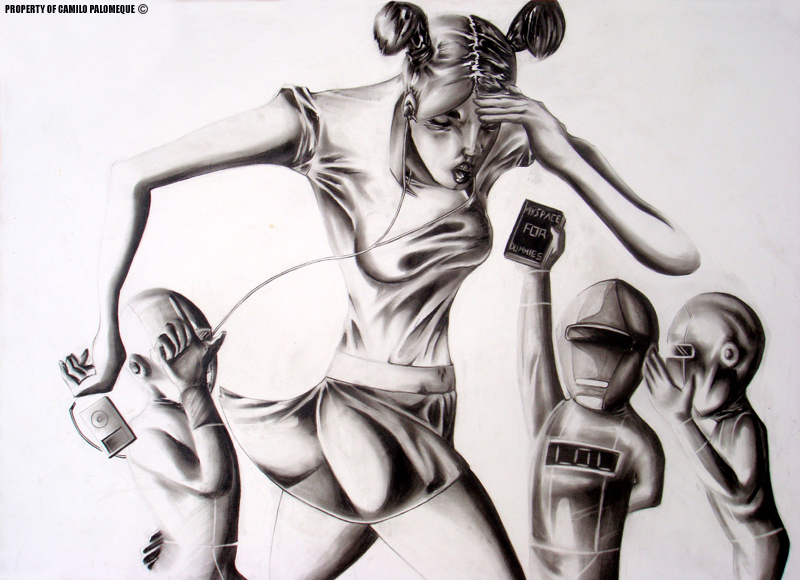
AMM: Your work moves between the handcrafted and the synthetic. When you place these two worlds in tension, are you exploring a conflict between human authorship and technological mediation—or are you questioning whether that distinction still matters?
Camilo Palomeq’: My work argues that the distinction between the human and the synthetic is more relevant than ever. With advancements in generative AI and large language models capable of replicating recognizable artistic styles in milliseconds, the relationship between authorship, originality, and creativity is undergoing a profound transformation. We are being forced to reconsider not only how images are made, but also what makes them meaningful. As both a traditional artist working in physical media and interactive design, my work reflects the ongoing tension and conflict between these two worlds.
AMM: You describe your images as suggestive rather than definitive. How much of your work emerges from conscious intention, and how much comes from impulses, associations, or desires that you only understand after the image already exists?
CP: Every composition begins with a deliberate idea, but over time, that idea can evolve beyond its original scope in both technique and interpretation. I like to have solid footing before beginning a piece, allowing the process of execution to determine whether the original idea needs to be reshaped or transformed.
As the work develops, the process itself begins to influence the outcome. The suggestive quality of my imagery comes from that openness in the execution. I am interested in creating images that leave room for interpretation, In that sense, the work is never entirely finished by my intentions alone; it continues to evolve through the ways it is seen, remembered, and interpreted by others.
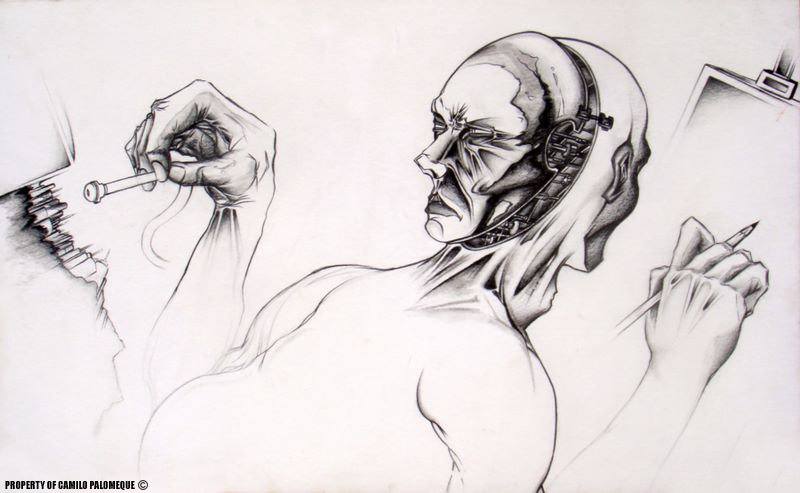
AMM: Identity is central to your practice, yet you work across fine art, film, and interactive media—forms that can continually reshape how a self is represented. Do you experience identity as something stable that technology helps reveal, or as something constantly constructed and reconstructed through images?
CP: I don’t believe identity is defined by the medium, platform, or technique, but rather by what the final work reveals about our experiences. Just as we change and mature over time, the forms and mediums we use to communicate evolve as well. My work reflects decades of technological and cultural changes through physical and interactive media, using these different forms to convey a specific time, place, or memory.
For me, the context in which an experience exists is an essential part of its meaning, ultimately revealing that identity needs not to be either stable or entirely constructed.
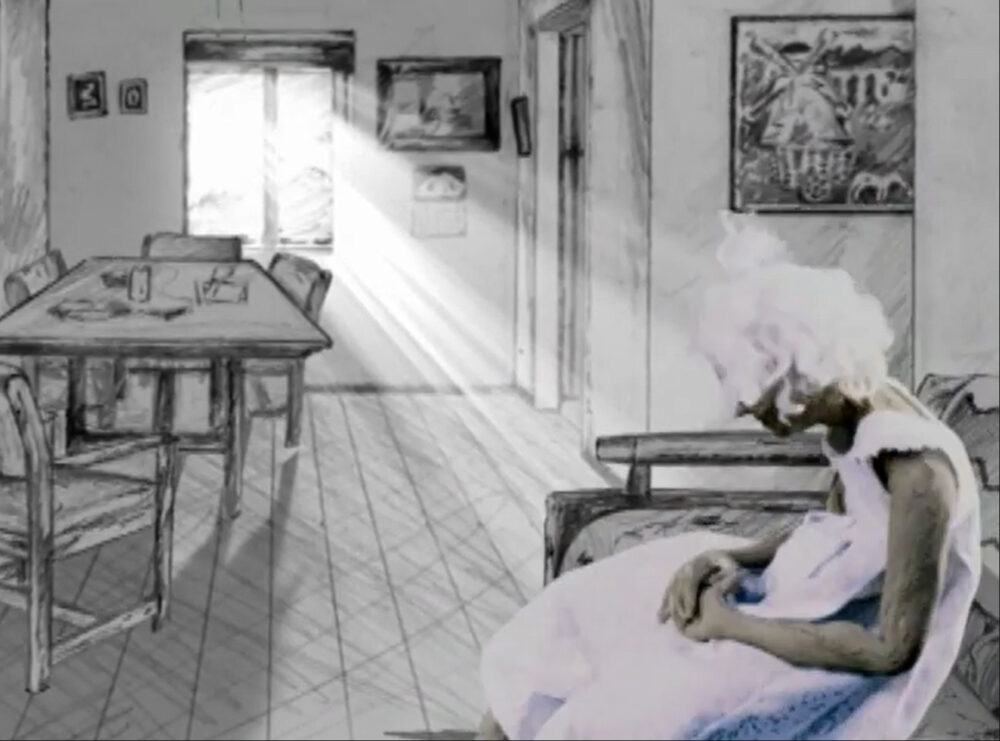
AMM: As a creative technologist, you work with tools capable of generating, transforming, and mediating experience. At what point does technology expand your imagination, and at what point do you fear it might begin to determine the way you imagine?
CP: All my ideas originate in my own experiences, thoughts, and imagination. Whether I’m creating an illustration, a stop-motion film or an installation featuring the latest interactive projection mapping technology, these are simply a means of expressing these very human experiences. The tools may evolve with technological advances, but the ideas and intentions behind my work remain my own.
The dilemma arises when the capabilities of a tool begin to dictate the direction of the work simply because they are available or technically impressive. It is easy to become preoccupied with what a technology can do and lose sight of why a particular experience needs to exist in the first place.
I try to remain conscious of that distinction.
AMM: Your practice brings together traditional craft and digital innovation. If all technological tools were removed from your process tomorrow, what would remain essential to your artistic identity—and what would that reveal about the true source of your work?
CP: These tools are exactly that: tools. If they were removed, my artistic identity would remain fundamentally unchanged. The spark of an idea, a blank surface, and a pencil are all I really need to express my thoughts and emotions, whether for an audience of thousands or simply for myself.
Correct the obvious punctuation errorsMake the introduction more concise