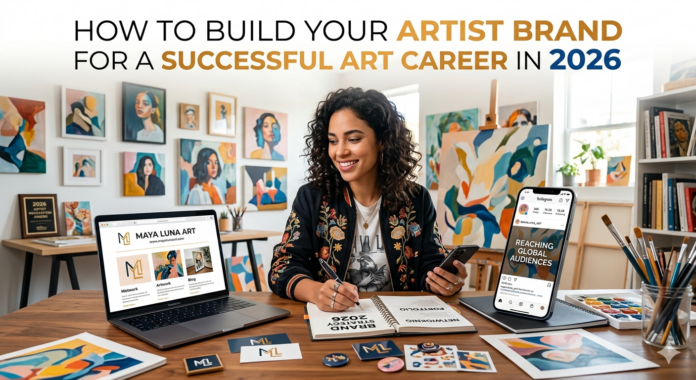
How to Build Your Artist Brand for a Successful Art Career in 2026
Cómo Construir Tu Marca de Artista para una Carrera Artística Exitosa en 2026
En 2026, el mundo del arte es más competitivo, digital y global que nunca. Ya no basta con crear obras impactantes: también necesitas una marca personal sólida para llegar a coleccionistas, galerías y curadores. Como crítico de arte y estratega SEO con un doctorado en historia del arte y marketing digital, comparto una guía paso a paso para que los artistas construyan una marca profesional y reconocible que apoye una carrera artística sostenible.
1. Define Tu Identidad Artística
Tu identidad artística es la base de tu marca. Pregúntate:
¿Qué temas, materiales o conceptos definen mi trabajo?
¿Qué emociones o ideas quiero que mi audiencia experimente?
¿Quién es mi público ideal: coleccionistas, galerías, museos o compradores online?
Una identidad clara crea consistencia en tu portafolio, redes sociales, exposiciones y prensa, aumentando el reconocimiento y la confianza en tu obra.
Consejo profesional: Escribe una declaración de artista breve que combine inspiración, métodos y visión en 3–5 frases. Esto será tu ancla narrativa de marca.
2. Construye una Presencia Online Profesional
Tu huella digital es ahora la forma principal en que los coleccionistas descubren artistas. Componentes clave:
a. Sitio web de artista
Muestra tu portafolio con imágenes de alta calidad (1200–2000 px de ancho).
Incluye declaración de artista, biografía, CV, menciones en prensa e información de contacto.
Aplica mejores prácticas SEO: optimiza títulos, texto alternativo para imágenes, meta descripciones y URLs.
b. Estrategia de redes sociales
Plataformas como Instagram, TikTok y Pinterest siguen siendo esenciales. Consejos:
Publica de manera consistente y comparte contenido detrás de cámaras.
Usa hashtags relevantes y geotags.
Interactúa con seguidores mediante comentarios, encuestas y videos en vivo.
Consejo profesional: Vincula todas tus redes a tu sitio web para generar tráfico y medir engagement.
3. Aprovecha el Storytelling para Destacar
Coleccionistas y galerías recuerdan historias más que imágenes. Tu viaje artístico —desde la inspiración hasta el proceso de taller— crea una conexión emocional.
Comparte anécdotas sobre técnicas, desafíos o influencias culturales.
Incluye tu filosofía y lo que hace única tu obra.
Usa video o contenido corto para comunicar tu historia de forma visual y personal.
Ejemplo: En lugar de solo publicar una pintura, explica el proceso, los materiales o las emociones que la inspiraron.
4. Haz Networking Estratégico
El branding no es solo visibilidad; se trata de construir relaciones auténticas:
Asiste a inauguraciones, ferias de arte y residencias artísticas.
Colabora con curadores, críticos y otros artistas.
Busca entrevistas y publicaciones en medios especializados.
En 2026, el networking híbrido (online y presencial) seguirá creciendo. Usa LinkedIn, Clubhouse y grupos de Discord dedicados a artistas para expandir tu alcance.
5. Ofrece Múltiples Puntos de Entrada a Coleccionistas
Diversifica tu audiencia ofreciendo obras a diferentes niveles:
Obras originales para galerías y coleccionistas.
Ediciones limitadas o prints para compradores emergentes.
Obras digitales o NFTs para coleccionistas online.
Esto no solo aumenta tus fuentes de ingresos, sino que también fortalece tu presencia de marca en distintos mercados.
6. Colabora con Profesionales de Marketing
Incluso los artistas más talentosos necesitan apoyo para amplificar su alcance. Colaborar con agencias de PR, expertos SEO o gestores de redes puede:
Incrementar cobertura en revistas de arte y medios locales.
Optimizar tu sitio web y redes para buscadores.
Crear newsletters y campañas de correo electrónico para conectar directamente con coleccionistas.
Consejo profesional: Monitorea el ROI de tu marketing usando visitas al sitio web, interacciones en redes sociales y consultas de coleccionistas.
7. Comprométete con el Crecimiento Continuo
El branding no es estático. En 2026, los artistas exitosos:
Actualizan su portafolio regularmente.
Reevalúan objetivos y audiencias.
Experimentan con nuevos medios y plataformas.
Este enfoque iterativo garantiza que tu marca evolucione junto con el mercado del arte, manteniendo autenticidad y relevancia.
Conclusión
Construir tu marca de artista en 2026 implica visibilidad, storytelling y engagement estratégico. Una marca sólida no solo exhibe tu obra, sino que transmite tu visión, genera confianza y posiciona tu carrera para un éxito sostenible en el mercado global.
Acción inmediata: Comienza auditando tu presencia digital hoy. Actualiza tu sitio web, define tu narrativa y establece un calendario de publicaciones consistente. Tu marca es tu carrera: invierte en ella con inteligencia.
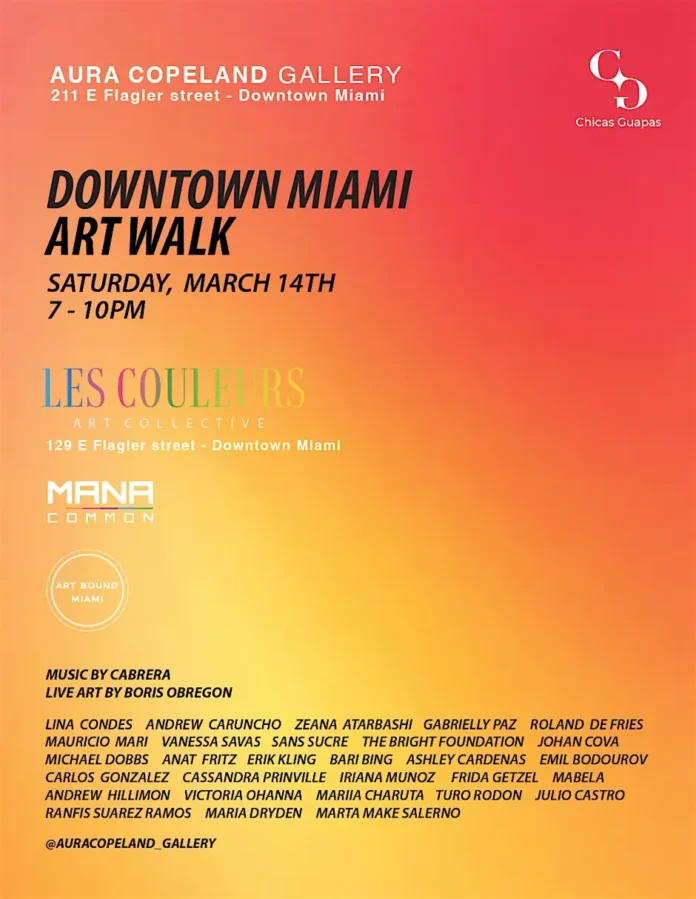
Save The Date: Miami Art Events Guide Saturday, Mar 14 from 7 pm to 10 pm
Check out amazing art and vibes at the Group Show happening live at Aura Copeland Gallery!
Downtown Miami Art Walk: 129 & 211 E Flagler st.
Join us for the Downtown Miami Art Walk, happening between two locations in the heart of Downtown Miami: 211 East Flagler Street and 129 East Flagler Street.
Explore an exciting group exhibition featuring mostly Miami-based emerging artists, along with a selection of mid-career and established artists. Enjoy an evening of live music, live art, a DJ, and an open bar while discovering fresh creativity and vibrant artistic energy in the city.
Save The Date: Miami Art Events Guide Friday, March 14
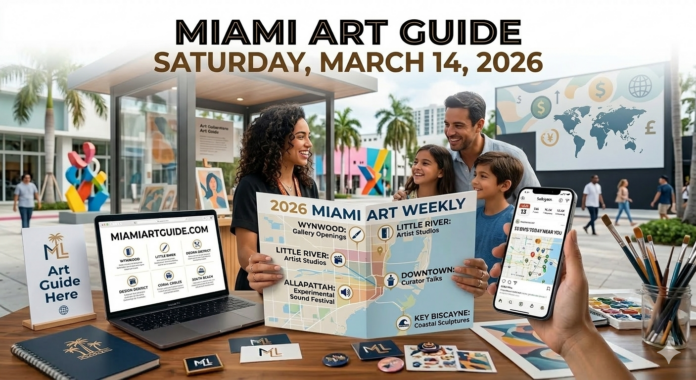
Miami Art Guide
Saturday, March 14, 2026
From family art days and environmental exhibitions to performances and gallery openings, South Florida’s art scene offers a diverse program of cultural events this Saturday. Here is a curated selection organized by neighborhood.
Miami Beach
Art Deco Welcome Center | Walking Tour
The Official Art Deco Walking Tour
Discover the architectural history of Miami Beach’s iconic Art Deco District on this guided tour organized by the Miami Design Preservation League. The 1.5–2 hour walking tour offers historical insights into the design, culture, and preservation of one of the city’s most recognizable neighborhoods.
PAMM Free Second Saturdays: Celebrating Women in Art
Enjoy free admission and a special community program celebrating women artists. Activities include art-making sessions, family-friendly tours, and educational programming for visitors of all ages.
A multidisciplinary festival exploring water as both a cultural and environmental resource. Highlights include the “What Do We Drink?” Best Miami Tap Water Competition, led by master water sommelier Rodrigo Anglarill, followed by performances, installations, and an artist perspectives panel.
Intermedia performance by Richard Vergez, with collaborators Marcela Loayza and Ana Méndez, presented in conjunction with Vergez’s solo exhibition Fragments of Disappearance. The performance explores themes of memory, presence, and the ephemeral nature of experience.
A solo exhibition by Adriana Estivill, curated by José Antonio Navarrete, exploring the intersections of memory, perception, and language through photography and book arts.
Time: 6 – 10 PM Location: 350 NE 75 St, Suite 103–2, Miami, FL 33138
Art, Design & Architecture in Nature: Spring Edition
Group exhibition curated by Hartvest Project and Doral Contemporary Art Museum, exploring the dialogue between contemporary artistic practices and the natural environment.
Experience Wynwood’s vibrant art scene during the monthly Second Saturdays Art Walk, where galleries, artist studios, and alternative art spaces open their doors to the public. Visitors can explore exhibitions, murals, and creative programming throughout the district.
Time: 7 – 11 PM Location: Wynwood Art District, Miami
Hollywood
Hollywood Art and Culture Center | Opening Reception
Three new exhibitions explore environmental narratives, fiber art, and documentary photography:
A free afternoon of creative activities celebrating Youth Art Month, including art-making workshops, story time, a music circle with Noam Brown, face painting, and family-friendly exhibition tours.
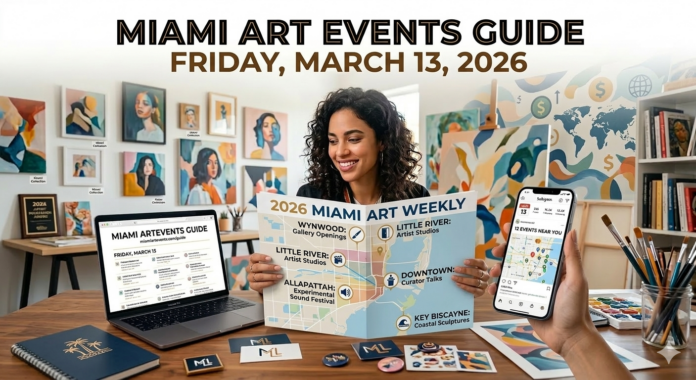
Miami’s art scene continues to thrive with a wide range of exhibitions, festivals, open studios, and talks taking place across the city. From experimental sound festivals in Allapattah to gallery openings in Little River and Wynwood, here are some of the most interesting art events happening on Friday, March 13.
Top Art Events in Miami This Weekend
Allapattah
El Espacio 23 | Open Studio
Open Studio with Artists in Residence
Visit the studios of artists-in-residence Sofia del Mar Collins and Laura Castro for an afternoon of conversation and insight into their current creative processes. Studio visits and informal discussions will be open to the public.
A multidisciplinary festival dedicated to the cultural, scientific, and artistic significance of drinking water. The evening includes experimental sound performances, installations, and a panel discussion featuring artists exploring water-related themes.
A highlight of the program is “Water in Beverages,” a demonstration and conversation examining water’s role in contemporary culture.
A group exhibition featuring Nicolás Beltrán, Nicole Burko, Dionnys Matos, Ernesto Gutiérrez Moya, and David E. Olivera. The show explores water as both an elemental force and symbolic presence across different painting practices.
The Brickell Key Gallery (BKG) | Opening Reception
Ricardo García – Solo Exhibition
The debut exhibition of the first art gallery on Brickell Key presents works by Ricardo García M., whose practice bridges Renaissance-inspired techniques with contemporary abstraction.
Museum of Contemporary Art of the Americas (MoCA-Americas)
Women of PAC — Kay Hurley
Solo presentation by Kay Hurley accompanied by works from invited PAC artists, creating a dialogue around contemporary perspectives and artistic practice.
A two-artist exhibition featuring Valerio D’Ospina and Katherine Stanek exploring perception, materiality, and constructed realities through painting and sculpture.
A solo exhibition featuring paintings and works on paper from 1985–1989, highlighting a pivotal moment in the artist’s development through layered color, gestural forms, and geometric structures.
An intimate evening with Cuban artist-in-residence Heyder Reyes, presenting his latest body of work exploring memory and identity.
Time: 6:30 PM Location: 2916 N Miami Ave, Suite 628, Miami, FL 33127 RSVP: Required
Fort Lauderdale
NSU Art Museum | Art in Context: History of Art Series
Lecture by Ariella Wolens
Join Ariella Wolens, Bryant-Taylor Curator, for an engaging and informal art history session designed for curious learners. This talk is part of an ongoing three-part lecture series exploring key moments in art history.
Time: 2 – 3 PM Location: One East Las Olas Blvd, Fort Lauderdale, FL 33301 Admission: Free for members / $16 non-members
Miami Beach
Miami Design Preservation League
Official Art Deco Walking Tour
Explore Miami Beach’s iconic Art Deco District on this guided walking tour led by the Miami Design Preservation League. The tour offers historical insights into the architecture and cultural legacy of one of the city’s most recognizable neighborhoods.
Time: 10:30 AM – 12:30 PM Location: Art Deco Welcome Center, 1001 Ocean Drive, Miami Beach
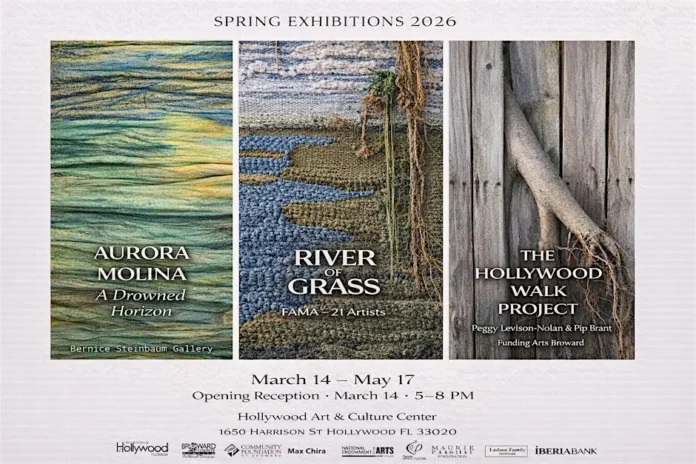
A Drowned Horizon by artist Aurora Molina River of Grass 20 artists from Fiber Artist Miami Association. The Hollywood Walk Project: Peggy Levison Nolan and Pip Brant
Opening reception:
March 14 • 5 – 8 PM
Free Arts Day with Aurora Molina: Sunday, March 15 • 12 – 3 PM
Hollywood Art and Culture Center
www.artandculturecenter.org
1650 Harrison St. Hollywood, FL 33020
Join Us for the Spring Exhibition Opening Reception!
ADrowned Horizon by artist Aurora Molina is an immersive installation of felt, thread, and layered textiles addressing Florida’s environment and landscape.
River of Grass presents 21 artists woven interpretations of the Florida Everglades on 6-foot looms from Fiber Artist MiamiAssociation.
The Hollywood Walk Project: Peggy LevisonNolan and Pip Brant feature the quirky, delightful observations captured in the photographs of two artist friends on their daily walks throughout Hollywood, Florida, for the past five years.
On view March 14, 2026 through May 17, 2026
River of Grass Artists:
Michelle Bardino Vela Jessica Barbosa Dalia Berlin Natalie Bheekie Veronica Buitron Andrea Cardenal Marco Caridad Fernanda Froes Mila Hajjar Isabel Infante Sarah Laing Paola Mondolfi Evelyn Politzer Alina Rodriguez Rojo Debora Rosental Susanne Schirato Aida Tejada Maru Ulivi Laura Villarreal Silvia Yapur Macarena Zilveti
About the Hollywood Art and Culture Center
Founded in 1975, the Hollywood Art and Culture Center is known in short as The Center and provides a central space that unites the community and serves as an inclusive catalyst and incubator for South Florida artists and performers to activate and elevate their work. The purpose is to help people connect, create and communicate to improve well-being and strengthen our community through art and cultural experiences for residents and visitors alike.
The Center is celebrating its 50th Anniversary as the county’s third oldest arts nonprofit and serves over 55,000 guests each year. The campus includes the new Hollywood Arts Hub that adjoins the current Main Galleries in the historic 1924 Kagey Home in downtown Hollywood, which features a 110-seat Arts Auditorium, Create More Art Studio, Digital Media Lab, and the Imagine Courtyard.
The Center presents year-round programs and venues that make numerous art forms accessible to all ages. In addition to the contemporary galleries in the Kagey Home, the Center operates the Artist In Residence Studios in the Art School on campus, manages facilities and delivers performances at the 500-seat Hollywood Central Performing Arts Center, and festivals and screenings at Cinema Paradiso Hollywood for independent, foreign language and first-run film.
Casa Atelier invites you to an evening with Cuban artist-in-residence, Heyder Reyes.
The opening marks the presentation of a new body of work developed during Reyes’ residency at Casa Atelier.
The residency creates a focused phase for new production, close curatorial dialogue, and thoughtful placement.
Through a language of fantastic realism, Reyes explores universal emotions — solitude, desire, and resilience — shaping a visual world that reflects on identity, displacement, and the human condition.
Guests are invited to experience the works, meet the artist, and gather in an intimate setting.
What to expect
- Presentation of new works – Conversation with the artist – Informal gathering
Hosted by Casa Atelier at Mindspace, Wynwood. In partnership with Mindspace.
ABOUT THE ARTIST
Born in Cuba, Reyes develops a practice grounded in drawing and painting, where the human figure becomes a site of tension, memory, and restraint. His work navigates themes of identity, power, and silence; often revealing what is held back rather than what is declared. Through precise gestures and a controlled visual language, Reyes invites slow looking and sustained reflection.
Heyder Reyes, Ingravido XIII, 2024 oil on canvas, 91 x 60 cm, 36 x 24 inches
How to Build Your Artist Brand for a Successful Art Career in 2026
How to Build Your Artist Brand for a Successful Art Career in 2026
In 2026, the art world is more competitive, digital, and global than ever before. It’s no longer enough to create compelling work—you also need a strong personal brand to reach collectors, galleries, and curators. As an art critic and SEO strategist with a PhD in both art history and digital marketing, I’ll share a step-by-step guide to help artists build a professional, recognizable brand that supports a sustainable art career.
1. Define Your Artistic Identity
Your artistic identity is the foundation of your brand. Ask yourself:
What themes, materials, or concepts define my work?
What emotions or ideas do I want my audience to feel?
Who is my ideal audience: collectors, galleries, museums, or online buyers?
A clear identity creates consistency across your portfolio, social media, exhibitions, and press, which increases recognition and trust in your work.
Pro Tip: Write a short artist statement that combines your inspiration, methods, and vision in 3–5 sentences. This will be your anchor for your brand narrative.
2. Build a Professional Online Presence
Your digital footprint is now the primary way collectors discover artists. Key components include:
a. Artist Website
Showcase your portfolio with high-quality images (1200–2000px wide).
Include an artist statement, biography, CV, press mentions, and contact info.
Implement SEO best practices: optimize titles, alt text for images, meta descriptions, and URLs for search engines.
b. Social Media Strategy
Platforms like Instagram, TikTok, and Pinterest remain essential for visual artists. Tips:
Post consistently and share behind-the-scenes content.
Use relevant hashtags and geotags.
Engage with followers through comments, polls, and live videos.
Pro Tip: Link all social media to your website to drive traffic and track engagement.
3. Leverage Storytelling to Stand Out
Collectors and galleries remember stories more than images. Your artistic journey—from inspiration to studio process—creates an emotional connection.
Share anecdotes about your techniques, challenges, or cultural influences.
Include your philosophy and what makes your work unique.
Use video or short-form content to communicate your story visually and personally.
Example: Instead of simply posting a painting, explain the process, materials, or emotions behind it.
4. Network Strategically
Branding isn’t just about visibility—it’s about building authentic relationships:
Attend gallery openings, art fairs, and artist residencies.
Collaborate with curators, critics, and fellow artists.
Seek interviews and features in art publications.
In 2026, hybrid networking—both online and in-person—will continue to grow. Use LinkedIn, Clubhouse, and Discord groups dedicated to artists to expand your reach.
5. Offer Collectors Multiple Entry Points
Diversify your audience by offering work at different levels:
Original artworks for galleries and collectors.
Limited editions or prints for emerging buyers.
Digital works or NFTs for online collectors.
This not only increases revenue streams but also strengthens your brand’s presence across markets.
6. Collaborate with Marketing Professionals
Even the most talented artists need support to amplify their reach. Collaborating with PR agencies, SEO marketers, or social media managers can:
Increase press coverage in art magazines and local media.
Optimize your website and social media for search engines.
Develop newsletters and email campaigns to engage collectors directly.
Pro Tip: Track your marketing ROI by monitoring website visits, social media engagement, and inquiries.
7. Commit to Continuous Growth
Branding is not static. In 2026, successful artists:
Update their portfolio regularly.
Reassess goals and target audiences.
Experiment with new media and platforms.
This iterative approach ensures your brand evolves with the art market while staying authentic to your vision.
Conclusion
Building your artist brand in 2026 is about visibility, storytelling, and strategic engagement. A strong brand doesn’t just showcase your work—it conveys your vision, builds trust, and positions you for sustainable success in the global art market.
By combining a clear artistic identity, a professional online presence, compelling storytelling, and strategic networking, you can create a brand that resonates with collectors, galleries, and audiences worldwide.
Action Step: Start by auditing your online presence today. Update your website, define your narrative, and create a posting schedule that consistently shares your work and story. Your brand is your career—invest in it wisely.
The history of American art in the late 20th and early 21st centuries cannot be written without acknowledging the profound contributions of women artists. From conceptual and political interventions to monumental sculpture and innovative painting, these artists have reshaped the language of contemporary art while confronting issues of identity, power, gender, and history.
The following figures represent some of the most influential American women artists whose work continues to shape the cultural landscape in 2026.
1. Julie Mehretu
One of the most celebrated painters of her generation, Julie Mehretu is known for monumental abstract compositions that merge cartography, architecture, and political history. Her layered paintings create complex visual systems that reflect globalization, migration, and urban transformation. In recent years, her works have achieved strong institutional recognition and major auction success, reinforcing her status as a central figure in contemporary abstraction.
2. Amy Sherald
Amy Sherald gained international recognition after painting the official portrait of Michelle Obama, but her work extends far beyond that iconic moment. Sherald’s portraits present Black Americans in contemplative and dignified settings, challenging traditional narratives of representation in art history. Her impact continues to grow, and she was named among Time Magazine’s Women of the Year in 2026.
3. Kara Walker
Kara Walker is widely recognized for confronting the history of slavery, race, and power in the United States. Her signature black paper silhouettes and large-scale installations create haunting narratives that explore the violent legacy of American history. Walker’s work remains a powerful force within both museum exhibitions and academic discourse.
4. Simone Leigh
Simone Leigh has become one of the most important sculptors working today. Her ceramic and bronze sculptures explore Black female identity, African diasporic traditions, and the politics of representation. Leigh’s work merges historical references with monumental forms that challenge Western sculptural conventions.
5. Mickalene Thomas
Mickalene Thomas is known for richly textured paintings and collages that celebrate Black femininity, beauty, and empowerment. Her use of rhinestones, patterned surfaces, and photographic references creates vibrant portraits that challenge traditional art historical representations of women.
6. Cindy Sherman
A pioneer of conceptual photography, Cindy Sherman revolutionized the medium with her Untitled Film Stills series. By transforming herself into multiple fictional characters, Sherman interrogates identity, media stereotypes, and the construction of femininity.
7. Barbara Kruger
Barbara Kruger’s graphic works—combining bold text with black-and-white imagery—have become some of the most recognizable visual statements in contemporary art. Drawing from advertising aesthetics, her work critiques consumer culture, power structures, and gender politics.
8. Jenny Holzer
Jenny Holzer transformed language into a visual medium. Her LED installations, projections, and public texts deliver powerful political messages in urban spaces and museums. Holzer’s works—such as the famous Truisms series—use language to provoke reflection on authority, violence, and truth.
9. Guerrilla Girls
Formed in 1985, the Guerrilla Girls are an anonymous feminist collective that exposed sexism and racism in the art world through posters, performances, and public campaigns. Their activism highlighted the underrepresentation of women in major museums and galleries, sparking a global conversation about equity in the arts.
10. Judy Chicago
A pioneer of feminist art, Judy Chicago reshaped the art historical canon with groundbreaking works such as The Dinner Party. Her practice integrates craft traditions, collaborative processes, and historical research to highlight the overlooked achievements of women throughout history.
11. Sheila Hicks
Sheila Hicks is one of the most influential textile artists of the modern era. Her monumental fiber installations blur the boundaries between craft, sculpture, and architecture, demonstrating the expressive potential of textile materials within contemporary art.
12. Kiki Smith
Kiki Smith’s multidisciplinary work spans sculpture, printmaking, and installation. Often addressing themes of the body, mythology, and spirituality, her work explores the fragile relationship between humanity and nature.
13. Lynda Benglis
Known for her experimental sculptures made from poured latex, foam, and wax, Lynda Benglis challenged traditional definitions of sculpture in the 1970s. Her work continues to influence generations of artists interested in material experimentation.
14. Marilyn Minter
Marilyn Minter’s hyper-sensual paintings and photographs explore beauty, glamour, and desire. By focusing on surfaces—glitter, sweat, cosmetics—Minter critiques the seductive power of advertising and the beauty industry.
15. Shahzia Sikander
Although born in Pakistan and working internationally, Shahzia Sikander has become an influential figure in American contemporary art. Her work transforms the language of Indo-Persian miniature painting into contemporary installations, animations, and drawings that explore migration, gender, and postcolonial identity.
16. Jaune Quick-to-See Smith
A pioneering Native American artist, Jaune Quick-to-See Smith uses painting, collage, and printmaking to critique colonial history and environmental destruction. Her work brings Indigenous perspectives into mainstream contemporary art discourse.
17. Yoko Ono
Although internationally known as a conceptual artist and musician, Yoko Ono’s influence on performance and participatory art remains immense. Her works invite viewers to become active participants, turning art into an act of collective imagination and peace activism.
Conclusion
The artists featured here represent multiple generations and artistic strategies—from conceptual text works and activist collectives to monumental sculpture and contemporary portraiture. What unites them is their ability to redefine the boundaries of art while addressing the urgent social, political, and cultural questions of their time.
In 2026, American women artists are not simply participants in the art world—they are among its most powerful innovators and critical voices.
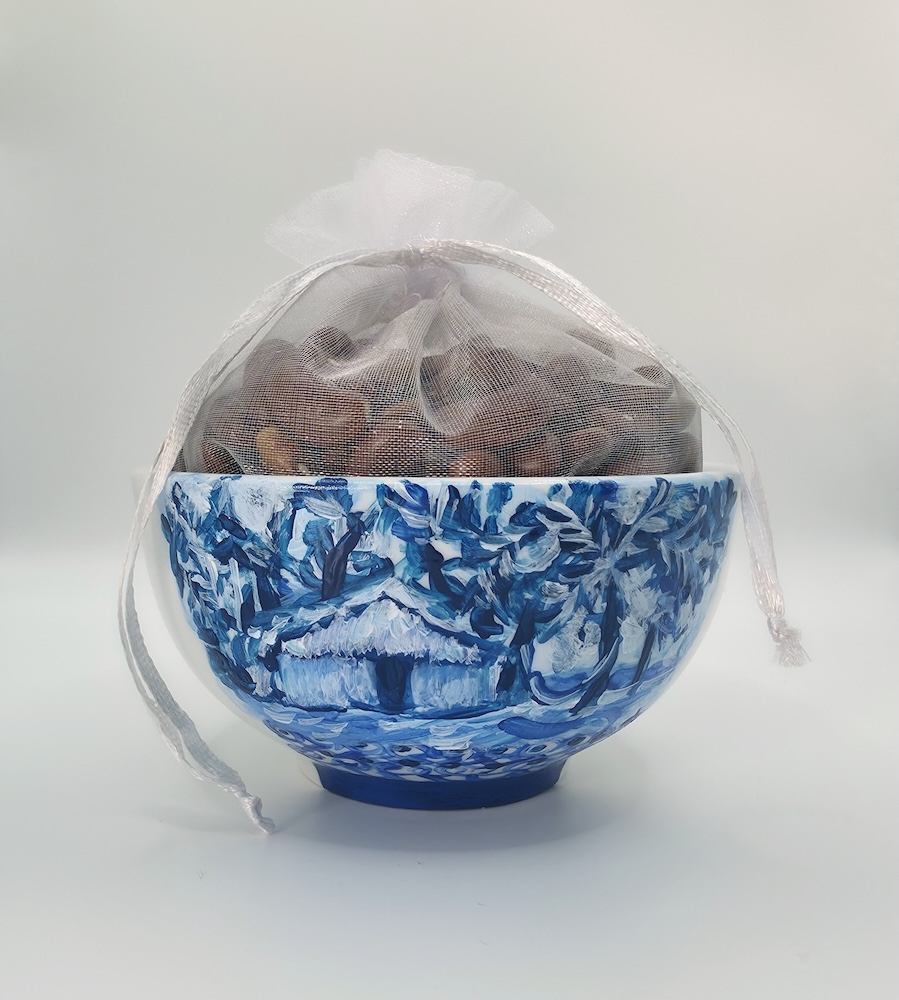
Las Poroteras (detail), painted rice cup and beans. Courtesy of the artist.
MaiYap: A House of Small Altars
Sophie Bonet
A House of Small Altars is an exhibition about what survives. Not the spectacular markers of culture, but the quiet systems of care—objects, gestures, and repetitions—that carry identity across time, migration, and loss. Rooted in the lived experience of Chinese–Panamanian artist MaiYap, the exhibition unfolds as a domestic architecture shaped by memory, ritual, and labor. It is a house built not from walls, but from what is held, repeated, and remembered.
The project emerged from a moment of rupture. During the COVID-19 pandemic, amid a global surge in anti-Asian violence, MaiYap began reexamining her identity as an Asian Panamanian woman living in the United States. That reckoning prompted a deeper inquiry: what defines heritage when culture has been carried across oceans, adapted through survival, and preserved largely within the home? She returned to a guiding question that anchors the exhibition: What was in my house that wasn’t in yours?
The answer did not reside in formal tradition or public ritual, but in domestic life—in food, repetition, and unspoken gestures of care. In diasporic contexts, the home often becomes the most resilient site of cultural transmission, where memory is carried through the body rather than the archive, through practice rather than instruction. While language, dress, and public customs may shift across generations, foodways and domestic rituals persist. They are enacted daily, without explanation, and learned through repetition.
For MaiYap, the house was never a singular structure. It existed as a constellation: her family home adjacent to her parents’ store, and the park across the street. These spaces formed a porous ecosystem of labor and play, safety and solitude, devotion and neglect. When she was five years old, her siblings and grandparents moved away to pursue better education, leaving her behind without explanation. That early fracture—being free to roam yet emotionally abandoned—becomes a quiet undertow throughout the exhibition. Memory here is not stable or complete; it is improvised, embodied, and unresolved.
The works in A House of Small Altars do not attempt to reconstruct the past. Instead, they acknowledge memory as fragmented—commemorative without nostalgia, devotional without doctrine. Each installation operates as an altar in the anthropological sense: a mediating structure where the visible and invisible, the personal and collective, the living and ancestral intersect. These altars are small not in significance, but in scale—formed through everyday materials and repeated acts rather than monumentality.
The Gathering, installation view. Porcelain soup spoons, hilo pabilo (Panama). Image by Zaire Aranguren. Courtesy of the artist.
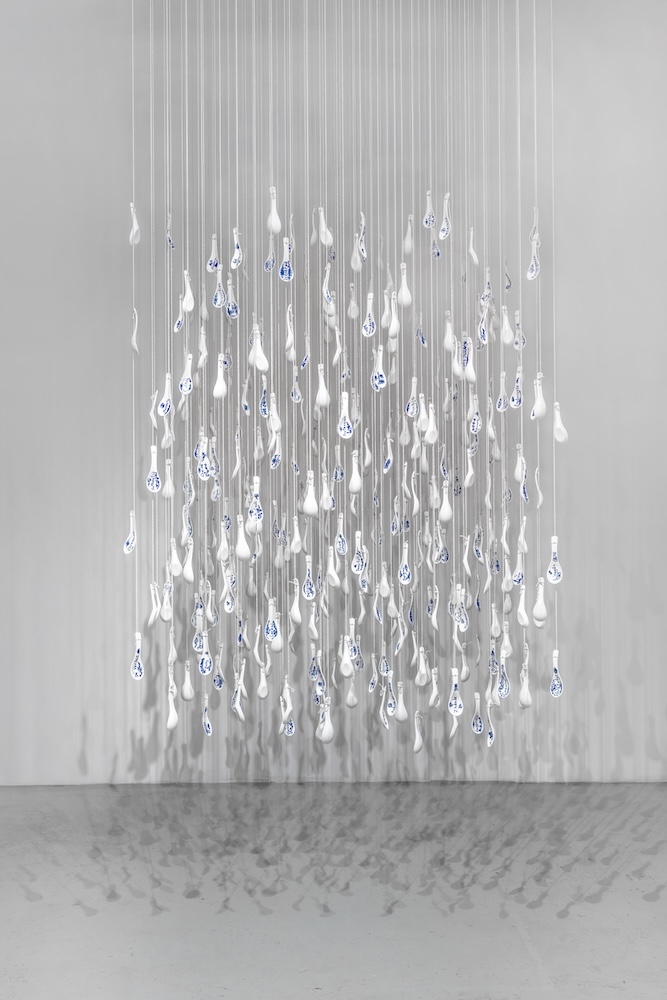
At the center of the exhibition is The Gathering, an installation originally composed of 520 hand-painted white porcelain soup spoons suspended at eye level with hilo pabilo brought from Panama. In Chinese households, the tāng gēng (湯羹) soup spoon holds particular intimacy. Unlike chopsticks, which require dexterity and autonomy, the spoon is often used to feed others—children, elders, the sick—and is associated with warmth, attentiveness, and care.
The Gathering (detail), hand-painted porcelain spoons. Courtesy of the artist.
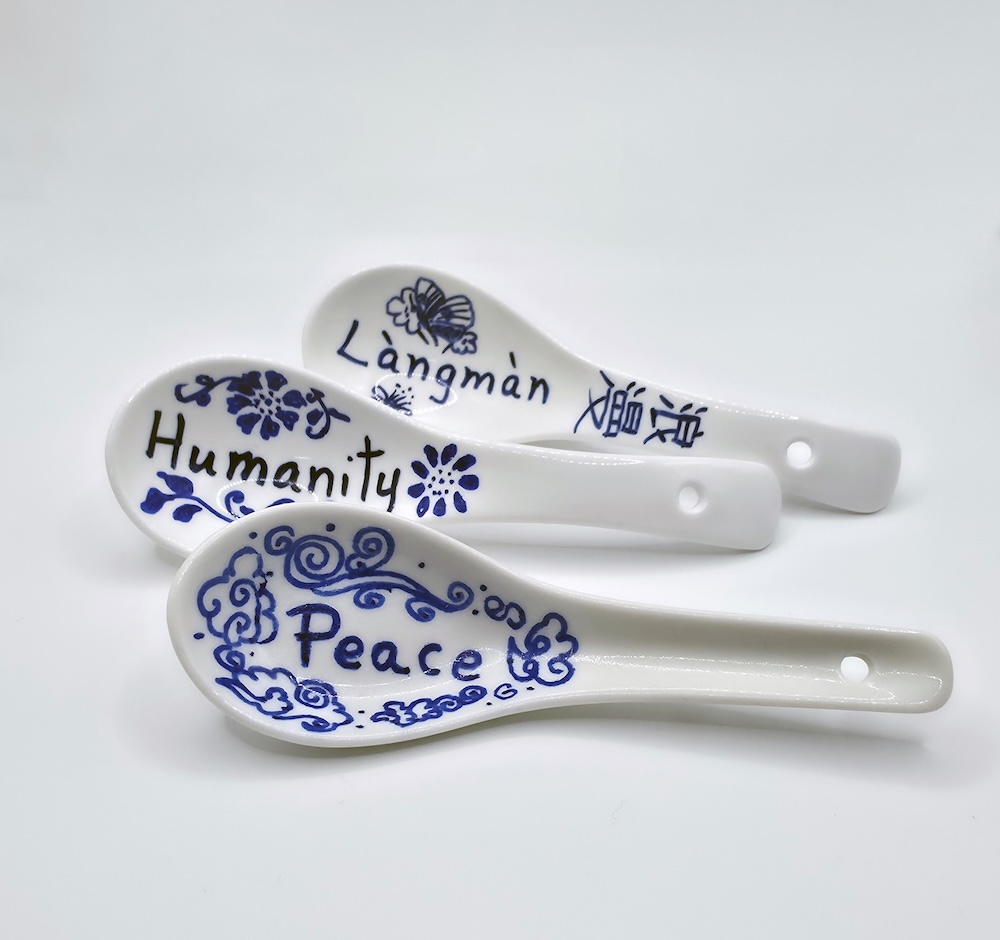
In diasporic homes, food rituals frequently become the most enduring carriers of cultural memory. Ingredients adapt to new geographies and recipes shift, but the rhythm of preparation and sharing remains. Each spoon in The Gathering bears a word in Chinese, Spanish, or English—languages that shape MaiYap’s cultural formation. These words name emotions that arise around cooking, sharing, and receiving food: love, patience, obligation, exhaustion, joy. Meaning does not translate seamlessly; it accumulates through repetition.
The number 520 carries layered significance. In contemporary Chinese culture, it phonetically resembles wo ai ni (“I love you”) and refers to May 20, an unofficial Valentine’s Day. Within the installation, the number also mirrors the scale of domestic labor—cooking not once, but endlessly; loving not as declaration, but as sustained practice. Suspended in the round, the spoons require viewers to move slowly, implicating the body in remembrance.
The choice of hilo pabilo is equally deliberate. A humble cotton twine commonly used in Panamanian homes and small businesses, it belongs to a material culture of repair—tying, bundling, mending, holding things together. Here, it becomes a material archive of labor and care, binding nourishment to work and geography to memory.
Utter Devotion, installation view. Incense sticks, rope, matches. Courtesy of the artist.
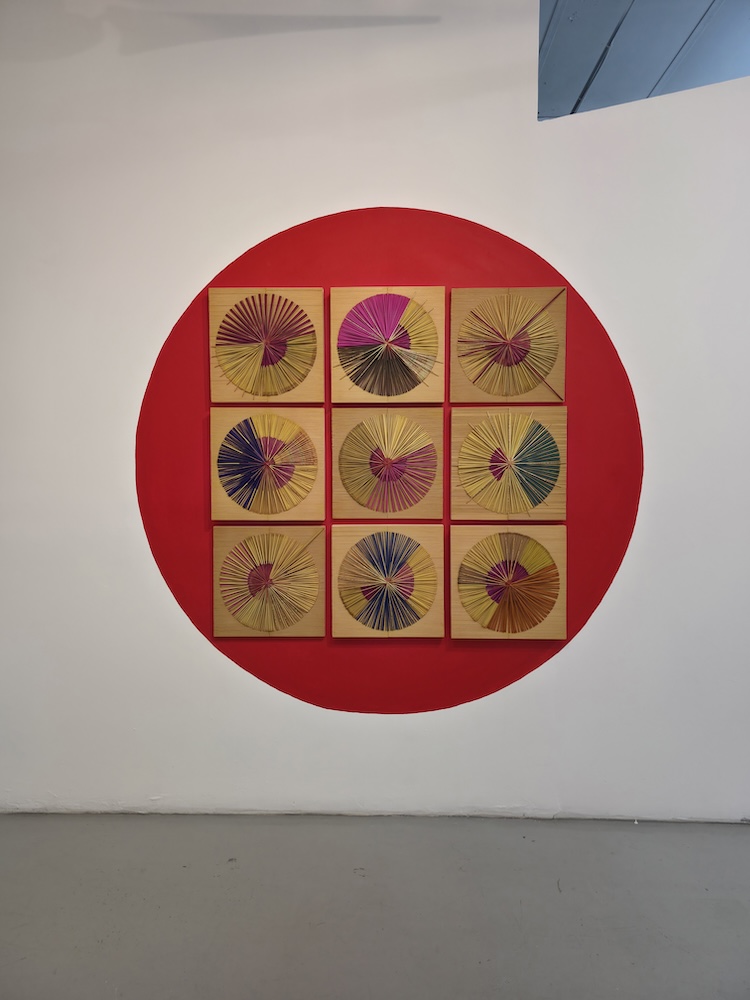
Utter Devotion functions as a threshold within the exhibition. Composed of incense sticks, the work draws from the artist’s memory of her mother’s daily ritual of offering three incense sticks before the statue of Guan Yu, widely revered for loyalty, righteousness, protection, and moral integrity.
Although MaiYap was raised Catholic in Panama—a predominantly Catholic country—this private ritual persisted quietly within the home. Such practices exemplify religious syncretism, common in diasporic contexts where belief systems coexist rather than replace one another. Domestic altars often function as sites of cultural preservation under conditions of migration and assimilation. They are not performative or doctrinal; they are sustained through repetition, without witnesses.
In Chinese cosmology, the square symbolizes Earth and the circle Heaven—stability and eternity held in balance. In Utter Devotion, repetition itself becomes sacred. Faith is enacted not through spectacle, but through continuity—through showing up every day.
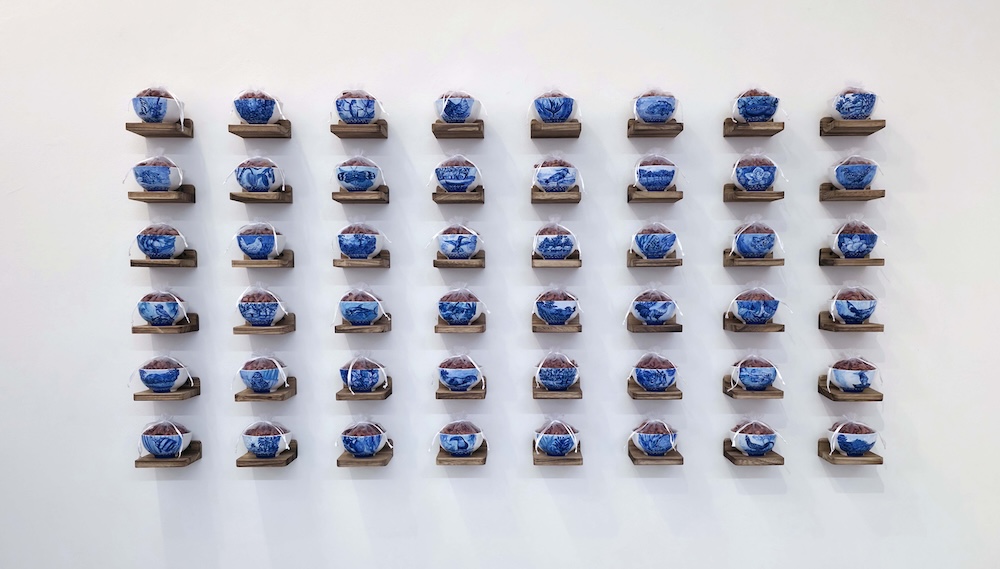
Las Poroteras, installation view. Chinese rice cups, beans, organza. Courtesy of the artist.
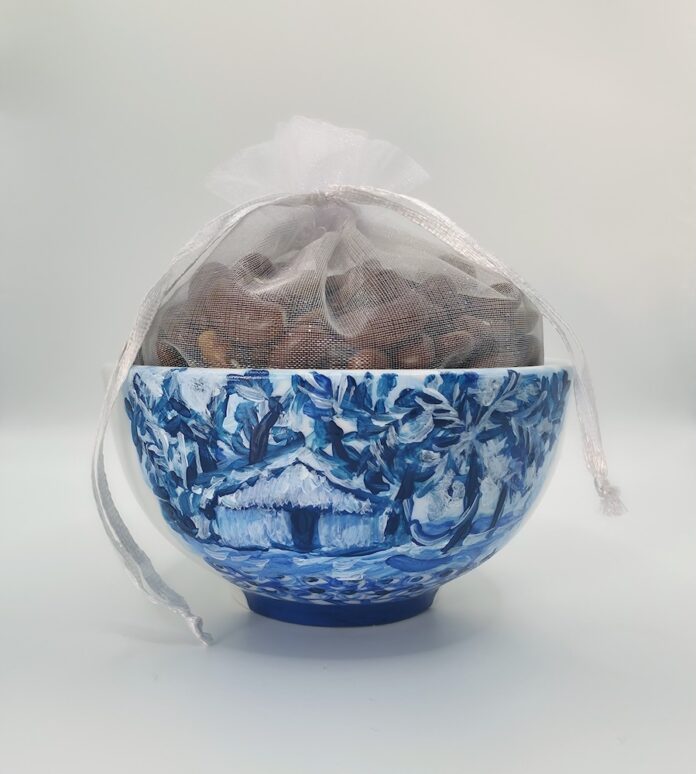
In Las Poroteras, MaiYap presents a body of 88 sculptural vessels made from Chinese rice cups filled with beans and wrapped in organza. Rice cups occupy a specific place in Chinese foodways, offering a practical solution for eating rice with chopsticks while symbolizing sustenance and abundance. The number 88 signifies double happiness, prosperity, and continuity in Chinese numerology.
Las Poroteras (detail), painted rice cup and beans. Courtesy of the artist.
Painted in blue and white in the style of Ming dynasty ceramics, the cups feature imagery drawn from the artist’s childhood in Aguadulce, Panama—palm trees, roosters, fish, jungle landscapes, and the islands of San Blas. These motifs resist singular cultural origin. The vessels are neither Chinese nor Panamanian alone; they are sites of cultural negotiation shaped by migration and adaptation.
The beans reference fertility, agriculture, and women’s labor—particularly the often-invisible work of cultivation, preparation, and sustenance. Across cultures, beans are associated with nourishment and survival. Here, placed in delicate organza bags, they transform the cups into offerings, honoring matrilineal knowledge passed through hands rather than texts.
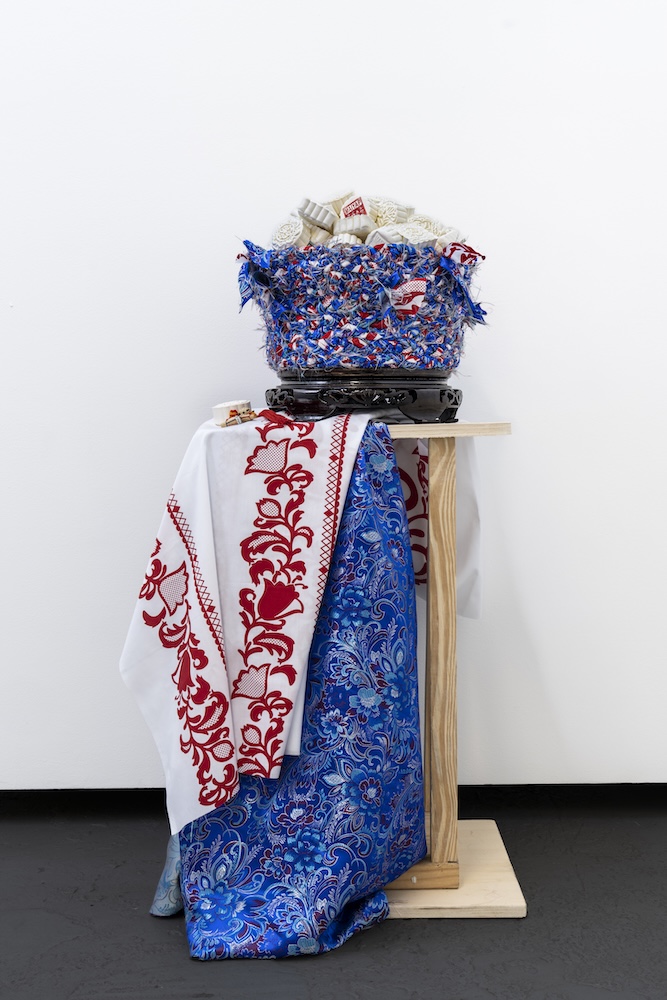
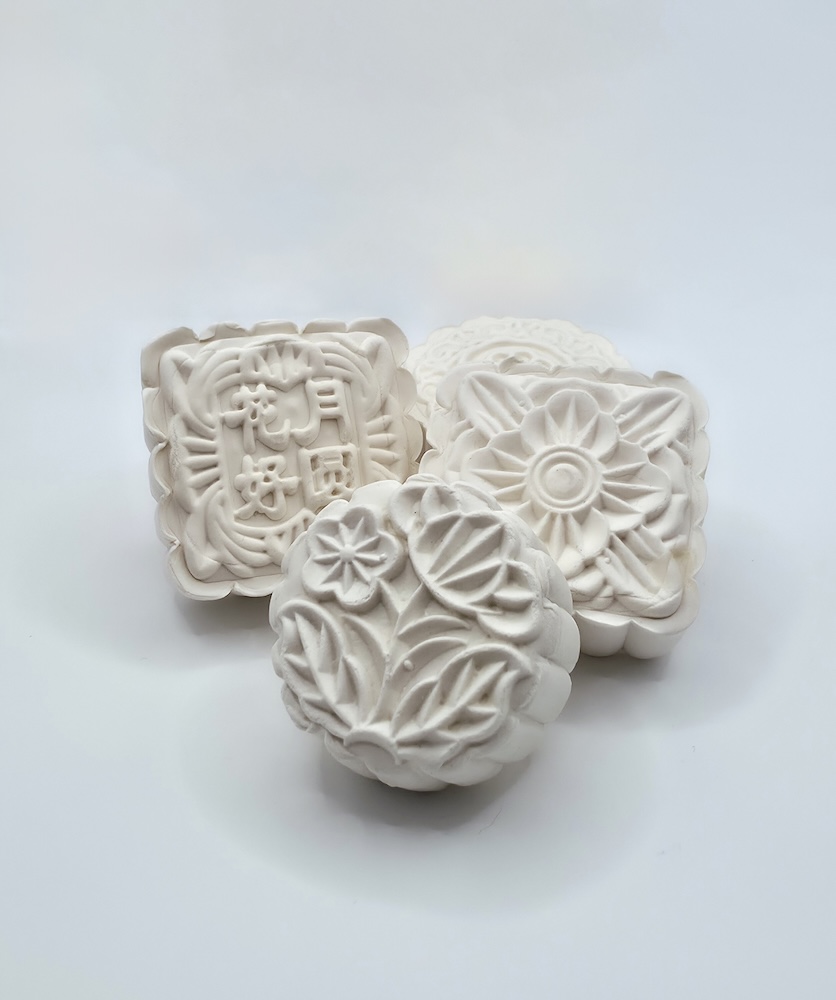
Over the Moon completes the environment. The installation consists of sculpted mooncakes—originally conceived in a set of 520—resting within a nest constructed from traditional Panamanian pollera fabrics and traditional Chinese tapestries. The nest introduces a register of memory that is soft, tactile, and protective, grounding the work in textile traditions historically tied to femininity, ceremony, and cultural transmission.
Over the Moon, installation view. Sculpted mooncakes, nest of traditional Panamanian pollera fabrics, and traditional Chinese tapestries. Image by Zaire Aranguren. Courtesy of the artist.
The pollera, one of Panama’s most emblematic garments, carries histories of craftsmanship, ornamentation, and regional identity. Its embroidered floral motifs and layered construction are associated with celebration, visibility, and collective pride. Chinese tapestries, by contrast, often function within domestic interiors as carriers of symbolic imagery and auspicious meaning, passed down through generations as markers of lineage and continuity.
Textiles—among the earliest technologies of care—clothe bodies, line domestic spaces, and absorb touch, wear, and time. Here, fabric becomes shelter rather than surface. The nest does not frame the mooncakes as objects for display; it holds them as offerings—protected, cradled, and gathered.
Over the Moon (detail), mooncakes within textile nest. Courtesy of the artist.
Mooncakes themselves are objects of layered history. Traditionally exchanged during the Mid-Autumn Festival, they symbolize reunion, completeness, and cyclical time. Historically, they also functioned as vehicles for resistance: during the thirteenth century, messages were hidden inside mooncakes to coordinate revolt against Mongol rule. Celebration and survival coexist within their form.
Taken together, the installations form a single environment rather than a sequence of objects. A House of Small Altars operates as a living ethnography—one that understands culture not as static inheritance, but as embodied practice shaped through repetition, care, and everyday labor. As a curator, I approach this exhibition not as an act of classification, but of listening. MaiYap’s guiding question—What was in my house that wasn’t in yours?—becomes an invitation rather than a boundary.
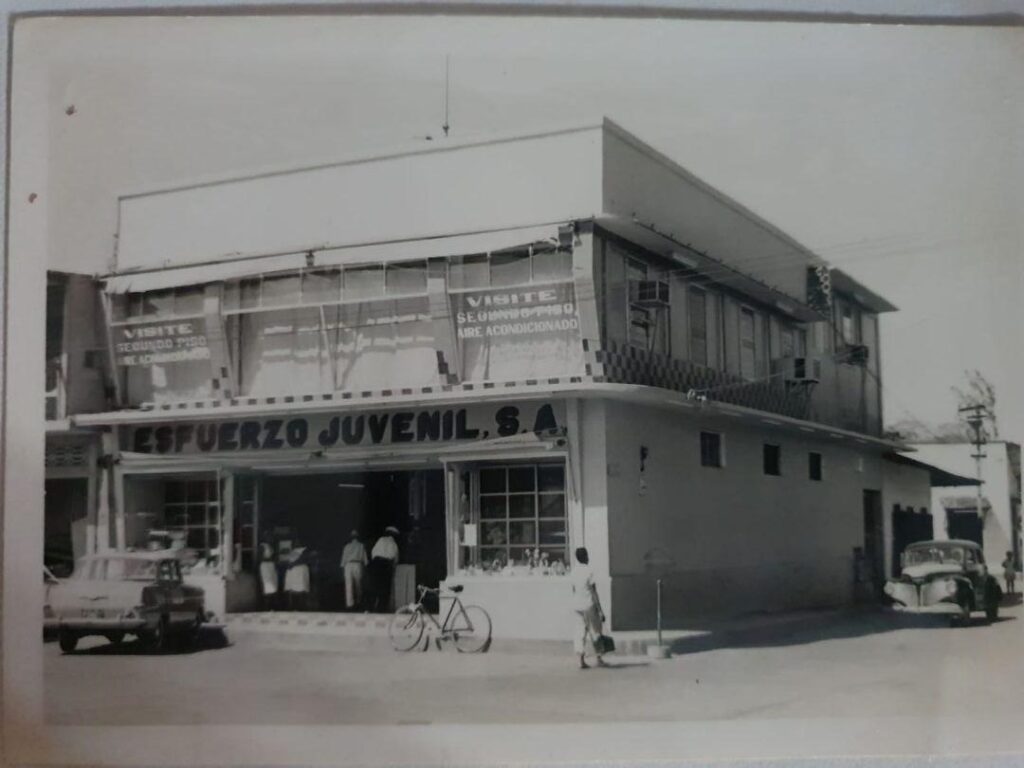
Archival Images. Yap Family, 1960. Courtesy of the artist.Archival Images. Yap’s Family Store “Esfuerzo Juvenial”. Courtesy of the artist.
Ultimately, this exhibition is an offering: to a mother who migrated at eighteen and worked her entire life; to ancestors whose knowledge traveled through hands rather than texts; and to viewers, invited not as observers but as participants—asked to slow down, to witness, and to recognize that healing, like devotion, is built through small, repeated acts. In this house, nothing is monumental—yet everything matters.
This essay is informed by interdisciplinary scholarship on memory, ritual, care, and diasporic cultural transmission. It draws particularly from frameworks that understand memory as embodied practice rather than fixed archive (Diana Taylor; Paul Connerton), domestic ritual as a site of cultural continuity under conditions of migration (Arjun Appadurai), and care as an ethical and material practice sustained through repetition, repair, and labor (Joan Tronto).
Bibliography
1. Appadurai, Arjun. Modernity at Large: Cultural Dimensions of Globalization. Minneapolis: University of Minnesota Press, 1996.
2. Connerton, Paul. How Societies Remember. Cambridge: Cambridge University Press, 1989.
3. Hirsch, Marianne. The Generation of Postmemory: Writing and Visual Culture After the Holocaust. New York: Columbia University Press, 2012.
4. Mintz, Sidney W. Sweetness and Power: The Place of Sugar in Modern History. New York: Penguin Books, 1985.
5. Taylor, Diana. The Archive and the Repertoire: Performing Cultural Memory in the Americas. Durham: Duke University Press, 2003.
6. Tronto, Joan C. Moral Boundaries: A Political Argument for an Ethic of Care. New York: Routledge, 1993.
Sophie Bonet (b. 1986) is a South Florida–based curator whose practice is deeply informed by her background in social and cultural anthropology. She approaches exhibitions as living ecosystems—responsive spaces shaped by memory, ritual, and transformation. Her transdisciplinary work is research-driven and grounded in the belief that art functions as a site of dialogue, cultural inquiry, and collective imagination.
Bonet has led exhibitions and public programs across prominent institutions in the United States and abroad, including the Contemporary Arts Museum Houston (CAMH), the Barcelona Museum of Contemporary Art (MACBA), and the Museum of Contemporary Art North Miami (MOCA), where she served as Exhibition Manager for landmark presentations such as Juan Francisco Elso: Por América (in collaboration with El Museo del Barrio), Didier William: Nou Kite Tout Sa Dèyè, and Jamea Richmond-Edwards: Ancient Future. Her early research at MACBA focused on the archival documentation and critical interpretation of Espai 13’s history, tracing three decades of artist-led experimentation at the Joan Miró Foundation.
Currently Chief Curator of The Frank C. Ortis Gallery in Pembroke Pines, Florida, Bonet leads an ambitious exhibition program centered on accessibility, sensory engagement, and community-rooted storytelling. Curating across disciplines—from ecological installation to fiber art and new media—she explores themes of identity, migration, belonging, and place through an anthropological and phenomenological lens.
Bonet holds degrees in Fine Arts, Art History, and Anthropology. She is currently pursuing graduate research examining curating as a ritual and phenomenological practice shaped by memory, embodiment, and cultural translation. She is a member of IKT – the International Association of Curators of Contemporary Art.
The Light of the World Exhibition Opens at the Olga M. and Carlos A. Saladrigas Gallery in Miami
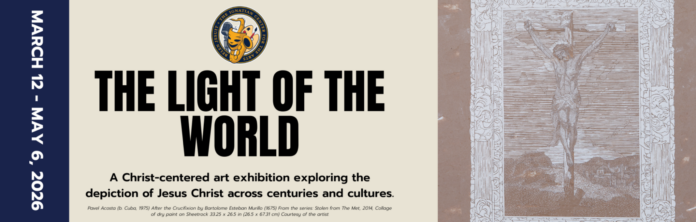
Miami, FL — The Olga M. and Carlos A. Saladrigas Gallery at Belen Jesuit Preparatory School proudly presents The Light of the World, a Christ-centered exhibition exploring the artistic representation of Jesus Christ across centuries and cultures. The exhibition will be on view March 12 through May 6, 2026, at Belen Jesuit Preparatory School, located at 500 SW 127 Avenue, Miami, Florida.
The exhibition opens with a public reception on Thursday, March 12, from 6:00 to 9:00 PM, featuring live music and refreshments. Admission is free and open to the public.
A Journey Through Sacred Art
For nearly two thousand years, artists have interpreted the figure of Jesus Christ, shaping some of the most powerful and enduring images in the history of art. The Light of the World invites visitors to explore this profound tradition through an extraordinary selection of paintings, sculptures, and drawings spanning from the 16th century to the present day.
The exhibition includes Russian icons, Renaissance works, paintings from the Cuzco School, late 19th- and early 20th-century Latin American pieces, and contemporary works by local and international artists. Among the highlights are icons created in the 21st century as devotional prayers, demonstrating how sacred imagery continues to evolve within contemporary artistic practice.
Curated by Carol Damian, Ph.D., and Adriana Herrera, Ph.D., the exhibition offers a rich and immersive narrative that traces how artists from Europe, Russia, South America, and the United States have interpreted the life and symbolism of Christ.
Participating Artists
Artists featured in the exhibition include:
Pavel Acosta, Stella Bernal de Parra, Karim Borjas, Pablo Cano, Willy Castellanos, Mercedes Durrieu, Fernanda Frangetto, Héctor Fuenmayor, Flor Godward, Silvia Lizama, Marcela Marcuzzi, Andrés Michelena, Vero Murphy, Darío Ortiz, Pamela Palmieri Bettner, Natalia Plascencia, Víctor Hugo Rivas, María Luisa Santamarina, and Raimundo Travieso.
Public Programs and Community Engagement
Throughout the exhibition, the gallery will host curator-led tours, artist talks, and panel discussions with participating artists and art critics. The programming aims to deepen the public’s engagement with sacred art and foster dialogue about the cultural and spiritual significance of these works.
Committed to accessibility and education, The Light of the World invites visitors from all backgrounds to experience the enduring power of sacred imagery.
Exhibition Details
What:The Light of the World Where: Olga M. and Carlos A. Saladrigas Gallery, Belen Jesuit Preparatory School 500 SW 127 Avenue, Miami, FL 33144
When: March 12 – May 6, 2026 Opening Reception: Thursday, March 12, 6:00 – 9:00 PM
Gallery Hours: Wednesdays and Thursdays, 8:00 AM – 4:00 PM, or by appointment. For appointments: [email protected]
Admission: Free
Media Contact
For media inquiries, please contact: Teresa Martinez Director of Communication [email protected]
For artwork inquiries, images, or interview requests, please contact: Carol Damian – [email protected] Adriana Herrera – [email protected]
About Belen Jesuit Preparatory School
Founded in 1854 by the Society of Jesus in Havana, Belen Jesuit Preparatory School was re-established in Miami in 1961 following the confiscation of private schools in Cuba. Today, the institution serves approximately 1,400 students in grades 6–12 and counts more than 8,000 alumni, continuing its long tradition of academic excellence, cultural engagement, and community leadership.