Home Blog Page 31

Andy Warhol: The Artist Who Made America Look at Itself

Andy Warhol
Andy Warhol

Andy Warhol: The Artist Who Made America Look at Itself

In the pantheon of twentieth-century art, few figures loom as large or as paradoxically as Andy Warhol. Born Andrew Warhola in 1928 to Slovakian immigrant parents in Pittsburgh, he would become the most recognizable artist of his generation—a man who transformed soup cans into icons, elevated celebrity to high art, and blurred the boundaries between commerce and culture so thoroughly that we’re still untangling the implications today.

Warhol didn’t just document the rise of consumer culture and mass media in postwar America; he became its most perceptive chronicler, its shrewdest critic, and perhaps its most enthusiastic participant. His legacy extends far beyond the art world, touching fashion, film, music, and our fundamental understanding of fame, authenticity, and value in the modern age.

From Commercial Illustrator to Art World Phenomenon

Warhol’s path to artistic immortality began in the unglamorous trenches of commercial illustration. After graduating from Carnegie Institute of Technology in 1949 with a degree in pictorial design, he moved to New York and spent the 1950s building a successful career creating advertisements for magazines, department stores, and shoe companies. This background proved crucial. While the reigning Abstract Expressionists like Jackson Pollock and Willem de Kooning sought to distance art from commerce, treating the canvas as a space for pure emotional expression, Warhol moved in the opposite direction.

He recognized something the art establishment had missed: that commercial imagery had become the most powerful visual language of American life. Advertisements, product packaging, celebrity photographs—these were the images that ordinary people encountered daily, that shaped their desires and structured their understanding of the world. To ignore this visual landscape in favor of gestural abstraction was, in Warhol’s view, to miss the point of what it meant to be alive in twentieth-century America.

The breakthrough came in the early 1960s with his now-legendary Campbell’s Soup Cans. Displaying thirty-two canvases, each depicting a different variety of Campbell’s soup, Warhol presented products as worthy subjects for serious artistic contemplation. The art world reacted with confusion, outrage, and fascination. Was this art or advertising? Celebration or critique? The genius lay precisely in the ambiguity. Warhol refused to provide easy answers, maintaining throughout his life an enigmatic public persona that deflected interpretation.

The Factory: Art as Industrial Production

In 1962, Warhol moved his studio to a silver-painted loft space that became known simply as The Factory. The name was intentional and provocative. While artists traditionally worked in studios—spaces associated with individual creative genius and craft—Warhol operated a factory, deliberately invoking industrial production and questioning romantic notions of artistic creation.

The Factory became legendary not just for the art produced there but as a social scene. It attracted an eclectic cast of characters: socialites and street hustlers, drag queens and debutantes, musicians and misfits. Warhol cultivated this circus-like atmosphere, understanding that the personalities and dramas unfolding in his space were as much a part of his artistic practice as the silkscreens being produced. The Factory was performance art before the term became commonplace, a living tableau of downtown Manhattan’s creative and destructive energies.

His use of silkscreen printing epitomized his approach to art-making. This mechanical reproduction technique, borrowed from commercial printing, allowed him to create multiple versions of the same image with subtle variations. Assistants often executed much of the physical work, leading critics to question whether Warhol was even making “his own” art. But this missed the point entirely. Warhol was interrogating the very concept of authorship and originality in an age of mass reproduction. If uniqueness was what made art valuable, what happened when images could be endlessly duplicated? His work forced uncomfortable questions about authenticity and value that remain urgent today.

Celebrity, Repetition, and the American Death Drive

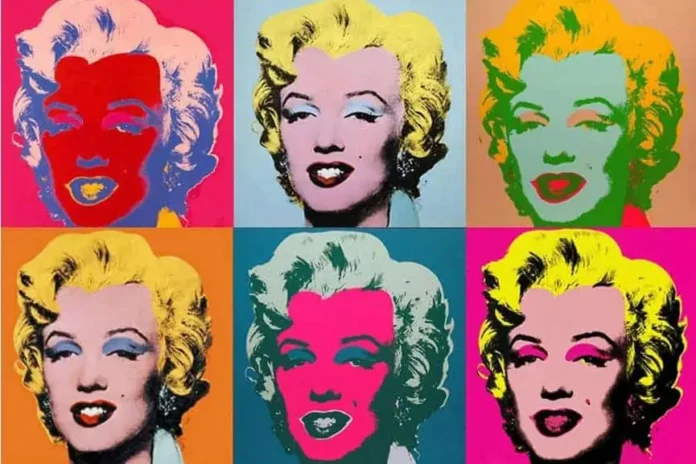
Warhol’s portraits of celebrities—Marilyn Monroe, Elizabeth Taylor, Elvis Presley, Jackie Kennedy—represent some of his most iconic and misunderstood work. At first glance, they seem to simply celebrate fame, reproducing familiar faces in bright, eye-catching colors. But look closer, and something darker emerges.

His Marilyn Diptych, created shortly after Monroe’s death in 1962, presents fifty images of the actress derived from a single publicity photograph. On the left panel, Marilyn appears in vibrant colors; on the right, the images fade into murky blacks and grays, her face becoming progressively more ghostly and indistinct. The work captures how celebrity functions in American culture—the bright surface appeal masking tragedy, the way repetition drains even the most beautiful face of meaning, transforming a person into a commodity that can be reproduced, consumed, and ultimately discarded.

This fascination with repetition extended to his Disaster series, silkscreens depicting car crashes, electric chairs, and other scenes of death and violence taken from newspaper photographs. By reproducing these images multiple times within a single canvas, Warhol captured how modern media has numbed us to tragedy through constant exposure. Horror becomes wallpaper. The shocking becomes routine. It was a profoundly unsettling commentary on American culture disguised as pop art.

Film, Music, and Multimedia Experimentation

Warhol’s ambitions extended well beyond painting and printmaking. Between 1963 and 1968, he created nearly 650 films, ranging from his notorious eight-hour static shot of the Empire State Building to more narrative works featuring Factory regulars. These films challenged conventional notions of cinema, often eschewing traditional storytelling in favor of extended observation. Sleep, a five-hour film of poet John Giorno sleeping, tested the limits of viewer patience and attention, asking what constitutes a cinematic event worthy of documentation.

His involvement with The Velvet Underground, the experimental rock band he managed and promoted in the mid-1960s, demonstrated his influence beyond visual art. Warhol designed the iconic banana cover for their debut album and created the Exploding Plastic Inevitable, a multimedia performance series combining the band’s music with projected films and lights. This Gesamtkunstwerk—total artwork—anticipated the immersive multimedia experiences that would dominate contemporary art and entertainment decades later.

The Business of Being Andy Warhol

“Being good in business is the most fascinating kind of art,” Warhol famously declared. “Making money is art and working is art and good business is the best art.” This conflation of artistic and commercial success scandalized the art establishment but proved remarkably prescient. Warhol understood that in contemporary capitalism, the boundaries between art, commerce, and personal brand had collapsed.

He formalized this understanding by founding Andy Warhol Enterprises Inc. and later creating Interview magazine, which documented celebrity culture with a knowing mixture of fascination and detachment. His commissioned portraits of wealthy patrons and celebrities became a lucrative business, with Warhol functioning as court painter to the Studio 54 era’s social elite. Critics accused him of selling out, but this misunderstood his project. Warhol wasn’t selling out; he was demonstrating that the concept of selling out had become meaningless in a culture where everything, including authenticity itself, was for sale.

His aphorisms—collected in books like The Philosophy of Andy Warhol (From A to B and Back Again)—revealed a sharp mind behind the deadpan public persona. “In the future, everyone will be world-famous for 15 minutes” proved remarkably prophetic in our age of viral fame and social media influencers. “I am a deeply superficial person” captured his paradoxical depth, using the language of superficiality to expose the superficiality of depth.

The Attempt That Changed Everything

On June 3, 1968, Valerie Solanas, a radical feminist who had appeared in one of Warhol’s films, entered The Factory and shot him. Warhol barely survived, undergoing extensive surgery and suffering physical complications for the rest of his life. The shooting marked a turning point, both personally and culturally. The optimistic, boundary-pushing energy of the mid-1960s gave way to something darker and more paranoid.

After his recovery, Warhol’s work became more commercial, focusing increasingly on commissioned portraits and celebrity subjects. Some critics saw this as artistic decline, a retreat into safe, lucrative territory. Others argue that Warhol was simply continuing his project of interrogating American celebrity and consumer culture, now from the position of being a celebrity himself. The shy immigrant’s son from Pittsburgh had become exactly the kind of famous person he had once depicted, and his later work explored that position with characteristic ambiguity.

Legacy and Cultural Transformation

Warhol died suddenly in 1987 following routine gallbladder surgery, at age fifty-eight. In the decades since, his influence has only expanded. The art market’s current structure—where contemporary artists function as brands, where corporations collect art as investments, where the line between high and low culture has all but vanished—owes much to the path Warhol blazed.

His impact extends beyond art into broader culture. The reality television era, where ordinary people become famous simply for being famous, realizes Warhol’s insights about celebrity. Social media platforms, where everyone curates their own personal brand and seeks viral recognition, function as democratized versions of his Factory. The influencer economy, where personal authenticity becomes a marketable commodity, operates on principles Warhol articulated decades ago.

Contemporary artists from Jeff Koons to Damien Hirst to Takashi Murakami all work in Warhol’s shadow, whether acknowledging it or not. His demonstration that art could embrace rather than resist commercial culture opened possibilities that the art world continues to explore and debate. Museums mount blockbuster exhibitions of his work that draw crowds comparable to those for Renaissance masters, while his pieces regularly command prices in the hundreds of millions of dollars at auction—a commercialization of art that would no doubt have delighted him.

The Mirror Warhol Held Up

Perhaps Warhol’s greatest achievement was making America look at itself. His work functioned as a mirror, reflecting back the images, desires, and anxieties of postwar consumer culture. But like any good mirror, it also distorted and revealed. In his hands, soup cans became icons, celebrities became ghosts, disasters became decoration, and the boundary between high art and commerce dissolved entirely.

The debates his work sparked—about originality and reproduction, commerce and art, fame and authenticity—haven’t been resolved because they’re fundamentally unresolvable. They’re the constitutive tensions of living in late capitalism, and Warhol’s genius was recognizing this and making it the subject of his art rather than pretending these tensions didn’t exist.

Critics who dismissed him as shallow missed the profound intelligence operating behind the platinum wig and deadpan delivery. Warhol understood that in a media-saturated consumer culture, superficiality wasn’t a failure to engage with deeper truths but was itself the deeper truth. The surface was the depth. The image was the reality. To insist otherwise was to engage in nostalgic fantasy about a pre-commercial authentic culture that, if it ever existed, was irretrievably lost.

Today, as we navigate a world of deepfakes and Instagram aesthetics, of influencer culture and personal branding, of art NFTs and viral fame, Warhol’s work feels less like historical documentation and more like prophecy. He didn’t just document the rise of contemporary media culture—he predicted where it would lead and showed us our reflection in that future. Whether we find that reflection beautiful, horrifying, or some ambiguous mixture of both tells us more about ourselves than about Warhol.

In the end, perhaps his most lasting contribution was demonstrating that art could be critically engaged with contemporary culture without standing outside it in judgment. You could be simultaneously within the system and commenting on it, celebrating it and critiquing it, participating in consumer culture while exposing its mechanisms. This productive ambiguity—refusing easy moral positions in favor of complex, contradictory engagement—may be his most important legacy for artists and thinkers navigating our equally complex, contradictory present.

https://warholfoundation.org/

John Atkinson Grimshaw. He Fixed the Moon Forever

John Atkinson Grimshaw

John Atkinson Grimshaw. He Fixed the Moon Forever

He did not just depict night — he elevated it.
He didn’t just paint the moon — he made it stay.

Born in 1836 in Leeds, England, John Atkinson Grimshaw was a self-taught painter who emerged as one of the most evocative visual poets of the Victorian era. While many of his contemporaries chased grand historical themes or bright pastoral scenes, Grimshaw turned his gaze toward the quiet majesty of moonlight, transforming city streets, fog-drenched harbors, and rainy avenues into luminous dreamscapes. His legacy? He didn’t just paint the moon — he fixed it forever in the cultural imagination.

A Self-Taught Master of Atmosphere

Grimshaw had no formal art education. Originally working as a clerk for the Great Northern Railway, he abandoned his job in the 1860s to pursue painting full-time — a bold leap into an uncertain world. But within a few years, his talent became undeniable. Drawing early inspiration from the Pre-Raphaelites, he shared their fascination with detail, precision, and rich atmosphere.

However, Grimshaw charted a path all his own. While the Pre-Raphaelites focused on medieval themes and floral symbolism, he brought their intense realism to Victorian city life, capturing the subtle magic of gaslight, moonshine, and mist on the everyday.

Painting Light, Fog, and Time Itself

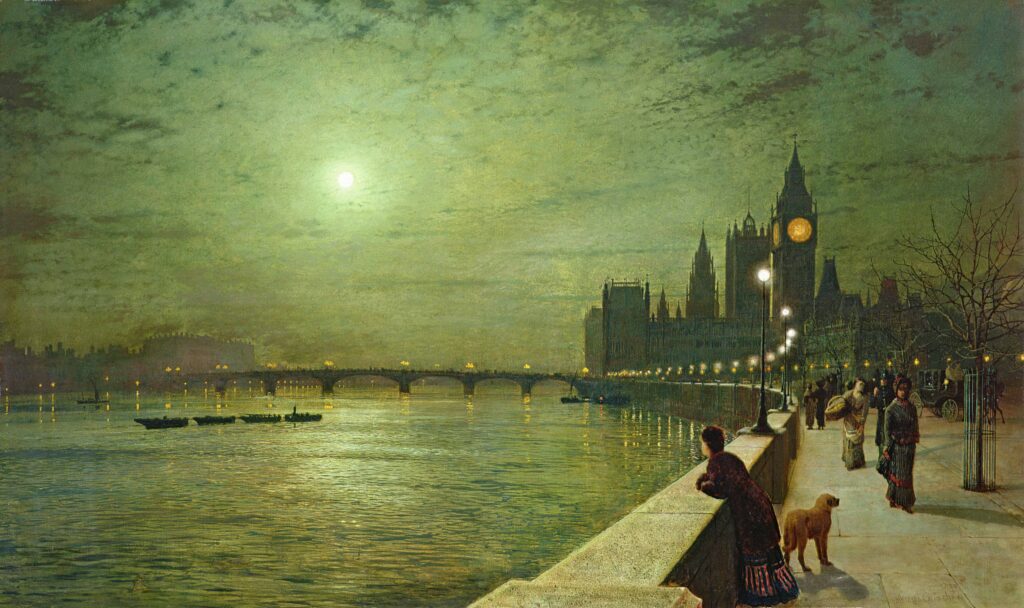
Grimshaw’s work is instantly recognizable. He had an uncanny ability to paint humidity, reflections, and the invisible chill of fog. His scenes of cobbled streets slick with rain, ships at silent docks, and shopfronts glowing under gaslight evoke a haunting stillness — a kind of timeless suspension that feels more dream than document.

Working with painstaking technique — often believed to be assisted by camera obscura methods — he achieved a level of photorealism rare in his time. Yet there’s nothing clinical about his work. Each painting is imbued with emotion: nostalgia, melancholy, quiet wonder.

His moonlit urban scenes in places like Leeds, Liverpool, Glasgow, and London turned the industrial city into a thing of beauty. The grime and gloom of Victorian England became, under his brush, a theater of light and shadow.

A Singular Vision No One Could Imitate

Despite his success and growing popularity during his lifetime, Grimshaw was never fully embraced by the Royal Academy — likely due to his self-taught status and the unconventional subject matter of his work. But his collectors and admirers were unwavering, including artists like James McNeill Whistler, who once remarked: “I considered myself the inventor of nocturnes until I saw Grimshaw’s moonlit pictures.”

Grimshaw painted a world few others could see. And no one since has truly matched the precision, mood, and atmospheric mastery of his nocturnes.

The Enduring Glow

John Atkinson Grimshaw died in 1893, but his work continues to glow with life. His paintings feel both historical and eternal — windows into a Victorian world as intimate as it is spectral. Whether it’s a lone figure walking under gaslights or the hush of a harbor at night, Grimshaw painted silence, solitude, and the sublime beauty of darkness.

Albert Bierstadt. He Painted the Mountains Like No One Else

Albert Bierstadt
Albert Bierstadt

Albert Bierstadt. He Painted the Mountains Like No One Else

Born in 1830 in Solingen, Germany, Albert Bierstadt would become one of the most influential landscape painters of the 19th century and a defining visual voice of the American West. When he was only three years old, his family emigrated to the United States, a move that would shape both his life and his art. It was in America that Bierstadt encountered the vast, untamed wilderness that would become the central subject of his work.

From Europe to the New World

Although raised in the United States, Bierstadt returned to Europe to pursue formal artistic training. He studied at the Düsseldorf School, where he absorbed a disciplined, highly detailed approach to painting, along with a taste for dramatic composition and theatrical lighting. This European academic foundation would later distinguish his work from many of his contemporaries.

When Bierstadt returned to America, he applied this refined technique to landscapes of unprecedented scale. The result was something new: American nature rendered with Old World precision and Romantic grandeur.

Albert Bierstadt

The American West as Vision

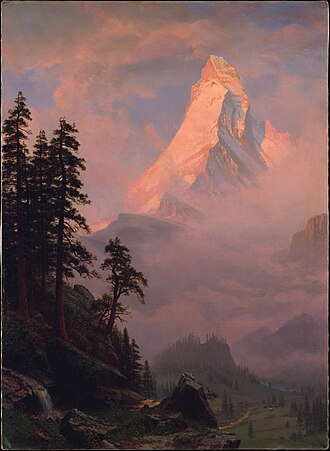
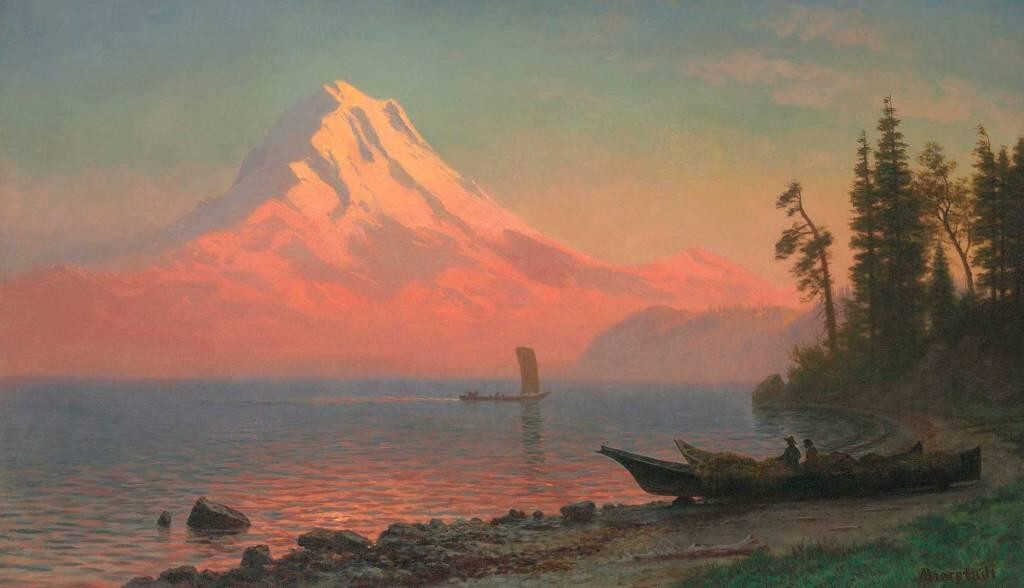
As a prominent member of the Hudson River School, Bierstadt became famous for his monumental views of the American West. His paintings depict towering mountain ranges, sweeping valleys, and luminous skies, often bathed in an almost supernatural light. These were not simple records of geography; they were visions of a land both real and idealized.

Beginning in 1859, Bierstadt undertook a series of extensive expeditions across the continent. With sketchbook in hand, he traveled through the Rocky Mountains, Yosemite Valley, the Sierra Nevada, Oregon, and the Columbia River region. These journeys allowed him to study the landscape firsthand and provided the raw material for the large-scale studio paintings that would later captivate audiences.

Light, Scale, and Spectacle

Bierstadt was known for his immense canvases and his masterful control of light. Glowing sunsets, mist-filled valleys, and radiant mountain peaks dominate his compositions. His work is often associated with luminism, a style characterized by serene surfaces, careful detail, and atmospheric light.

He was also a savvy self-promoter. Bierstadt frequently presented his paintings as theatrical events, unveiling them to the public in specially arranged exhibitions. Viewers paid admission to stand before his canvases, experiencing the American wilderness as something sublime and almost spiritual.

A Life of Travel and Devotion

Beyond the American West, Bierstadt also traveled to Canada and the Bahamas, notably while caring for his ailing wife. Even during these personal trials, he continued to paint, maintaining an unwavering commitment to his artistic vision.

He lived for periods in San Francisco and later New York, remaining deeply engaged with the art world while devoting his life to depicting the majesty of nature. Although his popularity declined toward the end of his life as artistic tastes shifted, his dedication never wavered.

Legacy of a Visionary

Albert Bierstadt died in 1902, leaving behind a vast body of work that forever shaped how the American landscape was imagined. His paintings did more than document nature — they transformed it into vision, elevating mountains, valleys, and skies into symbols of national identity and natural wonder.

A prolific artist and a charter member of the Boone and Crockett Club, one of North America’s earliest conservation organizations, Bierstadt also played a role in fostering appreciation for the preservation of natural landscapes. His images helped inspire public interest in places like Yosemite, contributing indirectly to the conservation movement.

Today, Bierstadt is remembered not just as a painter of scenery, but as an artist who captured the American West at a moment when it still felt boundless — luminous, monumental, and forever on the edge of myth.

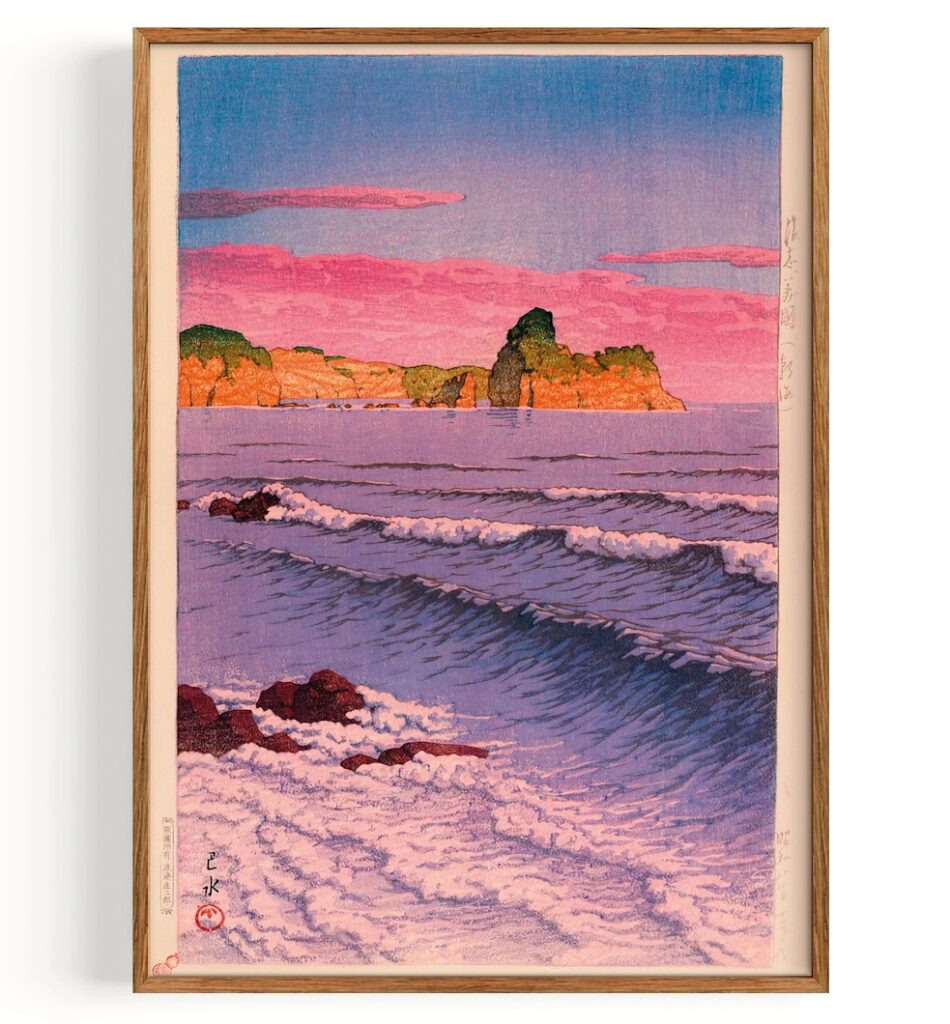
Hasui Kawase. Every Evening, He Held Back the Sun

Hasui Kawase
Hasui Kawase

Hasui Kawase. Every Evening, He Held Back the Sun

Every evening, in his prints, the sun does not disappear abruptly.
It lingers.
And Hasui lets it.

Born in Tokyo in 1883 into a family of merchants, Hasui Kawase grew up surrounded by the quiet rhythms of everyday Japan. From an early age, he showed a sensitivity to landscape and atmosphere, drawn not to spectacle, but to the subtle poetry of place — a temple at dusk, a road after snowfall, a shoreline as daylight fades.

Trained in both traditional Japanese art and Western painting techniques, Hasui developed a visual language that bridged eras. This dual education would become central to his career, allowing him to modernize woodblock printing without abandoning its spiritual roots.

The Shin-hanga Revolution

A turning point came in 1918, when Hasui met the visionary publisher Watanabe Shōzaburō. Together, they helped define and elevate the shin-hanga movement — a revival of traditional woodblock printing adapted to modern sensibilities and international audiences.

While shin-hanga embraced collaboration between artist, carver, printer, and publisher, Hasui’s personal vision stood apart. His works were not loud declarations of modernity; instead, they were whispers, filled with atmosphere, restraint, and emotional depth.

Hasui Kawase

Light, Silence, and the Human Absence

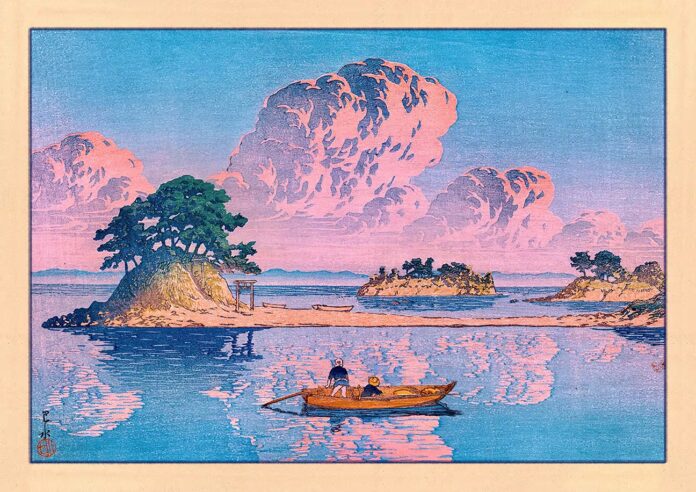
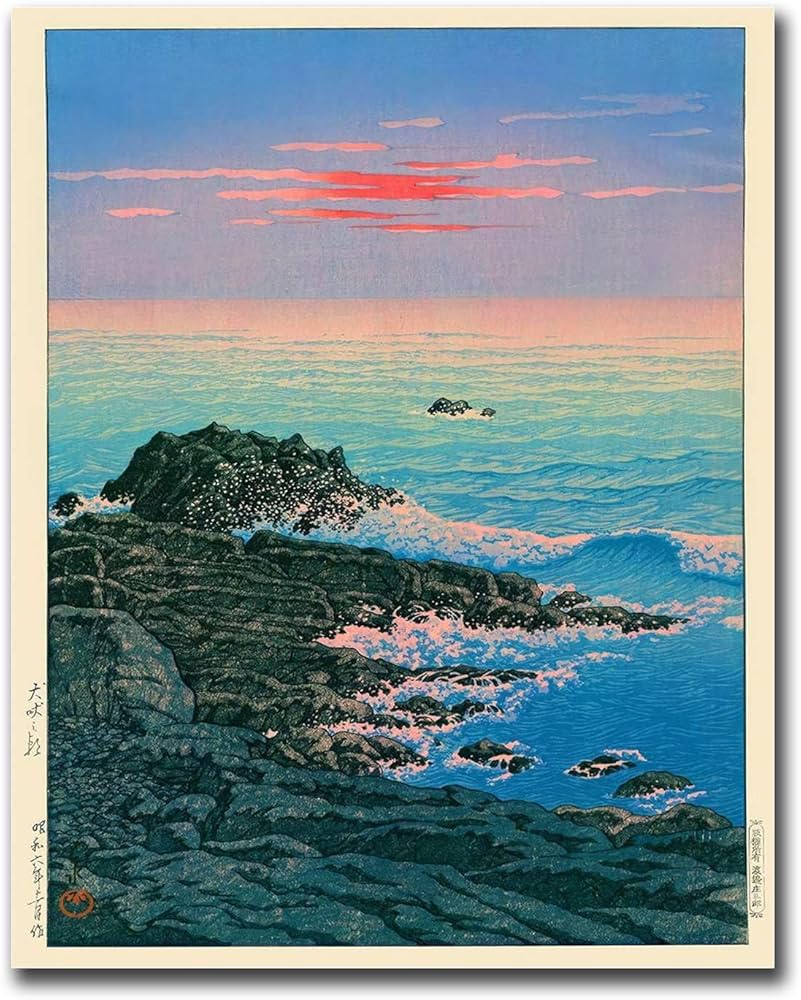
Over the course of his life, Hasui created more than 600 landscape prints. Many are notably empty of people, yet deeply human in feeling. Snowfall muffles sound. Evening light lingers longer than expected. Rain turns streets into mirrors. In Hasui’s hands, nature is not a backdrop — it is the main subject, alive with mood and memory.

He was, above all, a master of light. Twilight, moonlight, snowfall, and fading sunsets recur throughout his work. These moments are transitional, suspended between day and night, movement and stillness. It is in these pauses that Hasui found his voice.

His prints do not rush. They seem to hold back time, as if allowing the viewer one final breath before night fully arrives.

A National Treasure

In 1956, Hasui Kawase was officially recognized by the Japanese government as a Living National Treasure, honoring his role in preserving and elevating the art of woodblock printing. The title acknowledged not only his technical mastery, but his profound contribution to Japan’s cultural memory.

By the time of his death in 1957, Hasui had left behind a body of work defined by gentleness, precision, and emotional clarity. His landscapes do not shout; they resonate. They invite contemplation, offering a vision of Japan — and of time itself — quietly settling into rest.

A World Falling Asleep

Hasui Kawase did not paint dramatic moments. He painted what happens after — when footsteps fade, when light softens, when the world exhales. His unique gaze captured the beauty of endings that are not final, but tender.

Hasui Kawase

Morozumi Osamu. The Singular Vision

Morozumi Osamu
Morozumi Osamu

Morozumi Osamu. The Singular Vision of a Japanese Printmaking Master

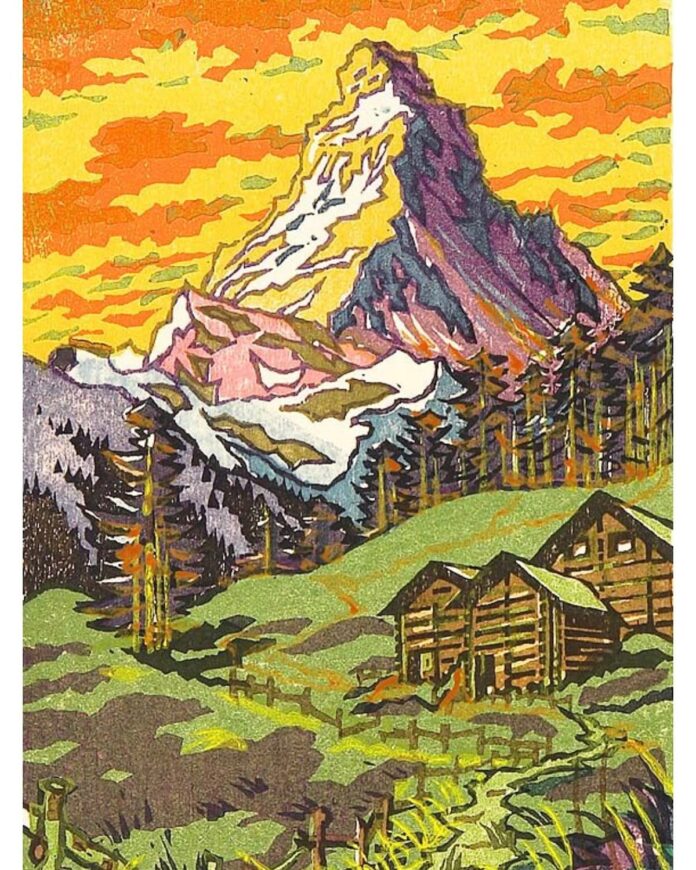
In the rich and ever-evolving landscape of Japanese printmaking, Morozumi Osamu (両角修) stands as a figure of quiet innovation. Born in 1948 in Nagano Prefecture, Morozumi is among the first generation of Japanese artists to emerge in the aftermath of World War II — a time of reconstruction, reflection, and artistic redefinition. Alongside contemporaries such as Kawachi Seiko, Morozumi helped shape the postwar legacy of Japanese woodblock printmaking with a voice that is both deeply traditional and unmistakably his own.

Though he would later be recognized internationally for his contributions to hanga (Japanese printmaking), Morozumi’s journey began in the realm of sculpture. At Tama Art University, he studied under the renowned Fukita Fumiaki, whose influence would resonate throughout his career. It was during these formative years that Morozumi began to carve his own path — quite literally. In 1972, before even completing his formal education, he was awarded the Young Talent Award by the Japanese Print Association and took first prize at the Nichido Grand Print Exhibition, signaling the arrival of a remarkable new voice in Japanese art.

Sculpting Shadows in Monochrome

Since the early 1970s, Morozumi has dedicated himself to an original technique that bridges his background in sculpture with the aesthetic discipline of woodblock printing. Using nails of varying sizes to perforate the woodblock, he creates intricate, monochrome prints that shimmer with light and shadow. These aren’t merely images — they are meditations. The resulting works possess a quiet drama, a sculptural density, and a rhythmic tension between form and void.

Unlike many artists who title their works as a guide for interpretation, Morozumi typically leaves his prints untitled and numbered, inviting viewers into a more personal, contemplative space. His work resists easy categorization — at once minimalist and organic, architectural and mysterious. They evoke not so much a narrative as a sensation — of wind through trees, the hush of sacred spaces, the weight of stillness.

A Global Imprint

Morozumi’s artistic vision has resonated far beyond Japan’s borders. Since 1975, his work has been exhibited internationally and has appeared in major texts on contemporary Japanese printmaking, including Gendai hanga zukan and publications by Lawrence Smith, the former curator of Japanese art at the British Museum. His prints, often modest in size but immense in presence, have found homes in galleries and private collections around the world.

A Gaze That Sees Beyond Borders

While the title Japanese Gaze on Nepal may suggest geographic observation, Morozumi’s true gaze is inward, timeless, and transcultural. His work doesn’t depict Nepal, or any specific place; rather, it echoes the meditative landscapes of the soul — places where silence speaks, and light carves meaning from darkness.

In a world saturated with color, noise, and speed, Morozumi Osamu’s monochrome visions offer a retreat — a chance to look, really look, into the subtlety of things. Through wood and nail, shadow and form, he reminds us that sometimes, the most profound revelations lie in what is left unsaid.

Frits Thaulow: When Water Becomes a Living Mirror

Frits Thaulow
Frits Thaulow Water Mill 1892

When Water Becomes a Living Mirror: The Art of Frits Thaulow

Frits Thaulow reminds us that art, at its best, does more than depict the world — it awakens it.

Among the masters of Impressionism, Frits Thaulow (1847–1906) holds a distinctive place — not only for his technical brilliance but for his rare gift of rendering water as something almost alive. His paintings transform rivers, canals, and reflective surfaces into living mirrors, capturing not just their physical presence but their emotional resonance.

A Nordic Eye with Global Reach

Born in Norway and classically trained at the Academy of Fine Arts in Copenhagen and later in Karlsruhe, Germany, Thaulow began his artistic journey deeply rooted in the Nordic landscape tradition. Early in his career, he immersed himself in the coastal beauty of Skagen, Denmark, where light and sky interact in uniquely northern ways. This period laid the foundation for his lifelong fascination with natural light and atmospheric movement.

Impressionism with Depth

Though associated with Impressionism, Thaulow’s work diverges from its Parisian core. Where Monet focused on fleeting light and loose forms, Thaulow sought structure, clarity, and texture, particularly in his treatment of water. His rivers flow, ripple, shimmer, and reflect — yet never blur into abstraction. In Thaulow’s world, water is both a surface and a depth, a mirror and a movement.

The French Years

After moving to France in 1892, Thaulow’s style matured into something uniquely his own. He traveled and painted across the French countryside, settling in quiet towns where he found inspiration in everyday scenes — stone bridges, quiet mills, tree-lined canals. His canvases from this period feel intimate yet grand, infused with an emotional sensitivity that transcends geography.

Thaulow wasn’t just painting places — he was capturing states of being. A tranquil stream under bare trees, a frozen riverbank, or a canal glimmering at dusk — all radiate a silent intensity, a sense that nature itself is aware.

Recognition and Legacy

Celebrated during his lifetime, Thaulow was awarded numerous honors, most notably the Légion d’honneur, France’s highest cultural distinction. Yet his legacy stretches far beyond medals. He remains a key figure in Norwegian art history and a touchstone for painters of water and light around the world.

Even today, viewers stand before his works and wonder: How can still water feel so alive?
The answer lies in Thaulow’s ability to blend observation with emotion — to see nature not just as it is, but as it feels.

Marketing en Redes Sociales para Artistas en 2026

Marketing en Redes Sociales para Artistas en 2026

Marketing en Redes Sociales para Artistas en 2026: Más que Publicar Imágenes

En 2026, el arte ya no se muestra solo en galerías. Vive, respira y se vende en redes sociales. Para artistas visuales, las plataformas digitales se han convertido en herramientas esenciales no solo para mostrar obra, sino para construir marcas personales, conectar con audiencias globales y generar ingresos reales.

Pero el simple hecho de publicar imágenes ya no es suficiente. El éxito requiere estrategia, autenticidad y visión a largo plazo.

Del portafolio a la narrativa: redes que conectan

Las redes sociales —especialmente Instagram, TikTok y Pinterest— siguen siendo los espacios dominantes para artistas visuales. Pero hoy, la clave no es solo exhibir una obra terminada, sino invitar al público al proceso creativo, compartir la historia detrás de cada pieza, y construir una identidad artística coherente.

Estudios recientes muestran que los artistas que desarrollan una narrativa visual fuerte y auténtica logran no solo mayor engagement, sino conexiones más duraderas con sus seguidores.

La autenticidad no es opcional

La audiencia digital actual valora la transparencia. Mostrar imperfecciones, etapas del proceso, errores y decisiones creativas humaniza al artista y fortalece el vínculo con la comunidad. Esta autenticidad, más que una estética pulida, es lo que impulsa el crecimiento orgánico en 2026.

Las métricas más valiosas ya no son solo seguidores o “likes”, sino interacción genuina: comentarios, mensajes, guardados, reacciones, y recomendaciones de persona a persona.

El campo de batalla del algoritmo: constancia con estrategia

Aunque los algoritmos de plataformas cambian constantemente, ciertos principios se mantienen:

  • Publicar con regularidad, sin saturar
  • Diversificar formatos: reels, carruseles, lives, historias
  • Incluir llamadas a la acción (CTA): desde “guarda esto” hasta “comenta tu opinión”
  • Usar palabras clave y hashtags relevantes, tanto en captions como en alt text (sí, Instagram lo permite)
  • Aprovechar momentos relevantes y tendencias, sin perder la coherencia artística

Un error común es publicar sin objetivo. Hoy, los artistas exitosos planifican su contenido: equilibran publicaciones de producto terminado, proceso creativo, estilo de vida artístico, inspiración, y educación para su audiencia.

Construcción de comunidad > promoción directa

La venta de arte en redes sociales es una consecuencia de crear una comunidad, no el objetivo inmediato. Las audiencias no quieren ver solo promociones; quieren conectar emocionalmente con el artista. En este sentido, la interacción —responder comentarios, agradecer menciones, compartir aportes de seguidores— es tan importante como el contenido mismo.

De seguidor a coleccionista: el embudo artístico

El recorrido del seguidor hacia la compra es sutil y emocional. En 2026, los artistas visuales más exitosos entienden que cada publicación debe:

  1. Atraer con valor visual o narrativo
  2. Nutrir con contenido que educa, entretiene o inspira
  3. Convertir cuando la conexión emocional es fuerte (ya sea comprando una obra, encargando una pieza o compartiendo tu perfil)

Este embudo no ocurre en una sola red. Cada plataforma cumple un rol distinto:

  • Instagram es vitrina + storytelling
  • TikTok es descubrimiento + entretenimiento
  • Pinterest es búsqueda visual + inspiración a largo plazo
  • YouTube (en algunos casos) permite profundizar en el proceso creativo o vida del artista

El campo invisible: metadatos y optimización

Aunque Instagram y TikTok no manejan “metadatos” como Amazon, sí existen elementos clave que cumplen esa función:

  • Nombre de perfil y biografía optimizados con palabras clave
  • Descripciones (captions) claras, humanas y con intención
  • Hashtags funcionales, no solo decorativos
  • Texto alternativo (alt text) para accesibilidad y visibilidad

Cada uno de estos detalles ayuda al algoritmo a entender quién eres y a quién debería mostrarle tu contenido.

La paradoja del artista conectado

Finalmente, en 2026 el reto no es solo crecer, sino sostener una presencia digital que no te agote como creador. La visibilidad es importante, pero no puede venir a costa de tu salud mental o de tu práctica artística.

La clave está en encontrar tu ritmo, automatizar lo necesario, colaborar con otros artistas y plataformas, y recordar que tu valor no se mide en seguidores, sino en impacto y conexión.

El marketing en redes sociales para artistas en 2026 no se trata solo de vender, sino de crear relaciones, compartir procesos, y construir identidad visual en comunidad. El mundo del arte ha cambiado. Y ahora más que nunca, ser artista también implica ser narrador, estratega y ser humano visible.

Max Brandrett

max brandrett
Max Brandrett

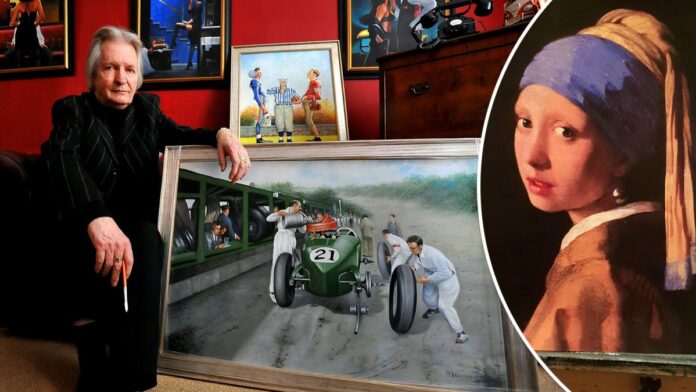
Max Brandrett: Britain’s Most Notorious Art Forger

Max Brandrett is a British artist best known not for original works, but for his uncanny ability to replicate the styles of history’s greatest painters. Dubbed “Britain’s No. 1 art forger,” Brandrett’s life has been a blend of artistic brilliance, deception, and self-reflection.

Born in 1948, Brandrett began forging artwork in his youth, driven by a mix of artistic passion and financial necessity. Over the years, he created convincing imitations of Caravaggio, Vermeer, Rembrandt, and other Old Masters. His fakes were so expertly done that many passed through auction houses and art dealers, fooling even experienced experts.

Despite several brushes with the law, Brandrett’s forgeries were often sold not as malicious scams but as curiosities — sometimes with full disclosure, other times not. In recent years, he has spoken publicly and humorously about his past, including at the Cambridge Union, where he discussed the blurred lines between imitation, creativity, and fraud.

Brandrett’s story has been featured in Vice, the BBC, and national newspapers, and he has become a kind of folk hero for those fascinated by the contradictions of the art world. He now paints openly under his real name and has exhibited replica works and original pieces under the theme of art’s value, perception, and deception.

He tells his amazing rags-to-riches life story to millions through podcasts, personal appearances, in print and in interviews – from a childhood in Barnardo’s homes, to running away and joining the circus, hoodwinking the art world with his paintings and drawings, mixing with the great and the good (and the not so good), and giving away tens of thousands of pounds in charitable donations. 

Max Brandrett

“That idea of starting over is fundamental.” Waltercio Caldas

Waltércio Caldas
Waltércio Caldas

That idea of starting over is fundamental.” Waltercio Caldas

Moma.org

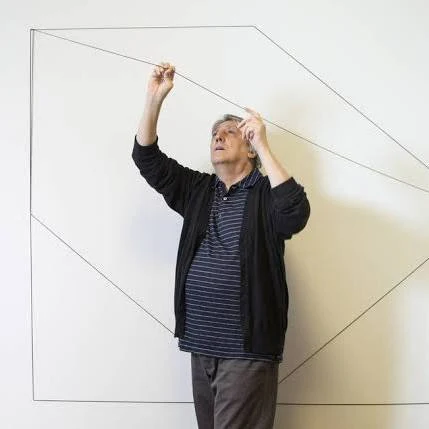
“I would like to produce an object with the maximum presence and the maximum absence,” Waltercio Caldas said in 1990.1
 At the time, Caldas had been pursuing this goal for 30 years, producing drawingsprints, and sculptures that occupy the flickering space between there and not there. In his varied practice, wire sculptures outline forms in space, glass objects mimic the surface tension of water, and the blank page of a work on paper is at least as important as the marks applied to it.

Raised in a modern home designed by his architect father in Rio de Janeiro, Caldas committed to art at an early age. He completed academic training at the School of Fine Arts before pursuing a more theoretical and experimental course at Rio’s Museum of Modern Art (newly completed in 1955) with the celebrated Concrete painter Ivan Serpa. In 1967, when he was 21, Caldas destroyed every drawing he had made and started over. “This act left a lasting impression on me, and it is still present in my mind whenever I need to make a decision,” the artist recalled in 2016. “That idea of starting over is fundamental.”

From then on, Caldas approached the making of each artwork as a discrete act of creation. “Art objects are—or should be—inaugural objects,” he has insisted, “and despite being connected by a subjective series of an artist’s choices, each new object changes the pattern of the artist’s work dramatically.”

 While he has disavowed the development of a single theme across his work, his pursuit of novelty is an ongoing commitment. End (Fim), from 1973, explores this cherished contradiction, featuring six rows of seven stickers printed with the word FIM—“END” in English—in a neat grid on a piece of photo paper. Crucially, the sticker that would complete the grid is missing at lower right, leaving the work open-ended. Here the artist shows us how conclusions can be renewals, too.

Caldas remained in Brazil during much of the period between 1964 and 1985, when a military dictatorship ruled the country. He channeled his antiauthoritarian political convictions into his editorial collaborations on the magazines Malasartes (1975–76) and A Parte do Fogo (1980) with fellow artists Cildo MeirelesJosé ResendeCarlos Zilio, and the critic Ronaldo Brito. In these provocative albeit short-lived publications, the contributors defended art’s place within the public sphere, which the dictatorship sought to curtail and foreclose. Meanwhile, Caldas continued making enigmatic, polished artworks that did not immediately reveal this turbulent context. While highly conceptual, Caldas’s resolutely physical objects garnered comparisons to New York Minimalism, a connection Caldas resisted. “To me, the ‘reduction to essentials’, a concept often used by Minimalists, sounds like a useful procedure only for a society of excess,” Caldas once remarked. “We never deal (at least in the art and culture of Brazil) with the idea of excess. Here, we have to produce both the artwork and the condition for the artwork at the same time.”

Instead of merely reflecting the historical conditions of his time, Caldas occupied himself with reflection itself. In the 1970s, he began to incorporate mirrors into his sculptures to draw attention to the machinations and seduction of illusion. The appealing red button affixed to Mirror of Light (1974), for example, disrupts our perception of finding a trustworthy image of the world in its reflection. References to the 17th-century Spanish painter Velázquez—a master of mirrors, mimesis, and social critique—appear throughout Caldas’s work. The sculpture Painted Iron, for example, takes its structure from Velázquez’s 1618 Christ in the House of Martha and Mary, while the artist’s book O Livro Velazquez features blurred reproductions of paintings with their figures removed.     

“Some people…question art’s utility of purpose, saying things like ‘art doesn’t change the world,’” Caldas has said. “But you see, art doesn’t have to do that; it’s enough for art to change language, expectations, people. That in itself is a real achievement.”

“Me gustaría crear un objeto capaz de contener la máxima presencia y la máxima ausencia”, dijo Waltercio Caldas en 1990.
 Por aquel entonces, Caldas llevaba treinta años persiguiendo ese objetivo, produciendo dibujosgrabados y esculturas que ocupaban el oscilante espacio entre estar y no estar ahí. En su variada producción, las esculturas de alambre dibujan formas en el espacio, los objetos de cristal imitan la tensión de la superficie del agua y la zona en blanco en una obra sobre papel es tan importante como las marcas que se le imprimen encima.

Caldas creció en Río de Janeiro, en una casa moderna diseñada por su padre arquitecto, y desde muy joven se volcó al arte. Primero completó su formación académica en la Escuela de Bellas Artes y luego se inclinó por un curso más teórico y experimental en el Museo de Arte Moderno de Río, recientemente acabado en 1955, con el célebre pintor de arte concreto Ivan Serpa. En 1967, cuando tenía veintiún años, Caldas destruyó todos los dibujos que había hecho y volvió a empezar. “Este hecho me marcó para siempre y sigue presente en mi memoria cada vez que tengo que tomar una decisión”, recordaba el artista en 2016. “La idea de volver a empezar es fundamental”.
  
Desde entonces, Caldas se planteó la realización de cada pieza de arte como una creación individual. “Los objetos de arte son —o deberían ser— objetos inaugurales”, ha insistido, “y a pesar de estar interconectados por una subjetiva serie de decisiones del artista, cada nuevo objeto cambia radicalmente el patrón de trabajo del artista”.
 Aunque se ha negado a desarrollar un único tema a lo largo de toda su carrera, su empeño en la novedad ha sido un compromiso constante. End (Fim), de 1973, plantea esta preciada contradicción al presentar seis filas de siete etiquetas impresas con la palabra “FIM” —“FIN” en español— que forman una prolija cuadrícula sobre un trozo de papel fotográfico. Pero, significativamente, falta la etiqueta que completaría la cuadrícula en la parte inferior derecha, lo que deja la obra abierta. Así, el artista nos muestra cómo las conclusiones también se pueden ver como renovaciones.      

Caldas permaneció en Brasil la mayor parte del periodo comprendido entre 1964 y 1985, época en la que la dictadura militar gobernaba el país. Canalizó sus convicciones políticas antiautoritarias en colaboraciones en las revistas Malasartes (1975–76) y A Parte do Fogo (1980), junto a los artistas Cildo MeirelesJosé ResendeCarlos Zilio y el crítico Ronaldo Brito. En estas publicaciones, de carácter provocador, aunque de corta vida, los colaboradores defendían la importancia del arte en la esfera pública, cosa que la dictadura intentaba restringir y prohibir. Mientras, Caldas continuó creando obras enigmáticas y refinadas que no revelaban de inmediato aquel turbulento contexto. Si bien eran muy conceptuales, a los objetos resueltamente físicos de Caldas se los comparó con el minimalismo neoyorquino, una referencia a la que Caldas se resistía. “En mi opinión, la «reducción a lo esencial», ese concepto que suelen utilizar los minimalistas, parece un procedimiento útil sólo en una sociedad caracterizada por los excesos”, comentó Caldas en una ocasión. “Jamás lidiamos (al menos en el arte y la cultura brasileña) con la idea de exceso. Aquí tenemos que producir la obra de arte y las condiciones para la obra de arte al mismo tiempo”.
  
En lugar de limitarse a reflejar las condiciones históricas de su época, Caldas se preocupó por el propio fenómeno del reflejo. En la década de 1970, empezó a incorporar espejos a las esculturas para llamar la atención sobre la manipulación y lo seductor de las ilusiones. El atractivo botón rojo colocado en Mirror of Light (1974), por ejemplo, perturba nuestra sensación de haber encontrado una imagen fidedigna del mundo gracias a su reflejo. A lo largo de toda la obra de Caldas se pueden ver referencias al pintor español del siglo XVII Velázquez —experto en espejismos, mimetismos y crítica social. La escultura Painted Iron, por ejemplo, está inspirada en la pieza de Velázquez Cristo en casa de Marta y María de 1618, mientras que el libro de artista O Livro Velazquez contiene borrosas reproducciones de cuadros a los que se les han quitado las figuras.     

“Algunas personas… cuestionan la utilidad del arte diciendo cosas como «el arte no cambia el mundo» —ha comentado Caldas— Pero mire, el arte no tiene que hacer eso; basta con que modifique el lenguaje, las expectativas, a las personas. Eso ya es un verdadero logro”.

Elise Chagas, Mellon-Marron Research Consortium Fellow, Department of Drawings and Prints and the Cisneros Institute, 2022

Elise Chagas, becaria del Consorcio de Investigación Mellon-Marron, Departamento de Dibujos y Grabados, y del Instituto de Investigación Patricia Phelps de Cisneros, 2022

Source: https://www.moma.org/artists/7615-waltercio-caldas

Galería La Cometa: arte colombiano en el mundo

Galería La Cometa
Galería La Cometa

Galería La Cometa: Arte Colombiano desde Bogotá al Mundo

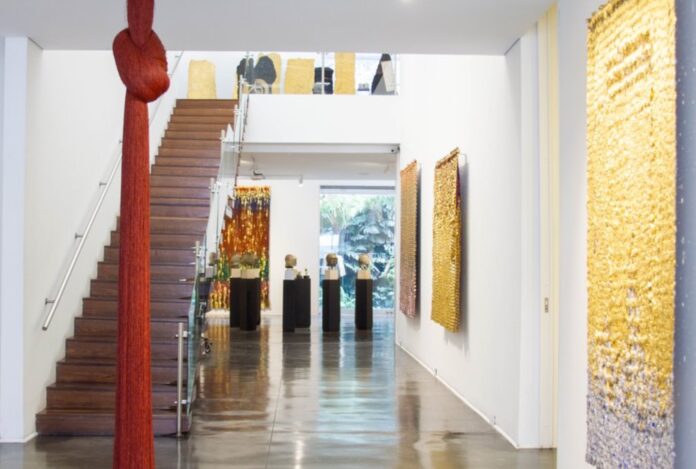
Durante un recorrido por la feria Estampa, la galería La Cometa se destacó como uno de los espacios más notables, gracias a su propuesta de arte latinoamericano y una conversación cercana con Esteban Jaramillo, parte de la familia fundadora del proyecto.

Un Proyecto con Raíces y Visión Internacional

Esteban Jaramillo explica que Galería La Cometa fue fundada en 1986 y hoy se encuentra en una etapa de expansión.
“La galería principal está en Bogotá, en el tradicional Barrio Chico”, cuenta. “La galería principal está en Bogotá, en el tradicional Barrio Chico”, comenta. “También tenemos sedes en Medellín, Madrid y recientemente abrimos La Cometa Miami. Mi padre, fundador y director, continúa al frente, y ahora, como segunda generación, mis hermanos y yo estamos dando un vuelco más internacional al proyecto”.

Primera Participación en Estampa con su Espacio en Madrid

Este 2023 marcó la primera participación de La Cometa en Estampa, a través de su nueva sede madrileña, inaugurada en abril.
“Tenía referencias muy positivas de colegas galeristas”, comenta Jaramillo. “Estampa ha cambiado mucho. Originalmente estaba más enfocada en la serigrafía, pero hoy es un espacio mucho más abierto y dinámico”.

Estampa vs. ARCO: Diferentes Públicos, Diferentes Objetivos

Esteban distingue claramente entre ambas ferias: “ARCO es la feria principal de España, con un reconocimiento internacional muy amplio. Estampa, en cambio, es más local; muchas de las galerías participantes son españolas. Pero tiene un valor clave: conecta con un público interesado en obras de arte con precios más accesibles, lo cual responde a una nueva dinámica de coleccionismo”.

También mencionó haber recibido buenas referencias sobre Art Madrid, otra feria con enfoque contemporáneo.

La Cometa: Una Plataforma para el Arte Latinoamericano

Más allá de su presencia en ferias, Galería La Cometa reafirma su compromiso con el arte latinoamericano, abriendo espacios que conectan la escena colombiana con mercados internacionales. Su participación en eventos como Estampa refuerza la idea de que el arte puede ser accesible sin perder profundidad, y que las galerías pueden jugar un papel vital en tender puentes entre regiones, estéticas y públicos.

La Cometa Miami

1015 NW 23rd Street, Unit 2. 33127

La Cometa Bogotá

Carrera 10 No. 94 A – 25

La Cometa Madrid

Calle San Lorenzo 11

La Cometa Medellín

Calle 10A # 37 – 40

Artistas y sus países:

  1. Adam Goldstein – Colombia
  2. Adrián Gaitán – Colombia
  3. Alejandro Ospina – Colombia
  4. Alejandro Sánchez – Colombia
  5. Ana González – Colombia
  6. Camilo Restrepo – Colombia
  7. Carlos Castro – Colombia
  8. Daniel Nyström – Suecia
  9. Fernando Pinto – Colombia
  10. Gabriela Pinilla – Colombia
  11. Glenda León – Cuba
  12. Johan Samboni – Colombia
  13. Juan Cárdenas – Colombia
  14. Juan Delgado – Colombia
  15. Juan Jaramillo – Colombia
  16. Justyna Kisielewicz – Polonia
  17. Liliana García – Colombia
  18. Luisa Pastor – España
  19. Miguel Ángel Rojas – Colombia
  20. Ricardo Cárdenas – Colombia
  21. Vanessa Gómez C. – Colombia
Page 31 of 277
1 29 30 31 32 33 277