Home Blog Page 2

Me pongo el sol al hombro y el mundo es amarillo

Edison Peñafiel

Me pongo el sol al hombro y el mundo es amarillo

(I Put the Sun on My Shoulder and the World Turns Yellow)

Edison Peñafiel

Curatorial essay — Sophie Bonet

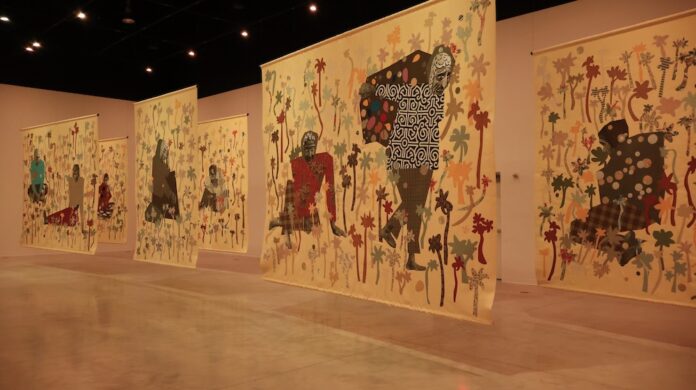
There are works that do not reveal themselves immediately—not because they conceal something, but because they demand time and presence. Me pongo el sol al hombro y el mundo es amarillo (I put the sun on my shoulder and the world turns yellow) belongs to this kind of experience. It does not present itself as a closed image or a linear narrative, but as a space activated through the body. Seven monumental curtains, suspended at the center of the gallery, form a porous, traversable territory in which perception is constructed through movement.

From the first encounter, the work resists a frontal reading. There is no single position from which it can be fully apprehended. As viewers move around and through the curtains, images fragment, overlap, and interrupt one another. Looking requires motion. Seeing requires choosing where to stand. The experience is neither immediate nor transparent; it unfolds gradually, partially, and through the body.

This mode of engagement situates the installation within a phenomenological understanding of perception, in which seeing is inseparable from being [1]. Perception here is not passive or distanced; it is negotiated. It adjusts to the rhythm of the body—to advancing, pausing, and turning back. The work does not reward speed or certainty. Instead, it asks for sustained attention.
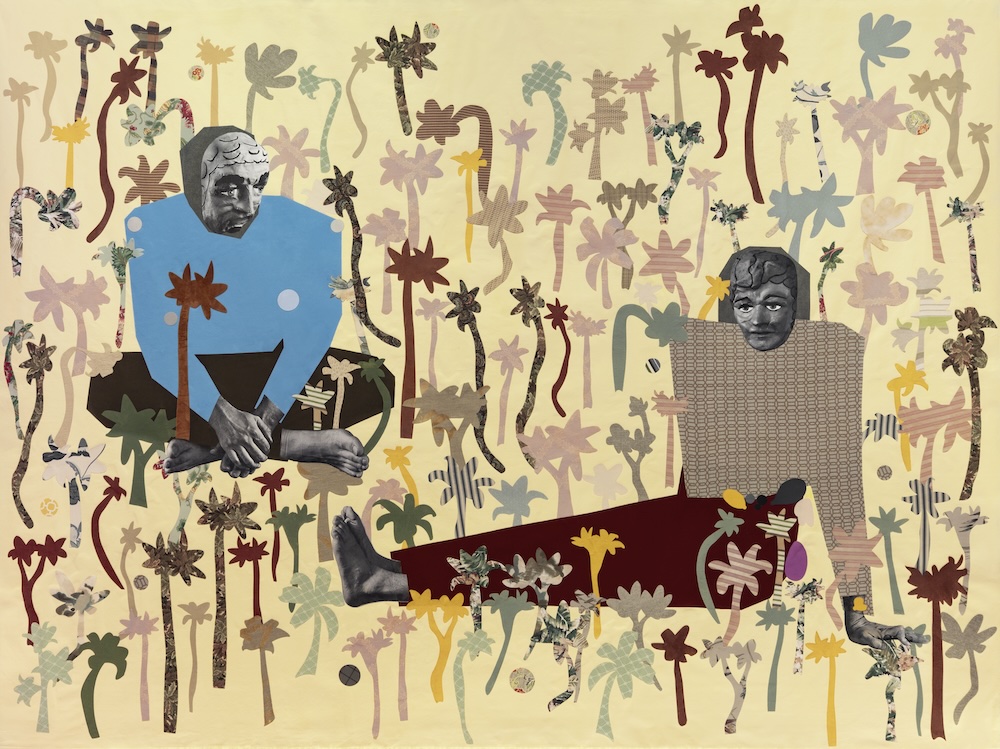
Edison Peñafiel
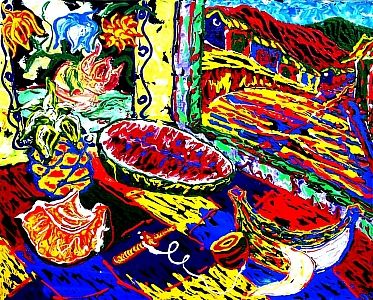
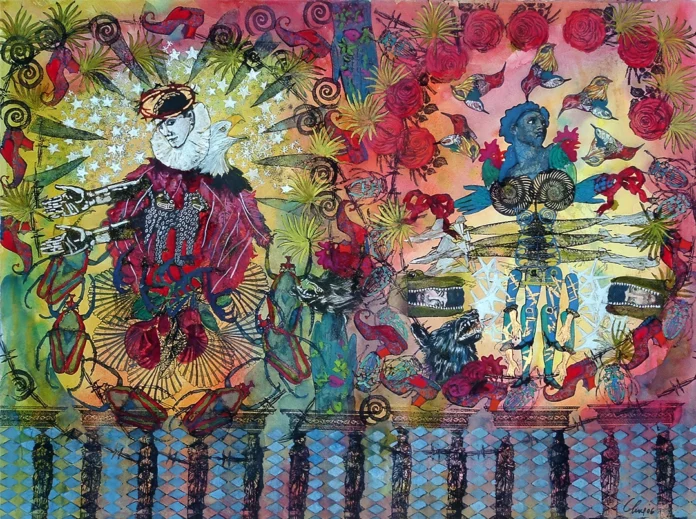
Edison Peñafiel, Me pongo el sol al hombro y el mundo es amarillo VI, 2021.
Técnica mixta: pintura acrílica para muro sobre lienzo, tela y transfer textil. 168 x 119 in.
Cortesía del artista.

Across the curtains, two chromatic fields recur. In one, dominated by yellow, figures rest. Bodies appear suspended within a luminous, open, yet contained space. On the reverse, painted blue, figures are seen from behind, walking toward a horizon that remains out of sight. There is no beginning and no end. What emerges instead is a condition: continuous movement interrupted by pause.

Migration is inscribed here not as a singular event or a specific geographic route, but as a bodily experience that repeats itself. Walking, stopping, continuing. Movement does not necessarily lead to arrival; it becomes a way of inhabiting time. The pause—the yellow moment—is not the end of the journey, but a threshold: a necessary rest before taking up the weight again and moving on.

Time in this work is not linear. Peñafiel conceives it as a spiral: gestures return, images reappear, histories fold back onto themselves. Figures recur across the curtains, shifting subtly from one scene to another, deliberately stripped of individual traits. Masked and anonymous, they resist individuation. Rather than representing specific subjects or narrating particular experiences, they function as presences—bodies that contain lived conditions. This anonymity does not erase experience; it protects it. It prevents the gaze from consuming the figures as images of suffering or displacement, opening instead a space for recognition without appropriation [2].

In this displacement, something crucial occurs: the act of witnessing no longer belongs to the figures, but to the viewer. The figures do not speak or explain. They remain. It is the viewer who, through movement, becomes the witness. The experience becomes durational, sustained by attention rather than by the accumulation of information.

This temporal quality is further reinforced by a subtle sonic dimension that moves through the space. Sound does not accompany or illustrate the installation—it dilates it. What unfolds is an almost imperceptible deconstruction of No soy de aquí, ni soy de allá by Facundo Cabral [3], composed of elongated, sustained chords that seem to slow the passage of time, as if the present itself were stretching. At moments, minimal sounds emerge—the rustle of moving plants, distant birds—barely audible, more sensed than recognized. Sound operates at the verge of perception: it does not impose itself or announce its presence. It filters in. It is felt before it is heard, situating the body within a suspended rhythm that mirrors the slowness, pause, and attentiveness the work demands.

The choice of the curtain as the installation’s primary structure is not incidental. Curtains belong to the domestic realm: they regulate light, separate without sealing, and mark thresholds between intimacy and exposure. They are objects that filter more than they define. In this installation, curtains function as epistemological devices. They do not reveal everything at once. They demand movement. To see, one must cross, circle, and insist. Meaning does not emerge from distance, but from experience.
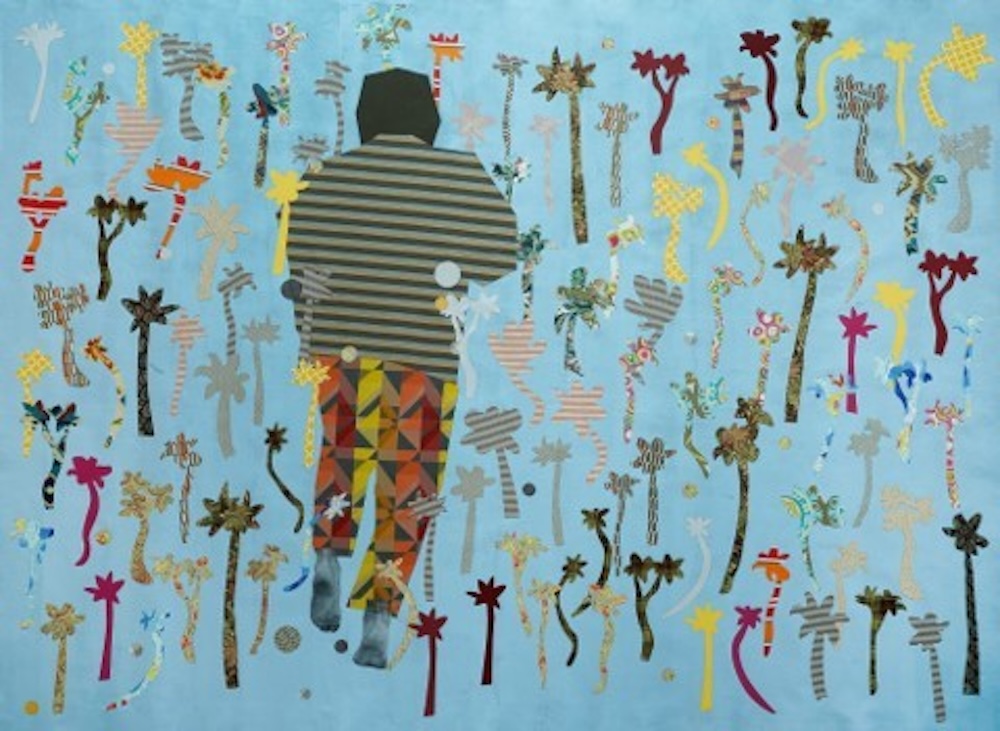
Edison Peñafiel
Edison Peñafiel, Me pongo el sol al hombro y el mundo es amarillo TBD, 2021.
Técnica mixta: pintura acrílica para muro sobre lienzo, tela y transfer textil. 168 x 119 in.
Cortesía del artista.

Scale intensifies this relationship. Rising over ten feet high, the curtains exceed human proportion and envelop the viewer. This is not monumentality in a heroic or commemorative sense. It is an architecture of initiation—a structure that recalibrates perception and transforms space into a sensory experience.

Color operates here as an atmospheric and existential condition rather than as a closed symbolic code. Yellow and blue do not signify fixed states or singular emotions; they alter how space and time are experienced through the body. The title of the work comes from a fragment of the monologue that Facundo Cabral would recite before performing the song No soy de aquí, ni soy de allá (1971): I put the sun on my shoulder and the world turns yellow. The phrase does not describe a world that changes, but a way of inhabiting it. In Cabral’s words, color emerges as a vital stance—a way of looking that does not deny exposure, but accepts it. To place the sun on his shoulder is to carry weight: experience, memory, fatigue—without relinquishing movement.

Material choices reinforce this intimate register. Raw canvas, fabric, and wall paint evoke the everyday and the domestic, distancing the work from spectacle. The lilies applied to the curtains introduce a quieter emotional register. For the artist, this motif holds personal resonance: Azucena, his mother’s name, means lily, and “Lili” was her family nickname [5]. This reference is never declared. It remains embedded in the material language of the work, like a memory that does not require explanation.

From an anthropological perspective, I Put the Sun on My Shoulder and the World Turns Yellow attends to how bodies inhabit transition. It privileges experience over narrative, presence over representation. What the work ultimately offers is an invitation: to cross and cross again, to move slowly, to pause, to look anew. Meaning does not emerge through declaration, but through being.

Notes

[1] Maurice Merleau-Ponty, Phenomenology of Perception, trans. Donald A. Landes (London: Routledge, 2012).
(Original French edition, 1945.)

[2] Edison Peñafiel, conversation with the curator, Miami, 2025.

[3] Facundo Cabral, “No soy de aquí, ni soy de allá,” song lyrics, 1971.

[4] Gaston Bachelard, The Poetics of Space, trans. Maria Jolas (Boston: Beacon Press, 1994).
(Original French edition, 1958.)

[5] Edison Peñafiel, conversation with the curator, Miami, 2025.

Sophie Bonet (b. 1986) is a South Florida–based curator whose practice is deeply informed by her background in social and cultural anthropology. She approaches exhibitions as living ecosystems—responsive spaces shaped by memory, ritual, and transformation. Her transdisciplinary work is research-driven and grounded in the belief that art functions as a site of dialogue, cultural inquiry, and collective imagination.

Bonet has led exhibitions and public programs across prominent institutions in the United States and abroad, including the Contemporary Arts Museum Houston (CAMH), the Barcelona Museum of Contemporary Art (MACBA), and the Museum of Contemporary Art North Miami (MOCA), where she served as Exhibition Manager for landmark presentations such as Juan Francisco Elso: Por América (in collaboration with El Museo del Barrio), Didier William: Nou Kite Tout Sa Dèyè, and Jamea Richmond-Edwards: Ancient Future. Her early research at MACBA focused on the archival documentation and critical interpretation of Espai 13’s history, tracing three decades of artist-led experimentation at the Joan Miró Foundation.

Currently Chief Curator of The Frank C. Ortis Gallery in Pembroke Pines, Florida, Bonet leads an ambitious exhibition program centered on accessibility, sensory engagement, and community-rooted storytelling. Curating across disciplines—from ecological installation to fiber art and new media—she explores themes of identity, migration, belonging, and place through an anthropological and phenomenological lens.

Bonet holds degrees in Fine Arts, Art History, and Anthropology. She is currently pursuing graduate research examining curating as a ritual and phenomenological practice shaped by memory, embodiment, and cultural translation. She is a member of IKT – the International Association of Curators of Contemporary Art.
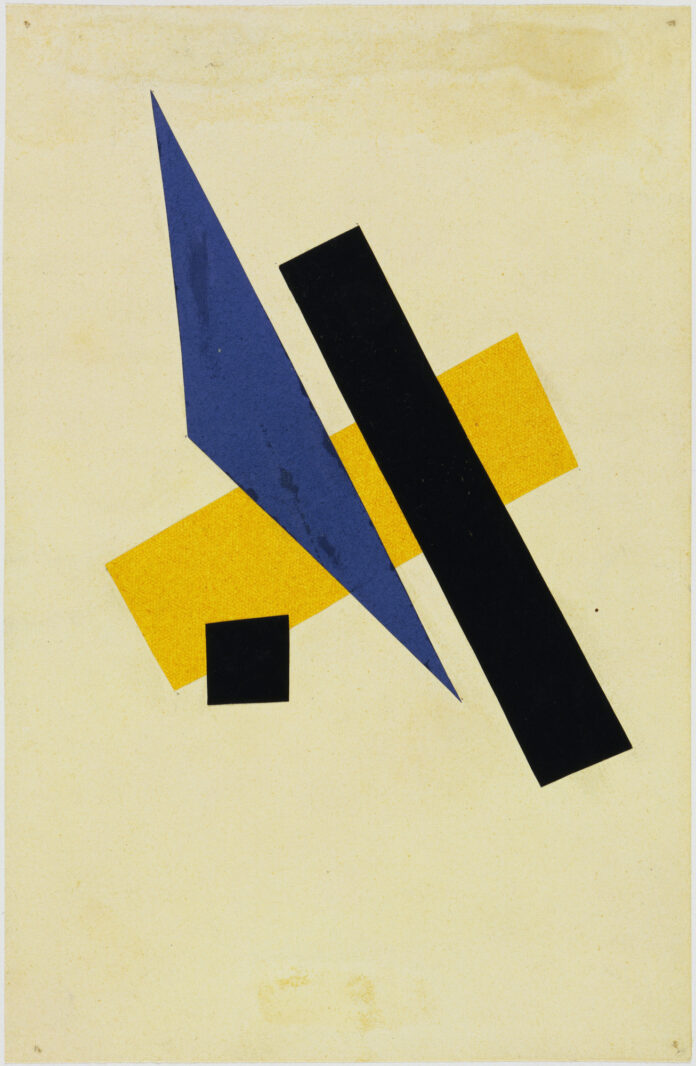
Lyubov Sergeyevna Popova 

Lyubov Sergeyevna Popova 

Lyubov Sergeyevna Popova 

Rusia, 1889–1924

Lyubov Sergeyevna Popova (Лююбо́вь Серге́евна Попо́ва) was one of those Russian artists associated with the avant-garde of the revolutionary era. She stood out among her peers, placing herself among the elite of Russian art after the 1917 Revolution, which she actively helped to build with painting, sculpture, fashion and whatever else they put in front of her.

Popova was distinguished by very architectural compositions and is also characteristic of her search for non-objectivity, so among her main influences was Malevich.

Her first works were landscape painting, portraits and human figures. But when she came into contact with the avant-garde Popova became a “radical”. Cubism or futurism are better suited to what she wants to say. She became interested in collage and the use of relief, as well as the importance of the material used. It is in 1916 that she begins her reflection on the presence or absence of the object, towards non-objectivity.

With the triumph of the Russian Revolution, Popova became one of its most important artists. She composes suprematist canvases, where she mixes color, volumes and lines, with geometric shapes that blend into each other and create an organization of the elements, not as a means of figuration, but as autonomous constructions.

In 1921 he abandoned bourgeois easel painting. From then on “the organization of the elements of artistic production must return to the shaping of the material elements of life, that is to say, to industry, to what we call production”.

And so he continued, producing art until he died of scarlet fever at the age of 35.

Lyubov Sergeyevna Popova 

A Shareable Guide for Artists, Creatives & Students

A Shareable Guide for Artists, Creatives & Students

From the walls of Wynwood to gallery spaces in Coral Gables, Miami’s thriving art scene needs serious materials—and the Magic City delivers! Whether you’re a pro artist, a design student, or a weekend creator, this guide will lead you to the best art supply spots in the 305.

1. Blick Art Materials – Miami

6250 S Dixie Hwy, Miami, FL 33143
blick.com

The go-to store for fine artists, students & professionals.
Huge inventory
Premium + student-grade brands
Great for painting, drawing, printmaking, sculpture & more
Student discounts & regular in-store demos!

2. Michael’s – Multiple Locations

michaels.com
8303 W Flagler St, West Miami

The art-craft hybrid shop for hobbyists, students & DIY creators.
Affordable supplies
Great selection of sketchbooks, craft paints, canvases
Custom framing available
Family-friendly with tons of seasonal items.

3. Jerry’s Artarama – West Miami

6448B S Dixie Hwy, South Miami, FL 33143
jerrysartarama.com

A trusted name in the fine art world, now in Miami.
Wide selection for pros and educators
Bulk options + student packs
Top-tier canvas, paint & brush brands
Great value for money!


🌎 BONUS: Online + Hybrid Options

  • Blick & Jerry’s offer online ordering with in-store pickup
  • Amazon is great for tools and gadgets
  • Caza Art Supplies offers limited online shopping with pickup

Quick Match Guide

Your Art StyleShop Here
Fine Art (Oil, Acrylic, Drawing)Blick / Jerry’s
Urban / Mural / Street ArtCaza
Mixed Media / ExperimentalArtist & Craftsman
DIY / Crafts / Budget-FriendlyMichael’s

Save, Print, Share!

This guide is ideal for:

  • Artist residency welcome packets
  • University or college art departments
  • Art fairs, newsletters, and exhibitions
  • Studio bulletin boards

Want a designed PDF version for easy printing or email? Just say the word—I’ll generate a clean, formatted version for download.


Compiled by: Art Miami Magazine Editorial Team
For more resources, visit artmiamimagazine.com

Let me know if you’d like this turned into a downloadable flyer or social media carousel!

Olga de Amaral: Cuerpo textil

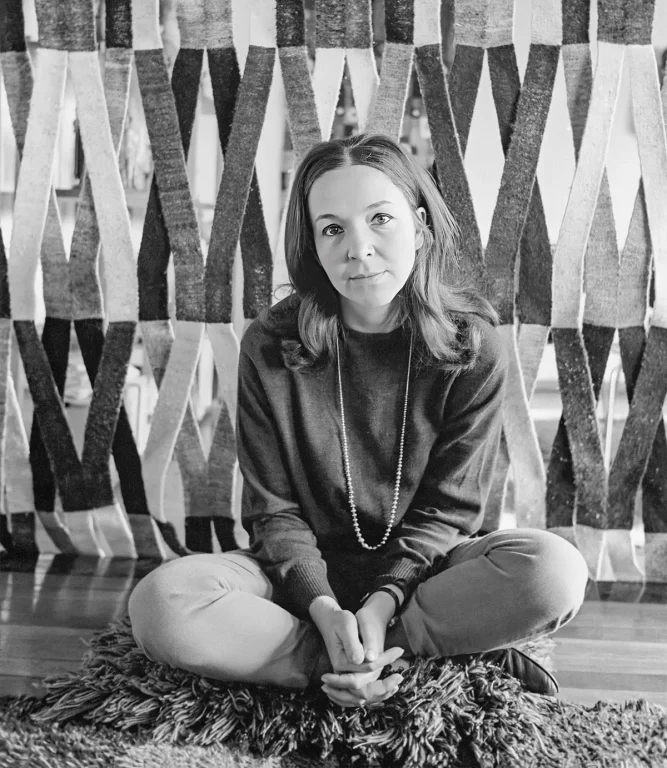
Olga de Amaral
Olga de Amaral

Olga de Amaral: Cuerpo textil

Exhibition Information

Olga de Amaral: Cuerpo textil
February 27 – May 11, 2026 · Level 2
Opening: Thursday, February 26, 2026, 7:00 PM

MALBA — Museo de Arte Latinoamericano de Buenos Aires
Av. Figueroa Alcorta 3415, C1425CLA, Buenos Aires, Argentina
[email protected]
https://malba.org.ar

Curators: María Amalia García and Marie Perennès
Catalogue: Bilingual (Spanish / English), with archival materials
Developed in collaboration with: Casa Amaral and Marie Perennès

There is a particular category of artistic encounter that refuses to resolve itself into mere appreciation. Standing before Olga de Amaral’s monumental weavings — horse-hair catching the light, gold leaf trembling with the breath of a nearby visitor, cotton threads hanging like an arrested monsoon — one does not simply look. One inhabits. Cuerpo textil, the ambitious retrospective now on view at MALBA in Buenos Aires, offers precisely this order of experience: six decades of an artist who dismantled the very grammar of what a textile could be, and rebuilt it as something closer to cosmology.

A Retrospective Long Overdue

The exhibition arrives in Buenos Aires with extraordinary institutional momentum. Cuerpo textil follows the critical triumph of Amaral’s first major European retrospective at the Fondation Cartier pour l’art contemporain in Paris (October 2024 – March 2025), curated by Marie Perennès, who co-curates the MALBA presentation alongside the museum’s chief curator, María Amalia García. The Buenos Aires iteration has been developed in close collaboration with Casa Amaral, the artist’s Bogotá studio-foundation, and it represents, crucially, the first large-scale retrospective of Amaral’s work on Latin American soil in more than thirty years — the last being her 1993 survey at the Museo de Arte Moderno de Bogotá.

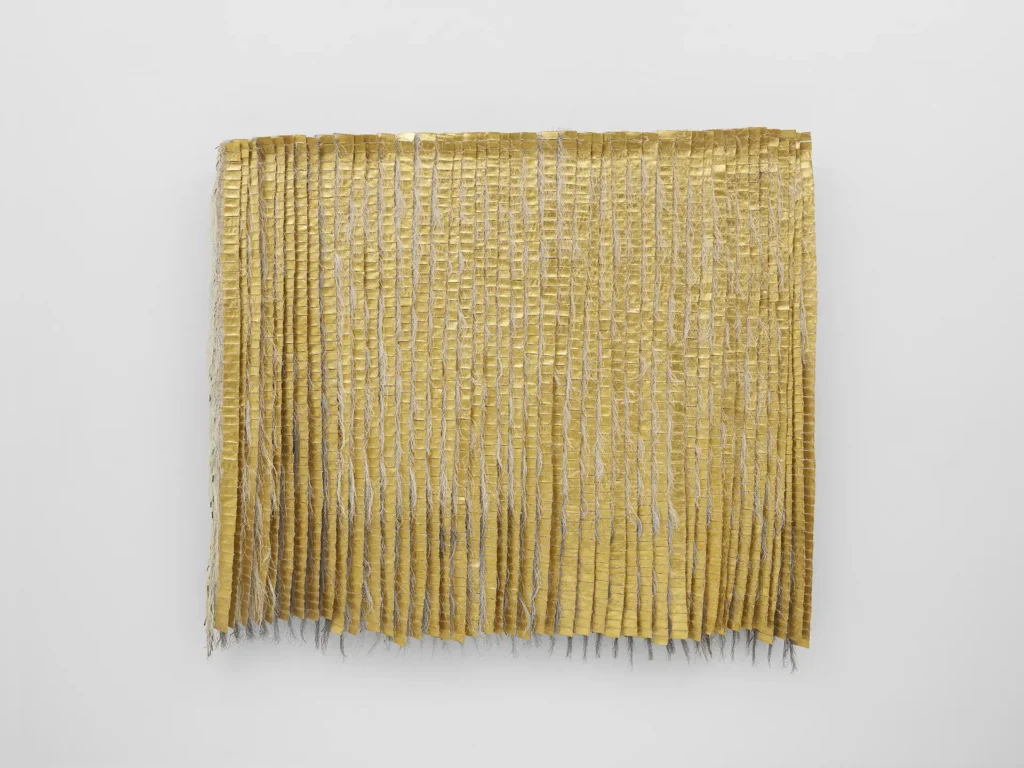
Alquimia XXVII
Alquimia XXVII

More than fifty works drawn from public and private collections in Bogotá, Medellín, and New York are assembled across Level 2 of the museum. The installation traces a chronological and conceptual arc from the formal experiments of the 1960s through to the serene monumentality of the early 2000s. For Buenos Aires audiences encountering Amaral’s full creative range for the first time — or rediscovering it after decades — the experience carries the unmistakable charge of a historical corrective.

“As I build these surfaces, I create spaces of meditation, contemplation and reflection. Every small unit that forms the surface is not only significant in itself, but is also deeply resonant of the whole.”
— Olga de Amaral, Metropolitan Museum of Art lecture, 2003

Formation: Cranbrook, the Bauhaus Ghost, and the Andean Inheritance

Born Olga Ceballos Vélez in Bogotá on June 14, 1932, Amaral trained first in Architectural Drafting at the Colegio Mayor de Cundinamarca before departing for the United States in 1952. At the Cranbrook Academy of Art in Michigan — an institution suffused with the ethos of the Bauhaus — she found her medium in the weaving atelier of Marianne Strengell, a Finnish-American designer who had redirected the pedagogical attention of the loom from decorative pattern toward structural grid and material truth. This encounter between a Latin American sensibility steeped in the visual culture of pre-Columbian textiles and a modernist institution premised on the unity of art and craft would define everything that followed.

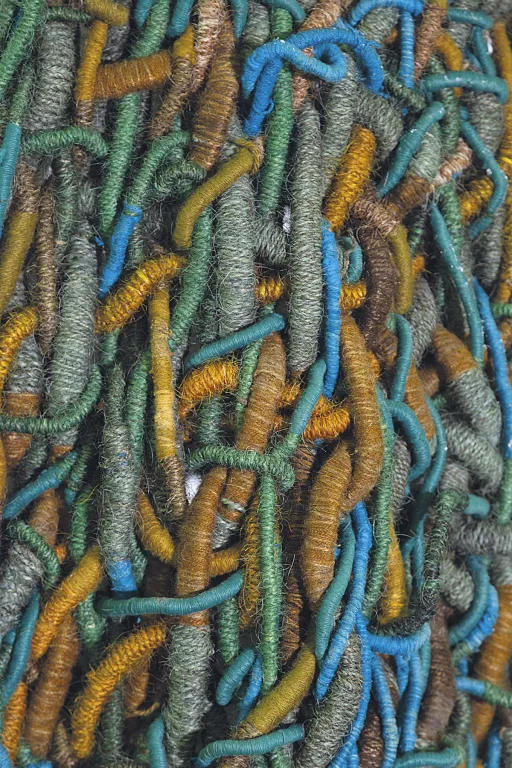
Returning to Colombia in 1955, Amaral refused to make the binary choice that lesser careers might have demanded: either the inherited traditions of Andean weaving or the international grammar of postwar abstraction. Her genius resided precisely in her refusal of that false dichotomy. She held both inheritances simultaneously and let them pressure each other into something unprecedented. The natural fibers — horse-hair, wool, linen, cotton — that form the physical substance of her works are not picturesque references to folkloric craft. They are load-bearing elements of her visual argument, freighted with the anthropological depth of civilizations that understood weaving not as decoration but as the fundamental technology of social cohesion and spiritual meaning.

Olga de Amaral. Farallón al ocaso, 1972

A Pioneer Among Pioneers: The Fiber Art Revolution

The 1960s situate Amaral within a generation of artists — among them Magdalena Abakanowicz and Sheila Hicks — who were collectively dismantling the assumption that textiles occupied a decorative, subordinate register below painting and sculpture. Amaral was the first Latin American artist to participate in the Lausanne International Tapestry Biennial in 1967. She taught at the Haystack Mountain School of Crafts and was included in the landmark exhibition Wall Hangings at the Museum of Modern Art in New York — an event that announced, with institutional authority, the elevation of fiber art into the contemporary discourse. Her 1970 solo exhibition Woven Walls at what is now the Museum of Arts and Design in New York consolidated this positioning.

What distinguished Amaral within even this distinguished company was the philosophical ambition she brought to the structural question of where a textile lives in space. Her works were never flat. They pulled away from the wall. They accumulated weight and shadow. They created chambers of light and suspended architectures. The designation “wall hanging” always felt like a category error applied to her output: these works do not hang from walls so much as they generate their own gravitational fields.

Gold, Alchemy, and the Pre-Columbian Imaginary

Among the most arresting works in Cuerpo textil are those from the Alquimia (Alchemy) series, begun in 1984, and the later Estelas (Stelae) series from 1996. Both deploy gold leaf — applied over gesso-coated cotton — with a logic that is simultaneously material and symbolic. The gold here is not ornamental gilding. It carries the entire weight of a colonial history: gold plundered from Colombia over centuries by European powers, gold venerated by pre-Columbian cultures as the terrestrial emanation of the sun. To apply gold to a textile — to the most fundamentally human of materials, the woven surface that covered bodies and sealed dwellings and marked social status since before recorded history — is to perform a kind of cultural restitution. The material is reclaimed, reintegrated, returned to a relational context.

The Estelas are perhaps the series in which Amaral’s synthetic achievement is most concentrated. Their name invokes the monumental funerary stelae of pre-Columbian archaeology — the carved upright stones marking place and sovereignty. Amaral’s woven versions are gilded towers of compressed time: the cotton structure, the gesso ground, the acrylic medium, and the gold leaf form a stratigraphy analogous to geological deposit, to sedimentary memory. They are simultaneously utterly contemporary and unmistakably ancient.\

The Brumas and the Phenomenology of Atmosphere

The exhibition’s treatment of the Brumas (Mists) series — begun in 2013 — represents one of the most phenomenologically rewarding passages in the entire retrospective. Here, thousands of cotton threads coated with gesso and finished with acrylic paint are suspended from overhead structures, falling in cascades of saturated color that move almost imperceptibly in the slightest air current. The effect is categorically different from anything achieved in the gold series: where the Estelas are concentrated, architectonic, and declarative, the Brumas are diffuse, atmospheric, and conditional. They suggest rainfall, cloud, the interior of a breath. Standing within them, one becomes aware of the body as a porous thing — susceptible to environment, continuous with climate.

The curatorial decision to include twenty-four works from the Brumas series — a significant concentration — reflects an astute reading of how Amaral’s late work has expanded the spatial ambition of her practice toward something approaching environmental installation. These are not objects to be looked at so much as conditions to be experienced.

Kintsugi, the Grid, and Global Resonances

The curatorial apparatus of Cuerpo textil is attentive to the international circulation of Amaral’s ideas and influences. After encountering the Japanese ceramic practice of kintsugi — the art of repairing broken objects with gold, making the repair visible rather than concealing it — at the studio of British potter Lucie Rie in 1970, Amaral began her Fragmentos Completos (Complete Fragments) series, embedding gold leaf within the fabric of her weavings in a logic that paralleled kintsugi’s philosophy: that fracture and repair are not failures to be hidden but truths to be honored.

This episode illuminates something structurally important about Amaral’s creative method: she is a synthesizer of a very high order, capable of absorbing influences from Japanese ceramic philosophy, Andean textile tradition, Bauhaus structural formalism, and pre-Columbian iconography, and producing from their encounter a language that belongs to none of these sources individually but could not have existed without all of them.

Curatorship: Archive, Context, and Institutional Argument

The curatorial approach of García and Perennès merits specific attention. The exhibition is accompanied by an extensive bilingual catalogue (Spanish/English) that makes available, for the first time, archival material documenting Amaral’s career trajectories, her interventions in architectural contexts, and the international circulation of her work. This archival ambition is itself an argument: it positions Amaral not as a recovered figure needing rescue from obscurity, but as an artist whose institutional footprint — the Banco de la República, the MoMA, the Metropolitan Museum of New York, the Musée d’Art Moderne de Paris, the Kyoto National Museum of Modern Art — was always already substantial, yet whose full significance within the history of contemporary art has been incompletely processed.

The exhibition also recuperates a dimension of Amaral’s practice largely invisible to the gallery circuit: her collaborative work in fashion and interior textiles through Telas Amaral, the studio she founded with the artist Jim Amaral. The inclusion of the mantas guajiras — textiles in dialogue with the weaving traditions of the Wayuu people of the Guajira Peninsula — opens the retrospective onto questions of cultural exchange and artistic responsibility that the curatorial team handles with appropriate nuance.

The Dissolution of Category as Artistic Achievement

The most radical claim embedded in Cuerpo textil — and in Amaral’s oeuvre as a whole — is epistemological. By creating works that are simultaneously paintings (they carry chromatic arguments of breathtaking sophistication), sculptures (they occupy three-dimensional space with the authority of cast bronze), environments (they alter the conditions of the rooms they inhabit), and architectures (they structure human movement and visual attention), Amaral exposes the art historical category system as an artifact of institutional convenience rather than a description of what art actually does.

The question of whether textile art is “really” art — a question that has haunted fiber practitioners since the medium was exiled from the academy centuries ago, relegated to the domestic sphere as women’s work — becomes, in Amaral’s hands, simply unanswerable. Not because it is too hard, but because the premises that generate it have been dissolved. Her works do not argue for the elevation of textile to the status of fine art. They demonstrate, materially and irrefutably, that the category distinction was always incoherent. Thread is as capable of meaning as paint. The loom is as capable of argument as the chisel.

The ancient textile traditions of Andean communities and the vernacular dimension of materials such as wool and horse-hair are integrated into her work from a contemporary perspective that interrogates spatiality and the body.
— MALBA Exhibition Statement, 2026

Global Momentum and Historical Significance

It is worth situating Cuerpo textil within the exceptional institutional momentum that has gathered around Amaral’s work in recent years. Following the European retrospective at Fondation Cartier (2024–2025) and its subsequent presentation at ICA Miami (2025), the MALBA exhibition completes a circuit that has introduced Amaral’s practice to audiences who encountered it, if at all, only through isolated works in permanent collections. Her presence in Woven Histories: Textiles and Modern Abstraction — the major traveling exhibition that moved through LACMA, the National Gallery of Art, the National Gallery of Canada, and MoMA between 2023 and 2025 — further consolidated her position within the revised historiography of postwar abstraction that has been one of the defining scholarly projects of this decade.

Amaral represented Colombia at the Venice Biennale in 1986 and received a Guggenheim Fellowship in 1973. She was named Visionary Artist by the Museum of Arts and Design in New York in 2005 and received the Women’s Caucus for Art Lifetime Achievement Award in 2019. She has realized close to one hundred solo exhibitions and participated in more than one hundred group shows over seven decades. These numbers sketch the outline of a career of extraordinary sustained commitment.

A Body of Work, a Body of Knowledge

Cuerpo textil — the body of the textile, the textile as body — is a title that carries multiple registers. It names the corporeal dimension of Amaral’s materials: wool and horse-hair are literally animal, carrying the trace of living bodies. It names the spatial dimension of her works: they take up room in the way that bodies do, displacing air, creating shadow, demanding proximity and distance. And it names the anthropological dimension that underlies her entire practice: the understanding, shared across cultures and millennia, that the woven surface is not merely functional but symbolic — that to weave is to make meaning, to bind community, to inscribe time.

At ninety-three, Olga de Amaral continues to work from Bogotá. The vitality of this retrospective — its refusal to feel elegiac, its insistence on the contemporary urgency of works made across six decades — is the most compelling testimony possible to the endurance of her vision. Cuerpo textil is not a farewell. It is a reckoning, long overdue, with an artist who has been quietly, monumentally reshaping what we understand art to be.

Olga de Amaral

Bogotá, Colombia, 1932

She studied Architectural Drafting at the Colegio Mayor de Cundinamarca and, in 1952, moved to the United States to pursue textile studies at the Cranbrook Academy of Art in Michigan. During the 1960s, she taught at the Haystack Mountain School of Crafts and participated in significant exhibitions, including Wall Hangings at the Museum of Modern Art (MoMA) in New York, before presenting her solo exhibition Woven Walls at the Museum of Arts and Design in 1970.

After living in Barcelona and Paris in the early 1970s, she returned to Colombia, represented the country at the 1986 Venice Biennale, and held her first major retrospective at the Museum of Modern Art in Bogotá in 1993. She has presented nearly one hundred solo exhibitions and participated in more than one hundred group shows.

Her work is included in the permanent collections of major institutions such as the Banco de la República, the Museum of Modern Art (MoMA) and the Metropolitan Museum of Art in New York, the Musée d’Art Moderne de Paris, and the Kyoto National Museum of Modern Art.

Personal Vision and Discipline in Barbara Ahlbrand’s Work

Barbara Ahlbrand

Personal Vision and Discipline in Barbara Ahlbrand’s Work

By Rodriguez Collection Team

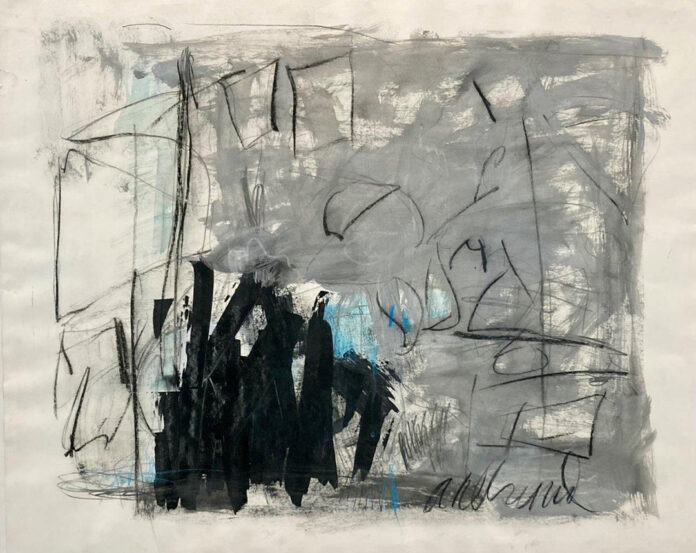
Barbara Ahlbrand has built her trajectory around a simple and steady conviction: the need to sustain a personal vision. That commitment appears clearly both in her own statements and in the way her work has been described. Over the years, Ahlbrand has developed an extensive and consistent body of work, shaped by a recognizable artistic identity and by an ongoing engagement with portraiture, the figure, everyday objects, and abstraction.

Her education followed an unorthodox path. Rather than moving through a fixed or narrowly academic formation, her development took shape through studio classes and community-based opportunities in the Cincinnati, Ohio, and Northern Kentucky area. Among the institutions connected to that process are the Baker-Hunt Foundation, the Art Academy of Cincinnati, and Northern Kentucky University. That trajectory suggests a living relationship to artistic practice, built through sustained work, observation, and studio discipline.

One name holds a decisive place at the beginning of that formation: Aileen F. McCarthy, a student of Frank Duveneck and Barbara’s first teacher. Ahlbrand credits that influence with shaping her handling of paint and drawing media. The mark of that classical instruction remains important as a foundation, and from it she developed her own way of working with color, pictorial matter, and the energy of the line.

That combination of academic grounding and personal affirmation seems central to her path. Ahlbrand has worked to maintain her own perspective in portraiture, figurative work, and abstraction. The statement that accompanies her profile condenses that impulse with precision: “I constantly strive to maintain my personal vision.” More than a motto, the phrase functions as a principle of continuity. Her work does not appear to be guided by fashion, external programs, or the need for immediate validation, but by a sustained relationship to an inner measure.

Another important aspect of her trajectory is the stability of her working and living environment. Barbara Ahlbrand is a lifelong resident of Northern Kentucky and continues to work from her studio at the Pendleton Art Center in Cincinnati, a space shared by more than one hundred artists and described as one of the sites that keep the art scene alive and viable in the Midwest. That context offers both a community of practice and a concrete position within a regional artistic ecosystem of lasting vitality.

The description of her work also emphasizes the independence of her gaze. She is said to have maintained a strong sense of her own identity and to have amassed an extensive body of work over a career that clearly defines her singular vision as an artist. That formulation is significant because it shifts the emphasis away from alignment with broader trends or external narratives and toward the internal coherence of a practice. In Ahlbrand’s case, the work seems to be grounded in persistence and in fidelity to a sensibility entirely her own.

Within that horizon, her subjects form a broad and deeply human range. Portraiture, the figure, everyday objects, and abstraction coexist in her work as territories sustained by a common attention. They do not appear as isolated compartments, but as different zones of a single visual inquiry. Across them, craft, experience, and perception come together in a gaze capable of recognizing intensity both in human presence and in the quiet life of things.

It is also important to note the way her relationship to the art world is described. The material states that Ahlbrand has worked unconcerned with the art world at large. The phrase should not be read as withdrawal, but as a position. Her work stands on a clearly defined autonomy, on a practice that does not depend on external noise in order to carry value. What reaches the viewer, in that framework, is her own perspective: a distinct and fully formed way of seeing, built over time.

There is an ethical dimension in that position as well as an aesthetic one. To preserve a personal vision over the course of a long career demands discipline, patience, and a particular form of loyalty to one’s own work. Ahlbrand has gathered precisely that: an extensive body of work, a firm identity, and a language that moves across different genres without losing cohesion. Portraiture, figurative painting, the observation of ordinary objects, and abstraction all find their unity in the constancy of that gaze.

Taken as a whole, Barbara Ahlbrand’s trajectory speaks of ongoing formation, sustained labor, and fidelity to a personal sensibility. Her practice is grounded in drawing, painting, and printmaking; it is nourished by an early instruction rooted in classical training; and it matures within the context of an active artistic community, where her studio remains the place from which that vision continues to develop.

Barbara Ahlbrand has thus built a body of work grounded in craft, in the energy of pictorial media, and in the persistence of a distinct voice. In her work, painting remains a space of attention, character, and presence. Her trajectory confirms the value of an artist who has grown according to her own measure and sustained, over time, a vision entirely her own.

Images in Sequential Order
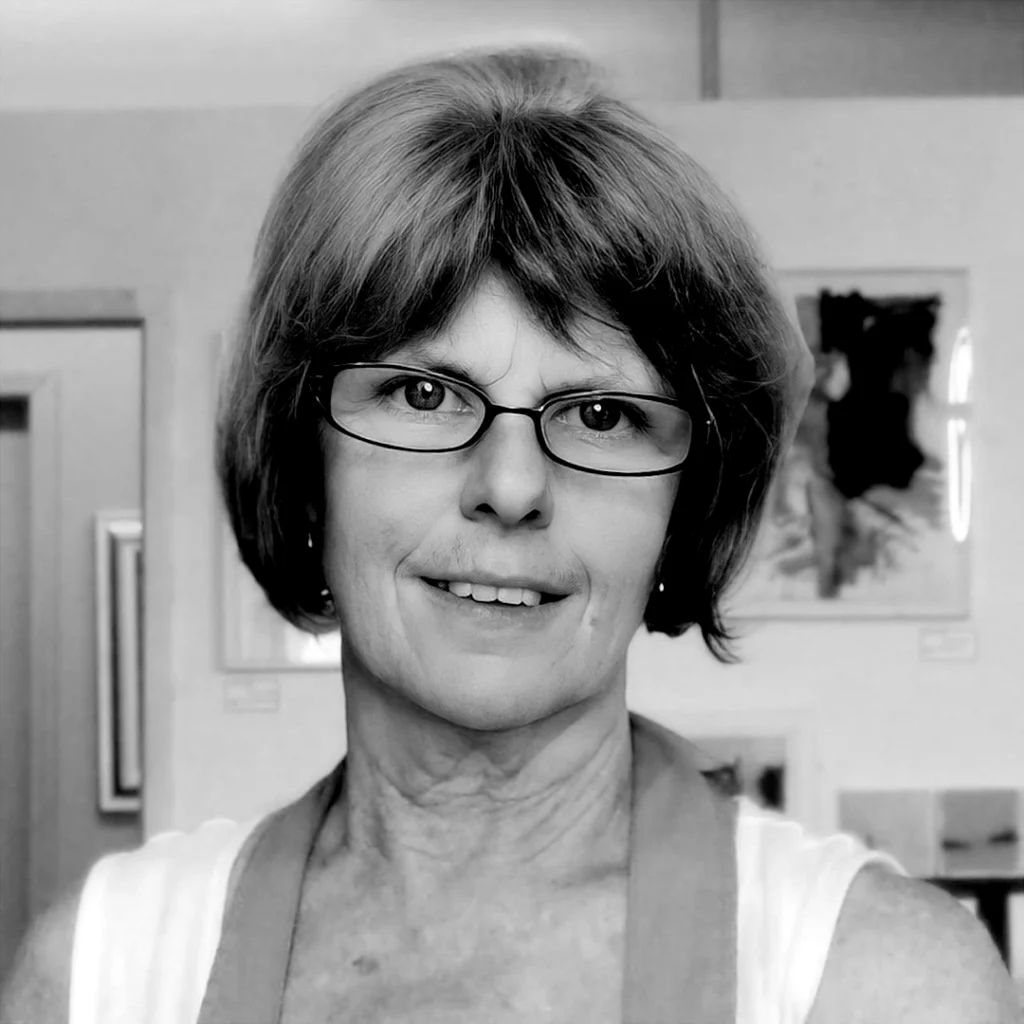
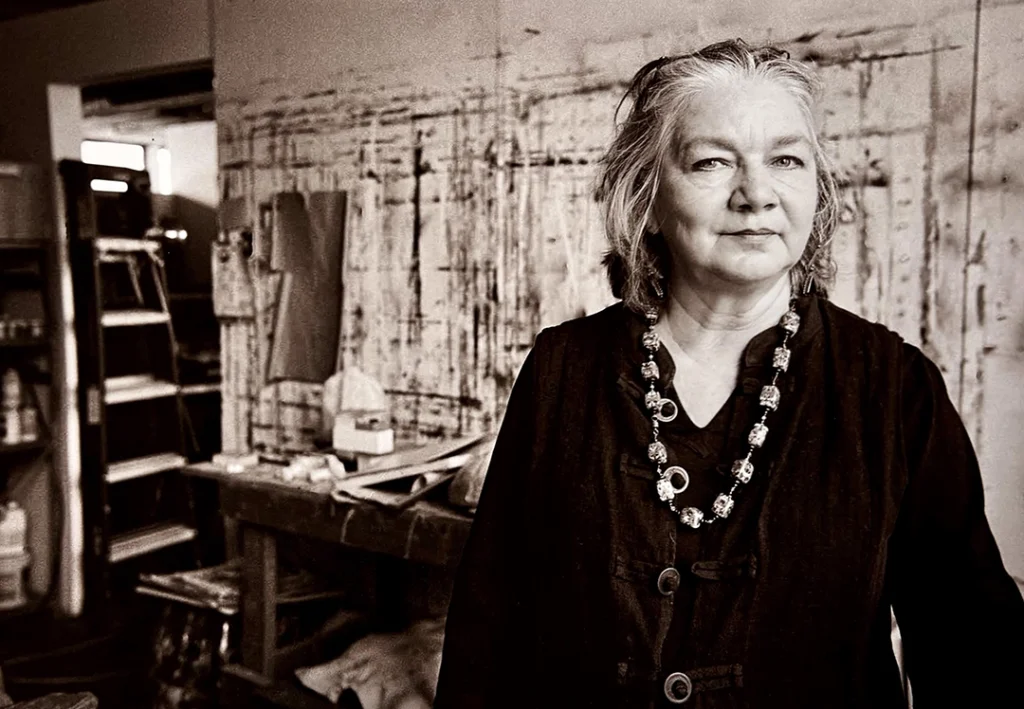
Photograph of the artist

Could be, undated
India ink, pastel, acrylic on paper | 35 x 29 in

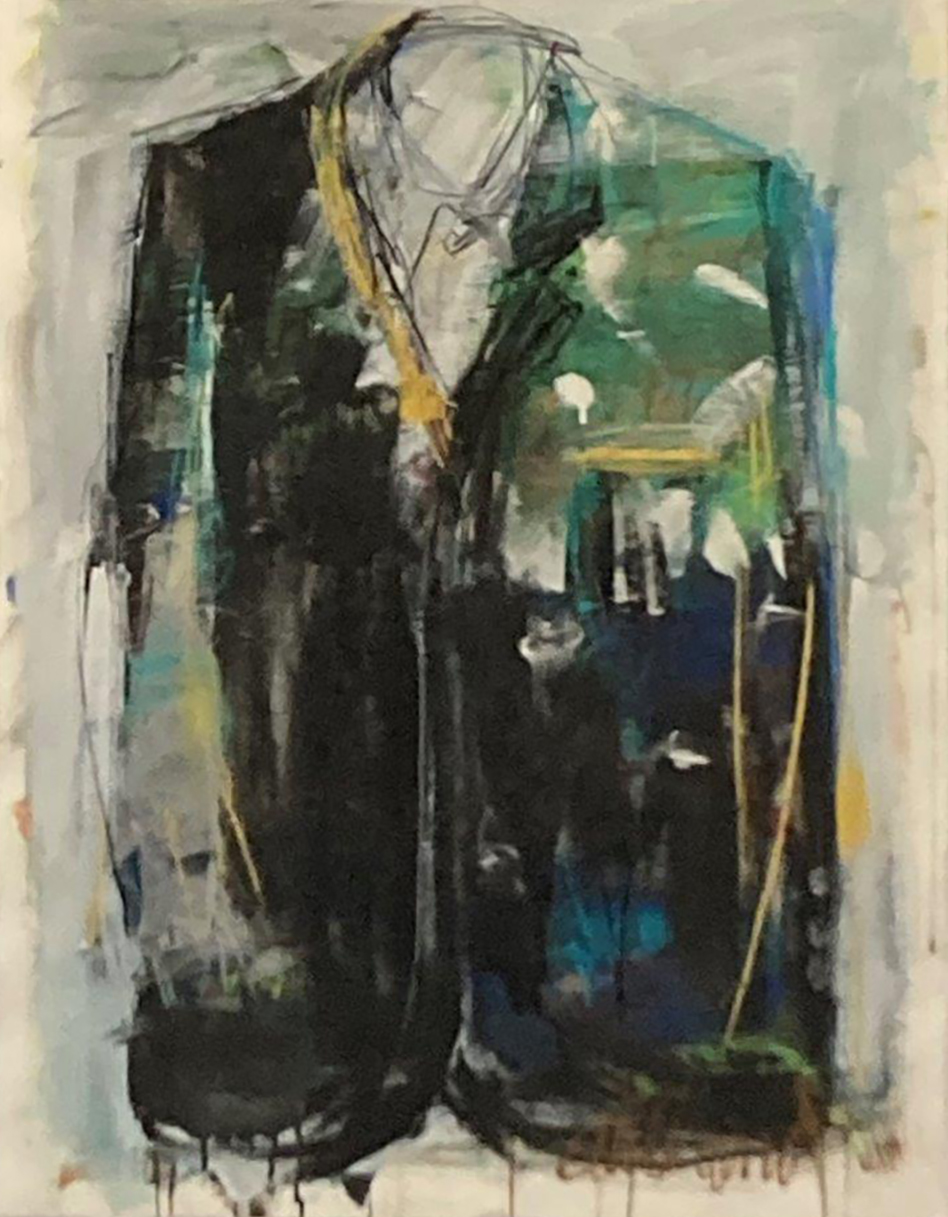
Black Suit, undated
India ink, pastel, acrylic on paper | 42 x 34 in

Source: https://www.mocaamericas.org/news-collection/personal-vision-and-discipline-in-barbara-ahlbrands-work

The Elastic World of M. Paula Wiggins

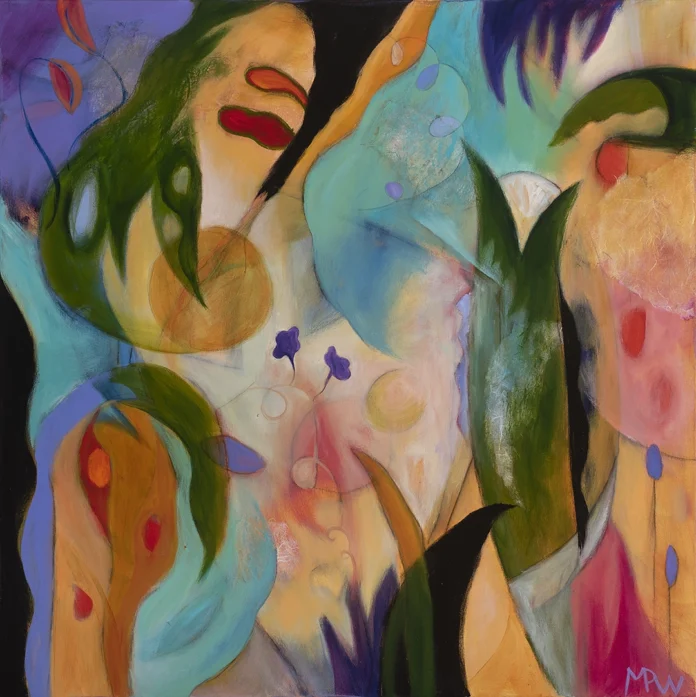
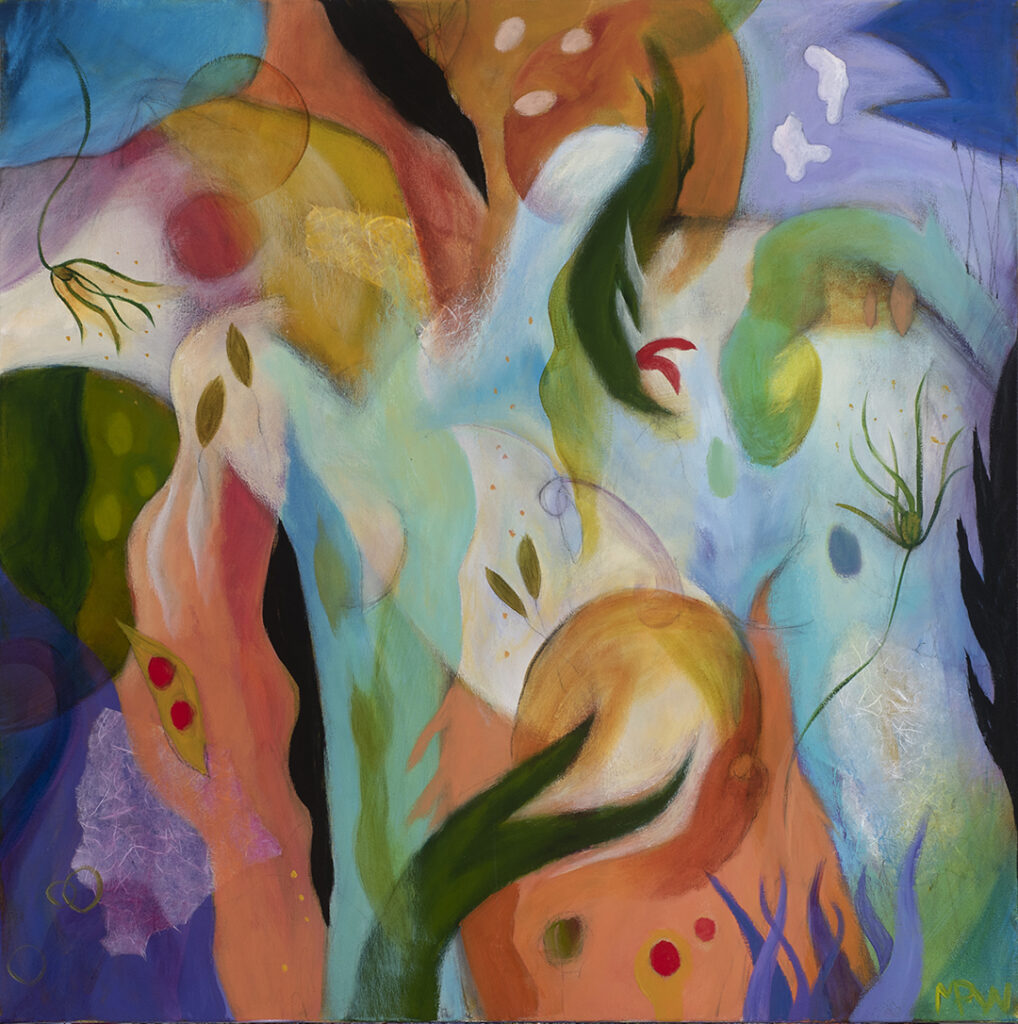
Delighted Jungle
Delighted Jungle, Undated Acrylic on canvas | 36 x 36 in

The Elastic World of M. Paula Wiggins

By Rodriguez Collection Team

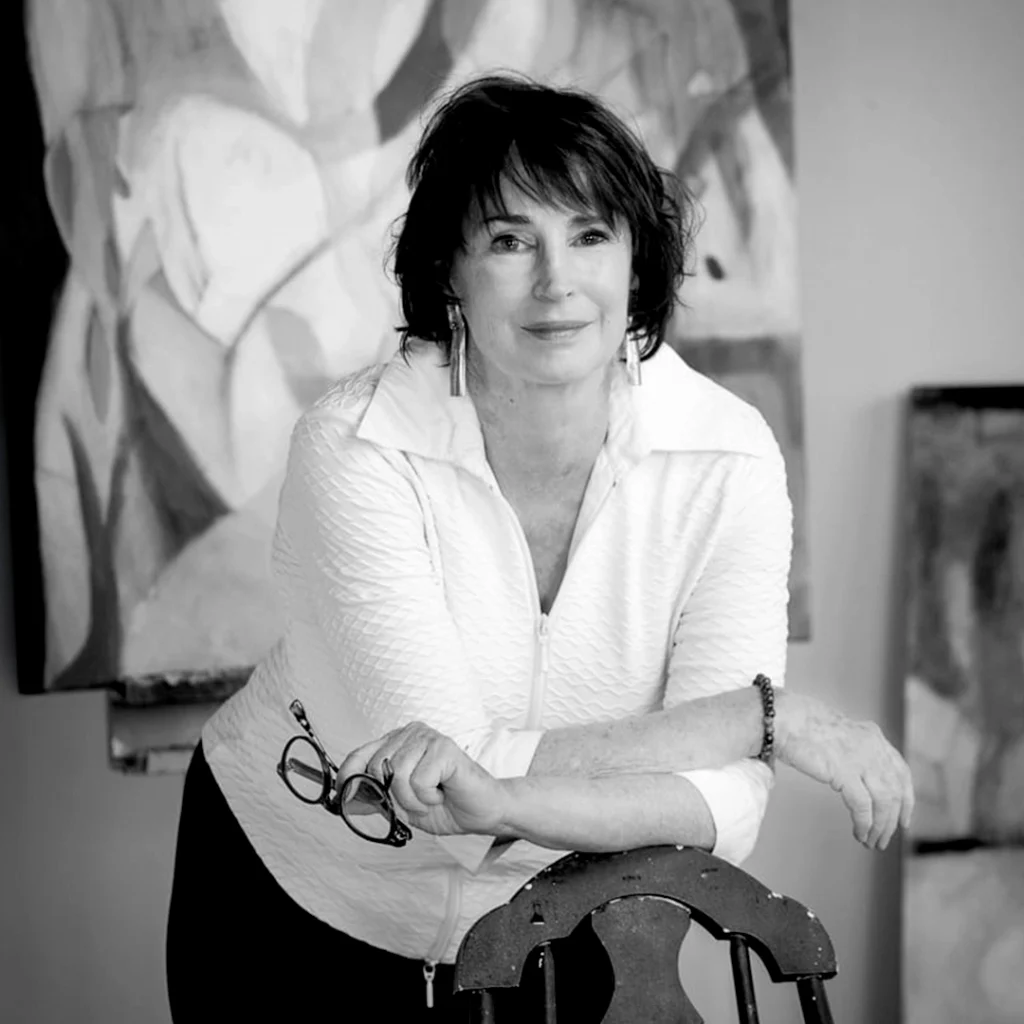
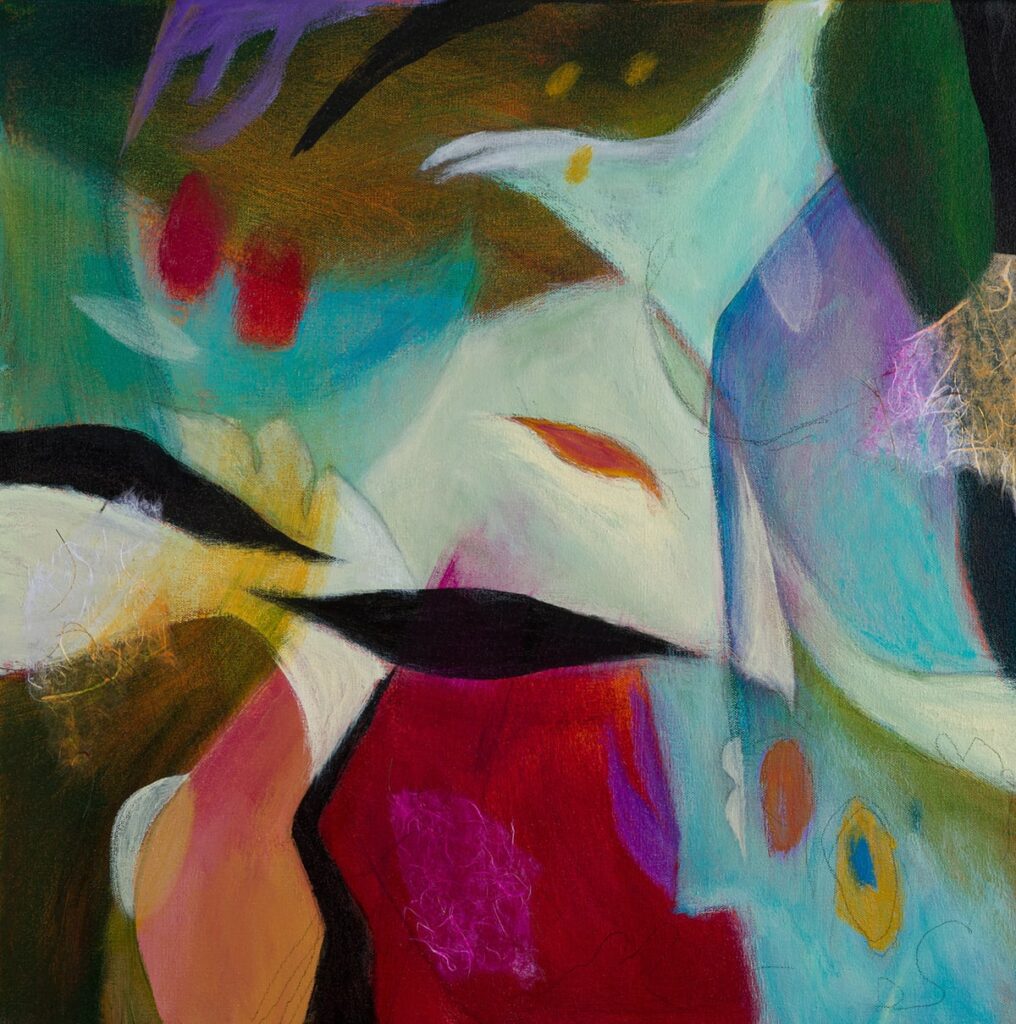
M. Paula Wiggins has built a long and varied practice through painting, drawing, collage, and illustration. Her work brings together abstraction and figuration, often through vivid color, layered surfaces, and an ongoing interest in symbol, humor, people, and the visible and invisible dimensions of experience. Across decades, she has moved between commissioned work and studio practice while continuing to develop a personal visual language grounded in experimentation and change.

Paula began her studies at DAAP, University of Cincinnati, as a painting major with a minor in film. She later returned to school at the Art Academy of Cincinnati for several years to study illustration. That formation opened a broad professional path. Over time, she produced work for magazines, newsletters, CD covers, calendars, posters, and other printed formats, while continuing to paint and draw. In 2000, she was part of a group of artists who exhibited in Germany. Around 2005, she changed her style toward abstraction.

Art and music have long been central to her life. She recalls an eighth-grade teacher, Sister Thomas Aquinas, who played music during art class and encouraged students to paint to what they heard and felt. Saint-Saëns’s Danse Macabre was one of the pieces that stayed with her. In her own words, art and music have always been her great loves. She has described art as “a drop of happiness and hope in our lives” and as “a window of insight into a purely imaginary realm that barely touches reality.” That idea offers an important key to her work, which moves freely between observation, imagination, and emotional association.

M. Paula Wiggins
M. Paula Wiggins

Wiggins has described her work in direct terms: “My work is about color, symbol, humor, people, the rational mind, the irrational mind, the world we see, the world we don’t.” That statement helps clarify the range of elements that appear in her practice. Her paintings often bring these concerns together through compositions that remain open to multiple readings. Color plays a particularly strong role in that process. Her palette is frequently bright and bold, and her use of color appears intended to provoke an immediate emotional response.

A significant aspect of her current practice is her decision to paint over old canvases. This process allows her to develop new ideas while maintaining a connection to earlier work. It also gives her surfaces a layered quality that reflects continuity within her artistic life. In this sense, the act of reworking older material can be understood as part of an ongoing conversation with her own past production.

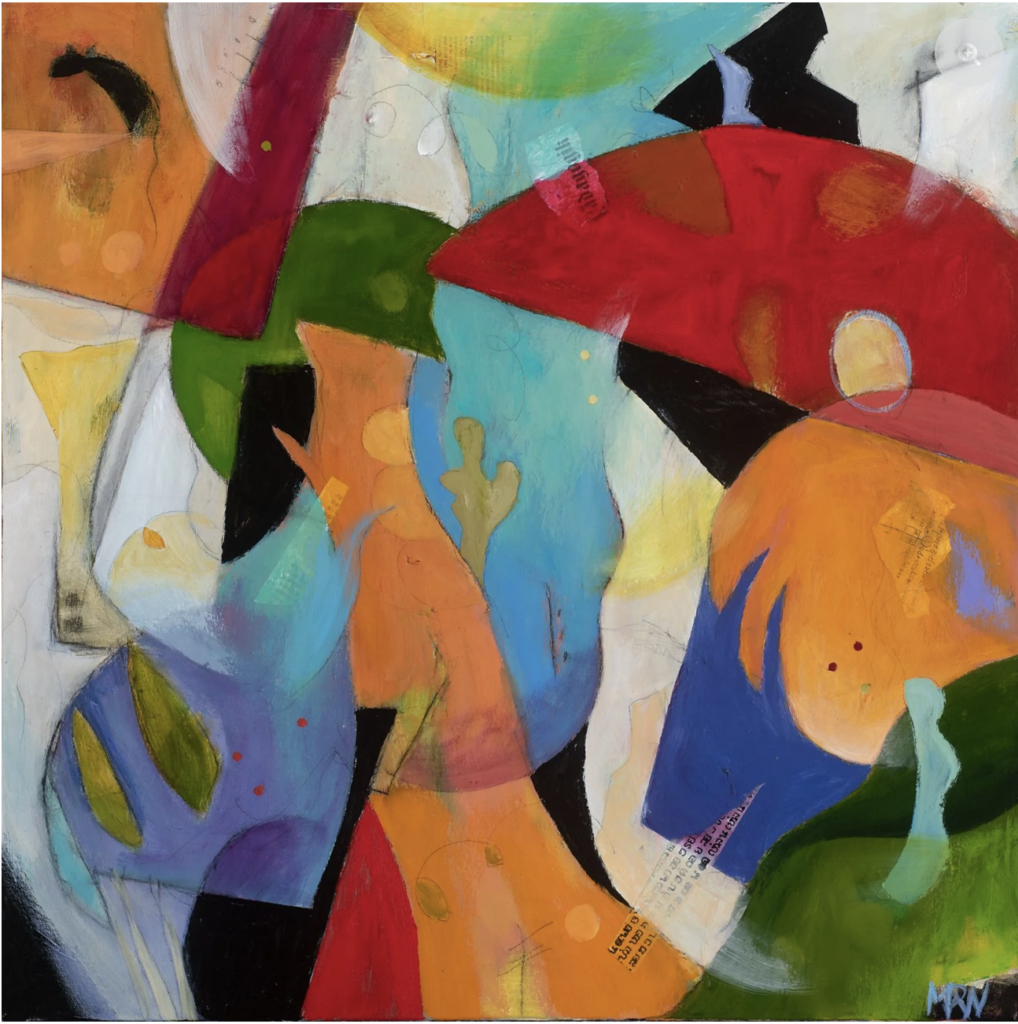
That logic of layering is present more broadly in the way Wiggins builds a canvas. Painting, for her, may include paper, found objects, paint, charcoal, additional paint, and varnish. Some descriptions of her work also point to the use of musical notation, parts of scores, printed newspaper material, and letters of the alphabet within collage-based compositions. These materials contribute to a visual field in which image, fragment, and structure remain in close relation.

Being both a painter and an illustrator gave Wiggins the opportunity to work across many different worlds. She collaborated with publishers and art directors and created images for magazines, books, posters, calendars, and CD covers. For seven years, she also ran the stock illustration site TheSpiritSource.com, which provided images from a large group of artists for the publishing trade. Alongside that professional activity, painting remained central to her studio life.

Juicy Jungle
Juicy Jungle, Undated

Acrylic on canvas | 36 x 36 in

Her formal education continued beyond her BFA from the University of Cincinnati. She also studied at the Art Academy of Cincinnati, attended the Arrowmont School of Arts and Crafts, and worked at the Fine Arts Work Center in Provincetown, Massachusetts. That continued formation suggests an artist committed to sustaining and expanding her practice over time.

One critical description included in the material presents her work as dealing “more abstractedly with personal experience,” in compositions that mirror the mind’s selection through memory. It also notes her use of musical notation, newspaper fragments, and alphabetic structures, together with brilliant reds, purples, and greens that suggest emotional states. This reading is useful because it places memory, structure, and emotion at the center of her work without reducing it to literal narrative.

Wiggins has also expressed a clear conviction about the role of the personal in art: “If the personal in art does not touch the universal, it is narcissism. Inward directed art should reach a spirit that links it to a wider being.” That statement gives important context to her practice. However personal its sources may be, her work aims toward connection and shared resonance.

There are now efforts to document Wiggins visually in her studio, and that context seems especially relevant in relation to her process. Such documentation can offer viewers a better understanding of the environment in which the work develops and of the materials, revisions, and ongoing decisions that shape it. In her case, the studio is also the place where older and newer surfaces meet, where works in progress remain open, and where process becomes visible.

M. Paula Wiggins has developed a body of work shaped by painting, illustration, experimentation, and sustained revision. Her practice brings together abstraction and figuration through color, layering, and a strong investment in image-making as a space for thought, feeling, and transformation. Seen across time, her work reflects both continuity and change, and remains open to the many worlds she has moved through as an artist.

A Life’s Work

“My work is about color, symbol, humor, people, the rational mind, the irrational mind, the world we see, the world we don’t. If the personal in art does not touch the universal, it is narcissism. Inward directed art should reach a spirit that links it to a wider being.”

Being both a painter and an illustrator has given M.P. Wiggins an opportunity to live in many different worlds. She has worked with publishers and art directors to create art for magazines, books, posters, calendars, and CD covers. For 7 years she had a stock illustration site “TheSpiritSource.com”, that provided images from a large group of talented artists for the publishing trade.

But her first love is painting, although “painting” may not be enough of a word to describe the building up of a canvas with paper, found objects, paint, charcoal, more paint, and varnish. Paula received a BFA from the University of Cincinnati and continued to learn by attending other schools and workshops: the Art Academy of Cincinnati, Arrowmont School of Arts and Crafts and the Fine Arts Work Center in Provincetown, MA.

“Paula Wiggins’ work deals more abstractedly with personal experience, in compositions so perfectly rendered that they mirror the mind’s selection through memory, a sorting-out process that leaves the nuggets and often eliminates the chaff. She uses musical notations and parts of scores as well as printed newspaper material in her collages-often superimposed upon the alphabet, a primal and primary intellectual structure, and brilliant reds, purples and greens to suggest emotional states through artist representation.”

Source: https://www.mocaamericas.org/news-collection/the-elastic-world-of-m-paula-wiggins

Halena Cline and the Persistence of Memory

Halena Cline
Merging Spheres II, 2006 Watercolor and Ink on Artistica acid-free Paper | 36¾ x 25½ in

Halena Cline and the Persistence of Memory

By Rodriguez Collection Team

One of the most endearing works in Women of PAC is an artist’s book by Halena Cline, a piece folded into the curatorial proposal at the last minute. Not because it possessed some exceptional aesthetic value, but because it allows us to witness a narrative will: the way the final stages of her process unfold, what precedes them, and what follows from them. It can thus be read as a kind of diary spanning nine years of work, from May 10, 2017 to the present. There is a paradox in the fact that this exhibition interrupts it in order to share its more or less private contents for roughly a month.

Based in Northern Kentucky, Halena Cline has sustained a studio practice over decades from her workspace at the Pendleton Art Center in Cincinnati, where she has worked continuously since 1990. Her work, widely recognized across the United States and held in collections both nationally and abroad, inhabits a territory where the experimental and the traditional coexist without friction, contaminating and reconfiguring one another.

Halena Cline
Halena Cline

That is one of the reasons Cline’s production does not answer to any single stylistic allegiance. Her work is structured through a logic of accumulation and transformation. References to movements such as Dadaism, Fauvism, and Surrealism converge within it, articulating a hybrid visuality that refuses membership in any fixed school. It is perhaps in this condition of stylistic crossbreeding that the core of her project begins to reveal itself.

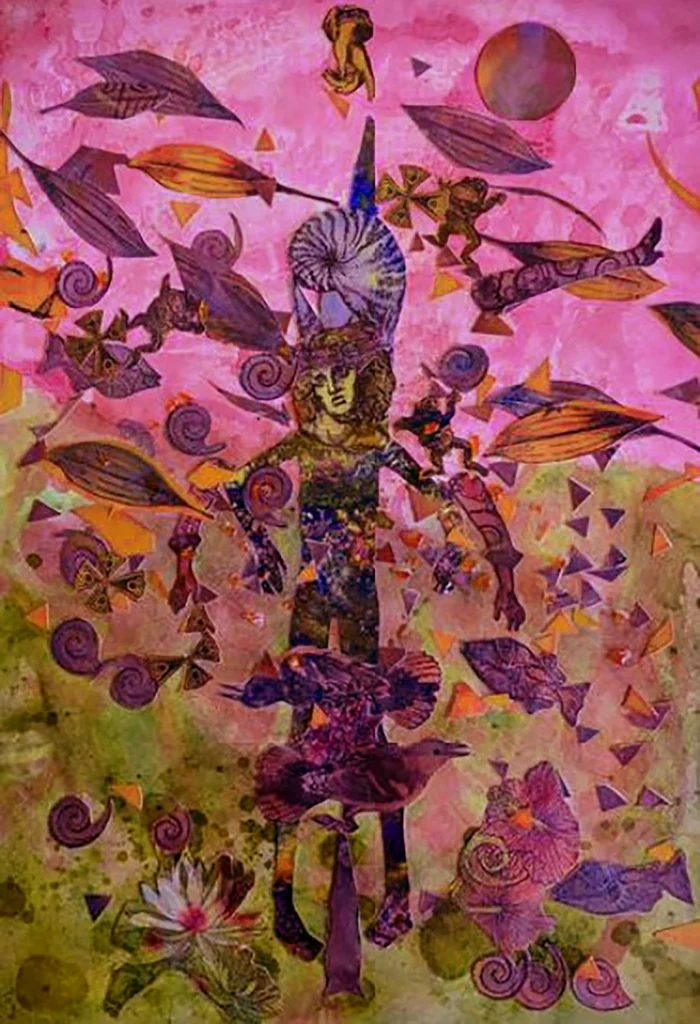
In a body of painting built out of experience, memory, and the need to speak, the figurative and the abstract intertwine in scenes that, though at first glance dreamlike or even playful, disclose tensions common to any act of creation. The figures—often fragmented, displaced, or suspended bodies—inhabit ambiguous spaces where the psychological assumes a determining weight. In works such as Merging Spheres, the simultaneous presence of the masculine and the feminine within separate yet interdependent atmospheres suggests a field of forces in which the emotional, the symbolic, and the subconscious are fused together.

A particularly significant line within her work is the one that turns toward childhood. Across several series, the figure of the young girl appears as both visual and conceptual axis. Strikingly, far from representing innocence, she appears in awkward, tense, even vulnerable postures. Cline constructs these silhouettes from painted papers—structures that evoke mannequins or dressmaker’s forms—along with elements such as barbed wire or suspended fruit. Her narrative becomes complex by holding all this figuration on a single plane of value. Precisely because they are indissoluble, the domestic, the social, and the psychological produce a shared resonance that activates a critical reading of fragility when exposed to the implacable judgment of contemporary society.

Halena Cline
Autumn Breeze, 2020

Watercolor and Ink on Artistica acid-free Paper | 25½ x 19¾ in

Cline’s commitment to issues touching on childhood, women, and society’s most vulnerable sectors is not confined to the content of her work; it also extends into her pedagogical labor. Convinced of the essential role of art in education, she has participated in numerous academic forums and lectures at institutions such as Northern Kentucky University, the University of Cincinnati, the Contemporary Art Center, and the Taft Museum in Cincinnati.

Her life trajectory—marked by intense experiences, displacements, and processes of personal reconstruction—runs directly through her production without cheapening itself into literal narrative. Instead, it becomes an insistence on exploring the margins of human experience: fear, memory, desire, and contradiction. Its power lies in remaining open, on the threshold of the question, within that unstable field where, as one of the ideas that traverses her imagination suggests, creation emerges from the tension between what we are and what we believe ourselves to be.

Halena Cline inhabits a territory of constant negotiation among form, experience, and consciousness: a space where her poetics, nourished by memory and direct experience, sustains itself in a continuous dynamic of tension and transformation.

Source: https://www.mocaamericas.org/news-collection/march-2026-memory-persistence-and-the-work-of-halena-cline

The Silence as Power: Introversion and Artistic Genius

El Silencio como Potencia: La Introversión y el Genio Artístico
The Silence as Power: Introversion and Artistic Genius

The Silence as Power: Introversion and Artistic Genius

I. Introduction: A World That Does Not Understand Silence

We live in the age of institutionalized noise. Contemporary culture rewards those who speak loudest, who take up the most space, who need no solitude to exist. In this extroversion-by-design world, the introverted artist appears as an uncomfortable anomaly: someone who withdraws when they should advance, who observes when they should act, who remains silent when everyone demands an immediate response.

But this reading is profoundly wrong. Introversion is not a lesser form of being human, nor a disguised social pathology. It is, in the words of psychologist Hans Eysenck, a particular cognitive architecture — and, for the artist, a structural advantage of the first order. Eysenck noted that introversion and creativity go hand in hand, precisely because working in solitude allows for superior concentration on the task, and because spending less energy on social interactions frees internal resources for creative work. Margaretsoraya

This article proposes that introversion is not simply compatible with artistic creation: in many cases, it is its very condition of possibility.

II. Jung, the Psyche, and the Inner Source

Any serious discussion of introversion must begin with Carl Gustav Jung, who coined the terms in his work Psychological Types (1921). Jung described the introvert as one whose consciousness may be aware of external conditions, but is not motivated by them: the extreme introvert responds primarily to internal impressions. Cole Schafer This distinction is philosophically crucial. The introvert does not live in the world; they live from the interior world outward. Their work is not a reflection of external reality, but a translation of a deeper, more difficult-to-articulate reality.

Jung classified four basic psychic functions — sensation, intuition, thinking, and emotion — which, combined with introversion or extroversion, produce eight personality types. The introverted emotional type tends to keep their affective experiences to themselves, constructing a protective barrier between their inner world and the outer one. PubMed Central This psychic architecture is not a social defect: it is the scaffolding from which the work of art is erected. The distance between the self and the world produces friction, and that friction, as in physics, generates heat — in this case, creative heat.

The academic study published in PMC on artistic neuropsychology underscores precisely this: introversion dominates the personality of artists, and research on modern artists — analyzing their childhood, trajectory, and personal lives — confirms the predominance of this trait as the engine of creation. PubMed Central

III. Solitude Is Not Emptiness: It Is Fertile Ground

There is a semantic confusion that we must dissolve with philosophical urgency: solitude does not equal isolation, and quietude does not equal sterility. Paul Gauguin articulated it with remarkable precision: “In my isolation I can grow stronger. Poetry seems to come on its own, effortlessly, and I only need to let myself dream a little while painting to suggest it.” The Creative Mind

The voluntary solitude of the introvert is, in phenomenological terms, an opening — not a closing. It is the space where the mind can establish connections that social noise systematically interrupts. In solitude, the introvert rests and listens to their inner voice, personal values become clarified, and excessive external stimuli cease to suffocate that inner voice. Margaretsoraya

Mihaly Csikszentmihalyi, the Hungarian-American psychologist who created the theory of flow, contributed weighty empirical evidence on this question. His research with more than ninety extraordinary people over five years revealed that the myth of the “solitary genius” is quite apt: it is often necessary to be alone to work on mathematical problems, to compose, to write, or to conduct experiments. His studies show that talented young people unable to remain alone do not develop their abilities. Yorokobu

This last observation is devastating in its simplicity: the inability to tolerate one’s own company is not emotional independence, but an incapacity to access the creative source. The introverted artist does not suffer from solitude; they cultivate it as an instrument.

IV. Flow and the Architecture of Creation

The concept of flow — a state of total immersion in an activity, where time dissolves and self-consciousness disappears — has a privileged relationship with introverted personality. In the state of flow, inspiration emerges effortlessly and self-consciousness disappears, facilitating the exploration of new ideas and techniques without fear of external judgment. DENIS TOLEDO This is exactly the psychological structure that the introvert inhabits most naturally: distance from others’ judgment, focus on the internal process, sensitivity to the immediate environment of creation.

Csikszentmihalyi described the creative personality with a single word: complexity. Creative people are people “of extremes”: they can be introverted and extroverted at the same time, behaving one way or another depending on circumstances. Their virtue is that the creative personality is characterized by its multidimensionality. La Mente es Maravillosa This does not invalidate the introvert thesis — it refines it. The introverted artist is not condemned to a single frequency; they can project themselves into the world, but they need to return to silence in order to recharge, to process, to transform experience into form.

Csikszentmihalyi himself acknowledges that Michelangelo and Leonardo da Vinci were solitary individuals who showed some difficulty explaining their ideas to others and spent most of their time absorbed in working on their projects. Amelica What this tells us about Renaissance genius is not that introversion was an obstacle, but that it was the silent engine behind the most transformative works in Western history.

V. Academic Evidence: The Statistics of Silence

The correlation between introversion and artistic creativity is neither impressionistic nor anecdotal. Among the consistent findings in the literature on artist and scientist personality, the tendency toward introversion stands out. Classic studies on scientific creativity have shown that the most creative individuals are also more achievement-oriented and less socially affiliated than their less creative peers. ScienceDirect

A study published in Frontiers in Psychology that analyzed 419 text samples from creative individuals found revealing results: creative individuals tended to use more words associated with patterns of introversion and openness to experience than less creative individuals. And when comparing domains, eminent artists used more linguistic markers of introversion than eminent scientists. PubMed Central Language itself — that window into the interior world — betrays the introverted orientation of the artist.

West and Farr (1990) specifically listed introversion as a characteristic of creative people. Other studies found that having an internal locus of control — a highly introverted trait — also predicts creativity. And since 1963, multiple researchers across fields ranging from business administration to psychology have concluded that individual creative performance frequently surpasses group performance. Scholar Commons

VI. The Great Introverts of Art: Stories at the Margin

The history of art is built, in large part, on the biography of silence. Emily Dickinson lived confined to her family home, communicating with visitors through a closed door; upon her death, her sister found a trunk containing 1,800 unpublished poems. Cormac McCarthy declined interviews, turned down public engagements, and once failed to appear at a literary banquet held in his honor. Harper Lee, after publishing To Kill a Mockingbird, disappeared into public obscurity only to resurface decades later with a sequel. Cole Schafer

These are not cases of social pathology. They are cases of a radically different economy of attention: one where psychic energy is not dispersed through the social fabric, but concentrated, condensed, transformed into work. Susan Cain, in her influential book Quiet, champions introverts for their insight, sensitivity, deliberateness, and artistic creativity, noting that when the introverted nature is not honored, artists easily drift toward depression, anxiety, or social difficulties — their creativity squandered. Psychology Today

Steve Wozniak, co-founder of Apple, is perhaps the most cited example from the world of technology, but his logic applies perfectly to art: Wozniak declared that engineers and inventors are like artists, and that like them, they do their best work alone — not on a team or in a corporate office, but in solitude. Inc

VII. Aesthetic Criticism: Art Born from Silence Has a Different Texture

From the perspective of art criticism, there is an observation that statistical studies do not always capture: work produced from introversion possesses a peculiar semiotic density. Within it are layers of meaning that are not exhausted on first reading — a stratification that presupposes a viewer willing to pause and listen.

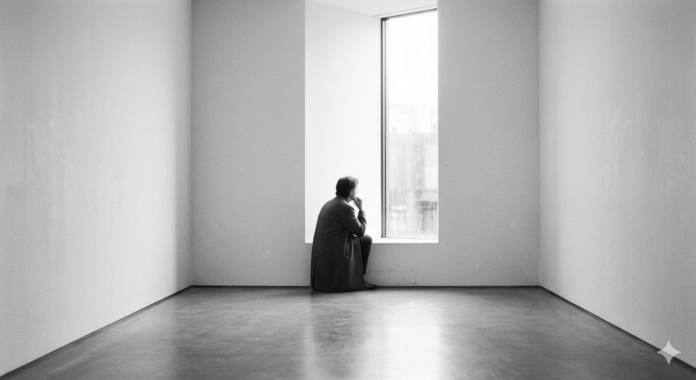
Consider the paintings of Edward Hopper: his isolated figures in late-night diners, his empty rooms bathed in oblique sunlight. This is the phenomenology of introversion converted into image. Or the music of Erik Satie, so quiet that it does not “fill” a space, but lets it breathe. Or the sculptures of Alberto Giacometti — figures thinned to the point of disappearance, existing at the boundary between presence and absence. Science journalist Winifred Gallagher frames it with precision: “The glory of the disposition that pauses to consider stimuli rather than rushing to engage with them is its long association with intellectual and artistic achievement.” The Creative Mind

Introverted art does not shout. It invites. And that invitation, paradoxically, creates deeper bonds with the viewer than any aesthetic exhibitionism ever could.

VIII. Conclusion: A Vindication of the Interior

Introversion is not a condition the artist must overcome in order to function fully in the art world. It is, in many cases, the central mechanism of their creative functioning. The capacity to inhabit one’s own silence, to process experience in depth before projecting it outward, to resist the dispersion imposed by constant sociability — these are cognitive and aesthetic virtues of the highest order.

Susan Cain argues that without introverts, the world would lack the theory of gravity, the theory of relativity, Chopin’s nocturnes, Proust’s In Search of Lost Time, and Peter Pan. The Creative Mind This list is not arbitrary: it is the roster of works that demanded a life oriented inward.

The introverted artist is not absent from the world. They are inside the world in a way that most people do not allow themselves, or cannot sustain. And it is from that position — uncomfortable, silent, profound — that they produce the works which, paradoxically, speak most powerfully to everyone.

Silence has a grammar. Learning it is the work of an entire artistic life.


Academic References

  • Jung, C.G. (1921). Psychological Types. Routledge Collected Works, Vol. 6.
  • Eysenck, H.J. (1995). Genius: The Natural History of Creativity. Cambridge University Press.
  • Csikszentmihalyi, M. (1996). Creativity: Flow and the Psychology of Discovery and Invention. Harper Collins.
  • Cain, S. (2012). Quiet: The Power of Introverts in a World That Can’t Stop Talking. Crown Publishing.
  • Ahmed, S. & Feist, G.J. (2021). “The Language of Creativity: Validating Linguistic Analysis to Assess Creative Scientists and Artists.” Frontiers in Psychology, PMC8639503.
  • West, M.A. & Farr, J.L. (1990). Innovation and Creativity at Work. Wiley.
  • Furnham, A. & Bachtiar, V. (2008). “Personality and intelligence as predictors of creativity.” Personality and Individual Differences, 45(7).
  • Needle, R. (2019). “Innovative and Introverted: How Introverts Function in the Creative Workplace.” Senior Theses, University of South Carolina.
  • Li, Y. et al. (2019). “Analysis on Artist Neuropsychology and Art Creation.” PMC, PMC6487786.

El Silencio como Potencia: La Introversión y el Genio Artístico

El Silencio como Potencia: La Introversión y el Genio Artístico
The Silence as Power: Introversion and Artistic Genius

El Silencio como Potencia: La Introversión y el Genio Artístico

I. Introducción: El mundo que no entiende el silencio

Vivimos en la era del ruido institucionalizado. La cultura contemporánea premia al que habla más fuerte, al que ocupa más espacio, al que no necesita soledad para existir. En este contexto extrovertido por diseño, el artista introvertido aparece como una anomalía incómoda: alguien que se retira cuando debería avanzar, que observa cuando debería actuar, que calla cuando todo el mundo exige respuesta inmediata.

Pero esta lectura es profundamente equivocada. La introversión no es una forma menor de ser humano, ni una patología social encubierta. Es, en palabras del psicólogo Hans Eysenck, una arquitectura cognitiva particular —y, para el artista, una ventaja estructural de primera magnitud. Eysenck señaló que la introversión y la creatividad van de la mano, precisamente porque trabajar en soledad permite una concentración superior en la tarea, y porque gastar menos energía en interacciones sociales libera recursos internos para la obra creativa. Margaretsoraya

Este artículo propone que la introversión no es simplemente compatible con la creación artística: en muchos casos, es su condición de posibilidad.

II. Jung, la psique y la fuente interior

Toda discusión seria sobre introversión debe partir de Carl Gustav Jung, quien acuñó los términos en su obra Tipos Psicológicos (1921). Jung describió al introvertido como aquel cuya conciencia puede ser consciente de las condiciones externas, pero no está motivada por ellas: el introvertido extremo responde primordialmente a las impresiones internas. Cole Schafer Esta distinción es filosóficamente crucial. El introvertido no vive en el mundo; vive desde el mundo interior hacia afuera. Su obra no es un reflejo de la realidad externa, sino una traducción de una realidad más profunda, más difícilmente articulable.

Jung clasificó cuatro funciones psíquicas básicas —sensación, intuición, pensamiento y emoción— que, combinadas con la introversión o extraversión, producen ocho tipos de personalidad. El tipo introvertido emocional tiende a guardar sus experiencias afectivas para sí, construyendo una barrera protectora entre su mundo interno y el externo. PubMed Central Esta arquitectura psíquica no es un defecto social: es el andamiaje desde el cual se erige la obra de arte. La distancia entre el yo y el mundo produce fricción, y esa fricción, como en la física, genera calor —en este caso, calor creativo.

El estudio académico publicado en PMC sobre neuropsicología artística subraya precisamente esto: la introversión domina la personalidad de los artistas, y la investigación sobre artistas modernos, analizando su infancia, trayectoria y vida personal, confirma la preponderancia de este rasgo como motor de la creación. PubMed Central

III. La soledad no es vacío: es espacio fértil

Existe una confusión semántica que debemos disolver con urgencia filosófica: soledad no equivale a aislamiento, y quietud no equivale a esterilidad. Paul Gauguin lo articuló con precisión notable: “En mi aislamiento puedo crecer más fuerte. La poesía parece venir sola, sin esfuerzo, y sólo necesito dejarme soñar un poco mientras pinto para sugerirla.” The Creative Mind

La soledad voluntaria del introvertido es, en términos fenomenológicos, una apertura —no un cierre. Es el espacio donde la mente puede establecer conexiones que el ruido social interrumpe sistemáticamente. En la soledad, el introvertido descansa y escucha su voz interior, sus valores personales se clarifican, y los estímulos externos excesivos dejan de sofocar esa voz interior. Margaretsoraya

Mihaly Csikszentmihalyi, el psicólogo húngaro-americano creador de la teoría del flujo, aportó evidencia empírica de peso sobre esta cuestión. Sus investigaciones con más de noventa personas extraordinarias durante cinco años revelaron que el mito del “genio solitario” es muy acertado: a menudo es necesario estar solo para trabajar en problemas matemáticos, componer, escribir o hacer experimentos. Sus estudios demuestran que los jóvenes con talento incapaces de permanecer solos no desarrollan sus capacidades. Yorokobu

Esta última observación es devastadora en su sencillez: la incapacidad de tolerar la propia compañía no es independencia emocional, sino incapacidad para acceder a la fuente creativa. El artista introvertido no sufre de soledad; la cultiva como un instrumento.

IV. El flujo y la arquitectura de la creación

El concepto de flow —estado de inmersión total en una actividad, donde el tiempo se disuelve y la autoconciencia desaparece— tiene una relación privilegiada con la personalidad introvertida. En el estado de flujo, la inspiración emerge sin esfuerzo y la autoconciencia desaparece, lo que facilita la exploración de nuevas ideas y técnicas sin temor al juicio externo. DENIS TOLEDO Es exactamente la estructura psicológica que el introvertido habita de manera más natural: distancia del juicio ajeno, enfoque en el proceso interno, sensibilidad al entorno inmediato de la creación.

Csikszentmihalyi describió la personalidad creativa con una sola palabra: complejidad. Los creadores son personas “de extremos”: pueden ser introvertidos y extrovertidos al mismo tiempo, comportándose de una u otra manera según las circunstancias. Su virtud es que la personalidad creativa se caracteriza por su multidimensionalidad. La Mente es Maravillosa Esto no invalida la tesis introvertida —la refina. El artista introvertido no está condenado a una sola frecuencia; puede proyectarse al mundo, pero necesita regresar al silencio para recargar, para procesar, para transformar experiencia en forma.

El propio Csikszentmihalyi reconoce que Miguel Ángel y Leonardo da Vinci eran personas solitarias que mostraban cierta dificultad para explicar sus ideas a otros y pasaban la mayor parte del tiempo ensimismados trabajando en sus proyectos. Amelica Lo que nos dice esto sobre el genio renacentista no es que la introversión sea obstáculo, sino que era el motor silencioso detrás de las obras más transformadoras de la historia occidental.

V. Evidencia académica: La estadística del silencio

La correlación entre introversión y creatividad artística no es impresionista ni anecdótica. Entre los hallazgos consistentes de la literatura sobre personalidad de artistas y científicos, destaca la tendencia hacia la introversión. Estudios clásicos sobre creatividad científica han mostrado que los creadores más creativos son también más orientados al logro y menos afiliados socialmente que sus pares menos creativos. ScienceDirect

Un estudio publicado en Frontiers in Psychology que analizó 419 muestras de texto de individuos creativos encontró resultados reveladores: los individuos creativos tendían a emplear más palabras asociadas a patrones de introversión y apertura a la experiencia que los individuos menos creativos. Y al comparar dominios, los artistas eminentes usaban más marcadores lingüísticos de introversión que los científicos eminentes. PubMed Central El lenguaje mismo —esa ventana al mundo interior— delata la orientación introvertida del artista.

West y Farr (1990) listaron específicamente la introversión como característica de las personas creativas. Otros estudios encontraron que tener un locus de control interno —rasgo altamente introvertido— también predice la creatividad. Y desde 1963, múltiples investigadores en campos que van desde la administración hasta la psicología han concluido que el desempeño creativo individual supera frecuentemente al grupal. Scholar Commons

VI. Los grandes introvertidos del arte: Historias en el margen

La historia del arte está construida, en gran medida, sobre la biographie del silencio. Emily Dickinson vivía confinada en la casa paterna, comunicándose con visitantes a través de una puerta cerrada; al morir, su hermana encontró un baúl con 1.800 poemas inéditos. Cormac McCarthy rechazaba entrevistas, declinaba compromisos públicos y una vez no se presentó a un banquete literario celebrado en su honor. Harper Lee, después de publicar Matar un ruiseñor, desapareció en la oscuridad pública para reaparecer décadas después con una secuela. Cole Schafer

Estos no son casos de patología social. Son casos de una economía de la atención radicalmente diferente: una economía donde la energía psíquica no se dispersa en el tejido social, sino que se concentra, se condensa, se transforma en obra. Susan Cain, en su influyente libro Quiet, reivindica a los introvertidos por su perspicacia, sensibilidad, deliberación y creatividad artística, señalando que cuando la naturaleza introvertida no es honrada, los artistas fácilmente derivan hacia la depresión, la ansiedad o las dificultades sociales, creativamente desaprovechados. Psychology Today

Steve Wozniak, co-fundador de Apple, es quizás el ejemplo más citado desde la tecnología, pero su lógica es perfectamente aplicable al arte: Wozniak declaró que los ingenieros e inventores son como artistas, y que como ellos, realizan su mejor trabajo solos, no en equipo ni en una oficina corporativa, sino en soledad. Inc

VII. Crítica estética: El arte que nace del silencio tiene una textura distinta

Desde la crítica de arte, existe una observación que los estudios estadísticos no siempre capturan: la obra producida desde la introversión tiene una densidad semiótica peculiar. Hay en ella capas de significado que no se agotan en la primera lectura, una estratificación que supone un espectador que también está dispuesto a detenerse, a escuchar.

Piénsese en la pintura de Edward Hopper: sus figuras aisladas en diners iluminados de noche, sus habitaciones vacías bañadas de sol oblicuo. Esta es la fenomenología de la introversión convertida en imagen. O en la música de Erik Satie, tan quieta que no “llena” el espacio, sino que lo deja respirar. O en la escultura de Alberto Giacometti, figuras delgadas hasta la desaparición, existiendo en el límite entre la presencia y la ausencia. La periodista científica Winifred Gallagher lo formula con precisión: “La gloria de la disposición que se detiene a considerar los estímulos en lugar de apresurarse a involucrarse con ellos es su larga asociación con el logro intelectual y artístico.” The Creative Mind

El arte introvertido no grita. Invita. Y esa invitación, paradójicamente, crea vínculos más profundos con el espectador que cualquier exhibicionismo estético.

VIII. Conclusión: Reivindicación del interior

La introversión no es una condición que el artista deba superar para ser plenamente funcional en el mundo del arte. Es, en muchos casos, el mecanismo central de su funcionamiento creativo. La capacidad de habitar el propio silencio, de procesar la experiencia en profundidad antes de proyectarla, de resistir la dispersión que impone la sociabilidad constante —estas son virtudes cognitivas y estéticas de primer orden.

Susan Cain afirma que sin introvertidos, el mundo carecería de la teoría de la gravedad, la teoría de la relatividad, los nocturnos de Chopin, En busca del tiempo perdido de Proust, Peter Pan. The Creative Mind Esta lista no es caprichosa: es la nómina de obras que exigieron una vida orientada hacia adentro.

El artista introvertido no está ausente del mundo. Está dentro del mundo de una manera que la mayoría no se permite o no puede sostener. Y es desde esa posición —incómoda, silenciosa, profunda— desde donde produce las obras que, paradójicamente, más hablan a todos.

El silencio tiene una gramática. Aprenderla es el trabajo de toda una vida artística.


Referencias Académicas

  • Jung, C.G. (1921). Tipos Psicológicos. Routledge Collected Works, Vol. 6.
  • Eysenck, H.J. (1995). Genius: The Natural History of Creativity. Cambridge University Press.
  • Csikszentmihalyi, M. (1996/1998). Creatividad: El fluir y la psicología del descubrimiento y la invención. Paidós.
  • Cain, S. (2012). Quiet: The Power of Introverts in a World That Can’t Stop Talking. Crown Publishing.
  • Ahmed, S. & Feist, G.J. (2021). “The Language of Creativity: Validating Linguistic Analysis to Assess Creative Scientists and Artists.” Frontiers in Psychology, PMC8639503.
  • West, M.A. & Farr, J.L. (1990). Innovation and Creativity at Work. Wiley.
  • Furnham, A. & Bachtiar, V. (2008). “Personality and intelligence as predictors of creativity.” Personality and Individual Differences, 45(7).
  • Needle, R. (2019). “Innovative and Introverted: How Introverts Function in the Creative Workplace.” Senior Theses, University of South Carolina.
  • Li, Y. et al. (2019). “Analysis on Artist Neuropsychology and Art Creation.” PMC, PMC6487786.

Odyssey: A Transformative Journey: Belkis Ayón and Carlos Alfonzo at MOAD

Odyssey:
Odyssey: A Transformative Journey: Belkis Ayón and Carlos Alfonzo at MOAD

Odyssey: A Transformative Journey: Belkis Ayón and Carlos Alfonzo at MOAD

Written By Olga Garcia-Mayoral

Some exhibitions don’t simply hang on the wall—they press back. Belkis Ayón and Carlos Alfonzo: Odyssey at the Museum of Art and Design (MOAD) at Miami Dade College is one of those rare shows that feels less like a viewing experience and more like a private reckoning staged in public. It’s on view through May 10, 2026, and it stands—without exaggeration—as one of the most compelling exhibitions Miami has to offer right now.

Bringing together two artists of immense force—Belkis Ayón (1967–1999) and Carlos Alfonzo (1950–1991)—Odyssey is a study in distinct aesthetic languages that share a common gravity. Their styles differ dramatically: Ayón’s printmaking carries a stark, mythic austerity; Alfonzo’s painting burns with expressive urgency. Yet the exhibition reveals how both artists arrive at similar stakes: image-making as spiritual inquiry, myth as a living archive, and storytelling as a continuous journey rather than a closed narrative.

What makes the experience feel so complete is the curatorial intelligence behind it. Chief Curator Amy Galpin has assembled a selection that doesn’t rely on spectacle; instead, it builds density—visual, psychological, and emotional. The exhibition design guides you without forcing you, allowing the works to speak in their own registers while quietly amplifying their correspondences. It’s a show that respects silence, encourages contemplation, and trusts the viewer to meet the work halfway.

Ayón: The Weight of Myth, the Sharpness of Silence

Belkis Ayón’s work is magnetic in its restraint. Her visual world—anchored by commanding figures and a rich vocabulary of black, white, and gray—feels like entering a ritual space where meaning is withheld just long enough to sharpen your attention. The surfaces carry a tension between softness and severity: velvety blacks that absorb light, pale forms that emerge like revelations, eyes that stare not as portraits but as presences.

Ayón’s compositions don’t simply depict myth; they seem to activate it. There is an atmosphere of secrecy and initiation—a sense that what you are looking at is only one layer of what is being communicated. The figures operate like symbols and beings at once: human, animal, divine, and something unnamed. It becomes difficult to remain an observer; the work invites an internal dialogue and self-questioning. You begin to feel how mythology can function not as a story of the past, but as a mirror.

The emotional impact of Ayón’s work isn’t loud. It arrives in the body like a slow realization. Her images hold violence and vulnerability in the same breath—an understanding of oppression that is not presented as a headline, but as atmosphere, structural, and unavoidable. The power comes from how little she needs to say to make you feel the stakes.

Alfonzo: Painting as Incantation

If Ayón’s work feels like a rite conducted in shadow, Carlos Alfonzo’s feels like a chant—urgent, radiant, often fierce. His paintings pulse with the force of someone pushing against limitation through color, gesture, and symbol. There is a physicality to the surface—an insistence in the mark-making—that reads as both defiance and devotion.

Alfonzo’s visual language can feel like an odyssey in motion: forms turning, bodies transforming, symbols colliding. His work often feels inhabited by multiple worlds at once—history and autobiography, spirit and street-level reality, tenderness and aggression. The paintings don’t settle into a single reading, and that’s the point: they demand that you return to them, reassess, re-enter. Their narratives are ongoing, not resolved.

There is also a kind of emotional transparency in Alfonzo’s work—an openness to intensity. You feel the artist’s awareness of violence and oppression not as distant commentary but as a lived condition. Yet the work is not consumed by despair; it converts tension into visual abundance, turning psychic pressure into creative force.

A Conversation Across Difference

The genius of Odyssey is that it doesn’t force equivalence between these artists. Instead, it stages a conversation—a dialogue across difference in which meaning emerges through proximity. Ayón and Alfonzo are connected here not by aesthetic similarity, but by shared commitments: to myth, to complex spiritualities, to bold storytelling, and to a sense of art as a journey that never really ends.

Both artists lived with the realities of Cuba’s constraints—scarcity and limited freedoms—and both developed practices that transform pressure into language. Yet their paths diverge, and the exhibition makes room for that. It shows two artists navigating their worlds differently while arriving at works that still speak to each other across time.

There’s a deeper resonance, too, in seeing these works in Miami—one of the great centers of the Cuban diaspora, a city shaped by the ongoing tension between memory and reinvention. This exhibition doesn’t just belong in Miami; it helps clarify Miami. It reminds us that cultural history is not simply inherited; it is argued over, revised, mourned, celebrated, and continually reimagined.

Curatorial Clarity and Emotional Architecture

Amy Galpin’s curatorial decisions feel both scholarly and intuitive. The show is built on pacing—moments when the viewer can breathe and moments when the work tightens its grip. The design supports the emotional “odyssey” suggested by the title: not a straight line, but a journey through layers of myth, spirit, and lived experience.

What’s striking is how the exhibition makes space for the works’ complexity without overexplaining them. You are invited to bring your own questions, your own history, your own sensitivity. The result is an exhibition that doesn’t just inform—it transforms.

Why You Should Go Now

Odyssey is the kind of exhibition that recalibrates your expectations of what a museum show can do. It is intellectually rich, visually gripping, and emotionally resonant. It is also rare: two artists, each monumental in their own right, presented in a way that honors their individuality while revealing their shared stakes.

If you care about Cuban and Cuban diasporic art, about contemporary myth-making, about spiritual complexity in visual form, or simply about what it feels like to encounter art that doesn’t let you remain untouched, this show is essential.

Miami has many offerings, but few that feel as necessary as this one. Belkis Ayón and Carlos Alfonzo: Odyssey is not just worth seeing; it is essential. It’s worth sitting with. And it may stay with you longer than you expect.

Odyssey:
Odyssey:
Page 2 of 276
1 2 3 4 276