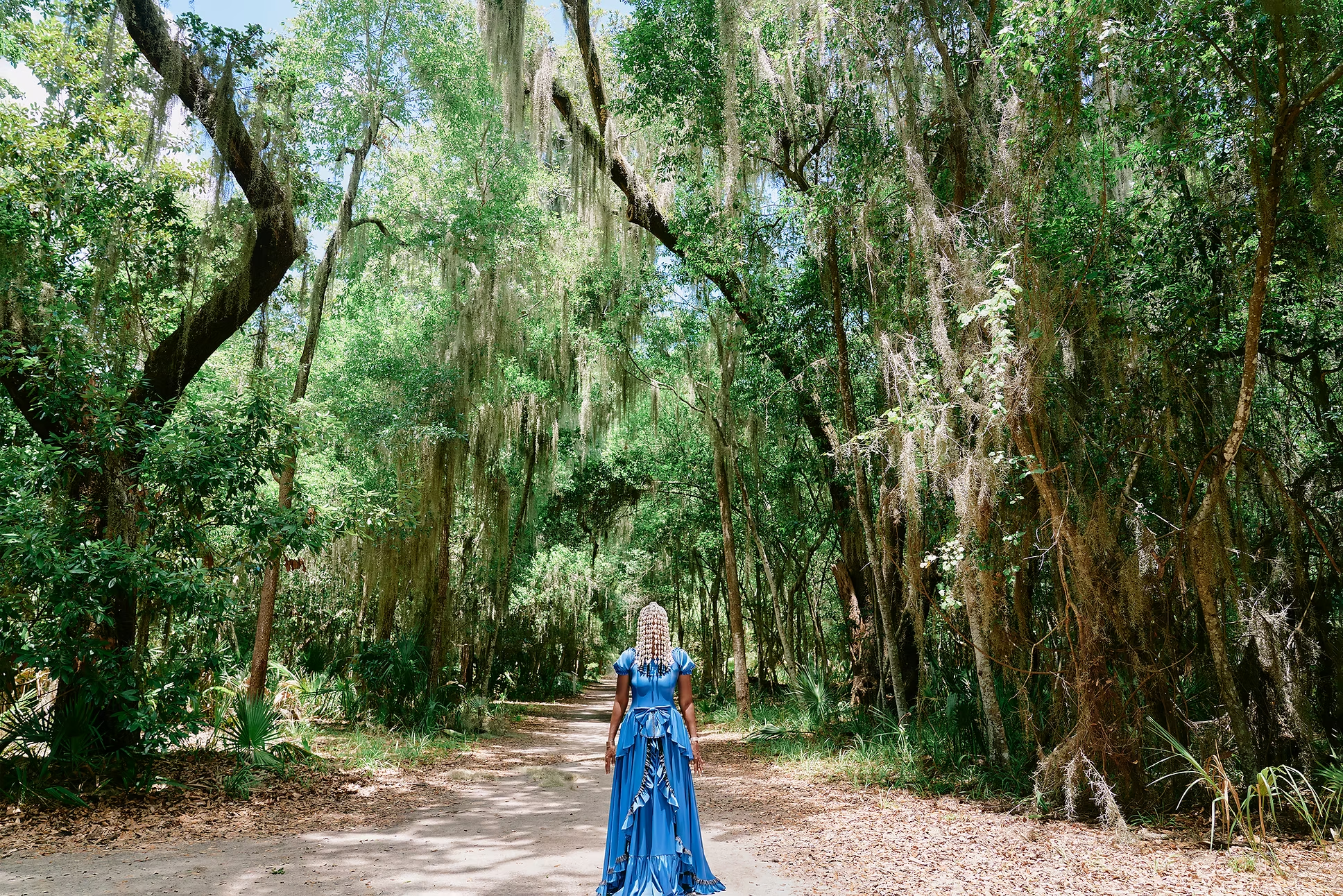
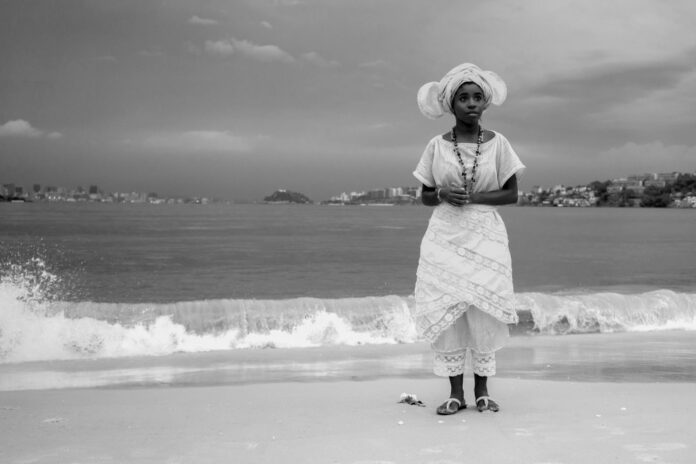
Adama Delphine Fawundu es una fuerza imparable. Su trabajo no es solo fotografía; es una conversación feroz con la historia, con la memoria, con lo que significa ser mujer, africana, afrodescendiente y simplemente humana en este mundo que insiste en encasillar identidades. Desde Brooklyn hasta Sierra Leona, desde el agua hasta la tierra, su obra es un testimonio de resiliencia, resistencia y reimaginación.
Fawundu no solo captura imágenes, sino que las construye con una reverencia casi sagrada por los materiales: telas, texturas, cabellos trenzados, patrones textiles que cargan siglos de significado. Su lente no es meramente documental; es un acto de afirmación, un grito visual contra el borrado de la historia negra en la diáspora. Piénsalo: ella no se limita a retratar cuerpos, sino que los envuelve en símbolos de pertenencia, en gestos que son al mismo tiempo protesta y celebración.
Su presencia en colecciones como las del Brooklyn Museum y Princeton University no es casualidad; Fawundu es de esas artistas que no piden permiso para existir en la historia del arte. Y es exactamente lo que hace falta hoy: artistas que tomen espacio, que rescriban narrativas, que no se conformen con los cánones impuestos. Su participación en el 100 Years|100 Women Project es otra prueba de su capacidad para conectar pasado y presente sin caer en la nostalgia vacía.
Hay artistas que documentan y artistas que transforman. Fawundu hace ambas cosas. Su trabajo es una lección de memoria viva, una interrogación continua sobre qué significa pertenecer. Su fotografía no es solo imagen; es testimonio. Es arte que respira, que exige ser visto, que nos obliga a mirar dos veces y preguntarnos qué historias hemos olvidado.
Rubem Valentim en el ICA Miami: Geometría, Espíritu y el Legado Afro-Brasileño
Una exposición imperdible que exige ser vista y experimentada.
Hay exposiciones que se ven, otras que se sienten y algunas que transforman. Crossroads: Rubem Valentim’s 1960s en el Institute of Contemporary Art, Miami, es de esas que logran las tres cosas a la vez. Es una experiencia que no solo nos sitúa frente a la fuerza plástica de la geometría, sino que nos recuerda que el arte puede ser un lenguaje místico, político y profundamente humano.
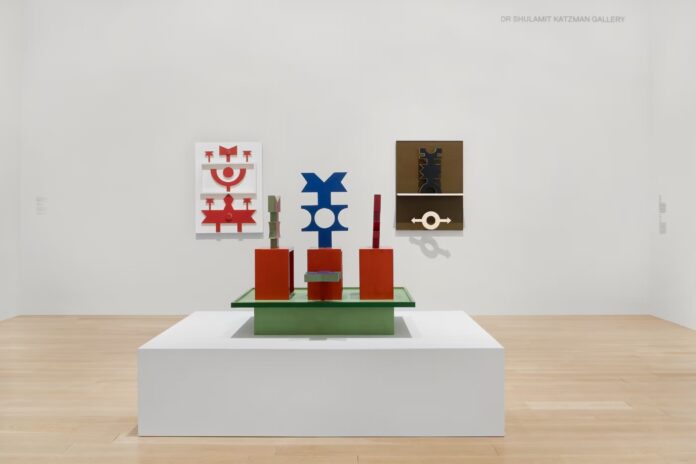
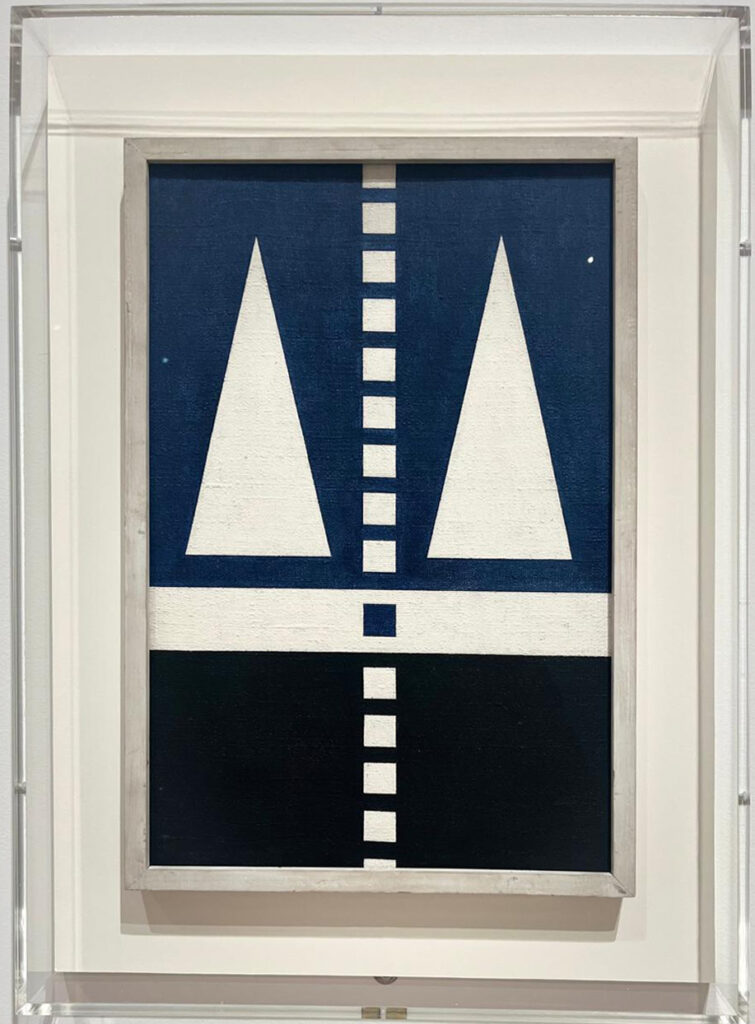
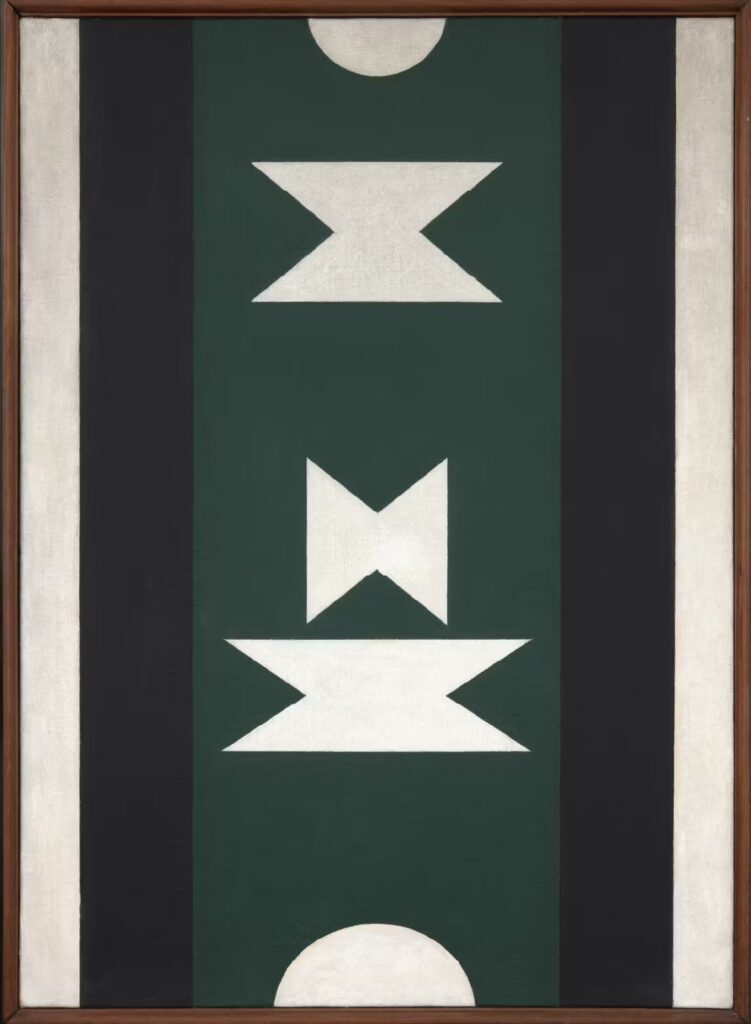
Valentim, con su inconfundible abstracción geométrica, abre una grieta en la historia del arte brasileño y se posiciona como un puente entre la modernidad y la herencia afro-brasileña. Sus formas simétricas no son solo ejercicios de orden y equilibrio; son emblemas espirituales, portadores de significados ancestrales y guiños a religiones como el candomblé y la umbanda. Hay en sus pinturas y esculturas una cadencia que recuerda a los ritmos rituales, una energía contenida en la perfección de cada línea, de cada bloque de color plano, que es imposible ignorar.
La muestra se centra en su producción de los años 60, una década en la que Valentim dividió su tiempo entre Brasil y Europa, absorbiendo influencias, redefiniendo su lenguaje visual y participando en eventos que marcarían su trayectoria. Es fascinante ver cómo su trabajo evoluciona desde una abstracción formalista hacia una construcción más simbólica, donde las referencias a la cultura africana y la diáspora negra se vuelven esenciales.
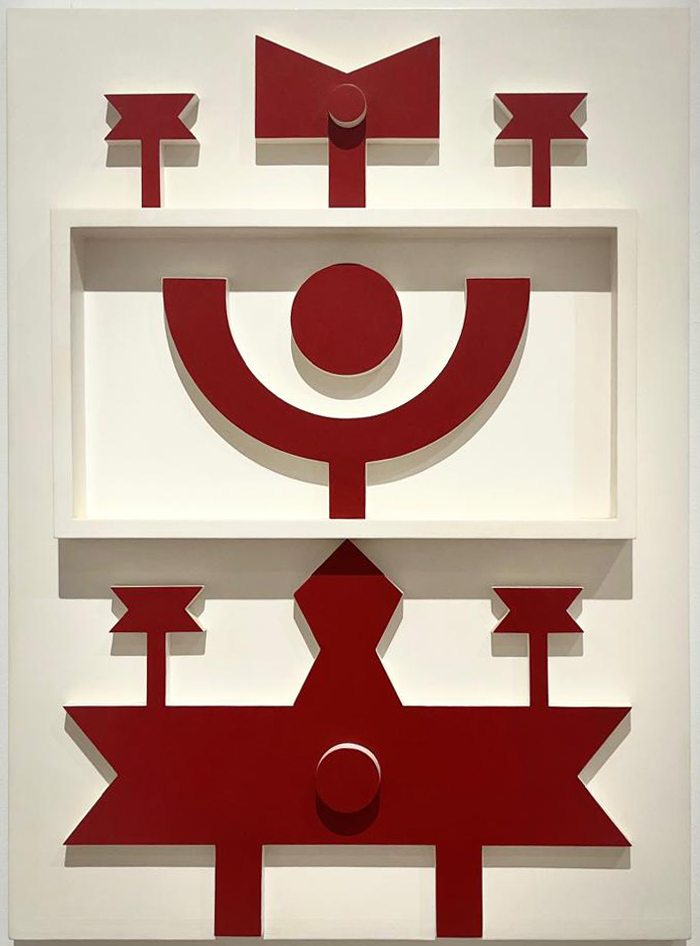
Estar frente a sus pinturas es enfrentarse a una paradoja: son rigurosamente ordenadas, casi matemáticas en su composición, pero al mismo tiempo vibran con una espiritualidad latente. Valentim logra lo que pocos artistas consiguen: dotar a la geometría de alma. Su uso del relieve en las piezas de la serie Emblems nos saca del plano bidimensional y nos obliga a interactuar con la obra en el espacio físico. Es un recordatorio de que la modernidad no tiene por qué ser fría o distante; puede ser profundamente humana, profundamente conectada con la historia y la identidad.
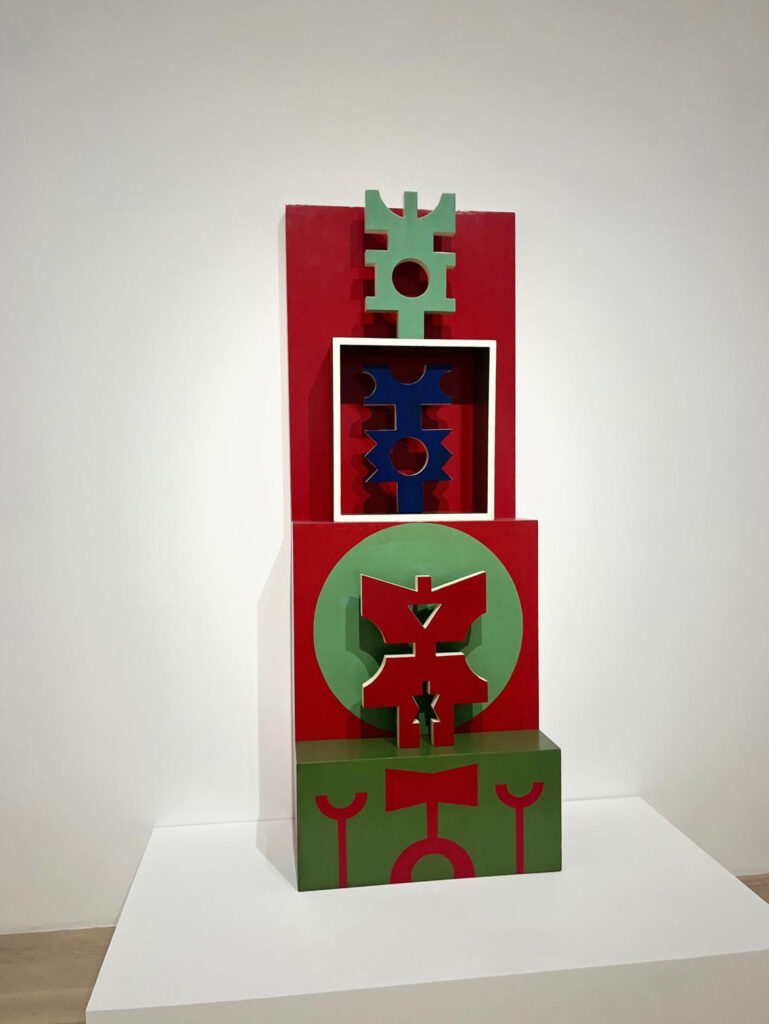
Mención aparte merecen sus esculturas, que se sienten como tótems contemporáneos, objetos de poder que dialogan con el presente sin perder su vínculo con el pasado. Valentim entendió que el arte es una herramienta de traducción cultural, una forma de preservar y resignificar símbolos que han sido sistemáticamente borrados o relegados por la historia oficial del arte.
El ICA Miami nos da la oportunidad de redescubrir a un artista que, aunque celebrado en Brasil, sigue siendo una voz subestimada en la historia del arte global. Su obra es un recordatorio de que la abstracción no es solo una cuestión estética, sino una estrategia de resistencia, de afirmación cultural y de exploración espiritual. Valentim no solo pintaba formas; construía un lenguaje visual para un Brasil que aún hoy lucha con su identidad híbrida, su herencia colonial y su riqueza multicultural.
Si el arte es una forma de cruzar caminos, Crossroads es el punto de encuentro donde la modernidad se encuentra con lo ancestral, donde la razón geométrica se encuentra con la vibración espiritual. Y en ese cruce, Valentim nos espera, con sus colores, sus formas y su visión profundamente transformadora.
RECEPTION + AUCTION Friday, March 21 Cocktail Reception 6:30 pm Live Auction 8:00 pm Silent Auction Closes 8:45 pm
FEATURED ARTISTS:
Harumi Abe Alissa Alfonso Candice Avery Yochi Y. Avin Hermes Berrío Duane Brant Pip Brant Starsky Brines Andres Cabrera-Garcia Michele Del Campo Pablo Cano Mabelin Castellanos Charles Clary Joanne Corry Damian Valdés Dilla Angelica Clyman Nicole Combeau Gregory Dirr Sheila Elias Carlos Estévez Christian Feneck Chris Fox Gilson Gabriela Gamboa Bonney Goldstein Felice Grodin Sharon Hart Katherine Hofmann Sandra lafrate Luke Jenkins Jeremiah Jenner Maru Jensen Khila Khani Ekaterina Khromin Judith King KX2 | Ruth Avra + Dana Kleinman Jodi Lekacos Paola Lettieri Kim Llerena Ramón Losa Cheryl Maeder Jordan Massengale Ted Matz Stephanie McMillan Luisa Mesa PJ Mills Artem Mirolevich Kim Moore Iriana Muñoz Glexis Novoa Edison Peñafiel Sebastian Ferreria Martinez de la Pera Pedro Pablo Bacallao Perdomo Deborah Perlman Galal Ramadan Juan Sebastian Restrepo Donna Ruff Roger Sadler Samantha Salzinger Raul Santos Gretchen Scharnagl Dennis Scholl Ali Shrago-Spechler Carmen Smith Adriane Stark Ma Nong SUN Bill Sypher Kim Rae Taylor Kristen Thiele Amber Tutwiler Kristy Wagstaffe Peggy Levison Nolan Karey Walter Patricia Schnall Gutierrez Katya Neptune
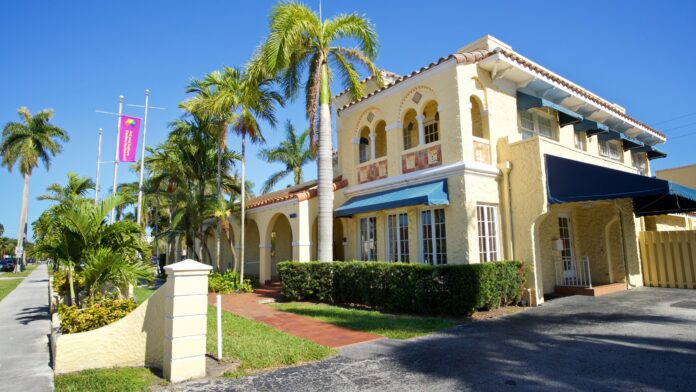
The Art and Culture Center/Hollywood is considered a leader among South Florida multidisciplinary cultural organizations for its contemporary gallery exhibitions, arts education for youth, and award-winning documentary film shorts. The Center’s mission is to cultivate creativity and the support of the arts in our community through education, innovation, and collaboration. The Center was founded in 1975 as the only visual arts nonprofit in south Broward County, operating out of a small community space on Hollywood beach. We now manage visual arts galleries in the renovated Kagey Home built in 1924, an Arts School that is adjacent to the main facility, and the 500-seat Hollywood Central Performing Arts Center located near downtown Hollywood. The Center impacts about 40,000 people each year through its programs and facilities. In 2019, the Center was allocated $2.5 million in City funds towards its Arts Ignite! building initiative as part of a General Obligation Bond referendum that was approved by Hollywood voters. These funds will support the City’s expansion of our facilities with the construction, in 2024, of a modern 5,000-square-feet Arts Education Wing that will adjoin the 1924 Mediterranean Revival architecture of the Kagey galleries and offices.
The Center has presented originally curated gallery exhibitions featuring South Florida and national artists throughout its nearly 50-year history. Each year, 125+ artists representing a range of backgrounds and artistic media exhibit in our first-floor galleries. We collaborate with leading curators in Florida and such partnering entities as the South Florida Cultural Consortium, Miami-based Oolite Arts, and City of Hollywood to create innovative gallery shows and public-art projects. In 2023, the Center partnered with the City’s Community Redevelopment Agency on its Downtown Mural Project to create a new public mural on the west façade of our Arts School building. We are a three-time host organization, in 2011, 2017 and 2023, for the prestigious South Florida Cultural Consortium Fellowship Program. In 2024, the Center will collaborate for the first time with the Atlanta-based nonprofit South Arts to present its annual Southern Prize exhibition featuring fellowship winners from its nine-state Southeast region.
Curator Talks and Tours: Gyula Kosice's "Intergalactic"
Curator Talks and Tours: Gyula Kosice’s “Intergalactic”
March 20, 2025 7:00 PM – 8:00 PM At PAMM 1103 Biscayne Blvd, Miami, FL 33132
For the opening of Gyula Kosice: Intergalactic, join exhibition co-curators María Amalia García and Mari Carmen Ramírez for a tour and intimate conversation.
The curator-led tour and Intergalactic Member Lounge are currently at capacity. Members are still welcome to explore the exhibition during our member preview, starting at 11am, or use the member unlimited admission benefit at any other time. This way, we can ensure an enjoyable experience while preserving the integrity of the artwork.
One hundred years after his birth, Gyula Kosice: Intergalactic celebrates the career of the Argentine artist Gyula Kosice (b. 1924, Košice, Czechoslovakia; d. 2016, Buenos Aires, Argentina), an experimental artist, sculptor, poet, and theorist. Co-founder of Arturo (1944) and Madí (1946), two constructive art groups centered in the Río de la Plata region between Uruguay and Argentina, he was also a prominent figure in the international avant-garde after 1945. His practice introduced original artistic ideas, such as interactive sculptures, which questioned the relationship between the art object and the spectator and experimented with a wide range of materials, many of which had never been used in art.
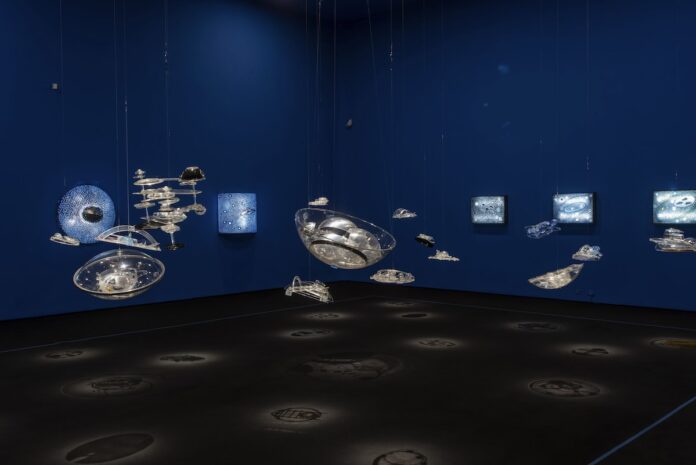
Like Julio Le Parc and Carlos Cruz-Diez, he incorporated light and motion yet, was one of the first to incorporate water in his works. Intergalactic focuses on his experimental production, in which motion was a constant and essential feature. It includes works that he created between 1950 and 1980, such as acrylic sculptures, kinetic reliefs, and drops of water, most of which incorporated lights and were activated by aerators and motors.
The exhibition features Gyula Kosice’s most ambitious work, The Hydrospatial City (1946–2004), an experiential installation comprised of architectural prototypes that speculate on the possibility of human settlement beyond Earth brought on by socioeconomic inequality, environmental degradation, and astronomical population growth. As an alternative, he proposed a city of semi-open, modular habitats suspended 5000 feet above the ground and powered by oxygen and hydrogen harnessed from water vapor in the clouds.
Schedule 11am–7pm Member Exhibition Preview 6–7pm Curator-led, members-only tour 7–9pm Public Exhibition Opening 7–9pm Member Appreciation Lounge: Intergalactic 7:30pm Curator Talks and Tours: Gyula Kosice’s Intergalactic
Free with museum admission. Admission is $18 for adults and free for members.
Jaye Rhee’s Fragile Terrain Is a Pixelated Dreamscape With a Dose of Existential Dread
Jaye Rhee’s Fragile Terrain Is a Pixelated Dreamscape With a Dose of Existential Dread
Editor review
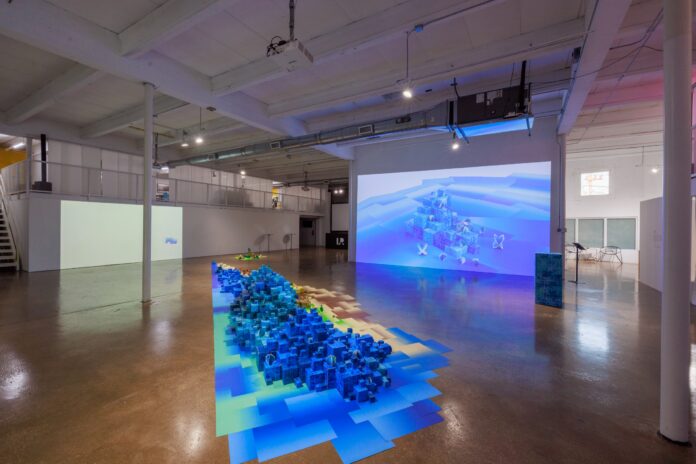
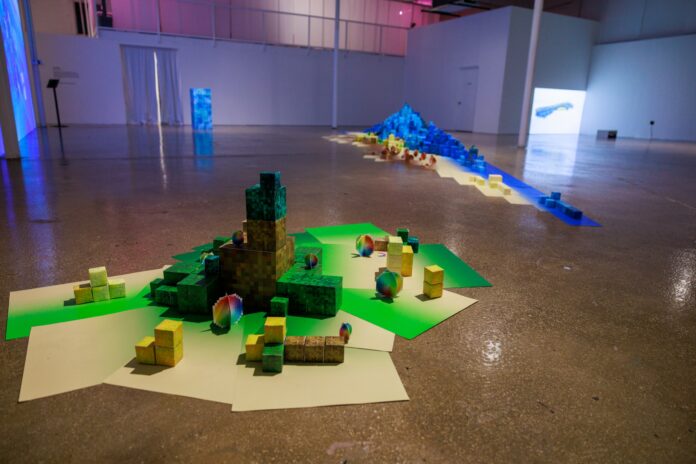
Walk into Locust Projects right now, and you’ll find yourself drowning—not in water, but in pixels. Jaye Rhee has conjured a paper-cut hallucination of Miami’s oceanfront, a swirling mass of 700 pixelated cubes and 200 rounded objects; each meticulously handcrafted from recycled, custom-printed paper. This process of handcrafting each element, from the initial design to the final placement, is a testament to Rhee’s dedication and artistic skill. It is a landscape that is not a landscape, a place that exists nowhere except in memory, screens, data, and the flickering remnants of our over-digitized lives.
But here’s the allure: It is breathtakingly beautiful. Fragile Terrain is seductive and artificial, a film set masquerading as nature, a virtual world that crinkles under your breath. It’s a mirage built on paper and nostalgia, and like all mirages, it makes you question what is real. Where does nature end and technology begin? Are we experiencing the world or just its representation?
Rhee—trained at the School of the Art Institute of Chicago and now based in New York—doesn’t just make art; she hijacks your senses. This isn’t some polite, decorative thing. Her work is sly, calculated, and loaded with existential contradictions. These contradictions, such as the juxtaposition of the natural and the digital, the beautiful and the artificial, are at the heart of her work. It’s landscape painting for the algorithmic age, a callback to the 19th-century Romantics who longed for untouched nature, only this time; the longing is filtered through pixels, data points, and mass production.
It is also impossible to overlook the ominous undertone running through this show. This fragile, handcrafted illusion of paradise is built from waste—a stark reminder that even our idyllic visions are shaped by consumption and excess. The tech that allows us to replicate nature is aiding in its destruction. That is the gut punch here: Fragile Terrain is both a love letter and a warning sign, a call to action.
And yet—god, it is gorgeous. The whole thing shimmers like a broken screen, a heat mirage, a glitch in the system. Stand there long enough, and you’ll start to feel the pull of it, the weight of all those hand-folded, perfectly imperfect pixels, each one whispering: Is this real? Does it even matter? This contemplation is part of the experience Rhee invites you to have with her work. What are your thoughts? How does it make you feel?
Jaye Rhee has built something that floats between worlds, where nature is a ghost, the digital is physical, and everything—absolutely everything—is fragile. You should see it before it disappears.
Final Verdict: A poetic mind-bender of an exhibition. It will make you question everything and look damn good doing it.
The intersection of digital technology and environmental consciousness materializes in a striking installation that transforms recycled paper into an immersive coastal landscape. Fragile Terrain, a newly commissioned multimedia exhibition by international artist Jaye Rhee, opens at Locust Projects with a Meet the Artist Reception on Thursday, February 13, from 7-9 p.m., and runs through April 5.
The 2,800-square-foot Main Gallery becomes home to a meticulously crafted sculptural environment featuring 700 pixelated paper cubes and 200 rounded paper objects. This handcrafted installation, constructed entirely from custom-printed recycled materials, creates an abstracted vision of Miami’s iconic oceanfront landscape while challenging viewers to consider the relationship between digital representation and natural reality.
Drawing parallels to 19th-century romantic landscape painting, Rhee’s work explores humanity’s complex relationship with both nature and technology. The installation raises questions about how digital simulacra influence our sense of identity and connection to the environment, while acknowledging the environmental impact of the very technology it references.
Jaye Rhee is an interdisciplinary artist whose work examines the complex relationships between real and constructed environments, with a particular focus on how visual culture mediates identity, memory and perception. Born in Seoul, South Korea, Rhee now lives and works in New York. She received both her BFA and MFA from the School of the Art Institute of Chicago.
Her diverse practice, encompassing video, photography and performance, has been showcased at prominent institutions worldwide, including Buffalo AKG Art Museum, Norton Museum of Art, Queens Museum, The Bronx Museum of the Arts, Mori Art Museum in Tokyo, Seoul Museum of Modern Art and La Triennale di Milano. Rhee’s contributions to contemporary art have been recognized through numerous awards, including the Doosan Yonkang Art Award, Franklin Furnace Fund and the Seoul Museum of Art Young Artist Grant.
Ground Floor / Dr. Shulamit Katzman Gallery Ground Floor / Kadre Family Gallery
Explore the works of Afro-Brazilian painter Rubem Valentim at Crossroads: Rubem Valentim’s 1960s
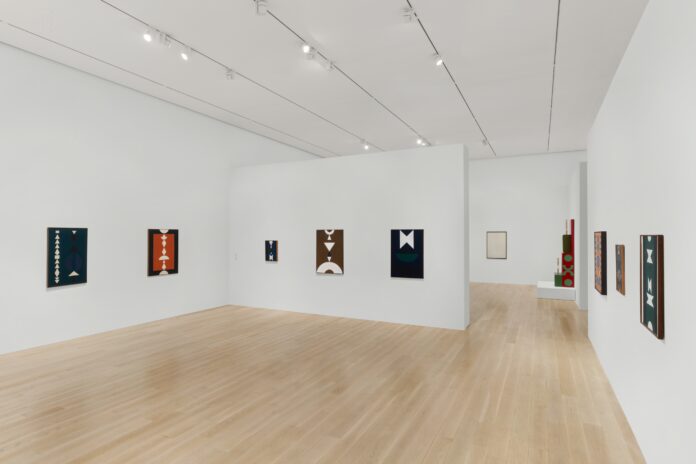
ICA Miami presents the first US museum exhibition of the late Afro-Brazilian painter Rubem Valentim (b. 1922, Salvador, Brazil; d. 1991, São Paulo). A singular voice in modernist painting and geometric abstraction, Valentim explored the medium’s formal concerns and social resonances across cultures and spiritual practices. This exhibition focuses on works Valentim produced in the 1960s, and the transformation of his work and thinking during this time.
Valentim split the decade between Brazil, which was then poised between rapid industrialization and military dictatorship, and Europe, where he first came upon the African art and Third World politics that would influence his painting practice. Having moved from his native Salvador, Bahia, to Rio at the end of the previous decade, in the 1960s, Valentim produced crisp paintings, characterized by rational form and symmetrical composition. Like the most progressive artworks produced in Brazil at the time, such as the paintings of Waldemar Cordeiro and the photographic experiments of Geraldo de Barros, Valentim’s paintings of this period are characterized by compositional clarity and easy communicability, and concerned with offering tools to a quickly urbanizing population to better function with new systems and velocities of communication, new technologies, and new ways of living in modernizing––if still quite segregated and economically uneven––cities.
From 1963 to 1966, Valentim lived in Europe. Although he settled for most of this time in Rome, where he held his first exhibition outside Brazil, he also visited other cities. In London, he saw African sculptures for the first time in person. The impact of this encounter is registered in the paintings of this period: works that retain the sharp lines and shallow pictorial spaces of geometric abstraction, but in which generic forms become shapes that allude to totems, objects used in worship ceremonies, fragments of temple architecture, and to signs, such as axes and arrows, associated with Afro-Brazilian deities. Valentim’s sojourn abroad culminated with his participation in the First World Festival of Negro Arts held in Dakar, Senegal, in 1966.
In 1967, upon returning to live in Brasilia, the country’s new modern capital, Valentim began a radical series of works titled “Emblems.” Produced in shallow bas-relief, these works extend into the physical space of the viewer, rejecting any remaining illusionistic possibility that the picture plane offers. They also further reduce Valntim’s palette, often employing only a single color over a pristine white background. While still using abstracted geometric forms, Valentim searched to deepen his connection to the art of Afro-Brazilian religious practice, and create paintings as a technology to interpret cosmological meaning. In the process of embodying this new task, the paintings grow increasingly ideographic, whereby sign and meaning fuse and representation itself is troubled.
Valentim’s work can be found in the collections of the Museum of Modern Art, New York; Museum of Fine Arts, Boston; Pinacoteca do Estado de São Paulo; Museu de Arte Moderna do Rio de Janeiro; Museu de Arte Moderna da Bahia; Museu de Arte de Brasília; Museu de Arte de São Paulo (MASP); Museu Afro Brasil, São Paulo; and the Museum of Fine Arts, Houston. His work has been exhibited at the Venice Biennale and the São Paulo Biennial. In 2019, he was the subject of a major retrospective exhibition, “ Rubem Valentim: Afro-Atlantic Constructions,” at MASP.
“Crossroads: Rubem Valentim’s 1960s” is organized by ICA Miami and curated by Gean Moreno, Director of the Art + Research Center at ICA Miami.
weekly on Sunday, Wednesday, Thursday, Friday, Saturday
From: 11:00 AM to 6:00 PM
Keiichi Tanaami: Memory Collage
Special Exhibition / 2nd Floor
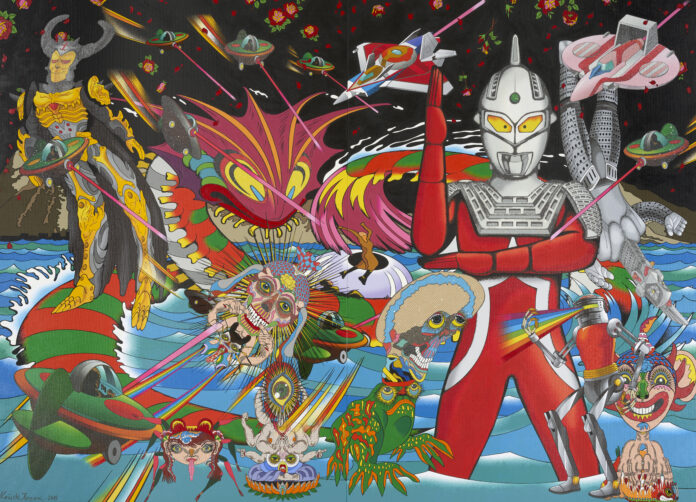
The Institute of Contemporary Art, Miami, presents “Keiichi Tanaami: Memory Collage,” the artist’s first US solo museum exhibition. Keiichi Tanaami (1936-2024, Tokyo) has been a pioneering figure in Japanese and global Pop art for seven decades, creating magnificently immersive works across media in order to consider American and Japanese culture in the post-war period. Tanaami anticipated the crossover of popular culture and fine art, and through his connections to design has taken a radical and critical approach to how images of desire and violence transform society. Works included in this exhibition, produced between 1965 and 2024, track the artist’s use of collage to express the complex media landscape of our time.
Tanaami’s life and work are deeply informed by his upbringing in Japan, the trauma of the Second World War, and the country’s postwar reconstitution. Although the war had forced Tanaami and his mother to flee to the countryside in 1943, the massive United States air raids on Tokyo at the end of the conflict, as well as his experience in air raid shelters, had immense impact on the then-nine-year-old boy and continue to haunt his imagination. Tanaami’s hallucinatory works brim with American airplanes, search lights, monsters real and imagined, and fleeing masses. Sexual images permeate his works across decades, as do synthetic colors; Tanaami records popular culture commercializing desire in order to suppress the devastation of war. Tanaami graduated from the Musashino Art University, Kodaira, Japan, with a degree in graphic design in 1960. He forged a successful career in design and advertising, working as the first art director of Japanese Playboy and creating record covers for Jefferson Airplane and the Monkees, which contributed to the introduction of psychedelic culture in Japan.
During the 1960s, Taanami’s artistic practice frequently took the form of exuberant collages overflowing with clippings from international magazines. These dense collages are fascinating indexes of postwar visual culture, drawing from Western and Japanese news sources, commercial forms, and chapbooks. Tanaami would also elaborate on these fantastic sets of images through engagingly musical, surreal, and psychedelic animations that today are classics of avant-garde film.
Combining disparate media, Tanaami creates worlds that explore how war distorts perception through fragmentation, nightmares, and hallucinatory visions. During the 1970s, Tanaami’s iconic paintings combine idyllic landscapes with advertising, erotic imagery and anti-war slogans. Over subsequent decades, Tanaami would continually expand these worlds, quoting manga, theater and increasingly art history, from sources as varied as the sixteenth-century French School of Fontainebleau and Japanese woodblock (ukiyo-e). In recent years the artist has explored the role of the artist in visual culture through his Pleasure of Picasso (2020–) series, which make playful and technical use of appropriation and repetition while considering the flattening of social and commercial art and history today.
Additionally, the exhibition concisely surveys Tanaami’s recent work, a period of great productivity and experimentation for the artist. In epically large-scale painting and complex moving image, the artist has deployed technology to scale his kaleidoscopic visions. Through these radically produced, digitally printed and visually saturated paintings, Tanaami reflects on a contemporary regime of pervasive images, and the ever-present specter of history.
“Keiichi Tanaami: Memory Collage” is organized by ICA Miami and curated by Alex Gartenfeld, Irma and Norman Braman Artistic Director, and Gean Moreno, Director of the Art + Research Center at ICA Miami, with the assistance of Donna Honarpisheh, Associate Curator of the Art + Research Center at ICA Miami.
Join iWitness and The Betsy Hotel for the launch of Kilombo, an inspiring exhibition of documentary photography by award-winning photographer and visual anthropologist Maria Daniel Balcazar. Opening December 2, 2024, at The Betsy Hotel, Kilombo is a powerful tribute to the resilience and vibrancy of the African legacy in Brazil, captured through stunning large-scale images.
This exhibition marks the debut of iWitness @ The Betsy, a dynamic and ongoing collaboration that merges art, hospitality, and education. This exciting initiative is the result of a partnership between iWitness: IPC Institute of Visual Journalism, The Betsy Hotel, and the Wolfsonian Public Humanities Lab. Together, they aim to spark meaningful conversations about democracy, justice, and the vital role cultural traditions play in shaping identity.
Don’t miss the chance to witness the beginning of this powerful collaboration and celebrate the enduring influence of culture and heritage through the lens of documentary photography.
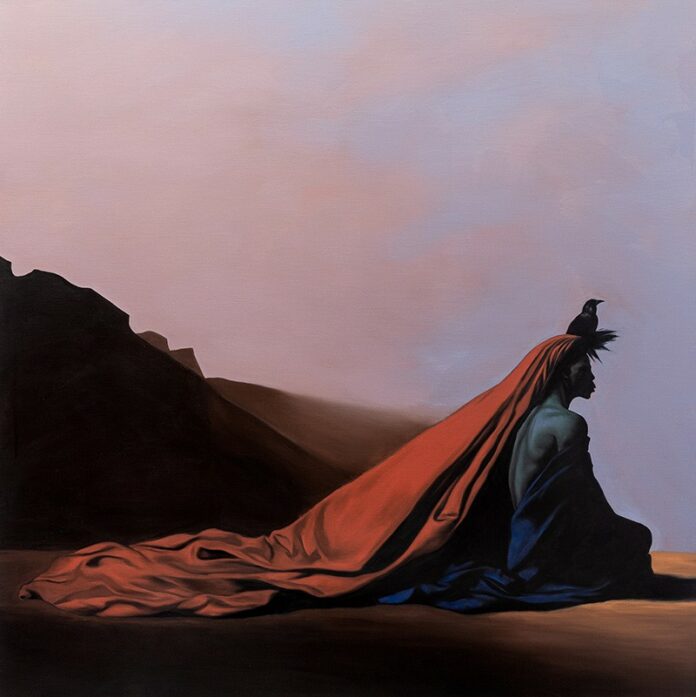
Opera Gallery_Gustavo Nazareno, Iku reading a poem for a pink sky, 2024
Opera Gallery Miami
Gustavo Nazareno: Afro-Latin Baroque
Through Mar 29, 2025
Mon-Sat : 11 AM – 8 PM | Sun: noon – 6 PM
Brazilian artist Gustavo Nazareno explores the rich intersection of cultural traditions through his compelling paintings that blend historical and contemporary influences. Gustavo Nazareno: Afro-Latin Baroque marks his first solo exhibition in the United States and will be on display at Opera Gallery from March 6-29.
This exhibition features 16 new paintings that delve into the intertwined legacies of faith, art and resilience within Afro-Brazilian and Latin American traditions. Running alongside his Bará charcoal drawing exhibition in Bal Harbour, the collection showcases Nazareno’s engagement with cultural syncretism and spirituality.
Rooted in the Afro-Brazilian artistic heritage of Minas Gerais, Nazareno’s work bridges the visual traditions of Brazilian Baroque masters with the spiritual aesthetics of Candomblé and Santería. His paintings employ chiaroscuro techniques reminiscent of Caravaggio while incorporating elements from contemporary fashion photography, creating compositions that feel both timeless and relevant.
The artist’s figures exist beyond traditional constraints, embodying an ethereal presence that blurs boundaries between the mythical and real. Through this body of work, Nazareno pays homage to the intertwined artistic legacies of Brazil and Cuba—lands shaped by resilience, faith and artistic expression.
By reinterpreting Baroque aesthetics through the lens of Afro-Brazilian spirituality, Nazareno invites viewers into a space of reflection and reimagined histories, continuing to push the boundaries of contemporary painting while engaging with historical traditions.
Opera Gallery Miami is pleased to present ‘Afro-Latin Baroque,’ a solo exhibition by Brazilian artist Gustavo Nazareno, marking his first solo presentation in the United States. Featuring 16 new paintings, this exhibition explores the intertwined legacies of faith, art, and resilience within Afro-Brazilian and Latin American traditions. Running alongside ‘Bará’ in Bal Harbour composed of charcoal drawings, ‘Afro-Latin Baroque’ showcases Nazareno’s deep engagement with cultural syncretism, spirituality, and the enduring power of artistic expression.
Nazareno’s work is rooted in the vibrant Afro-Brazilian artistic heritage of Minas Gerais and its complex relationship with Catholic iconography. Through a contemporary lens, he bridges the visual traditions of Brazilian Baroque masters such as Aleijadinho and Mestre Valentim with the spiritual aesthetics of Candomblé and Santería, creating compositions that feel both timeless and urgent. His paintings evoke the grandeur of Baroque theatricality, while embracing the ritualistic essence of Afro-Latin religious practices, forging a dialogue between historical legacies and contemporary identity.
In ‘Afro-Latin Baroque,’ Nazareno continues his exploration of duality—sacred and profane, light and shadow, movement and stillness. His figures resist fixed identities, existing beyond traditional gender or temporal constraints, embodying an ethereal presence that is both ghostly and divine. Drawing from the chiaroscuro techniques of Caravaggio and the expressive depth of contemporary fashion photography, his works blur the boundaries between the mythical and the real, evoking a sense of spiritual transcendence.
Speaking on the exhibition, Nazareno reflected, “This body of work is an homage to the intertwined legacies of Brazil and Cuba, two lands shaped by resilience, faith, and artistic brilliance. Through ‘Afro-Latin Baroque,’ I seek to explore the sacred convergence of Catholicism and Afro-Brazilian traditions, where the grandeur of Baroque art meets the vibrant spiritual essence of Candomblé and Santería.”
Through ‘Afro-Latin Baroque,’ Gustavo Nazareno continues to push the boundaries of contemporary painting, engaging with historical traditions while asserting a bold and deeply personal artistic vision. By reinterpreting Baroque aesthetics through the lens of Afro-Brazilian spirituality, he invites viewers into a space of reflection, reverence, and reimagined histories.