Home Blog Page 11

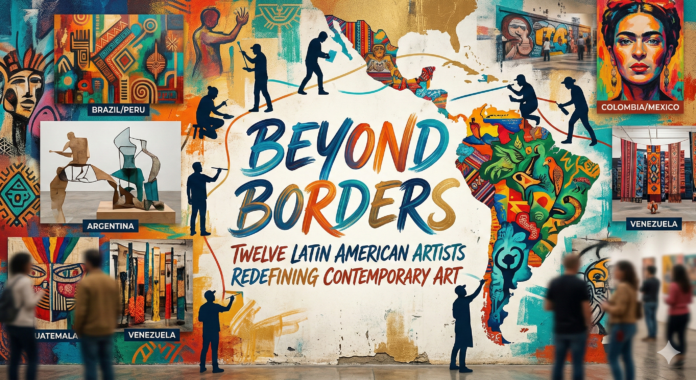
Beyond Borders: Twelve Latin American Artists Redefining Contemporary Art

Beyond Borders: Twelve Latin American Artists Redefining Contemporary Art

Beyond Borders: Twelve Latin American Artists Redefining Contemporary Art

The landscape of contemporary Latin American art pulses with urgent creativity. From monumental clay vessels to delicate paper cuts, from post-apocalyptic visions to intimate memory paintings, a generation of artists is transforming how we understand material, memory, and meaning itself. These twelve practitioners—working across Argentina, Brazil, Cuba, Ecuador, Mexico, Panama, and Venezuela—demonstrate that Latin American art today is not a single story but a constellation of powerful, distinct voices reshaping the global conversation.

Material as Memory, Sculpture as Gathering

Gabriel Chaile stands at the intersection of sculpture and social practice, working with clay and adobe to create monumental forms that honor Indigenous building traditions while addressing contemporary concerns. His massive vessels and ovens—objects that might weigh hundreds of pounds—are not simply sculptures to observe but spaces designed for gathering. In Chaile’s hands, the ceramic form becomes a site of collective memory and communal ritual, transforming the white cube gallery into something closer to a plaza or ceremonial ground. The artist’s choice of materials speaks to ancestral knowledge systems, yet his work addresses present-day questions about community, sustenance, and belonging in an increasingly atomized world.

Where Chaile builds gathering spaces from earth, Ariamna Contino excavates political and social structures through an entirely different materiality. Working primarily with hand-cut paper, Contino transforms extensive research into visually intricate works that belie their devastating subject matter. Her delicate constructions confront Cuban economic policy, environmental degradation, and systemic failures with surgical precision. The contradiction between the fragility of her medium and the weight of her themes creates a productive tension—these are not works that shout but rather speak in a language of accumulated detail, demanding sustained attention to reveal their full complexity.

Urban Systems and Architectural Memory

Cisco Merel approaches the visual environment of contemporary life as a system to be decoded and remapped. His practice moves fluidly between abstraction, photography, and sculpture, treating urban architecture and popular culture not as background but as primary text. Merel’s work captures the visual language of cities—the patterns, repetitions, and fragments that structure daily experience—and reorganizes them into sharp visual systems. His approach has particular resonance in an era of globalized aesthetics, where the visual codes of one city increasingly mirror another, and local specificity exists in tension with international flows of image and style.

Néstor Jiménez similarly engages with built environments, but his focus turns explicitly political. Using painting and installation often executed on recovered or discarded materials, Jiménez excavates the relationship between architecture and ideology in Mexico. His work understands that buildings are never neutral—they encode power structures, facilitate certain behaviors while constraining others, and physically manifest political decisions. By reimagining architectural forms and working on materials salvaged from demolition or abandonment, Jiménez positions his practice as both archaeological and speculative, uncovering the political unconscious of the built environment while imagining alternatives.

Mythology, Femininity, and Symbolic Worlds

Hilda Palafox has become internationally recognized for paintings and murals that construct entire mythological systems centered on feminine power. Her stylized figures—often monumental women rendered in bold colors and clean lines—inhabit worlds drawn from Mexican folklore but reconfigured into matriarchal societies. Palafox’s visual language combines the graphic clarity of illustration with the emotional depth of fine art painting, creating images that function simultaneously as contemporary icons and ancient archetypes. Her work participates in broader conversations about reclaiming Indigenous and pre-colonial narrative traditions while asserting specifically feminist visions of power and community.

Renata Petersen takes a different approach to gender and cultural critique, wielding dark humor as her primary tool. Working across ceramics, drawing, and comic-style imagery, Petersen lampoons religion, gender norms, and popular culture with irreverent wit. Her work embraces the taboo, using satire to expose the absurdities embedded in social conventions. Where Palafox builds mythic alternatives, Petersen dismantles existing structures through mockery, demonstrating that humor can be as sharp a critical instrument as any theoretical framework.

Nature Reimagined: From Lush Vitality to Post-Human Futures

Thalita Hamaoui’s paintings present nature as an immersive, almost hallucinogenic experience. Her lush landscapes seem to breathe, with color and vegetation pulsing across the canvas as if alive. These are not documentary records of specific places but emotional environments where the distinction between interior feeling and exterior world dissolves. Hamaoui’s approach to landscape painting rejects both romantic idealization and environmental documentary, instead treating nature as a shifting psychological space—simultaneously threatening and nurturing, familiar and utterly strange.

Carolina Fusilier offers a darker ecological vision. Her cinematic paintings and films imagine post-human futures where technology and nature have merged in unsettling ways. Working with atmospheric effects that blur boundaries between organic and synthetic, Fusilier creates scenes that feel simultaneously like science fiction and documentary evidence from a future already unfolding. Her speculative worlds refuse easy moralizing about technology or nature, instead presenting eerie landscapes where the categories themselves have collapsed, forcing viewers to navigate unfamiliar terrain without clear ethical coordinates.

Traces, Absences, and the Archive

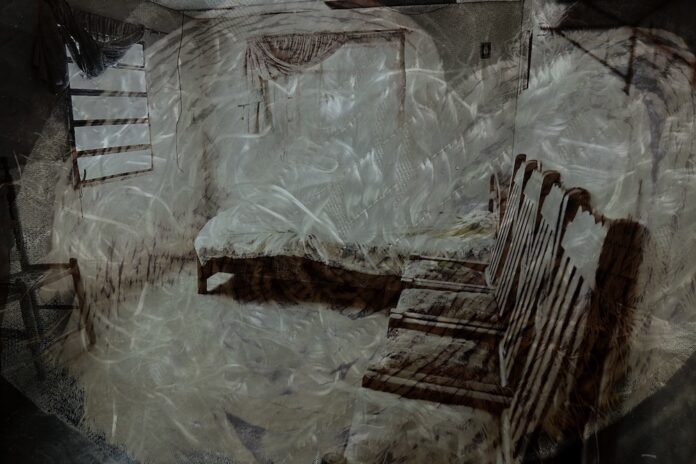
Ana Navas works with glass and collage to create what might be called portraits of absence. Her ghostly figures emerge from layered materials that suggest both transparency and obscurity, presence and disappearance. Navas explores how objects and images accumulate memory, how they carry traces of the people who made or used them, and how cultural history embeds itself in material form. Her work participates in archival practices but with an understanding that archives are never complete or neutral—they are constructed through selection and exclusion, always haunted by what they cannot or will not contain.

Adriel Visoto similarly engages with memory, though his archive is explicitly personal. Working in intimate, small-scale paintings drawn from his own photographs and recollections, Visoto transforms private moments into images with universal resonance. His quiet, emotionally charged scenes—often depicting everyday moments rendered with careful attention to light and atmosphere—demonstrate that the personal need not be confessional to be powerful. These are not grand narratives but accumulations of small observations, suggesting that meaning emerges not from spectacular events but from sustained attention to the texture of daily experience.

Language as Material, Meaning as Construction

Iván Krassoievitch occupies distinct territory in this constellation of practices, working primarily with poetry, text, and conceptual structures to interrogate language itself. His work treats words as physical materials to be arranged, deconstructed, and reimagined. Krassoievitch’s practice asks fundamental questions: How is meaning constructed? How does it erode? What happens when the systems we use to communicate are revealed as arbitrary? His conceptual approach connects to longer traditions of concrete poetry and institutional critique while remaining thoroughly contemporary in its concerns, addressing an era saturated with language yet marked by profound communicative failures.

Toward a Multiplicity of Futures

What unites these twelve artists is not a shared style or medium but a commitment to using art as a tool for thinking through the urgent questions of our moment. They work across and between traditional categories—painting, sculpture, installation, text—refusing the limitations of single disciplines. Their concerns range from the deeply personal to the explicitly political, from material traditions thousands of years old to speculative futures not yet realized.

Together, they demonstrate that contemporary Latin American art cannot be contained by simplistic narratives about “identity” or “tradition.” These artists draw on specific cultural contexts and histories, yes, but they do so in order to address questions that resonate globally: How do we build community? How do we process historical trauma? How do we imagine alternatives to existing power structures? How do we represent a world in ecological crisis? How do we find meaning when established systems have failed?

The work emerging from Latin America today demands attention not as exotic other but as essential contribution to global contemporary art. These twelve artists—and countless others working throughout the region—are not following trends established elsewhere but actively shaping the conversation, demonstrating that the most vital art being made anywhere exists in productive tension between the local and the global, the traditional and the speculative, the material and the conceptual.

In an art world still too often organized around a narrow set of geographic and institutional centers, these practices insist on a more complex, polyphonic understanding of where art happens and what it can do. They invite us not simply to look but to reconsider our assumptions about material, memory, mythology, and meaning itself.
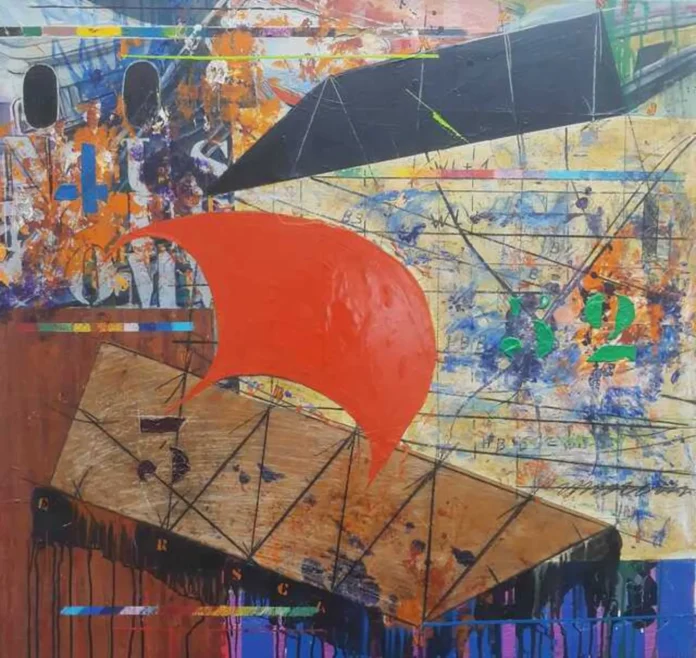
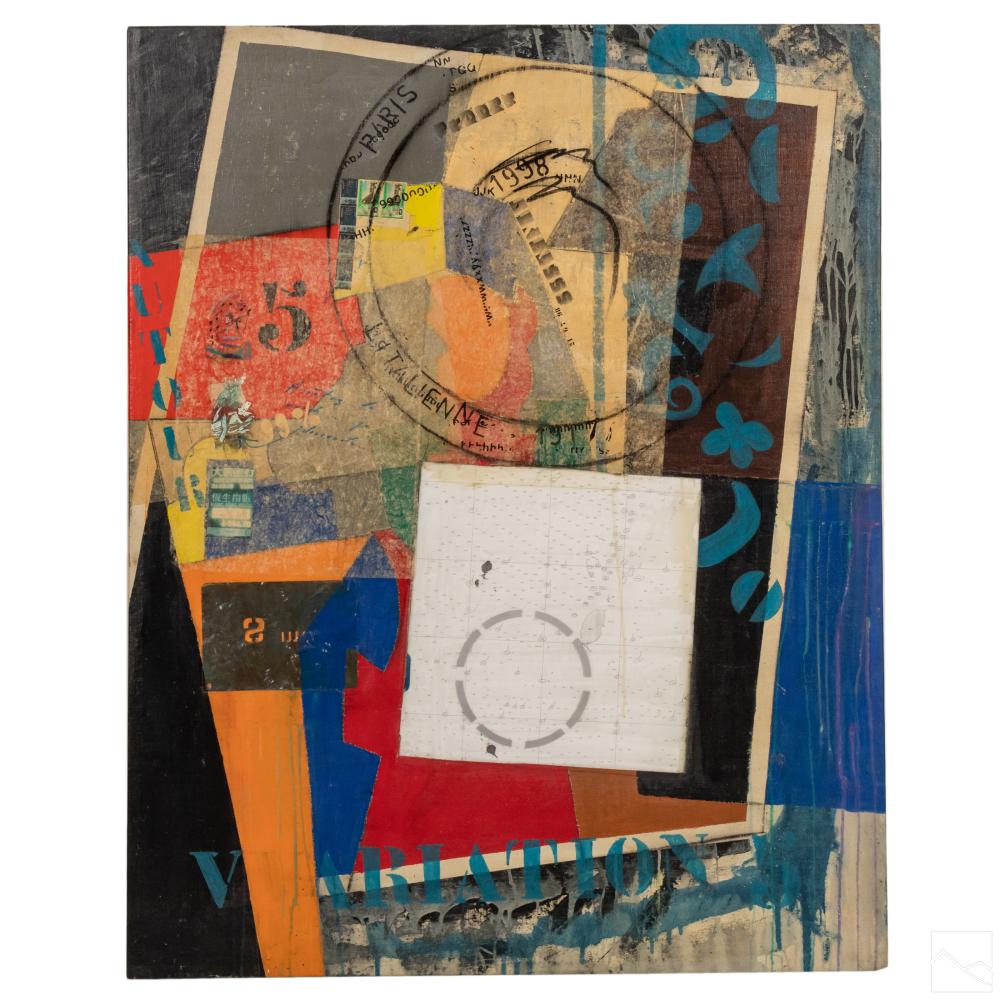
Latencia Nómada – Forever Play

Latencia Nómada – Forever Play

Latencia Nómada – Forever Play

Eduardo Planchart Licea

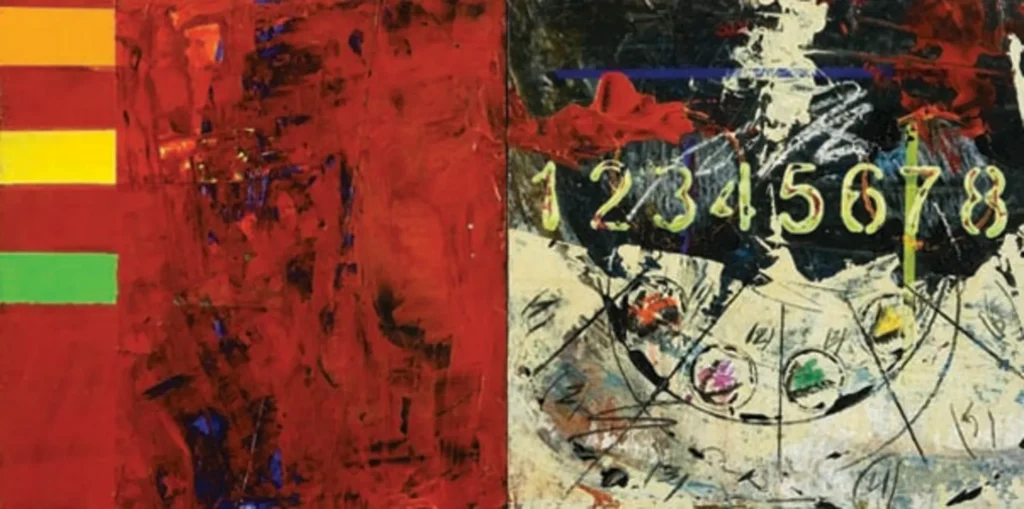
Asdrúbal Colmenárez transmite a la serie Latencia Nómada un fuerte dinamismo pictórico por su gestualidad, eco de los elementos conceptuales que incorpora a esta serie: mar, islas, geografías deconstruidas en espacios imaginarios, imágenes de revistas, dibujos naturalista, plantas, cómics. Un sentido lúdico se manifiesta en los elementos estructurantes de la composición: las líneas de luz en ángulos de noventa grados o en línea recta que tienen resonancias con el visor, los papeles de colores recortados con imágenes de pingüinos impresas sobre ellos, los sellos postales que dirigen la atención del espectador a diversos niveles perceptivos. El gestualismo se contrapone a la trama de coordenadas utópicas creando una tensión visual entre el caos y el orden, que hace referencia al planeta percibido como totalidad amenazada. Esta problememática se hace presente en los elementos plásticos introducidos como son las imágenes de animales, dibujos naturalistas de flores y animales conceptualmente emblemáticos.

El sello postal con su característica circunferencia se muta en centro visual de la obra, siendo además una manera de enfatizar la noción de nomadismo que caracteriza nuestra civilización y de la cual se hace eco esta serie. No sólo existimos en una perenne tocata y fuga, sino también los objetos que nos rodean tienen un largo historial viajero. Así, los tenedores con que comemos pueden ser chinos, los platos ingleses, la ropa coreana… Entre estos universos peregrinos transcurre nuestra cotidianidad, sin embargo no tienen la huella que los identifique como propios de un espacio cultural y natural, por esto vamos creando un collage imaginario que asocia cada uno de estos elementos a su geografía productiva.

A pesar de vivir en una aldea global existimos en un universo mental que nos impide identificarnos con el planeta, como un ser viviente integrado por millones de cadenas de vida de las cuales la humanidad es sólo una y a su vez nuestro sistema planetario es menos que una mota de polvo de nuestra galaxia. Esta realidad es conocida, pero en la práctica nuestra civilización la ignora. En lugar de ello seguimos atrapados por una visión geocéntrica, nacida de Ptolomeo, donde el planeta y la humanidad son el centro del universo, de ahí el enfásis en minimizar en estos cuadros la presencia humana al acentuar la vida silvestre y marina. De ahí el sentido de los collage y de su fuerza envolvente en esta serie, que se manifiestan en los centros visuales transformados en remolinos plásticos que parecen absorber y fundir todos los contenidos estéticos y conceptuales, estableciendo la idea de interrelación que caracteriza a las diversas formas de vida en la Tierra.

En nuestra aldea planetaria, ha surgido un nuevo tipo de nomadismo, en parte desvinculado de las sociedades tradicionales y relacionado con la expansión en el tiempo y el espacio que permite la sociedad posindustrial. No sólo hacemos referencia a la movilidad física del ser humano, sino a la trashumancia cultural, en donde todo pareciera pertenecer a todos. La cultura visual a través de los medios electrónicos ha creado nuevas categorías culturales: la comunicación instantánea y simultánea, genera una nueva cultura y una nueva manera de conocer, al extremo de crear una estética y una ideología, recreada constantemente de los fragmentos visuales de todas las culturas a que nos enfrentamos. Es este otro de los sentidos del collage en la propuesta de Asdrúbal Colmenárez, de ahí que entre mapas etnográficos y cartas marinas, introduzca elementos naturales como hojas, enfrentándonos de esta manera a la paradójica visión que generan los medios al hacernos confundir la realidad como verdad con la realidad nacida de los medios electrónicos que es una ilusión.

En estas piezas los elementos naturales acentúan el abismo que hay entre nuestra realidad planetaria y la imagen que nos hemos elaborado de ella, creándose en nuestro universo interior un rompecabezas imaginario. De ahí, que Asdrúbal llegue incluso a introducir en esta serie, fragmentos de rompecabezas en blanco, para intentar hacernos conscientes de la fragmentación y escisión que nos caracteriza. Destacan el ritmo y variedad que asumen las tipografías, que tiene sus raíces en el uso que hizo de ellas tanto el constructivismo ruso como el futurismo, las cuales se conjugan con imágenes de historietas que añade a ciertos cuadros como huella de nuestra cotidianidad y de cómo somos vividos por los arquetipos que crean los medios electrónicos, imágenes que están vinculadas directamente al por art y al arte como vía para acercarnos a una arqueología de nuestra cotidianidad.

Esta trashumancia ha convertido la existencia del hombre contemporáneo en una errancia entre selvas de concreto y espacios imaginarios, cuyos límites ya no son una región o un paisaje sino toda la extensión de nuestro planeta, al empequeñecerse las fronteras nos hemos lanzado a una contradictoria conquista del universo.

Estos contenidos conceptuales son constantes, a partir de los noventa, en la obra de Asdrúbal Colmenárez, quien inspira su lenguaje plástico en barcos, botes, naves espaciales, ovnis, coordenadas de geografías inexistente.

En términos estéticos este nomadismo contemporáneo se sustenta en categorías plásticas propias del modernismo.

Se establece así un continuo reciclar de lo hecho en contextos culturales diferentes para dar una falsa noción de novedad y renovación. Sin embargo, estas propuestas se nutren de las raíces culturales y espirituales de la humanidad, presente en artistas paradigmáticos de nuestra modernidad y contemporaneidad como es el caso del expresionismo abstracto en figuras como Jackson Pollock, en la relación que establece entre su arte y los dibujos de arena del chamanismo de los indios de América del Norte; en Mark Rothko y la vinculación de sus monocromías con la concepción no figurativa de la divinidad en la cultura hebrea; en Frank Stella quien inspira sus monocromías y su geometría en los escudos africanos. Este hecho está presente también en las antropometrías de Yves Klein, que tienen mucho que ver con los diseños corporales arcaicos.

9

En la contemporaneidad destacan Josep Beuys y su vinculación con el nomadismo chamánico, Anselm Kiefer debido a su fijación en los mitos universales, desde Babilonia pasando por Mesoamérica hasta la contemporaneidad. Esto es una evidencia de que las fronteras culturales se han roto y el arte se ha hecho eco de esta universalidad, que en lugar de crear una estética homogénea está dando nacimiento a un diversidad híbrida de la cual se hace eco la serie Latencia Nómada.

Elementos como el papel artesanal junto a los objetos vegetales y desechos consumistas acercan la propuesta a los postulados del arte povera. Estamos ante un acercamiento al arte conceptual que ha sido una constante en la obra de Asdrúbal Colmenárez. La exposición en su conjunto es un gran rompecabezas, en el sentido que cada obra se enlaza con la otra y a su vez cada una tiene múltiples ecos estéticos e ideáticos. El artistas pareciera burlarse de la posmodernidad con esta actitud, pues a través de su serie nos acerca a la idea de que no se ha creado todavía una ruptura que haya generado un nuevo paradigma en el arte que trascienda los límites del modernismo, aún cuando estemos en el nuevo milenio. Juego de ideas que se hace presente en el cuadro en que se encadenan lúdicamente varios 2000. La ruptura que planteaba el posmodernismo se hundió en su propio suelo, de ahí el sentido de la exposición en el Museo de Arte Contemporáneo de Caracas Sofía Imber de 1998.

La peregrinación existencial en la obra de Asdrúbal Colmenárez es una proyección de rasgos de su dimensión interna que se materializan en su obra. En ocasiones están vinculados con sus orígenes (Colmenárez nació en Trujillo en 1936), y su primera propuesta plástica está vinculada al surrealismo, técnicamente inspirada en sus raíces familiares, su padre era carpintero convirtiéndose este período en un viaje al inconsciente. Sus primeros trabajos creativos tienen la huella de un nomadismo interior.

Al llegar a París a fines de los sesenta, empieza su indagación con el movimiento magnético y la búsqueda de una relación con el público que desacralice la obra y la acerque a la vida, logrando un status ontológico propio, al generar un revelamiento de las capacidades creativas del espectador al entrar en contacto con la dimensión estética, generándo una tensión entre rasgos conceptuales y constructivistas.

Los psicomágneticos, son bandas de metal delgado sobre superficies de madera, que al ser tocados generan un movimiento ondular, que va creando nuevas formas al unir esta acción a líneas que pintaba sobre sus superficies. Con esta obra empezó a llamar la atención del crítico e investigador francés Frank Popper, que hace especial mención de él en su libro Arte, acción y participación”, de 1980. Se puede vincular esta etapa de su lenguaje a la de la brasileña Lygia Clark en la serie Trepantes, realizada en metal y madera a fines de los cincuenta. En pocos años el artista pasa de profesor de la Escuela de Artes Plásticas de Trujillo a profesor de arte experimental en París VIII. Esto evidencia que si algo caracteriza la vida del artista es el nomadismo, pues su obra se ha desarrollado entre Europa y entre trópicos. A principios de los noventa hay varios cuadros claves donde se evidencia este rasgo que ha caracterizado la vida de Asdrúbal Colmenárez, que se hace presente en la serie Mare Nostrum presentada en el MACCSI en 1993. Donde algunas piezas son retazos autobiográfico de sus errancias en el tiempo y el espacio a lo largo de su vida, tal como se palpa en el cuadro Serie Mare Nostrum IV de 1992, donde entre coordenadas imaginarias se unen los puntos en el tiempo y el espacio de significación existencial para el artista, creando un diagrama de su devenir.

Este clima impregna toda la exposición de Mare Nostrum a través de los elementos plásticos y conceptuales que introduce como mapas, cartas marinas, brújulas transmitiendo esa noción de viaje imaginario que debía trasladar al espectador ante geografías existentes sólo en la realidad interior, sentido que se convierte en uno de los ejes de la serie Latencia Nómada. Idea que también se manifiesta en su exposición en el Museo Alejandro Otero, 1996, al introducir el tema de aviones de papel, infantiles, realizados en acero, burlando la resonancias industriales del material tanto en la forma como en el color, dando la idea de un nomadismo imaginario. Sentido que se focaliza en la serie actual realizada entre 1998 y 1999, pues son visiones que parecieran nacidas del lente de una cámara cinematográfica, que materializa esta Latencia estética que se encontraban presentes en su lenguaje plástico debido a la ruptura histórica y cultural que debería traer el nuevo milenio. Sin embargo, nos recuerda el artista trujillano-parisiense que es necesario reenfocar nuestra atención al planeta que nos sustenta, pues el arte va más allá de la estética. Así esta propuesta muta la estética en una respuesta ética al empujarnos a reflexionar en el punto de ruptura que es el fin del milenio.

Estos contenidos conceptuales se encuentran materializados en estos collages pictóricos en la presencia de los pingüinos impresos en pedazos de papeles recortados, los dibujos naturalistas sobre papel de desecho que transmiten la noción de fragilidad en que se encuentran estas cadenas de vida, de las cuales somos responsables, pero también llama la atención sobre la necesidad de volver la atención a nuestros orígenes como especie, pues gran parte de la comprensión de nuestra historia contemporánea se esconde en los arquetipos de la Latencia Nómada de nuestro inconsciente, de ahí que algunos cuadros presentan fotocopias de mapas etnográficos de Africa y Brasil, pues el nomadismos contemporáneo tiene sus raíces en la cultura Nómada, lo cual lo hace un rasgo inherente a nuestra humanidad que sólo ha asumido nuevas máscaras.

Lisu Vega: Lo Que Me Habita / That Which Inhabits Me

Lisu Vega
Metal print (la huella). Courtesy of The Artist.

Lisu Vega: Lo Que Me Habita / That Which Inhabits Me

By Sophie Bonet, Chief Curator, The Frank C. Ortis Gallery

Lo Que Me Habita unfolds as a lived terrain rather than a linear narrative. Venezuelan artist Lisu Vega constructs an environment where memory is not recalled but inhabited—felt through gesture, material, silence, and repetition. Across three interrelated installations—Raíces Difusas (Faded Roots), Los Vacíos (entre la presencia y la ausencia), and Lo Que Me Habita—Vega gathers fragments of language, textile, image, and sound into a sensorial ecology shaped by migration, ancestral inheritance, and embodied knowledge.

Rather than offering memory as a fixed archive, Vega approaches it as something unstable and unfinished. Her work resists totality. What emerges instead is a constellation of partial gestures: photographs that refuse completeness, verses that trail off, fibers that oxidize and soften with time. In this way, Lo Que Me Habita aligns with a lineage of artists and writers—from Theresa Hak Kyung Cha to Gloria Anzaldúa—for whom language, exile, and the body are inseparable, and where silence itself becomes a form of transmission.¹

Lisu Vega
Installation view, Lo Que Me Habita, The Frank C. Ortis Gallery, November 2024. Image by Veronica Gort. Courtesy of The Frank C. Ortis Gallery.

Vega’s practice is grounded in an ethic of care—toward materials, toward inherited labor, and toward what remains after use. Repurposed textiles, oxidized cords, family photographs, and the byproducts of sublimation printing—residual papers, faded “ghost” images, misprints—are not treated as failures or waste. They are preserved as evidence of process, time, and touch.

This attention to material afterlife situates Vega’s work within a material ecology of memory, where transformation is not symbolic but physical. Fibers stain, metals corrode, images soften. Nothing is erased. Everything bears the trace of having been handled, carried, or left behind. Over time, these materials cease to function as objects alone and begin to register as extensions of the body itself—repositories of gesture, repetition, and lived experience.

Her approach resonates deeply with Wayuu weaving traditions, in which fiber is both cosmology and continuity—a matrilineal system of knowledge transmitted through hands rather than text.² Vega carries this sensibility not as a static inheritance, but as a living method, shaped equally by the ruptures of her Spanish and Portuguese colonial lineages. Rather than resolving these tensions, she allows them to coexist—layered, frayed, and reworked into a poetics of rupture and repair.

Lisu Vega
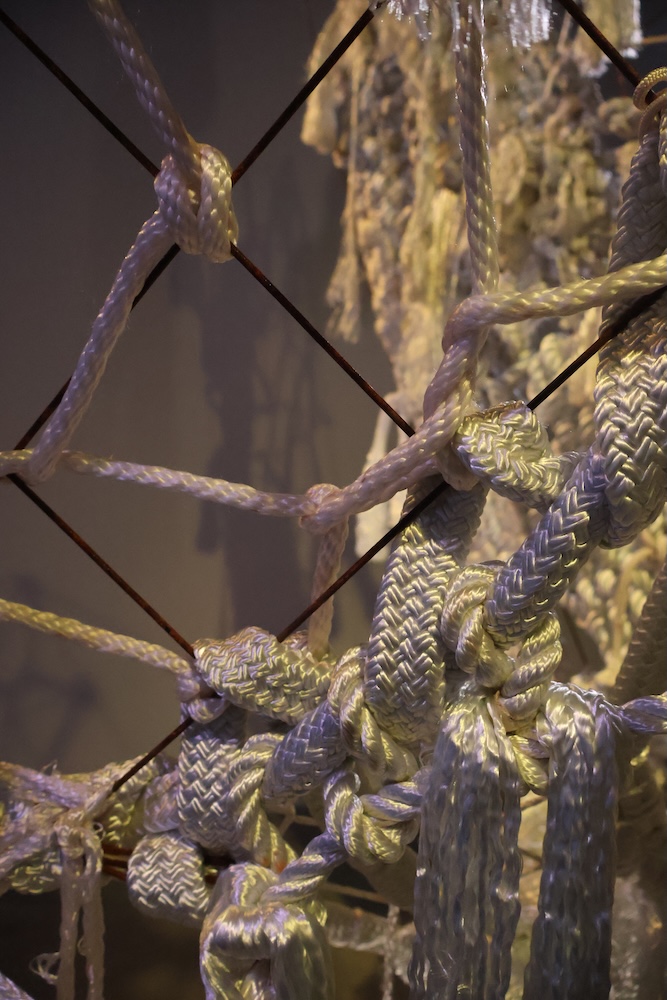
Detail view, oxidized fibers and textile elements. Image by Camila Diaz. Courtesy of The Frank C. Ortis Gallery.

Vega’s installations are activated through the body—hers and ours—where material memory shifts from object to gesture, and from surface to lived archive. Weaving, inscribing, and translating become ritual actions, echoing what Diana Taylor describes as the repertoire: a mode of knowledge transmission enacted through embodied practice rather than stored in static form.³

Fragments are not treated as remnants of loss but as vessels of knowing. Photographic shards, incomplete verses, and faint impressions printed on metal operate as tactile records—quiet, intimate, and resistant to spectacle. In this sense, Vega’s work finds affinity with Louise Bourgeois’ fabric cells and Tecla Tofano’s domestic interventions, where memory is held not as narrative but as pressure, intimacy, and affect. What appears fragile is, in fact, deliberate: a refusal of monumentality in favor of proximity.

Lisu Vega
Metal print (la huella). Courtesy of The Artist.

Language in Lo Que Me Habita refuses hierarchy. Poems appear in English, Spanish, Portuguese, Wayuunaiki, and American Sign Language, moving across banners, bodies, and sound. Translation is not offered as a tool for clarity but as an act of care—an acknowledgment that meaning shifts as it travels.

This polyphony situates Vega’s practice within a decolonial framework, where hybridity is not a compromise but a condition of survival. As Anzaldúa reminds us, the border is not merely geographic but linguistic, corporeal, and emotional.⁴ Vega extends this insight spatially, allowing languages to overlap, interrupt, and obscure one another. Silence here is not absence; it is a generative interval—space for breath, listening, and recognition.

Lisu Vega
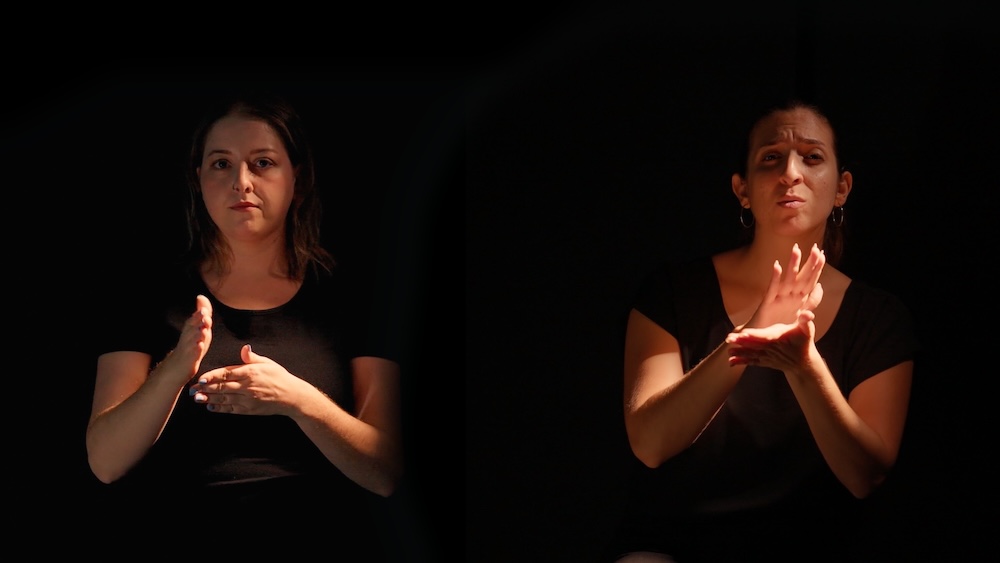
Video still, Raíces Difusas (Faded Roots) – sign language poem. Courtesy of The Artist.

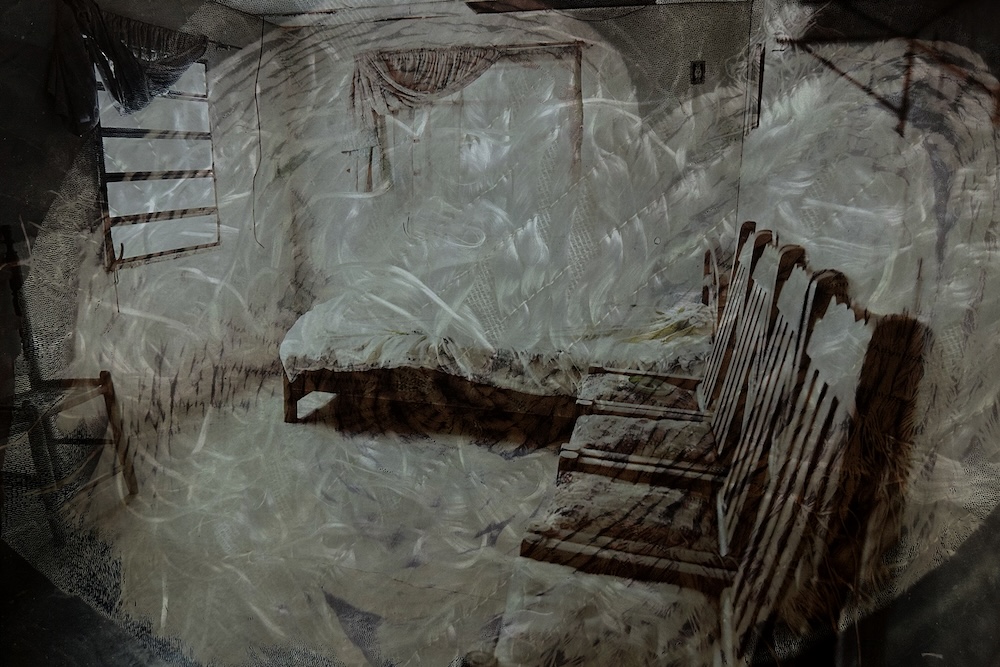
Across the exhibition, the domestic reappears as a recurring presence: Vega’s grandmother’s abandoned home, a bathtub, a sewing machine, a mattress, a mango tree. These elements surface not as documentation but as spectral architecture—what Gaston Bachelard described as the emotional residues embedded in space.⁵

The home becomes a ghost-body: porous, layered, marked by absence yet animated by memory. It is both shelter and wound. In Vega’s hands, domestic space mourns, but it also regenerates—offering a site where grief and continuity coexist. Memory here is not only inherited; it is inhabited, carried forward through attention, repair, and repetition.

lisu vega
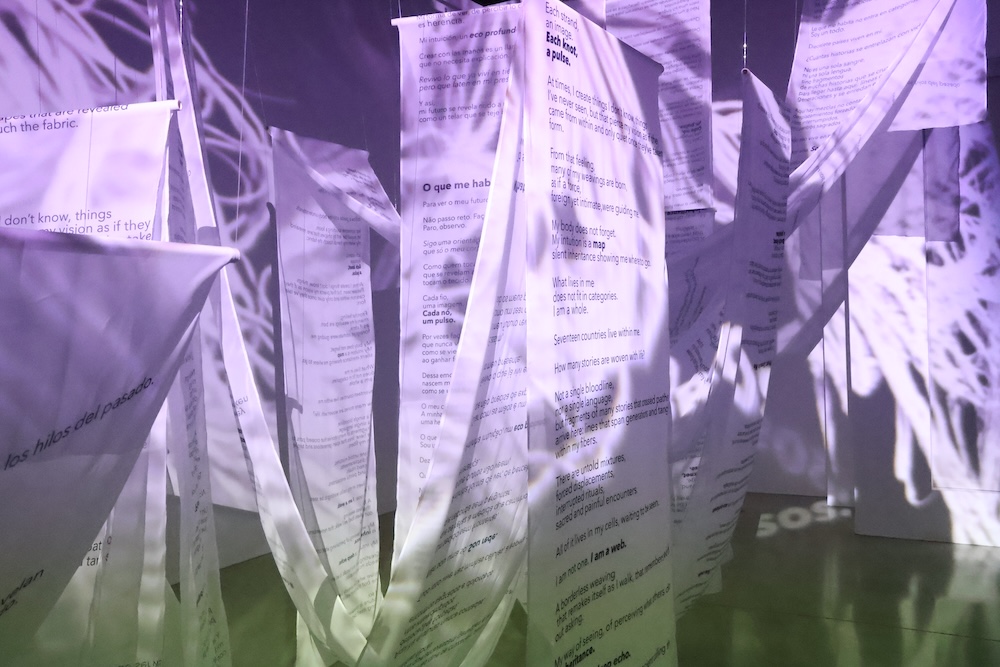
Installation view, suspended textile poetry, Lo Que Me Habita, The Frank C, November 2024. Image by Veronica Gort. Courtesy of The Frank C. Ortis Gallery.

Works in the Exhibition

Raíces Difusas (Faded Roots), 2025

Video installation with sign language, audio, braille, and printed poetry

Video projection by Isangela Verdu

Sign language interpretation by Lauren Mathes and Denisse Simonian

In Raíces Difusas, Vega’s poem is translated into multiple sensory registers—spoken, signed, tactile, and visual—foregrounding the body as a vessel of memory. The silent projection of hands interpreting poetry resists the dominance of spoken language, proposing a haptic poetics where gesture itself becomes text.

Los Vacíos (entre la presencia y la ausencia), 2025

Photographic installation with poetic fragments

Twelve metal photographs paired with fragments of poetry form an intimate architecture of looking. Magnifying lenses compel proximity, making memory an embodied act. Photography here becomes elegy—not as spectacle, but as quiet witnessing.

Lo Que Me Habita / That Which Inhabits Me, 2025

Dual installation: woven metal sculpture and suspended textile poetry

Video by Pedreáñez (Ocovisual)

Poem translated into Portuguese by Paola Gato Pacheco

Translated into Wayuunaiki by Nerri Gómez Montiel (Uliana clan)

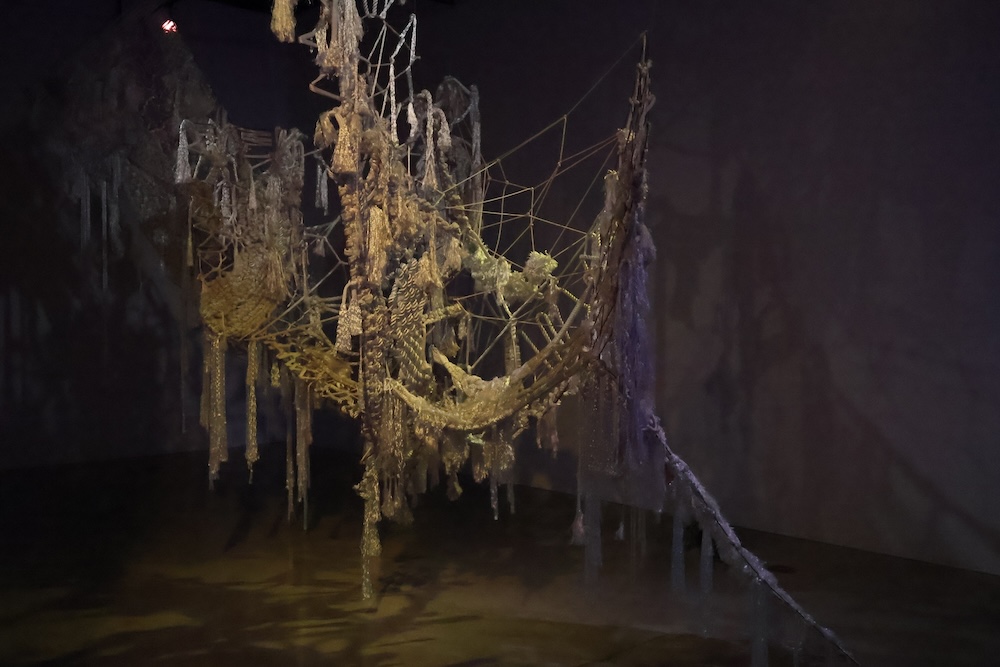
The exhibition culminates in a suspended net woven from oxidized rope and thread, surrounded by translucent banners printed with Vega’s central poem. As viewers move through the space, verses overlap and dissolve, sound circulates, and the body becomes part of the weave. Identity here is not fixed but porous—what Vega describes as a borderless weave.

Conclusion: What Remains, What Holds

Lo Que Me Habita is both elegy and invocation. It acknowledges the fractures of migration and the incompleteness of inheritance while insisting on continuity through gesture, repetition, and care. Vega does not offer resolution. Instead, she invites us to dwell within what remains—to listen, to touch, and to recognize that what inhabits us is not only memory, but the ongoing labor of holding it.

____________________________________________________________________________

Notes 

  1. Theresa Hak Kyung Cha, Dictee (Berkeley: University of California Press, 1982).
  2. S. C. Noguera Saavedra, “Wayuu Culture and Traditional Weaving,” Arts and Design Studies (2015).
  3. Diana Taylor, The Archive and the Repertoire (Durham: Duke University Press, 2003).
  4. Gloria Anzaldúa, Borderlands/La Frontera: The New Mestiza (San Francisco: Aunt Lute Books, 1987).
  5. Gaston Bachelard, The Poetics of Space (Boston: Beacon Press, 1994).

Selected Bibliography

Anzaldúa, Gloria. Borderlands/La Frontera: The New Mestiza. San Francisco: Aunt Lute Books, 1987.

Bachelard, Gaston. The Poetics of Space. Boston: Beacon Press, 1994.

Cha, Theresa Hak Kyung. Dictee. Berkeley: University of California Press, 1982.

Noguera Saavedra, S. C. “Wayuu Culture and Traditional Weaving.” Arts and Design Studies (2015).

Taylor, Diana. The Archive and the Repertoire. Durham: Duke University Press, 2003.

Sophie Bonet (b. 1986) is a South Florida–based curator whose practice is deeply informed by her background in social and cultural anthropology. She approaches exhibitions as living ecosystems—responsive spaces shaped by memory, ritual, and transformation. Her transdisciplinary work is research-driven and grounded in the belief that art functions as a site of dialogue, cultural inquiry, and collective imagination.

Bonet has led exhibitions and public programs across prominent institutions in the United States and abroad, including the Contemporary Arts Museum Houston (CAMH), the Barcelona Museum of Contemporary Art (MACBA), and the Museum of Contemporary Art North Miami (MOCA), where she served as Exhibition Manager for landmark presentations such as Juan Francisco Elso: Por América (in collaboration with El Museo del Barrio), Didier William: Nou Kite Tout Sa Dèyè, and Jamea Richmond-Edwards: Ancient Future. Her early research at MACBA focused on the archival documentation and critical interpretation of Espai 13’s history, tracing three decades of artist-led experimentation at the Joan Miró Foundation.

Currently Chief Curator of The Frank C. Ortis Gallery in Pembroke Pines, Florida, Bonet leads an ambitious exhibition program centered on accessibility, sensory engagement, and community-rooted storytelling. Curating across disciplines—from ecological installation to fiber art and new media—she explores themes of identity, migration, belonging, and place through an anthropological and phenomenological lens.

Bonet holds degrees in Fine Arts, Art History, and Anthropology. She is currently pursuing graduate research examining curating as a ritual and phenomenological practice shaped by memory, embodiment, and cultural translation. She is a member of IKT – the International Association of Curators of Contemporary Art.

El Hombre Dentro de los Dioses: Filosofía y Forma en *Primeval Gods*(1933) de Jacob Epstein

Jacob Epstein 'Primeval Gods', 1933

El Hombre Dentro de los Dioses: Filosofía y Forma en *Primeval Gods* (1933) de Jacob Epstein

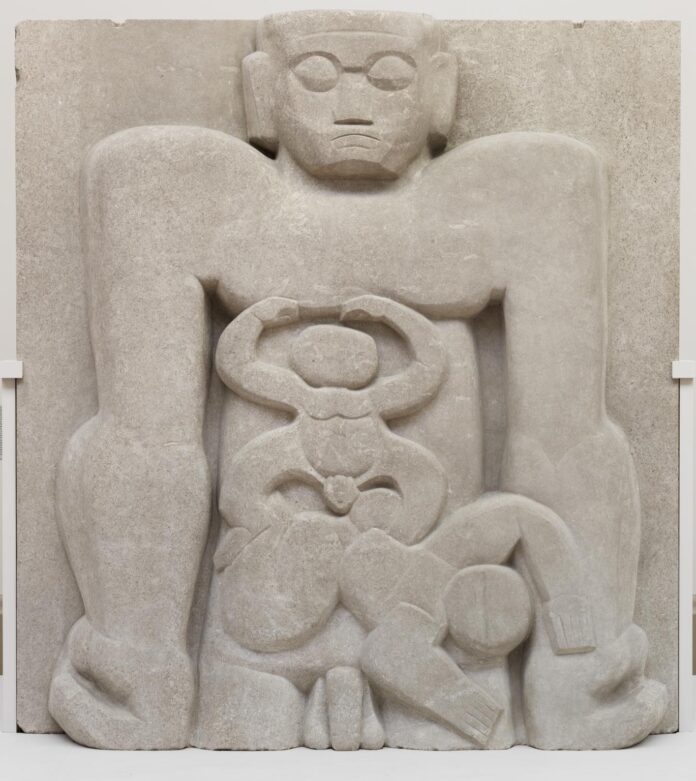
‘Primeval Gods’, 1933 “Un lado representa la energía ordenada y divina , y el otro el caos y las fuerzas elementales, recordando a los espectadores que el hombre existe dentro de estos poderes divinos, no por encima de ellos.”

Jacob Epstein 'Primeval Gods', 1933
Jacob Epstein ‘Primeval Gods’, 1933

 I. Introducción: Una Piedra, Dos Mundos

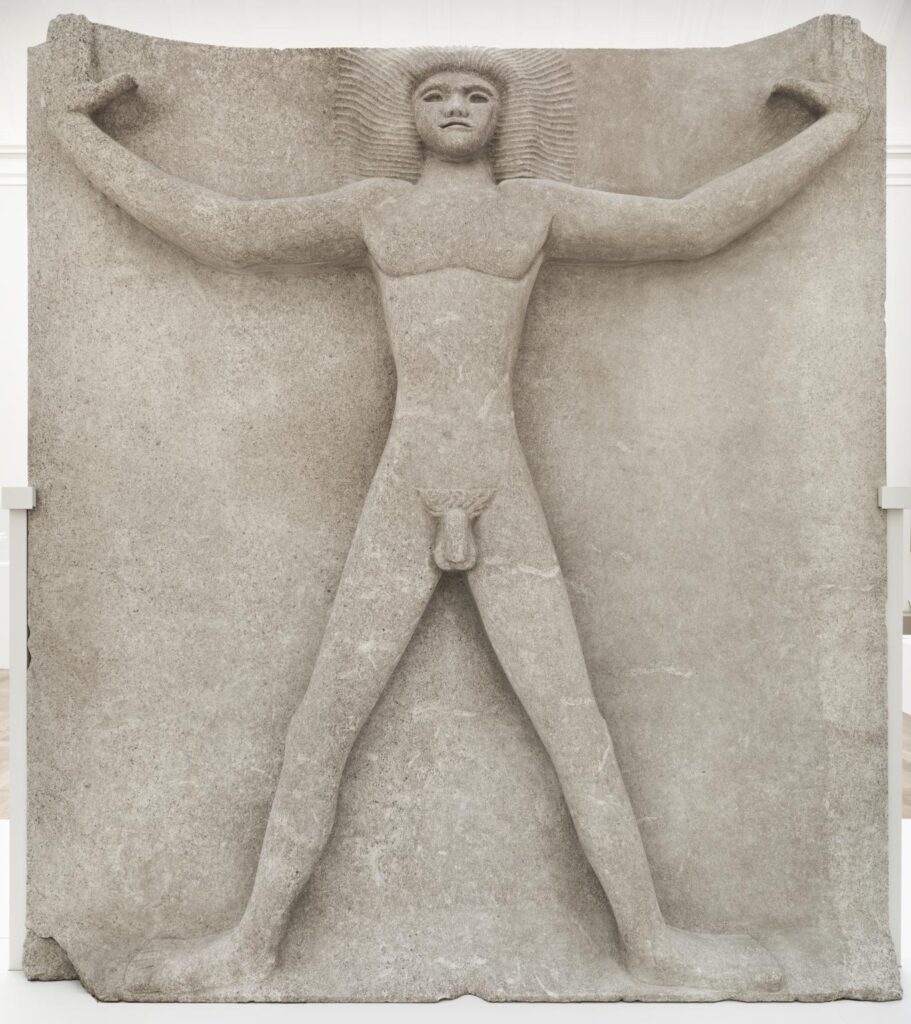
En 1932, Jacob Epstein regresó a un bloque de piedra Hopton-Wood que no había tocado en más de veinte años. Sobre su cara anterior había tallado, en 1910, *Sun God*: una figura frontal, erguida, monumental — símbolo de orden, energía solar y dominio divino. Ahora, por el reverso de ese mismo bloque, comenzó a tallar algo radicalmente diferente: una figura encorvada, con dos formas infantiles sobre su cuerpo, que completó en 1933 bajo el título *Primeval Gods*.

El resultado fue una obra de doble cara — como una cabeza de Jano — que no puede ser vista en su totalidad desde ningún punto único. Para ver *Sun God* hay que darle la espalda a *Primeval Gods*, y viceversa. Esta imposibilidad física no es accidental. Es filosófica.

En un lado: la energía ordenada, la luz, lo divino como principio rector. En el otro: el caos primordial, las fuerzas elementales, la procreación, la vida antes del orden. Juntos, los dos relieves articulan una de las preguntas más antiguas de la humanidad: ¿cuál es el lugar del ser humano en el universo? La respuesta de Epstein es inequívoca. El hombre existe *dentro* de estas fuerzas — no por encima de ellas.

 II. El Material Como Argumento: La Piedra que Dicta

Para comprender *Primeval Gods*, es necesario entender primero la filosofía material de Epstein. En la década de 1910, Epstein se convirtió en una figura central del movimiento de “talla directa” en Gran Bretaña, un enfoque que enfatizaba la “verdad a los materiales”, en el cual los escultores trabajaban directamente con la piedra, utilizando sus cualidades naturales en lugar de hacer modelos previos en cera o arcilla.

Esta no era simplemente una elección técnica. Era una declaración ética. La talla directa implicaba que el escultor no imponía su voluntad sobre la materia: la escuchaba. El material guiaba la forma. La piedra dictaba la escultura.

Volver al mismo bloque de Hopton-Wood después de dos décadas refuerza este principio con una dimensión temporal que la teoría no puede capturar: la piedra no había cambiado. El hombre sí. Lo que *Primeval Gods* añade al reverso de *Sun God* no es una negación de lo anterior, sino su complemento necesario — como si el bloque hubiera esperado que Epstein madurara lo suficiente para tallar el otro lado de la verdad.

Durante la década de 1930, estimulado por el renovado interés de Henry Moore y sus contemporáneos en la talla directa, y cada vez más afectado por críticos que consideraban la talla superior al modelado, Epstein emprendió una sucesión de grandes esculturas de temas simbólicos: *Genesis* (mármol, 1929-30), *Primeval Gods*, tallado en el reverso de su relieve *Sun God* de 1910 (piedra Hopton-Wood, 1931-33), *Behold the Man* (1934-35), *Consummatum Est* (alabastro, 1936), *Adam* (alabastro, 1938-39) y *Jacob and the Angel* (alabastro, 1940-41). Estas obras sin encargo perpetuaban, por un lado, la tradición monumental del siglo XIX, y por el otro, desafiaban las interpretaciones tradicionales de temas religiosos y de carga sexual.

El dato de que estas obras fueron realizadas *sin encargo* es fundamental. Epstein no respondía a ningún cliente, ninguna institución, ninguna audiencia predeterminada. Respondía a una necesidad interna de articular, en piedra, preguntas que la modernidad no podía responder.

 III. La Dualidad Cósmica: Orden y Caos como Estructura Filosófica

*Primeval Gods* representa una figura encorvada — un dios primordial masculino — que sostiene dos formas infantiles sobre su cuerpo. Frente a la verticalidad soberana del *Sun God*, esta figura se dobla, se acerca a la tierra, se humaniza en su peso. No es una figura de dominio: es una figura de carga.

Al añadir otro bloque de piedra del mismo ancho y largo en la parte posterior de *Sun God* y tallar en él el masivo relieve de *Primeval Gods*, Epstein proporcionó al espectador un dúo de perfiles — como una cabeza de Jano — de dos percepciones diferentes. Aunque sin divorciarse completamente del concepto de la dominación masculina, Epstein se propuso expresar, como segundo perfil, una perspectiva diferente: lo que podría denominarse “una percepción bíblica de la procreación”, en la que había colaboración de los sexos para procrear. Produjo un grupo familiar que tituló *Primeval Gods* y que, declaró, había completado en tres meses.

Esta dualidad no es simplemente formal. Es cosmológica. Epstein estaba construyendo, en piedra, un modelo del universo: un lado iluminado, solar, ordenado — el cosmos como lo conciben las tradiciones religiosas que colocan a la deidad por encima de la materia. Y un lado oscuro, primordial, generativo — el cosmos tal como lo conocen las tradiciones que ven en la naturaleza una fuerza anterior a cualquier dios antropomórfico.

La filosofía implícita es de una humildad radical. Si el *Sun God* podía leerse — como lo hicieron algunos contemporáneos — como una afirmación del poder humano sobre la naturaleza, *Primeval Gods* desmonta esa lectura desde adentro. El ser humano no está por encima del orden ni por encima del caos. Está contenido en ambos. Es, al mismo tiempo, criatura del sol y criatura de la tierra.

 IV. Las Fuentes: Egipto, África y la Construcción de un Lenguaje Universal

Epstein no llegó a esta filosofía en el vacío. La construyó a partir de un conjunto de influencias que sus contemporáneos europeos, atrapados en la tradición clásica grecolatina, no podían o no querían ver.

Epstein fue influenciado por las técnicas e imágenes utilizadas en las tallas del antiguo Egipto, África Occidental y Oceanía, que coleccionaba. En su época, su representación de la sexualidad, así como las formas simplificadas de sus monumentales tallas de figuras, suscitaron tanto admiración como críticas intensas, lo que limitó sus oportunidades de encargos públicos.

Esta síntesis de tradiciones no occidentales era, en el contexto del modernismo británico, un acto político además de estético. El primitivismo proporcionó a los artistas una forma de criticar las tradiciones estancadas de la pintura europea. El uso del arte primitivo de formas más simples y figuras más abstractas difería significativamente de los estilos tradicionales europeos de representación, y artistas modernos como Gauguin, Picasso y Matisse usaron estas formas para revolucionar la pintura y la escultura.

Para Epstein, sin embargo, la apropiación de formas no occidentales no era decorativa ni meramente formal. Era filosófica. Las culturas egipcia, africana y oceánica compartían, según su lectura, una comprensión del ser humano como parte de un sistema cósmico mayor — no como su centro ni su dueño. *Primeval Gods* es, en este sentido, una escultura construida desde esa comprensión.

La monumentalidad de la figura, su frontalidad simplificada, su escala que supera el cuerpo humano: todos estos elementos remiten a tradiciones donde la escultura no representa al individuo sino a las fuerzas que lo contienen. El ser humano es pequeño frente a esas fuerzas. La escultura lo recuerda.

 V. El Contexto Histórico: 1933 y la Crisis de la Modernidad

*Primeval Gods* se completó en 1933. No es un dato menor. En ese año, Adolf Hitler ascendió al poder en Alemania. El fascismo avanzaba por Europa. La promesa ilustrada del progreso racional — la idea de que la humanidad, armada de ciencia y razón, podría construir un mundo mejor — comenzaba a mostrar sus fracturas más profundas.

Después de una pausa de casi veinte años, Epstein regresó a la escultura *Sun God* y comenzó, en 1932, a tallar un nuevo relieve en el lado posterior del bloque: una figura encorvada con dos formas infantiles sobre su cuerpo, titulada *Primeval Gods*.

¿Por qué en ese momento? ¿Por qué volver a ese bloque precisamente en los años en que la modernidad comenzaba a mostrar sus contradicciones más violentas? La respuesta está en la filosofía de la obra misma. En un mundo que celebraba el dominio humano — sobre la naturaleza, sobre otros pueblos, sobre el futuro — *Primeval Gods* proponía lo contrario: que el ser humano no domina. Que existe *dentro* de fuerzas que lo preceden y lo exceden.

Esta era también una respuesta personal. Estas obras sin encargo perpetuaban la tradición monumental del siglo XIX y, al mismo tiempo, desafiaban las interpretaciones tradicionales de temas religiosos y de carga sexual. Epstein era un outsider: judío de origen polaco en Gran Bretaña, artista cuyas obras habían sido mutiladas por presión pública, escultor que nunca recibió el apoyo institucional que merecía. Su humildad cosmológica era también una humildad biográfica: él también sabía lo que significaba existir dentro de fuerzas que no controlaba.

 VI. La Herencia: *Primeval Gods* y la Generación Siguiente

La obra de Epstein definió fundamentalmente dos períodos del modernismo británico: la década de 1910, cuando realizó la escultura radical de la era de las máquinas con *The Rock Drill*, y la de 1930, cuando grupos de figuras monumentales como *Primeval Gods* conectaron con una generación más joven de escultores británicos.

Esa conexión con Henry Moore, Barbara Hepworth y sus contemporáneos no fue solo formal. Fue filosófica. Moore también buscaba, en sus figuras reclinadas y sus formas orgánicas, una comprensión del ser humano como parte del paisaje — no como su conquistador. La escultura temprana de Moore, en gran parte desconocida para el público general, permite explorar la evolución de elementos temáticos y formales en su obra y su respuesta continua a diferentes materiales, incluyendo su énfasis en la talla directa y el necesario equilibrio entre la abstracción y lo que él llamó el “elemento psicológico humano”.

*Primeval Gods* fue, en este sentido, un puente. Entre el siglo XIX y el XX. Entre el arte occidental y las tradiciones no occidentales. Entre la celebración modernista del dominio humano y una comprensión más antigua, más humilde, de la condición humana.

 VII. La Obra Hoy: Ubicación, Conservación y Legado

*Relief: Obverse: Sun God (1910); Reverse: Primeval Gods (1933)*, de Sir Jacob Epstein (1880-1959), es una obra en piedra Hopton-Wood que mide 213.4 × 198.1 × 35.6 cm y pesa 2,766 kilogramos. Se encuentra actualmente en el Metropolitan Museum of Art de Nueva York, donada en 1970 por Kathleen Epstein y Sally Ryan, dentro de la colección del Departamento de Arte Moderno y Contemporáneo.

Una versión también está en exhibición en la Tate Britain de Londres, donde forma parte del display permanente dedicado a la obra de Epstein. Una fotografía histórica de James Jarché, publicada en el *Daily Herald* el 25 de abril de 1933, muestra a Epstein junto a *Primeval Gods* en las Leicester Art Galleries, documento que atestigua la recepción contemporánea de la obra.

 VIII. Conclusión: Una Escultura que Nos Recuerda Nuestro Lugar

*Primeval Gods* no es una obra cómoda. No celebra al ser humano. No lo eleva. Lo sitúa.

En un lado, el sol: orden, energía divina, la aspiración hacia lo absoluto. En el otro, la tierra: caos, generación, las fuerzas anteriores a toda civilización. Y el ser humano, en el centro de esa tensión irresoluble, existiendo — no dominando, no trascendiendo, sino simplemente existiendo — dentro de poderes que lo contienen.

Esta es la filosofía de Epstein. No es pesimismo. Es precisión. Es la misma verdad que las tradiciones egipcias, africanas y oceánicas habían articulado durante milenios, y que la modernidad occidental había tratado de olvidar en su afán de progreso y control.

En 1933, mientras Europa se precipitaba hacia una de sus mayores catástrofes, Jacob Epstein tallaba en piedra un recordatorio: que la grandeza humana no consiste en elevarse por encima de las fuerzas naturales, sino en aprender a existir con dignidad dentro de ellas.

*Primeval Gods* sigue siendo, casi un siglo después, una de las esculturas más filosóficamente honestas del arte moderno.

 Referencias

– Metropolitan Museum of Art, Nueva York. *Relief: Obverse: Sun God (1910); Reverse: Primeval Gods (1933)*. Object Number: 1970.59. Curatorial Department: Modern and Contemporary Art.

– Tate Britain, Londres. *Sir Jacob Epstein: Sun God (verso: Primeval Gods) 1910, 1931–1933*. Display permanente, Duveen Galleries.

– National Portrait Gallery, Londres. Fotografía de James Jarché para el *Daily Herald*, 25 de abril de 1933. NPG x88293.

– Artware Fine Art / Oxford Dictionary of National Biography. *Portrait of Sir Jacob Epstein 1880–1959*.

– Wikipedia. *Jacob Epstein*. Última actualización: 2026.

– Silberstein, Rachel. *The “Aryan Sun” Phenomenon in the Sculpture of Jacob Epstein*. Academia.edu, 2025.

– TheArtStory.org. *Primitivism Movement Overview*.

– Wikipedia. *Primitivism*. Última actualización: 2026.

– Dallas Museum of Art / Yale University Press. *Henry Moore: Sculpting the Twentieth Century*. 2001.

OBJECT/SUBJECT: Pop-up at The Shop

Pop-up at The Sho
Pop-up at The Sho

OBJECT/SUBJECT | Pop-up at The Shop

Sunday, Mar 1
1:00 pm – 5:00 pm

Presented by Ariano Design Studio and Studio AF

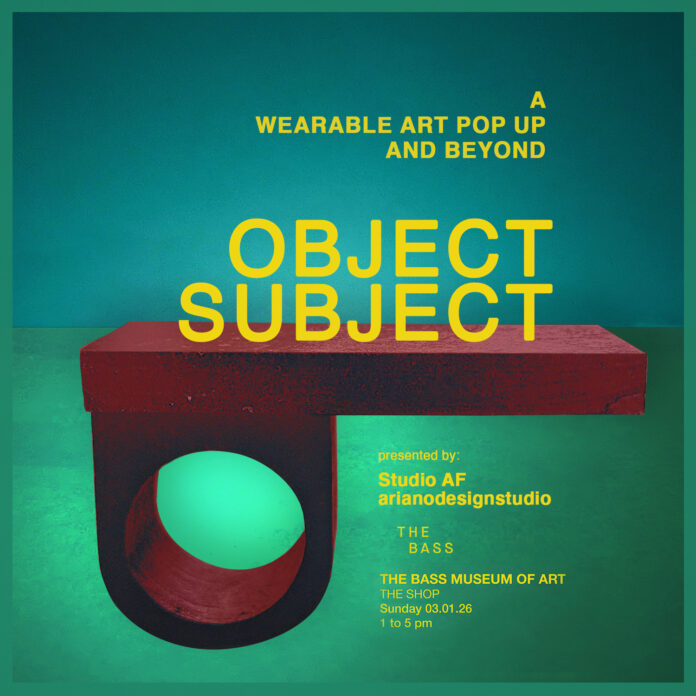
Object/Subject is a one-day pop-up event celebrating the intersection of design and fine art through a curated collection of one-of-a-kind artist-intervened rings.

Hosted at The Shop at The Bass,  the event invites visitors to explore unique works created by invited artists, ranging from wearable pieces to small collectible artworks. Each ring serves as an individual expression of artistic experimentation, blurring the boundaries between jewelry, design object, and fine art.

All pieces will be exhibited and available for purchase during the pop-up event. Selected works will continue to be available afterward at The Shop at the museum, offering collectors and visitors an extended opportunity to experience and acquire these distinctive creations.

The event promises an engaging afternoon celebrating craftsmanship, creativity, and community within the arts.

Her Majesty Queen Sofía to Present the 2026 Sophia Awards for Excellence

Majesty Queen Sofía
La reina Sofía asiste este martes a la misa en recuerdo de su hermana, Irene de Grecia, en la catedral ortodoxa griega de San Andrés y San Demetrio, en Madrid. Borja Sánchez-Trillo (EFE)

Her Majesty Queen Sofía to Present the 2026 Sophia Awards for Excellence

A Landmark Gala at Pérez Art Museum Miami

Miami, FL — March 21, 2026

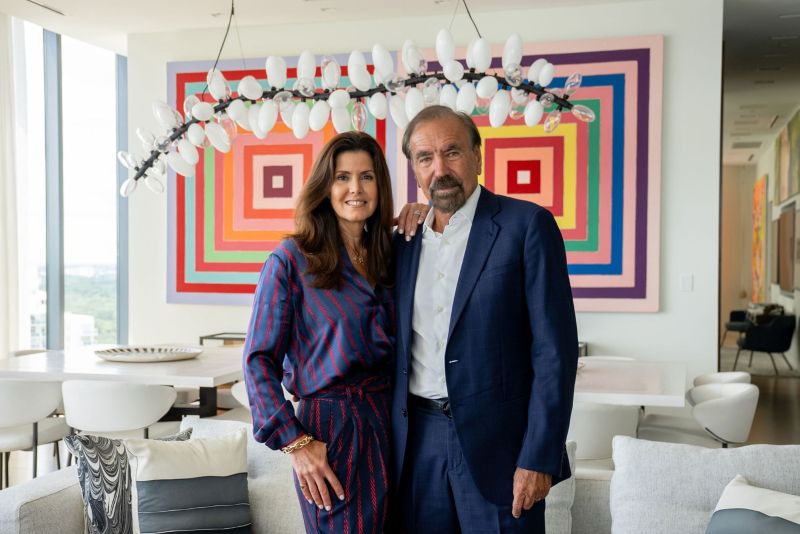
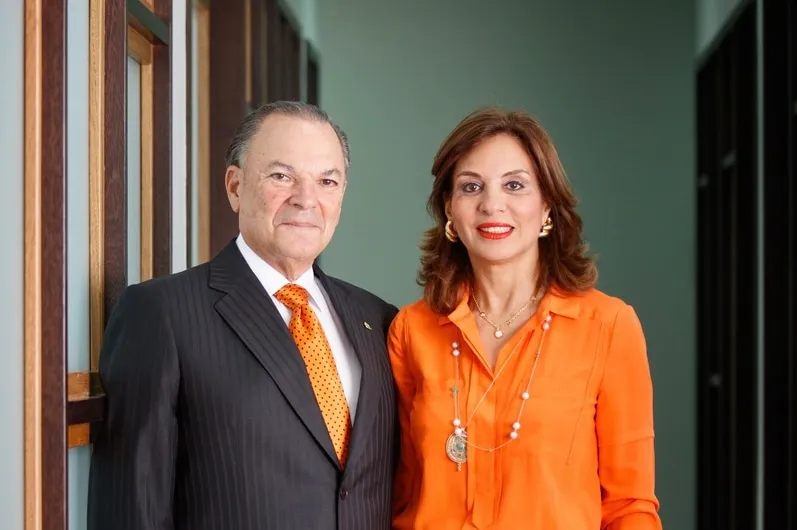
On Saturday, March 21, 2026, Miami will host an evening of international cultural significance as Her Majesty Queen Sofía travels from Spain to present the 2026 Sophia Awards for Excellence at a distinguished gala at the Pérez Art Museum Miami (PAMM).

Organized by the Queen Sofía Spanish Institute, the Sophia Awards for Excellence recognize individuals who build appreciation for Spain and the Spanish-speaking world through wisdom and humanitarianism. The 2026 honorees are:

These distinguished couples are being recognized for their visionary leadership and longstanding contributions that have strengthened communities across the United States, Latin America, and the Caribbean.

Jorge M. & Darlene Pérez
Frank & Haydée Rainieri

The Meaning Behind the Award

Named after the Greek word for wisdom, “Sophia,” the award is presented to a person or organization that has actively contributed to the international appreciation of Spain and the Americas through a donation of time, expertise, and innate wisdom in the areas of sciences, arts, or humanities.

From 1978 to 2013, the Institute annually presented Gold Medals to individuals whose achievements advanced international understanding of Spain and the Americas. Among past recipients were Santiago Calatrava, President Bill Clinton, Julio Iglesias, the National Soccer Team of Spain, Beatrice Santo Domingo, Antonio Banderas, Montserrat Caballé, and Felipe VI of Spain.

In 2018, the Institute renewed its highest distinction by inaugurating the Sophia Award for Excellence — a prize honoring the wisdom and humanitarian spirit embodied by its Patroness, Queen Sofía of Spain. Since its inception, the award has continued to recognize global leaders across arts, diplomacy, science, business, and philanthropy whose work fosters lasting bonds between the Spanish-speaking world and the United States.

A Historic Moment for 2026

The 2026 Gala carries particular historical resonance. As the United States approaches its semiquincentennial (1776–2026), the evening will mark the beginning of Florida’s participation in the America&Spain250 initiative — commemorating 250 years of shared history, friendship, and collaboration between Spain and the United States.

Through this initiative, the Queen Sofía Spanish Institute seeks to highlight Spain’s essential contributions to the American Revolution and to the development of the United States, while reaffirming the foundational role of Hispanic communities in shaping the nation.

Hosting the Gala in Miami underscores the city’s unique position as a cultural bridge linking the United States with Spain, Latin America, and the Caribbean. As Miami continues to rise as an international center for culture and philanthropy, the Sophia Awards ceremony situates the city at the crossroads of history, diplomacy, and contemporary leadership.

About the Queen Sofía Spanish Institute

Founded in 1954 in New York by a group of American Hispanophiles, the Queen Sofía Spanish Institute is a 501(c)(3) nonprofit organization dedicated to fostering American interest in the art, culture, language, literature, and history of Spain and the Spanish-speaking world. Through lectures, exhibitions, symposia, educational materials, and signature events, the Institute continues to strengthen cultural ties and promote mutual understanding between nations.

The Sophia Awards Gala offers guests the opportunity to join leaders from the cultural, philanthropic, civic, and business communities for an evening of international significance. Table sponsorships and individual tickets are available at multiple levels, including premier seating and private greetings with distinguished guests. Proceeds support the Institute’s educational and cultural initiatives.

Event Details:
The 2026 Sophia Awards for Excellence
Saturday, March 21, 2026
6:30 PM
Pérez Art Museum Miami
1103 Biscayne Blvd, Miami, FL 33132

For tickets and additional information, visit:
queensofiaspanishinstitute.org/sophiaawardforexcellence2026
or contact [email protected]

As Miami prepares to welcome Her Majesty Queen Sofía, the 2026 Sophia Awards promise not only celebration, but reflection — honoring the enduring bonds between Spain and the United States at a pivotal moment in shared history.

ISLAND CITY STAGE PRESENTS THE EAST COAST U.S.

ISLAND CITY STAGE PRESENTS THE EAST COAST U.S.
ISLAND CITY STAGE PRESENTS THE EAST COAST U.S. PREMIERE OF EVERYTHING BEAUTIFUL HAPPENS AT NIGHT BY TED MALAWER FROM APRIL 2 - 26

ISLAND CITY STAGE PRESENTS THE EAST COAST U.S. PREMIERE OF EVERYTHING BEAUTIFUL HAPPENS AT NIGHT BY TED MALAWERFROM APRIL 2 – 26

A poignant story about bravery and finding the courage to get on the same page; Tickets are on sale now

FORT LAUDERDALE, Fla. (February 27, 2026) – It’s the 1980s in Manhattan and celebrated children’s book author Ezra is at a creative and personal roadblock. His new book and literary legacy is in limbo. What, or who, will it take for him to find acceptance and inspiration again? Journey into a writer’s mind and heart as Island City Stage presents the East Coast U.S. premiere of Everything Beautiful Happens at Night from April 2 – 26. Tickets are on sale now.

From writer Ted Malawer (Red, White, & Royal Blue), Carbonell and Silver Palm Award-winning director Bruce Linser, and featuring stunning illustrations by multi-award-winning artist Bong RedilaEverything Beautiful Happens at Night is a tender, funny, and moving story about the life you have, the life you want, and who stays when the world gets quiet.

“The first time I read this play, I fell in love with it. The dialogue is smart, witty, and fast-paced, but the emotional depth of it sneaks up on you and takes you by surprise. I found myself laughing out loud and then crying a moment later, which is the mark of powerful theatre for me,” said Linser, making his Island City Stage directorial debut. “The characters and relationships are well-crafted and profoundly human. Although it’s set in a specific time and place, the themes still resonate deeply for where we are today. I think audiences will find it moving, and they’ll definitely be able to relate to it on a personal level.”

Ezra is a closeted children’s book author. Nancy is his fiercely loyal editor. Their creative partnership has shaped stories that delight generations. But when writer’s block pushes Ezra far past deadlines to deliver his latest book, a new voice enters the conversation and begins to change Ezra’s life, inspiring a controversial ending to Chipmunk and Squirrel, and testing the limits of his friendship with Nancy.

As a former literary agent for children’s book authors, then as an editor of children’s books, and ultimately as a children’s book author and novelist, himself, Ted Malawer has spun a tale close to home. Everything Beautiful Happens at Night was partially inspired by his childhood LGBTQ author heroes Maurice Sendak (“Where the Wild Things Are”) and Arnold Lobel (“Frog and Toad” books). The play held its world premiere at Capital Stage in Sacramento, California, in early 2025 and its second U.S. staging brings it to the award-winning Island City Stage in Wilton Manors, Florida.

Island City Stage’s production of Everything Beautiful Happens at Night, directed by Linser, stars Christopher Dreeson as EzraLaura Turnbull as Nancy, and Aidan Paul as Jake.

While Everything Beautiful Happens at Night marks Bruce Linser’s directing debut with Island City Stage, ICS audiences will recognize him as the actor who played John/James in Love! Valour! Compassion! and Jane/Lord Edgar in The Mystery of Irma Vep. He also played Gavin in the world premiere of Family Tree at Plays of Wilton next door. Favorite directing projects in the area include Woody Guthrie’s American SongThe Spitfire Grill, and the world premiere of The Science of Leaving Omaha (Palm Beach Dramaworks), numerous productions with MNM Theatre including Man of La ManchaAvenue QLittle Shop of HorrorsThe World Goes ‘RoundSide by Side by Sondheim, and 108 Waverly and The Timekeepers (Plays of Wilton). He is an associate member of the Stage Directors and Choreographers Society and a member of Actors’ Equity Association.

Christopher Dreeson (Ezra) was last seen at Island City Stage as Horace in The Little Foxes. He made his South Florida professional debut in 2018 in the Carbonell-recommended one-man show Confessions of a Nightingale playing the role of Tennessee Williams, directed by Jeffrey Bruce. Dreeson’s most recent Carbonell nomination was for Best Actor in a Supporting Role (John aka Fountainhead) in the New City Players production of Water by the Spoonful directed by Elizabeth Price. Last spring, Dreeson won a Del Lago award for Best Performance by a Featured Actor for his role of Jeff in Boca West’s production of Dry Powder at the Delray Beach Playhouse.

Laura Turnbull (Nancy) recently completed a successful run of Come From Away at the Maltz Jupiter Theatre and prior to that was seen in Spitfire Grill at Actor’s Playhouse. Over the past 25 years, Turnbull has performed with nearly every professional theatre in South Florida and last season appeared in All My Sons (New City Theatre), Anastasia (Slow Burn Theatre), and Lost in Yonkers (Palm Beach Dramaworks). When not on stage, she can be found behind the scenes costuming or assisting with costumes for several local theaters. In addition, Laura has worked on Broadway, Off-Broadway, national tours, regional theatres, television and film. She’s a proud, long-standing member of Actors Equity Association and SAG/AFTRA.

Aidan Paul (Jake) will be making his Island City Stage debut in Everything Beautiful Happens at Night. His recent credits include playing Adam/Leo in The Inheritance Part 1 (Zoetic Stage), Link in Hairspray (FSU) and Bobby in Cabaret (Mountain Theatre Company).

Everything Beautiful Happens at Night co-producers are Russell Vance, Michael Mullins and Terry Gaw; Lights and Sound Sponsor is Scott Bennett; Talent Sponsors are Paul Rolli & Bennett Quade and Robert Lee; Costume Sponsors are Rita Cassady and John Colemen; Set Sponsors are Margie & Trevor Fried; and Illustrations Sponsor is DC Allen & Ken Flick No Gay Hate Fund at Our Fund. Additional funding is provided by the following: The Our Fund Foundation, The Schubert Foundation Inc., the SHS Foundation, the Warten Foundation, and OutClique.

From twisted tales to touching human stories, Island City Stage’s upcoming season invites you to expect the unexpected. Upcoming bold productions, each delivering unexpected twists, inventive storytelling, and unforgettable theatrical moments include Light Switch by Dave Osmundsen from May 21 – June 14and Eureka Day by Jonathan Spector from August 20 – September 20.

Individual show tickets start at $45. A Mimosa Sunday performance sponsored by John Fomook and Charles Lee will take place on April 12. A special Women’s Night at the Theatre sponsored by Barbara Signer and Fran Epstein will take place on April 24. The show runs for one hour and 40 minutes with no intermission.

Island City Stage believes that theatre should belong to the next generation of storytellers, artists, and audiences. Its new “30 Under 30” initiative invites patrons ages 18–29 to experience award-winning, professional theatre for just $30 per ticket (plus taxes & fees; subject to availability on Thursday and Friday evenings and Saturday matinees). Limit one ticket per patron per production. A government-issued photo ID will be required at will call. When ordering online, use discount code “30U30.”

For more information and to purchase tickets, visit www.islandcitystage.org, call (954) 928-9800 or email [email protected]. Follow Island City Stage on Facebook at facebook.com/IslandCityStage and on Instagram at @islandcitystage1.

About Island City Stage

Founded in 2012, Island City Stage is a professional theater committed to sharing stories of universal interest, engaging diverse audiences with entertaining, challenging, and inspiring productions and programs, often exploring the LGBTQ+ culture. These shows are brought to life on stage through the talents of professional artists whose credits include Broadway, Off Broadway, national tours, major regional theaters, film and television. Island City Stage offers an intimate setting with six rows of stadium seating to foster a feeling of inclusion and participation in each theatrical event. Island City Stage is a 501 (c) 3 nonprofit organization. It is located at 2304 N. Dixie Hwy in Wilton Manors. For tickets and more information, please call (954) 928-9800 or visit islandcitystage.org.

LUZIA: Where Mexico Dreams in Light, Rain, and Flight

LUZIA: Where Mexico Dreams in Light, Rain, and Flight

LUZIA: Where Mexico Dreams in Light, Rain, and Flight

Written By Olga Garcia-Mayoral

Some shows entertain. LUZIA, Cirque du Soleil’s radiant tribute to Mexico, does something rarer: it enchants. It vibrates—literally and emotionally—with color, rhythm, and folklore, pulling you into a world where rain becomes choreography, light behaves like a living spirit, and the impossible feels as natural as breath. From the first moments, LUZIA reads like a moving mural—one painted with acrobatics, music, humor, and a deep affection for Mexico’s many landscapes: desert and jungle, city and coast, myth and modern life. It is, simply, a majestic experience and a joyful adventure for all ages.

I arrived expecting spectacle—because Cirque always delivers that—but I wasn’t prepared for how warm the experience would feel. LUZIA isn’t just a parade of jaw-dropping feats; it’s a show with a pulse. It’s playful and tender, exuberant and precise, constantly shifting its atmosphere as the weather changes through a day. One moment you’re laughing at a comic beat that lands with impeccable timing, the next you’re holding your breath as an artist suspends their body midair as if gravity were merely a suggestion.

A Living Folklore?

What makes LUZIA so unique is its sense of place. Mexico isn’t used as a costume here—it’s treated as a living source of imagination. You feel it in the textures of the scenes, in the ceremonial gestures, in the brightness of the palette, and in the way the music seems to carry dust, heat, and celebration all at once. The show’s imagery evokes traditions without flattening them into stereotypes. Instead, it builds a dreamscape where folklore becomes movement: spirits of the natural world, the poetry of everyday life, the humor that lives alongside hardship, the exuberance of festivals, the surreal logic of dreams.

At times, the visual storytelling feels like stepping into a book of magical realism—where you accept, without needing explanation, that a downpour can be part of a dance and that a sudden shift in light can transform the entire emotional temperature of a scene. There’s an underlying message in that beauty: wonder doesn’t erase reality; it expands it.

The Backstage Tour: The Other Miracle

After the performance, I had the privilege of going backstage—an experience that made the show even more meaningful. Seeing Cirque from behind the curtain reveals a different kind of magic: not illusion, but craft—the disciplined artistry and logistical intelligence that hold the spectacle together.

Backstage, the atmosphere is focused but surprisingly familial. You can feel the bonds among the cast members: the kind of friendship that forms when people trust each other with their bodies, their timing, their safety, and their nerves night after night. There’s a gentle camaraderie in the way they speak to one another—encouraging, teasing, checking in. It’s not performative. It’s real. And it’s beautiful to witness.

I watched two act rehearsals up close, and what struck me most was the precision. Onstage, the feats look effortless—like play. Backstage, you see the truth: everything is built on repetition, refinement, and deep listening. Small adjustments matter. A hand position changes. A cue is tightened. A breath is re-timed. The rehearsal process feels like tuning an instrument—again and again—until the sound is pure.

The Human Side of Spectacle

Speaking with cast members added an emotional layer to everything I’d just seen. These artists are not only performers; they are athletes, dancers, actors, and storytellers sharing a single vocabulary: movement. And what they share, above all, is devotion. Their bodies carry the demands of the show, but so do their minds—the concentration needed to be fully present, to land safely, to lift, catch, balance, and trust.

There’s also humility. Even at the level of Cirque du Soleil, the cast speaks about the work as if they still feel the thrill of learning. They don’t talk about it as “being talented.” They talk about it as showing up—the daily discipline of maintaining strength, softness, timing, and courage.

That devotion is part of what makes LUZIA feel so alive. When a performance is built on risk and trust, the audience can sense it. You can feel the moment before a launch, the instant of weightlessness, the split-second where the entire room silently negotiates with gravity.

The Art of Transformation: Makeup, Wardrobe, Props

Backstage, I also got to see the transformation process in detail: makeup, wardrobe, props, and the constant care that keeps everything performance-ready.

The makeup area felt like a studio in its own right—artists becoming characters not through exaggeration, but through intentional design. Brushes moved quickly and confidently, and the results were striking: faces shaped to read under stage lights, features enhanced to carry expression across distance, and details that echo the show’s folkloric universe. Makeup here isn’t “beauty”—it’s architecture for storytelling.

Wardrobe, too, is a world of its own. Costumes aren’t merely decorative; they’re engineered. They have to endure intense physical movement while remaining visually crisp and expressive. I watched garments being checked, adjusted, and repaired—tiny fixes that prevent larger problems. The care is meticulous: seams, fastenings, quick changes, reinforced points—all handled with the calm speed of professionals who understand that a costume is part of an act’s safety as much as its aesthetic.

Then there are the props: a dazzling ecosystem of objects that must look magical while functioning flawlessly. I saw items being touched up—paint corrected, edges cleaned, surfaces restored. It reminded me of museum conservation: the work of keeping an object alive through constant attention. The props may appear on stage for only a momentf, but behind the scenes, they receive full respect. They’re part of the performance’s ecosystem—small, essential storytellers.

Light and Sound: Invisible Choreography

Perhaps most fascinating was seeing how sound and lighting are continually refined. Onstage, light feels like a character: it shapes space, creates transitions, and amplifies emotion. Backstage, I watched adjustments being made—levels modified, cues checked, angles reconsidered. The lighting isn’t static; it’s responsive to the needs of the performers and the rhythm of the show.

Sound, too, is its own choreography. Every beat has a purpose, every swell guides attention, every shift helps shape the audience’s emotional journey. Watching technicians tweak settings reminded me that what we call “atmosphere” is often a crafted structure built by experts. Their work is as essential as any acrobat’s. Without them, the world of LUZIA wouldn’t breathe.

Works and Wonders

LUZIA succeeds because it understands what wonder actually is. Wonder is not only a spectacle—it’s a connection. It’s the feeling of being invited into a universe where beauty has rules you can sense even if you can’t explain them. It’s laughter shared in a crowd. It’s the quiet moment when a performer lands safely, and you realize you’d been holding your breath.

It’s also intergenerational. LUZIA is the kind of show where children watch with wide-eyed amazement, adults rediscover play, and everyone leaves a little lighter. You don’t need prior knowledge or context to enjoy it. You just need openness.

And if you’re fortunate enough to see behind the curtain, the wonder deepens. Because then you understand: the magic isn’t just what happens onstage—it’s the devotion that makes it possible. The hours of rehearsal. The family bonds. The makeup brushes and sewing kits. The props are lovingly maintained. The lighting cues are adjusted until they sing. The collective belief that excellence is an everyday practice.

LUZIA is Mexico rendered as a dream—a world of folklore and light—, but it’s also a portrait of what human beings can do when they commit to craft with joy. I left feeling exhilarated, moved, and grateful: grateful for the artistry, for the generosity of the backstage glimpse, and for the reminder that wonder is something we can still build—together—night after night.

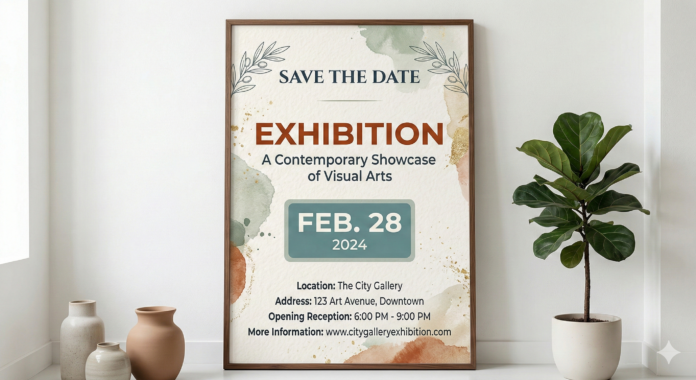
SAVE THE DATE: EXHIBITIONS ON FEBRUARY 28

SAVE THE DATE: EXHIBITION on Feb. 28

SAVE THE DATE: EXHIBITIONS ON FEBRUARY 28

Miami Art Weekend

From Design District to Downtown, a City in Full Creative Motion

Miami’s art ecosystem activates in full force this Saturday, February 28, with a dynamic lineup of openings, institutional programs, fundraisers, and special encounters spanning from the Design District and Wynwood to Allapattah, Little River, Downtown, and beyond.

What makes this particular Saturday compelling is not just the number of events — but the diversity of approaches: museum-caliber exhibitions, experimental spaces, major international artists, and community-rooted initiatives unfolding simultaneously.

Below is a curated geographic guide to navigating the evening.


Design District

Piero Atchugarry Gallery

Exile — Antonia Wright & Ruben Millares
7:00 – 9:00 PM
5520 NE 4th Ave, Miami

In a neighborhood increasingly defined by luxury and global design brands, Exile introduces a more introspective, politically charged conversation. The pairing of Antonia Wright and Ruben Millares promises a dialogue around displacement, identity, and territory—timely themes in a city shaped by migration.

Instagram: @pieroatchugarrygallery
pieroatchugarry.com


Fundación Pablo Atchugarry

RE.IMAGINATION — Curated by Dr. Ross Karlan
7:00 – 9:00 PM
5520 NE 4th Ave, Miami

Presented by The55Project Art Foundation, RE.IMAGINATION explores the cyclical nature of history through a diverse group of international artists. The exhibition continues the foundation’s commitment to cross-cultural narratives and philosophical inquiry within contemporary practice.

Instagram: @fpatchugarry.miami
fpatchugarry.org


Wynwood

Museum of Graffiti

Meet Niels “Shoe” Meulman
7:00 – 9:00 PM
2521 NW 3rd Ave

A rare opportunity to engage directly with a pioneer of Calligraffiti. Meulman’s work bridges street culture and fine art, reinforcing Wynwood’s foundational relationship to urban visual language.

Instagram: @museumofgraffiti
museumofgraffiti.com


WYN317

An Experience of Us — Carlos Solano
6:00 – 9:00 PM
317 NW 23rd St

Solano’s first solo exhibition reflects on connection, shared memory, and collective identity—an intimate counterpoint to Wynwood’s often high-energy atmosphere.

Instagram: @wyn317
wyn317.com


Allapattah

Allapattah continues to solidify its status as Miami’s most critically engaged art district.

KDR

La Mujer Que Llora — Mònica Subidé
5:00 – 8:00 PM
790 NW 22nd St

Subidé’s new paintings explore gesture, form, and emotional presence through sustained painterly investigation.

Instagram: @kdr305
kdr305.com


Baker—Hall & Mahara+Co

Holding Form
5:00 – 8:00 PM
1294 NW 29th St

A collaborative inauguration of Mahara+Co’s new shared space with Baker—Hall. The exhibition examines structure, materiality, and lived experience across a multi-artist presentation.

Instagram: @bakerhall.art
bakerhall.art


Little River

Little River offers one of the most layered evenings of the weekend.

Galbut Institute

IVY — Jason Galbut
12:00 – 4:00 PM
255 NE 69th St, Unit D

Galbut approaches painting as constructed surface—dense, layered, materially assertive. A quiet but rigorous exhibition.

Instagram: @galbutinstitute
galbutinstitute.org


homework

Fragments of Disappearance — Richard Vergez
5:00 – 9:00 PM
7338 NW Miami Ct

Vergez explores animism, erasure, and memory through installation, collage, and sculptural interventions.

Instagram: @homework.gallery
homework.gallery


Dimensions Variable

Salon Together — Fundraiser Exhibition
6:00 – 9:00 PM
101 NW 79th St

A ticketed exhibition featuring fully donated works from artists connected to DV’s 16-year history. Proceeds support the organization’s forthcoming archival publication.

Instagram: @dimensions_variable
dimensionsvariable.net


Downtown Miami

CARGO SPACE

on Belonging
4:30 – 8:30 PM

Featuring Amanda Cantin, John Dominic Colón, Iris Alejandra, Liang Lansi, Pablo Matute, and Richard Moreno, co-curated by Marie Franco and Ana Vergara. The exhibition addresses themes of identity, territory, and presence within the urban core.

Instagram: @cargo___space
cargospace.us


Beyond the Core

Lowe Art Museum (Coral Gables)

Nature and the Environment in the Indigenous Art of the Americas
11:00 AM – 12:00 PM
1301 Stanford Dr

An expert-led tour exploring environmental themes within Indigenous art traditions.

Instagram: @lowemuseum
lowemuseum.org


MIFA (Doral)

El Collar de Olimpia — Talk
11:00 AM
5900 NW 74th Ave

A conversation presented in collaboration with NF Art & Design.

Instagram: @mifamiami
mifamiami.com


Ceramic League of Miami (Kendall)

Edouard Duval-Carrié Masterclass
10:00 AM – 4:00 PM

A hands-on workshop with one of Miami’s most important artists.

Instagram: @ceramicleagueofmiami
ceramicleagueofmiami.org


A City in Motion

What distinguishes February 28 is not scale but density. Museum conversations, experimental projects, international residencies, and grassroots fundraisers coexist within a few square miles.

From layered painting in Allapattah to conceptual discourse in the Design District, from street-informed dialogue in Wynwood to reflective installations in Little River, Miami demonstrates once again that its strength lies in plurality.

Saturday is not just an art night. It is a map of where the city’s creative consciousness currently stands.

ARTEXPO NEW YORK RETURNS TO PIER 36

ARTEXPO NEW YORK RETURNS TO PIER 36

ARTEXPO NEW YORK RETURNS TO PIER 36

World’s original fine art marketplace announces dates for its 49th annual edition.

New York, NY – February 2026Redwood Art Group, the nation’s leader in exhibitions and event production, media, and marketing for the global art community, announces its highly anticipated four-day showcase, Artexpo New York, returning to Pier 36 at 299 South Street in Manhattan, from Thursday, April 9 to Sunday, April 12, 2026. Information on exhibitor registration and to purchase advance tickets can be found at www.redwoodartgroup.com/artexpo-new-york/.

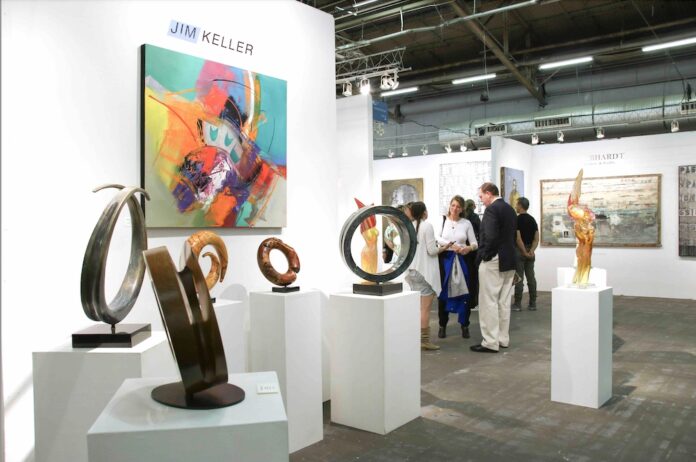
The annual fine art destination, now in its 49th year, will host more than 200 innovative exhibiting galleries, art publishers and dealers, and artists from across the globe across 70,000 square feet   of uninterrupted convention space, showcasing original work of 1000+ artists that includes prints, paintings, drawings, sculptures, photography, ceramics, giclee, lithographs and glass works, among other contemporary and fine art.

Throughout its nearly five historic decades in contemporary and fine art, Artexpo New York has hosted the likes of Andy WarholRobert RauschenbergKeith Haring and Leroy Neiman; intensifying the discourse on today’s industry challenges and magnifying the very best the fine art world   has to offer. In addition to visiting the world’s largest fine art trade show, more than 15,000 avid art enthusiasts and industry leaders will return to enjoy [SOLO], highlighting       established and independent emerging artists. This year’s Artexpo New York will also feature its annual lineup of programming within the Artexpo Pavilion and [SOLO] Pavilion, including Art Labs, the Discoveries Collection and Spotlight Program.

“As we return to Pier 36 for the 49th edition of Artexpo New York, we’re proud of the fair’s global reach and continued evolution,” said Eric Smith, President and CEO of Redwood Art Group. “With participation from artists and galleries representing more than 20 countries, Artexpo remains a platform for discovery, innovation, and forward-thinking programming that helps define what’s next in the art world.

Hosting more than 15,000 avid art enthusiasts, including 2,000+ trade representatives every year, Artexpo New York is the largest international gathering of qualified trade buyers—including gallery owners and managers, art dealers, interior designers, architects, corporate art buyers, and art and framing retailers. Attendees will have an opportunity to browse thousands of innovative new works of art and enjoy specific programming. [SOLO] offers established and emerging independent artists the opportunity to showcase their work on an international stage. Over the last decade, [SOLO] has become the ultimate venue for independent artists to be   discovered—not only by gallery owners and art publishers, but also by collectors and enthusiasts.

As part of the interactive schedule of programming, this year’s Artexpo New York will include Art Labs, featuring specially curated site-specific projects by prominent galleries, art institutions, and art collectives within the show; as well as the Spotlight Program, providing collectors with a focused look at several prominent galleries and artists that will each be creating a site-specific exhibition. This year’s expo also features the Discoveries Collection – selections of artwork chosen by the Artexpo New York curatorial team that make up a group of amazing discoveries throughout the fair. The full schedule of programming activity will be announced in March.

Exhibitors confirmed for this year’s Artexpo New York include: K-Art Projects USA, Miami, Florida; AGI Fine Art, New York City, New York; Mecenavie Gallery, Paris, France; Perseus Gallery, New York City, New York, SAB Art Collection, Los Angeles, California; ADDO Gallery, Suwanee, Georgia; The Gallery Steiner, Vienna, Austria; MIDO Gallery, Medelin Antioquia, Columbia; Famespace, Miami, Florida; Liz Wood art Selection, Miami, Florida;and Artavita / World Wide Art, Santa Barbara, CA, among many others.

The Opening Night VIP Preview for Artexpo New York begins on Thursday, April 9 from 5:00p.m. to 8:00p.m. The fair continues for the public and trade on Friday, April 10 through Sunday, April 12, starting at 11:00 a.m. daily, with advance tickets priced at $30 for general admission. A multi-day advance purchase ticket that includes access to the Opening Night VIP Preview and all other fair days (Thursday, April 9 to Sunday, April 12) is priced at $50. All ticket prices increase beginning March 15, 2026.

Page 11 of 277
1 9 10 11 12 13 277