Anna Cassel: The Invisible Architect of Spiritual Vision
To write about Anna Cassel is to confront the profound silences that shape art history—the absences, the unrecorded lives, the creative contributions that vanished into collaborative obscurity. Cassel (1860-1930) was one of the five Swedish women who formed the spiritualist group “The Five” (De Fem) alongside Hilma af Klint, Cornelia Cederberg, Sigrid Hedman, and Mathilda Nilsson. While af Klint has recently achieved international recognition as a pioneer of abstract art, Cassel and the other members of The Five remain largely unknown, their spiritual seeking and artistic contributions overshadowed by their more famous companion.
Yet to understand af Klint’s work and spiritual practice requires understanding the collective context in which it emerged. The Five was not simply a support group for af Klint’s individual genius but a genuine spiritual collective in which all five women participated as equals, contributing to the séances, automatic writings, and drawings that formed the foundation of their shared practice. Anna Cassel was integral to this work, and her spiritual journey—though less documented—deserves examination both in its own right and for what it reveals about women’s spiritual seeking at the turn of the twentieth century.
Anna Cassel was born in 1860 into a Swedish family about which we know frustratingly little. The sparse biographical information available tells us she never married, that she worked as a handwork teacher, and that she shared lodgings with Hilma af Klint for a period. These bare facts sketch the outlines of a life that would have been considered unremarkable by conventional standards—a single woman of modest means, earning her living through respectable but unglamorous work. Yet this surface ordinariness concealed a rich inner life devoted to spiritual exploration and metaphysical investigation.
The formation of The Five in 1896 represented a deliberate choice by these women to create space for spiritual practice outside the constraints of conventional religion and social expectation. The Lutheran Church dominated Swedish religious life, but for many, including Cassel and her companions, it offered inadequate answers to fundamental questions about the nature of reality, the fate of the soul, and the purpose of existence. Spiritualism and theosophy, by contrast, promised direct access to spiritual knowledge through practice rather than through clerical mediation or scriptural authority.
For unmarried women like Cassel, spiritualism offered particular freedoms and possibilities. In the séance room, conventional social hierarchies dissolved. A working-class woman could serve as medium for communications of cosmic importance. Gender, which limited women’s authority in almost every other sphere, became an asset in spiritualist practice, as women were believed to possess greater sensitivity to spiritual influences and more permeable boundaries between material and spiritual realms. This feminine spiritual authority stood in stark contrast to women’s exclusion from ordained ministry in conventional churches.
The Five’s practice centered on weekly séances conducted with remarkable discipline and seriousness over many years. The women would gather, often at Cassel’s apartment, create a meditative atmosphere through prayer or contemplation, and then enter into receptive states during which they believed spiritual entities—the “High Masters”—could communicate through them. These communications took the form of automatic writing, in which the medium’s hand would write or draw without conscious direction, and later in auditory messages that the women transcribed.
Cassel served as medium for several spiritual entities during The Five’s sessions. The detailed séance notebooks that survive—now housed with af Klint’s archive—record Cassel channeling beings named Gregor, Clemens, and others who offered spiritual teachings, moral guidance, and instructions for the group’s development. The content of these communications reveals the eclecticism characteristic of turn-of-the-century spiritualism: references to Christian concepts sat alongside theosophical ideas about karma and reincarnation, scientific metaphors about evolution and energy, and mystical teachings about the nature of consciousness and cosmic unity.
What was the phenomenological reality of Cassel’s experience during these séances? This question resists definitive answer, yet speculation informed by historical and psychological understanding can illuminate possibilities. Cassel may have experienced dissociative states in which aspects of her own consciousness manifested as seemingly external voices or presences. She may have accessed intuitive knowledge through a relaxation of ordinary rational control. She may have experienced genuine alterations in consciousness that contemporary neuroscience might explain through changes in brain state and activity patterns but which felt subjectively like communication with external intelligences.
What remains certain is that Cassel experienced these communications as real and meaningful, structuring years of her life around practices designed to facilitate them. The commitment this required should not be underestimated. The Five met regularly for over a decade, maintaining their practice with remarkable consistency despite the demands of employment, family obligations, and the skepticism or disapproval they may have encountered from those outside their circle.
The automatic drawings produced during The Five’s séances represent collaborative spiritual-artistic production in which individual authorship becomes difficult or impossible to assign. When Cassel’s hand moved across the page, guided by what she experienced as external intelligence, was she the artist? Was the spiritual entity she channeled the creator? Or was the drawing a product of the collective field generated by all five women together? These questions challenge fundamental assumptions about artistic authorship, creativity, and the individualism that has dominated Western art since the Renaissance.
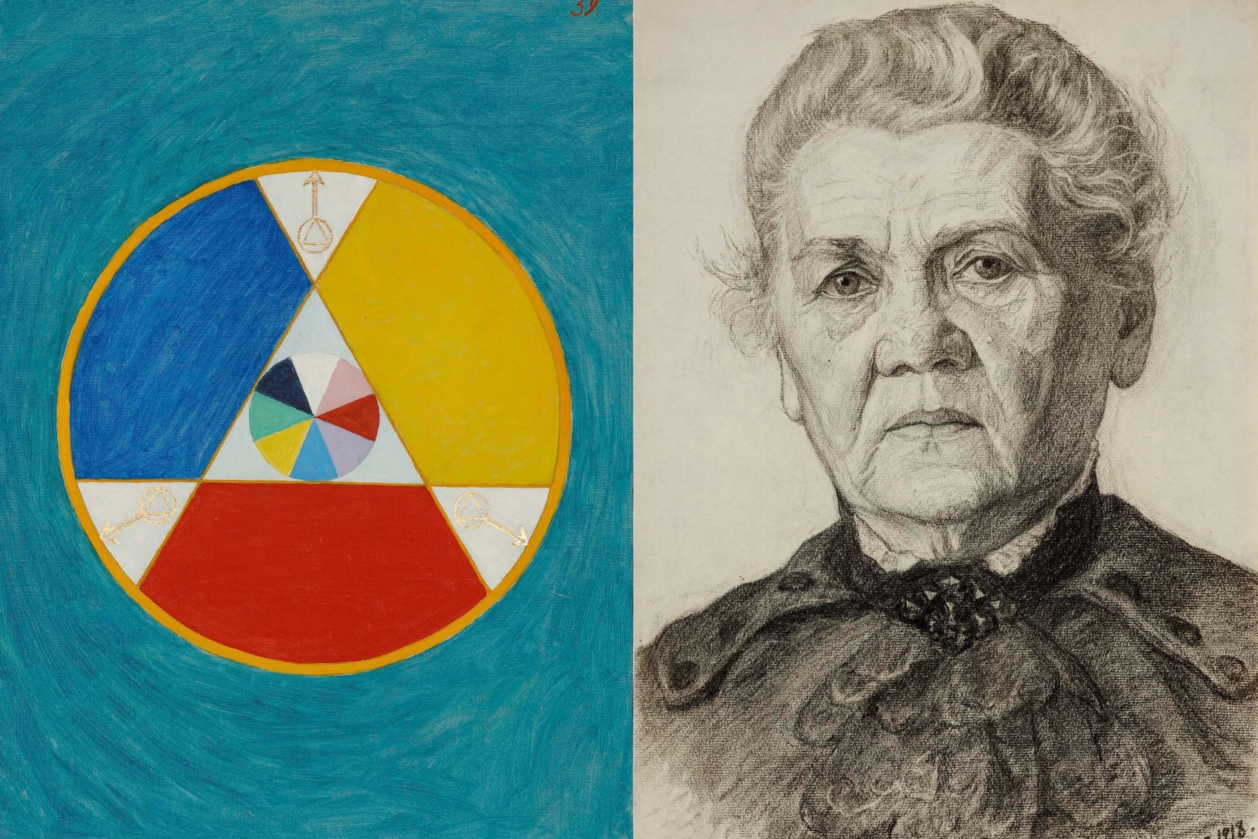
Cassel’s drawings from these sessions—those that survive and are identifiable as hers—show abstract forms, symbols, and geometric patterns similar to those produced by the other members of The Five. Spirals, circles, botanical forms, and letter-like symbols appear frequently, suggesting a shared symbolic vocabulary developed through the group’s collective practice. These images predate af Klint’s “Paintings for the Temple” and likely influenced their symbolic content and formal language, though the precise relationship between the collective automatic drawings and af Klint’s later independent work remains a matter of scholarly investigation and debate.
The question of influence and contribution within The Five raises complex issues. When af Klint received the commission in 1904 to create “The Paintings for the Temple,” she understood this as a directive from the High Masters channeled specifically to her. Yet this commission emerged from and depended upon the spiritual foundation established through The Five’s collective practice. The symbolic language, the spiritual worldview, the very understanding of art as spiritual communication—all these were developed collaboratively before af Klint began her independent visionary paintings.
Should we therefore understand Cassel and the other members of The Five as collaborators in af Klint’s achievement? Or does af Klint’s transformation of their shared spiritual vocabulary into monumental paintings constitute a distinct and individual contribution? The question reveals how poorly our frameworks for understanding creativity and achievement accommodate collaborative and spiritually-oriented practices. We want individual heroes, singular geniuses, clear lines of attribution. The Five’s practice resists these desires.
For Cassel, the spiritual search appears to have been its own reward, not a means to artistic recognition or achievement. There is no evidence she sought to create paintings like af Klint’s or aspired to be known as an artist. Her spirituality was lived as practice, devotion, and service rather than as a path to creative production or public recognition. This orientation reflects a different understanding of spirituality’s purpose—not self-expression or personal development but alignment with divine will and participation in cosmic processes beyond individual ego.
The theosophical teachings that shaped The Five’s practice emphasized spiritual evolution both individual and collective. Humans were understood to be evolving toward higher consciousness through successive incarnations, gradually shedding material attachment and developing spiritual faculties. This evolutionary framework gave spiritual practice cosmic significance—individual development contributed to humanity’s collective advancement. For Cassel, participating in séances and receiving spiritual communications was not merely personal enrichment but contribution to humanity’s spiritual progress.
This sense of participation in something larger than oneself may have made the obscurity of Cassel’s individual contribution less troubling than it appears from contemporary perspectives. If the goal was serving higher spiritual purposes rather than personal recognition, then whether her name would be remembered became less important than whether the work was done faithfully. This subordination of ego to spiritual service represents an orientation increasingly foreign to contemporary individualist culture yet common in many spiritual traditions.
The practical circumstances of Cassel’s life shaped her spiritual practice in important ways. Her work as a handwork teacher—teaching sewing, embroidery, and other textile crafts to girls—was respectable but economically marginal. She would not have had independent wealth or significant leisure time. The fact that she sustained a demanding spiritual practice alongside employment speaks to her dedication and suggests that spiritualism provided meaning and purpose that compensated for the limitations of her material circumstances.
Living situations also mattered. Cassel’s periods of sharing lodgings with af Klint would have facilitated their spiritual collaboration, allowing for spontaneous conversations, shared reading and study, and easy coordination of séance schedules. The domestic intimacy of women living together created spaces for spiritual exploration free from male oversight or interruption. These shared households functioned as informal spiritual communities where everyday life and spiritual practice interpenetrated.
The social dimensions of The Five’s practice deserve emphasis. These women supported each other through the challenges, doubts, and skepticism that spiritual seeking often entails. When one member questioned an experience or interpretation, others could provide reassurance and alternative perspectives. When spiritual communications proved difficult to understand, the group could collectively work toward interpretation. This mutual support was not merely practical but spiritually significant—the group itself became a container for spiritual experience, a collective field within which individual openings to non-ordinary consciousness became possible.
After af Klint received her individual commission in 1904, The Five’s collective séances continued but with altered dynamics. The group still met, still received communications, but increasingly the focus shifted toward supporting af Klint’s work on “The Paintings for the Temple.” How did Cassel experience this shift? Did she feel displaced or subordinated? Or did she understand af Klint’s commission as fulfillment of their collective spiritual work, with af Klint serving as the instrument through which their shared spiritual seeking would manifest in material form?
The historical record provides no clear answers to these questions. We have af Klint’s extensive writings, notebooks, and retrospective accounts of The Five’s activities, all filtered through her perspective and purposes. Cassel’s own voice, her subjective experience, her understanding of their spiritual work—these are largely absent from the archive. This absence itself tells us something important about whose perspectives are preserved and whose are lost, whose inner lives are deemed worthy of documentation and study.
What we can say with certainty is that Cassel continued her spiritual practice throughout her life. She remained connected to af Klint and to spiritual seeking even as The Five’s formal séances apparently ceased sometime around 1908. Cassel attended lectures by Rudolf Steiner, the founder of Anthroposophy, along with af Klint, suggesting ongoing engagement with new spiritual teachings and frameworks. She lived until 1930, dying four years before af Klint, having spent more than three decades devoted to spiritual exploration and practice.
The lack of information about Cassel’s later life raises questions that cannot be answered definitively. Did she continue to serve as medium for spiritual communications? Did she maintain spiritual practices independently? How did she understand the trajectory of her spiritual development over decades of seeking? Did she achieve the states of consciousness, the spiritual knowledge, the evolutionary advancement that theosophy promised? And by what measures would such achievement be judged?
These questions point toward fundamental tensions in how we evaluate spiritual seeking. From external perspectives, Cassel’s life might appear marked by absence—no marriage, no children, no public recognition, no lasting artistic or literary production. Yet from within a spiritual framework, the inner transformation and development that cannot be externally verified might be the only achievements that truly matter. The problem is that we cannot access Cassel’s inner life with sufficient clarity to know what she experienced or how she evaluated her own spiritual journey.
This epistemological limitation is not unique to Cassel but characteristic of spiritual experience generally. Mystical states, spiritual insights, and consciousness transformations are fundamentally subjective, accessible only to the experiencer. They can be reported and described but never fully conveyed or verified. This creates inevitable skepticism in secular contexts but also protects spiritual experience from reduction to external measurement or validation.
Contemporary reassessment of The Five and Cassel’s role within the group must resist the temptation to simply invert existing hierarchies—to elevate Cassel and diminish af Klint in the name of recovering women’s contributions. The reality is more complex: The Five represented genuine spiritual collaboration that enabled af Klint’s later independent work while also having value and meaning for its participants independent of that work. Cassel’s spiritual seeking mattered whether or not it produced paintings, and the collaborative field The Five created was itself an achievement.
What Cassel’s story reveals most clearly is the profound erasure of women’s spiritual labor and creative contribution in historical records and collective memory. Countless women throughout history have engaged in spiritual practices, mystical experiences, and religious innovations that left few traces because they occurred outside institutional structures, because they were deemed less important than men’s comparable activities, or because the women themselves did not seek or were denied opportunities for public recognition and documentation.
Recovering these lost histories is difficult and frustrating work. Sources are sparse, perspectives are limited, and silence pervades the archives where we hope to find evidence of women’s inner lives and spiritual experiences. Yet the effort matters because it challenges narratives that position women as passive recipients of male spiritual authority rather than active seekers and innovators in their own right. The Five and Cassel’s participation in it demonstrate that women created spaces for spiritual authority and experience outside patriarchal control even when those spaces left minimal historical traces.
Anna Cassel’s spirituality was characterized by commitment, collaboration, and service. She participated faithfully in demanding practices over many years, contributing to a collective spiritual project whose full significance she may not have been able to foresee. She subordinated personal recognition to spiritual purposes, serving as medium and collaborator rather than seeking individual distinction. And she sustained her spiritual seeking across decades, remaining engaged with questions of consciousness, reality, and cosmic purpose throughout her life.
In an era increasingly interested in collaborative and relational models of creativity, in spirituality outside conventional religious institutions, and in recovering women’s contributions to cultural and intellectual history, Anna Cassel’s example has renewed relevance. She reminds us that creative and spiritual work often emerges from collective practice rather than individual genius, that many who contribute essentially to important cultural developments leave minimal historical traces, and that the value of spiritual seeking cannot be measured solely by its external products or public recognition.
The challenge Cassel’s story poses to us is how to write histories and create accounts that acknowledge and honor contributions that resist conventional documentation. How do we value spiritual practice that produced no permanent material artifacts? How do we assess collaboration when individual contributions cannot be clearly distinguished? How do we recover women’s inner lives and spiritual experiences when the archives preserve primarily external facts and events?
These questions have no simple answers, but asking them is essential work. Anna Cassel lived a life devoted to spiritual seeking, participated in practices that contributed to remarkable artistic innovations, and sustained faith in dimensions of reality beyond the material and measurable. Her obscurity is art history’s failure, not hers. And her example invites us toward humility about what we can know, attention to what has been erased, and recognition that significance and achievement take forms that exceed our usual measures and often our capacity to perceive them.