Andy Warhol: The Artist Who Made America Look at Itself
In the pantheon of twentieth-century art, few figures loom as large or as paradoxically as Andy Warhol. Born Andrew Warhola in 1928 to Slovakian immigrant parents in Pittsburgh, he would become the most recognizable artist of his generation—a man who transformed soup cans into icons, elevated celebrity to high art, and blurred the boundaries between commerce and culture so thoroughly that we’re still untangling the implications today.
Warhol didn’t just document the rise of consumer culture and mass media in postwar America; he became its most perceptive chronicler, its shrewdest critic, and perhaps its most enthusiastic participant. His legacy extends far beyond the art world, touching fashion, film, music, and our fundamental understanding of fame, authenticity, and value in the modern age.
From Commercial Illustrator to Art World Phenomenon
Warhol’s path to artistic immortality began in the unglamorous trenches of commercial illustration. After graduating from Carnegie Institute of Technology in 1949 with a degree in pictorial design, he moved to New York and spent the 1950s building a successful career creating advertisements for magazines, department stores, and shoe companies. This background proved crucial. While the reigning Abstract Expressionists like Jackson Pollock and Willem de Kooning sought to distance art from commerce, treating the canvas as a space for pure emotional expression, Warhol moved in the opposite direction.
He recognized something the art establishment had missed: that commercial imagery had become the most powerful visual language of American life. Advertisements, product packaging, celebrity photographs—these were the images that ordinary people encountered daily, that shaped their desires and structured their understanding of the world. To ignore this visual landscape in favor of gestural abstraction was, in Warhol’s view, to miss the point of what it meant to be alive in twentieth-century America.
The breakthrough came in the early 1960s with his now-legendary Campbell’s Soup Cans. Displaying thirty-two canvases, each depicting a different variety of Campbell’s soup, Warhol presented products as worthy subjects for serious artistic contemplation. The art world reacted with confusion, outrage, and fascination. Was this art or advertising? Celebration or critique? The genius lay precisely in the ambiguity. Warhol refused to provide easy answers, maintaining throughout his life an enigmatic public persona that deflected interpretation.
The Factory: Art as Industrial Production
In 1962, Warhol moved his studio to a silver-painted loft space that became known simply as The Factory. The name was intentional and provocative. While artists traditionally worked in studios—spaces associated with individual creative genius and craft—Warhol operated a factory, deliberately invoking industrial production and questioning romantic notions of artistic creation.
The Factory became legendary not just for the art produced there but as a social scene. It attracted an eclectic cast of characters: socialites and street hustlers, drag queens and debutantes, musicians and misfits. Warhol cultivated this circus-like atmosphere, understanding that the personalities and dramas unfolding in his space were as much a part of his artistic practice as the silkscreens being produced. The Factory was performance art before the term became commonplace, a living tableau of downtown Manhattan’s creative and destructive energies.
His use of silkscreen printing epitomized his approach to art-making. This mechanical reproduction technique, borrowed from commercial printing, allowed him to create multiple versions of the same image with subtle variations. Assistants often executed much of the physical work, leading critics to question whether Warhol was even making “his own” art. But this missed the point entirely. Warhol was interrogating the very concept of authorship and originality in an age of mass reproduction. If uniqueness was what made art valuable, what happened when images could be endlessly duplicated? His work forced uncomfortable questions about authenticity and value that remain urgent today.
Celebrity, Repetition, and the American Death Drive
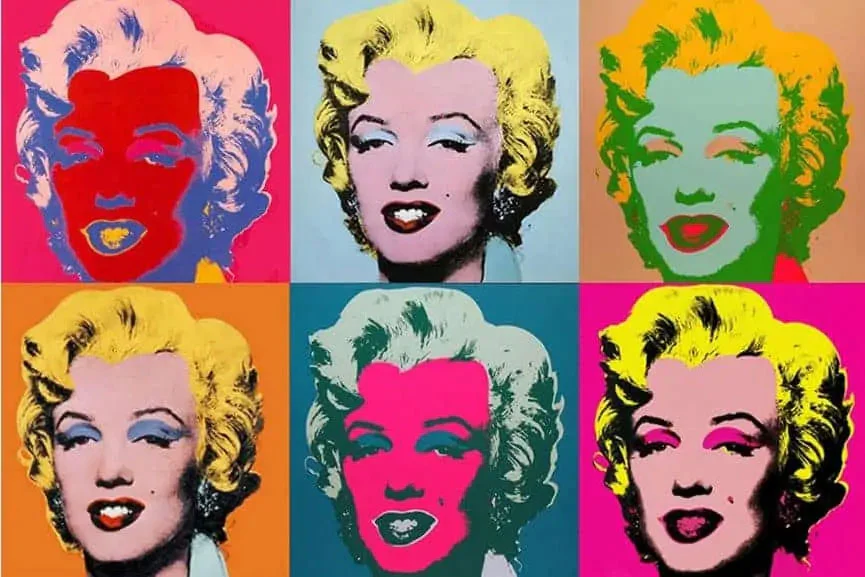
Warhol’s portraits of celebrities—Marilyn Monroe, Elizabeth Taylor, Elvis Presley, Jackie Kennedy—represent some of his most iconic and misunderstood work. At first glance, they seem to simply celebrate fame, reproducing familiar faces in bright, eye-catching colors. But look closer, and something darker emerges.
His Marilyn Diptych, created shortly after Monroe’s death in 1962, presents fifty images of the actress derived from a single publicity photograph. On the left panel, Marilyn appears in vibrant colors; on the right, the images fade into murky blacks and grays, her face becoming progressively more ghostly and indistinct. The work captures how celebrity functions in American culture—the bright surface appeal masking tragedy, the way repetition drains even the most beautiful face of meaning, transforming a person into a commodity that can be reproduced, consumed, and ultimately discarded.
This fascination with repetition extended to his Disaster series, silkscreens depicting car crashes, electric chairs, and other scenes of death and violence taken from newspaper photographs. By reproducing these images multiple times within a single canvas, Warhol captured how modern media has numbed us to tragedy through constant exposure. Horror becomes wallpaper. The shocking becomes routine. It was a profoundly unsettling commentary on American culture disguised as pop art.
Film, Music, and Multimedia Experimentation
Warhol’s ambitions extended well beyond painting and printmaking. Between 1963 and 1968, he created nearly 650 films, ranging from his notorious eight-hour static shot of the Empire State Building to more narrative works featuring Factory regulars. These films challenged conventional notions of cinema, often eschewing traditional storytelling in favor of extended observation. Sleep, a five-hour film of poet John Giorno sleeping, tested the limits of viewer patience and attention, asking what constitutes a cinematic event worthy of documentation.
His involvement with The Velvet Underground, the experimental rock band he managed and promoted in the mid-1960s, demonstrated his influence beyond visual art. Warhol designed the iconic banana cover for their debut album and created the Exploding Plastic Inevitable, a multimedia performance series combining the band’s music with projected films and lights. This Gesamtkunstwerk—total artwork—anticipated the immersive multimedia experiences that would dominate contemporary art and entertainment decades later.
The Business of Being Andy Warhol
“Being good in business is the most fascinating kind of art,” Warhol famously declared. “Making money is art and working is art and good business is the best art.” This conflation of artistic and commercial success scandalized the art establishment but proved remarkably prescient. Warhol understood that in contemporary capitalism, the boundaries between art, commerce, and personal brand had collapsed.
He formalized this understanding by founding Andy Warhol Enterprises Inc. and later creating Interview magazine, which documented celebrity culture with a knowing mixture of fascination and detachment. His commissioned portraits of wealthy patrons and celebrities became a lucrative business, with Warhol functioning as court painter to the Studio 54 era’s social elite. Critics accused him of selling out, but this misunderstood his project. Warhol wasn’t selling out; he was demonstrating that the concept of selling out had become meaningless in a culture where everything, including authenticity itself, was for sale.
His aphorisms—collected in books like The Philosophy of Andy Warhol (From A to B and Back Again)—revealed a sharp mind behind the deadpan public persona. “In the future, everyone will be world-famous for 15 minutes” proved remarkably prophetic in our age of viral fame and social media influencers. “I am a deeply superficial person” captured his paradoxical depth, using the language of superficiality to expose the superficiality of depth.
The Attempt That Changed Everything
On June 3, 1968, Valerie Solanas, a radical feminist who had appeared in one of Warhol’s films, entered The Factory and shot him. Warhol barely survived, undergoing extensive surgery and suffering physical complications for the rest of his life. The shooting marked a turning point, both personally and culturally. The optimistic, boundary-pushing energy of the mid-1960s gave way to something darker and more paranoid.
After his recovery, Warhol’s work became more commercial, focusing increasingly on commissioned portraits and celebrity subjects. Some critics saw this as artistic decline, a retreat into safe, lucrative territory. Others argue that Warhol was simply continuing his project of interrogating American celebrity and consumer culture, now from the position of being a celebrity himself. The shy immigrant’s son from Pittsburgh had become exactly the kind of famous person he had once depicted, and his later work explored that position with characteristic ambiguity.
Legacy and Cultural Transformation
Warhol died suddenly in 1987 following routine gallbladder surgery, at age fifty-eight. In the decades since, his influence has only expanded. The art market’s current structure—where contemporary artists function as brands, where corporations collect art as investments, where the line between high and low culture has all but vanished—owes much to the path Warhol blazed.
His impact extends beyond art into broader culture. The reality television era, where ordinary people become famous simply for being famous, realizes Warhol’s insights about celebrity. Social media platforms, where everyone curates their own personal brand and seeks viral recognition, function as democratized versions of his Factory. The influencer economy, where personal authenticity becomes a marketable commodity, operates on principles Warhol articulated decades ago.
Contemporary artists from Jeff Koons to Damien Hirst to Takashi Murakami all work in Warhol’s shadow, whether acknowledging it or not. His demonstration that art could embrace rather than resist commercial culture opened possibilities that the art world continues to explore and debate. Museums mount blockbuster exhibitions of his work that draw crowds comparable to those for Renaissance masters, while his pieces regularly command prices in the hundreds of millions of dollars at auction—a commercialization of art that would no doubt have delighted him.
The Mirror Warhol Held Up
Perhaps Warhol’s greatest achievement was making America look at itself. His work functioned as a mirror, reflecting back the images, desires, and anxieties of postwar consumer culture. But like any good mirror, it also distorted and revealed. In his hands, soup cans became icons, celebrities became ghosts, disasters became decoration, and the boundary between high art and commerce dissolved entirely.
The debates his work sparked—about originality and reproduction, commerce and art, fame and authenticity—haven’t been resolved because they’re fundamentally unresolvable. They’re the constitutive tensions of living in late capitalism, and Warhol’s genius was recognizing this and making it the subject of his art rather than pretending these tensions didn’t exist.
Critics who dismissed him as shallow missed the profound intelligence operating behind the platinum wig and deadpan delivery. Warhol understood that in a media-saturated consumer culture, superficiality wasn’t a failure to engage with deeper truths but was itself the deeper truth. The surface was the depth. The image was the reality. To insist otherwise was to engage in nostalgic fantasy about a pre-commercial authentic culture that, if it ever existed, was irretrievably lost.
Today, as we navigate a world of deepfakes and Instagram aesthetics, of influencer culture and personal branding, of art NFTs and viral fame, Warhol’s work feels less like historical documentation and more like prophecy. He didn’t just document the rise of contemporary media culture—he predicted where it would lead and showed us our reflection in that future. Whether we find that reflection beautiful, horrifying, or some ambiguous mixture of both tells us more about ourselves than about Warhol.
In the end, perhaps his most lasting contribution was demonstrating that art could be critically engaged with contemporary culture without standing outside it in judgment. You could be simultaneously within the system and commenting on it, celebrating it and critiquing it, participating in consumer culture while exposing its mechanisms. This productive ambiguity—refusing easy moral positions in favor of complex, contradictory engagement—may be his most important legacy for artists and thinkers navigating our equally complex, contradictory present.