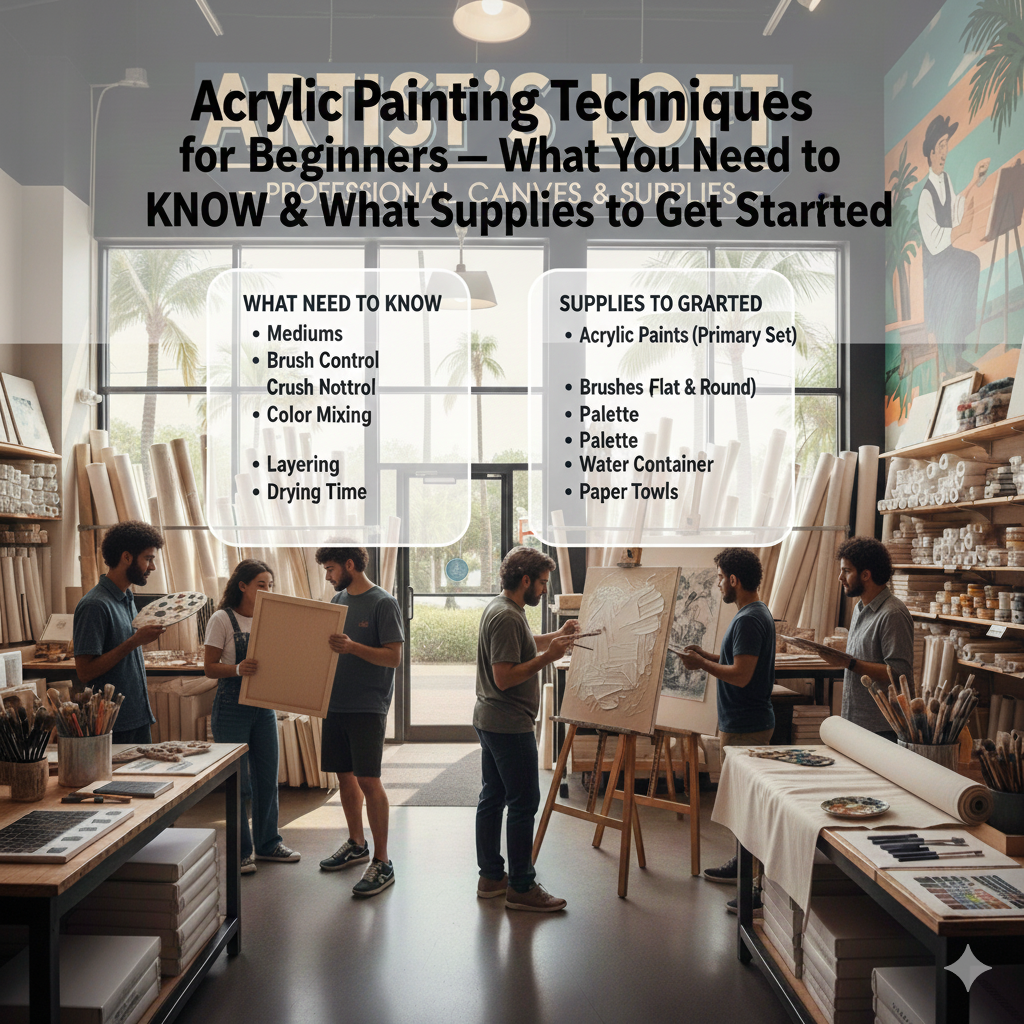
Acrylic Painting Techniques for Beginners – What You Need to KNOW & What Supplies to Get Started
Acrylic paint is one of the most versatile and forgiving mediums for beginners. It dries quickly, cleans up with water, and works on almost any surface. But walk into an art supply store, and the sheer variety of products can feel overwhelming. This guide will help you understand what you actually need to get started and what techniques you can explore as you grow.
There are so Many Kinds of Acrylic Paint
Not all acrylic paints are created equal, and understanding the differences will save you money and frustration.
Student Grade vs. Artist Grade: Student-grade paints are more affordable and contain less pigment, which means colors can look slightly washed out or chalky. Artist-grade paints have higher pigment concentration, offering richer colors and better mixing capabilities. As a beginner, student grade is perfectly fine to start with—brands like Liquitex Basics, Amsterdam, or Arteza offer excellent value.
Heavy Body vs. Soft Body: Heavy body acrylics have a thick, buttery consistency similar to oil paint and hold brush or palette knife marks beautifully. Soft body acrylics are more fluid and smooth, making them easier to blend. If you’re just starting out, heavy body paints give you more control and are great for learning texture techniques.
Craft Acrylics: These are the inexpensive paints you’ll find at craft stores. While they work for simple projects, they often lack the quality needed for serious painting. The pigments are weaker, and the binder quality is lower, which can lead to cracking or fading over time.
Start with a basic color palette: titanium white, mars black, cadmium red (or pyrrole red), ultramarine blue, cadmium yellow, and burnt umber. With these six colors, you can mix nearly any shade you need.
Essentials for Acrylic Painting with a Brush or Palette Knife
Paint
For your first purchases, invest in decent quality paint rather than buying dozens of cheap tubes. A set of 6-12 basic colors in student-grade heavy body acrylics will serve you better than 50 low-quality craft paints. Look for tubes rather than jars when possible—they keep paint fresher longer and allow for better portion control.
Brushes
You don’t need an expensive brush collection right away. Start with these basics:
- Flat brushes (sizes 4, 8, and 12): Great for broad strokes, filling in areas, and creating sharp edges
- Round brushes (sizes 2, 6, and 10): Perfect for details, lines, and versatile painting
- Filbert brushes (size 6 or 8): The rounded edge is excellent for blending
Synthetic brushes work wonderfully with acrylics and are more affordable than natural hair. Brands like Princeton, Royal & Langnickel, or even generic sets from art supply stores will work well. The key is cleaning them thoroughly after each session—dried acrylic will ruin brushes permanently.
Palette knives offer a completely different painting experience. These flexible metal tools create bold, textured strokes and are excellent for mixing paint. A basic trowel-shaped knife and an angled one will get you started with knife painting techniques.
Palette
Your palette is where you’ll mix colors, and you have several options:
- Disposable paper palettes: Convenient and mess-free, these tear-off sheets are perfect for beginners
- Plastic palettes: Reusable and easy to clean, though paint can dry quickly on them
- Stay-wet palettes: These use a sponge and special paper to keep paints workable for days—a game-changer for slower painters
- DIY options: A sheet of glass, a ceramic plate, or even freezer paper taped to cardboard all work in a pinch
Water Pot or Brush Washer
Keep two containers of water: one for initial rinsing and one for final cleaning. This keeps your colors cleaner. Look for brush washers with ridged bottoms that help remove paint from bristles, or simply use old jars or cups. Change your water frequently to avoid muddy colors.
Surfaces
Acrylics are wonderfully adaptable and adhere to many surfaces:
Canvas: The classic choice. Pre-stretched, pre-primed canvases are beginner-friendly and come in every size. Canvas panels (canvas glued to cardboard) are more affordable for practice.
Canvas paper or pads: Textured paper designed for acrylics—perfect for studies and experimenting without the cost of stretched canvas.
Wood panels: Smooth and sturdy, these create a different aesthetic. Make sure they’re sealed or primed first.
Watercolor paper: Use heavy weight (at least 140 lb) and prime it with gesso if you want texture, though many acrylic papers work straight out of the pad.
Unconventional surfaces: Fabric, rocks, terracotta pots, glass, metal—if you can prime it with gesso, you can probably paint on it.
Always check that surfaces labeled “multi-media” or “mixed media” specifically list acrylics as compatible.
Easel
While not essential, an easel helps you paint at eye level and step back to view your work. For beginners:
- Tabletop easels: Affordable and space-saving
- H-frame or A-frame easels: Sturdy floor-standing options that adjust for different canvas sizes
- Budget alternative: Lean your canvas against a stack of books on a table
Many beginners work flat on a table, which is perfectly fine, especially for smaller pieces.
Mediums
Acrylic mediums modify your paint’s properties and open up new creative possibilities. You don’t need these immediately, but they’re worth exploring as you progress:
Gesso: A primer that creates tooth (texture) for paint to grip. White gesso brightens colors underneath, while black or colored gesso can create moody undertones.
Matte or Gloss Medium: Extends paint without changing color, adjusts sheen, and can thin paint while maintaining adhesion.
Slow-Drying Medium (Retarder): Extends drying time for blending and detail work—especially helpful in dry climates or when working on larger pieces.
Texture Gels and Pastes: Create dimension and sculptural effects. Modeling paste can build up thick areas, while glass bead gel adds sparkle.
Flow Improver: Reduces surface tension, making paint flow more smoothly—particularly useful for detailed brushwork.
Start without mediums to learn how pure acrylics behave, then experiment with one at a time to understand their effects.
Essentials for All Acrylic Painting
Regardless of your specific technique, every acrylic painter needs:
Paper towels or rags: For wiping brushes, cleaning spills, and blotting excess paint
Spray bottle: A fine mist keeps paints on your palette from drying out during painting sessions
Apron or old clothes: Acrylic is permanent once dry, so protect your clothing
Palette knife (for mixing): Even if you’re not painting with knives, they’re essential for thorough color mixing
Painter’s tape: Creates clean edges and can mask off areas you want to keep paint-free
Gesso: For priming new surfaces or refreshing old canvases
A dedicated workspace: Even a corner of a table, covered with newspaper or a plastic tablecloth, gives you a consistent place to create
Spray Paints and Stenciling
Acrylic spray paints open up urban art techniques and allow you to cover large areas quickly.
Spray paints: Brands like Montana, Liquitex Spray Paint, or Krylon offer acrylic-based sprays in hundreds of colors. Always work in a well-ventilated area or outdoors, and use a respirator mask—not just a dust mask—to protect your lungs.
Stencils: Pre-made stencils or ones you cut yourself from acetate sheets or cardboard let you create crisp, repeatable patterns. Use low-tack painter’s tape to secure them, and apply paint with a sponge, brush, or spray in thin layers to prevent bleeding under edges.
Techniques: Layer stencils for complex images, use spray paint for gradients, or combine hand-painting with stenciled elements for mixed-media effects.
Marker Pens
Acrylic paint markers bridge the gap between painting and drawing, offering precision and portability.
Paint markers (like Posca, Molotow, or Artistro) contain liquid acrylic paint and work on almost any surface—canvas, wood, rocks, fabric, glass, and plastic. They’re perfect for:
- Adding fine details to paintings
- Lettering and calligraphy
- Rock painting and small crafts
- Outlining and defining edges
- Creating art without brushes or mess
Markers come in various tip sizes from extra fine to broad chisel tips. Shake them well before use and prime them by pressing the tip on scrap paper until paint flows. They dry quickly and permanently, offering coverage that regular markers can’t match.
Pour Painting
Pour painting (also called fluid art or acrylic pouring) has exploded in popularity for creating abstract, marbled effects.
What you need:
- Fluid acrylics or regular acrylics thinned with pouring medium
- Pouring medium: Floetrol (a paint additive) or dedicated acrylic pouring medium that thins paint to a honey-like consistency while maintaining adhesion
- Silicone oil (optional): Creates cells and interesting patterns
- Cups for mixing: One for each color
- Canvas or panel: Sealed surfaces work best
- Something to elevate your canvas: Plastic cups or a wire rack so excess paint can drip off
Basic technique: Mix each paint color with pouring medium to the right consistency (it should flow easily but not be watery). Layer colors in a cup, then flip it onto your canvas or pour in patterns. Tilt the canvas to spread paint, and use a torch or heat gun to pop bubbles and create cells.
Pour painting is messy and uses a lot of paint, so protect your workspace thoroughly with plastic sheeting.
Keeping Surfaces Clean
Acrylic’s fast-drying nature means mistakes become permanent quickly, but there are ways to keep your work and workspace tidy:
On your palette: Scrape wet paint off immediately, or let it dry completely and peel it off plastic palettes. For stay-wet palettes, change the paper when colors get muddy.
On brushes: Rinse constantly while painting. If paint starts to dry in the ferrule (metal part), it will splay bristles and ruin the brush. At the end of each session, wash brushes with soap and warm water, reshape the bristles, and let them dry flat or bristle-up.
On surfaces: If paint gets where you don’t want it while still wet, wipe it immediately with a damp cloth. Once dry, you can carefully scrape it with a blade or paint over it. For porous surfaces, prevention (using tape or careful application) is better than correction.
On clothes and furniture: Act fast. Run cold water through fabric from the back to push paint out, then wash with soap. Once acrylic dries, it’s nearly impossible to remove from fabric.
Varnish
Varnishing is the final step that protects your finished painting and unifies its appearance.
Why varnish?: It creates a protective layer against dust, UV light, and minor scratches. It also evens out the surface sheen—acrylics naturally dry with uneven glossiness where some areas look matte and others shiny.
Types:
- Gloss varnish: Enhances color vibrancy and creates a shiny finish
- Matte varnish: Reduces glare and creates a flat, non-reflective surface
- Satin varnish: A balanced middle ground between gloss and matte
Application: Wait at least two weeks for your painting to cure completely before varnishing. Work in a dust-free environment, apply thin coats with a wide, soft brush in one direction, and let dry completely between coats. Two to three thin coats work better than one thick coat.
Removable vs. permanent: Some varnishes are removable with specific solvents, allowing for future restoration. Permanent varnishes, once applied, become part of the painting. For beginners, permanent varnishes from brands like Liquitex or Golden are easier to apply and sufficient for most needs.
Getting started with acrylics doesn’t require a massive investment. Begin with basic paints, a few good brushes, surfaces to paint on, and the curiosity to experiment. As you discover which techniques excite you—whether that’s traditional brushwork, palette knife painting, pouring, or mixed media—you can gradually add specialized supplies. The beauty of acrylics is their versatility: they’ll grow with you as your skills and artistic voice develop.