Abstract Expressionism
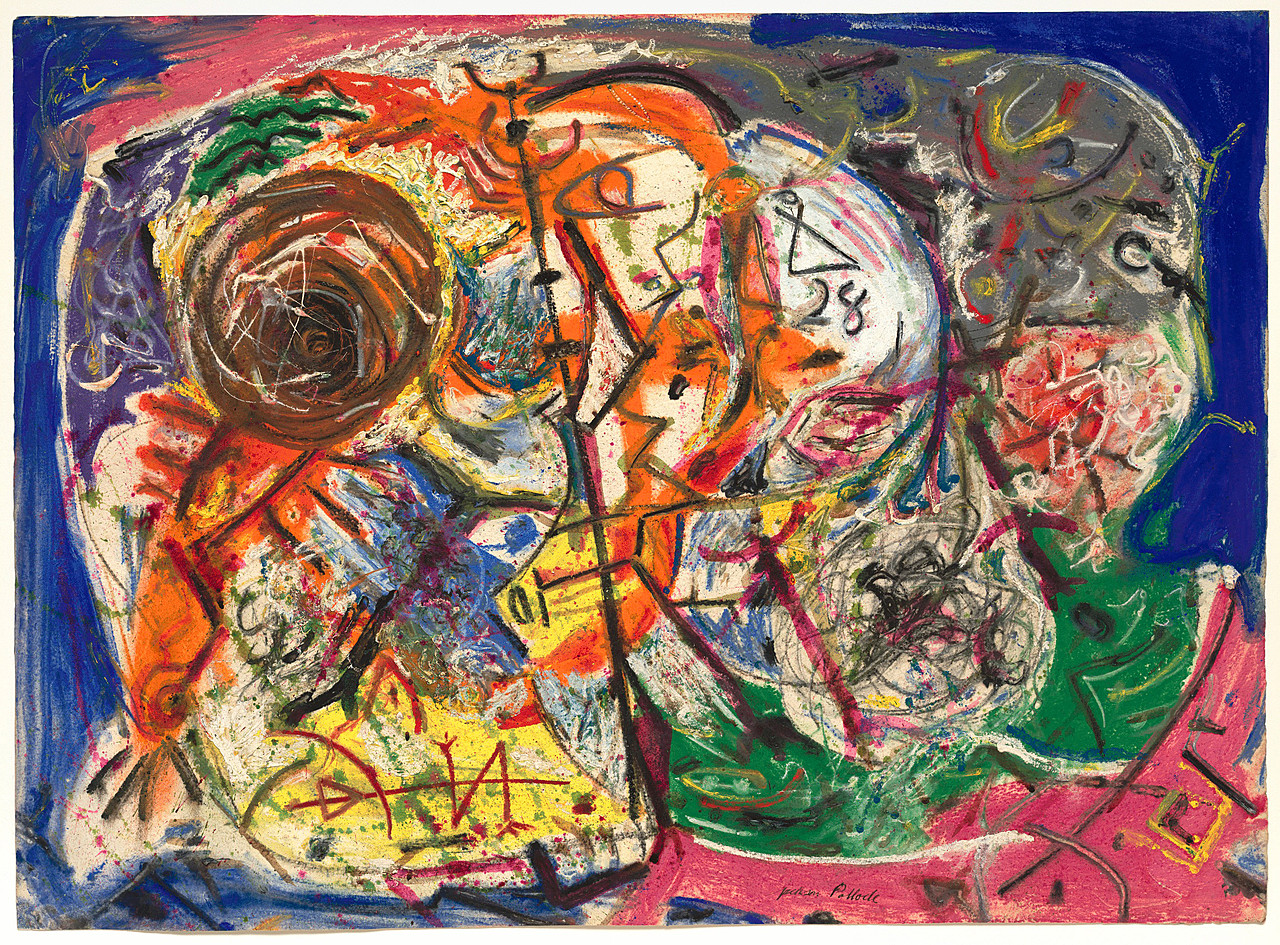
Alongside geometrical abstraction, an approach to abstraction gained in importance that focused on the direct expression of a spontaneous emotion. A gestural painting style with an uncontrolled flow of the paint is characteristic of artists such as Jackson Pollock and Sam Francis. This style of painting became known as Abstract Expressionism in the United States, while various terms were employed in Europe, for example Informalism and Tachisme. As different as the works by artists like Ernst Wilhelm Nay, Karl Otto Götz, Karl Fred Dahmen, Karel Appel, and Asger Jorn are, they share the striving for a means of artistic expression that directs its gaze to the origins.
This form of abstraction rejected the calculated and rational in favor of the intuitive, emotional, and unconscious. The canvas became a field of action—a place where the internal state of the artist could be externalized in dynamic gestures, vigorous brushstrokes, or chance effects of dripping and pouring paint. The artwork was no longer a representation of an object or idea but the record of an encounter—a performance between artist and medium.
Abstract Expressionism marked a pivotal shift in the postwar art world. In the United States, particularly in New York, it signaled the emergence of a new cultural center of modern art, displacing Paris. Artists such as Mark Rothko, Willem de Kooning, Franz Kline, and Helen Frankenthaler expanded the movement’s language, incorporating color fields, mythic symbolism, and large-scale formats that immersed viewers in pure sensation.
In Europe, artists engaged with similar concerns through their own contexts—grappling with the trauma of war, the breakdown of traditional values, and the search for a renewed human expression. The result was a transatlantic dialogue that, while diverse in technique and philosophy, collectively affirmed the expressive potential of abstraction as a response to the complexities of the modern condition.
At its core, Abstract Expressionism is not merely a style, but an attitude: one that embraces risk, affirms individual freedom, and privileges the raw gesture as a direct conduit to the human psyche.
Abstract Expressionism Artists
First Generation (New York School – 1940s-1950s)
Action Painters
- Jackson Pollock (1912-1956) – Drip paintings, all-over composition
- Willem de Kooning (1904-1997) – Gestural abstraction, “Women” series
- Franz Kline (1910-1962) – Bold black and white brushstrokes
- Lee Krasner (1908-1984) – Dynamic compositions, Pollock’s wife and artist in her own right
- Joan Mitchell (1925-1992) – Lyrical, landscape-inspired abstractions
- Norman Lewis (1909-1979) – One of few African American Abstract Expressionists
- Grace Hartigan (1922-2008) – Figurative-abstract hybrid works
- Elaine de Kooning (1918-1989) – Gestural portraits and abstractions
- Helen Frankenthaler (1928-2011) – Soak-stain technique, Color Field pioneer
Color Field Painters
- Mark Rothko (1903-1970) – Luminous color rectangles, emotional depth
- Barnett Newman (1905-1970) – “Zip” paintings, vertical bands of color
- Clyfford Still (1904-1980) – Jagged vertical forms, intense color
- Ad Reinhardt (1913-1967) – Minimalist approach, black paintings
- Robert Motherwell (1915-1991) – “Elegy to the Spanish Republic” series
Other Key Figures
- Arshile Gorky (1904-1948) – Bridge between Surrealism and Abstract Expressionism
- Hans Hofmann (1880-1966) – Teacher and theorist, “push and pull” technique
- Philip Guston (1913-1980) – Started abstract, later moved to figurative
- David Smith (1906-1965) – Sculptor, abstract metal constructions
- Richard Diebenkorn (1922-1993) – Moved between figuration and abstraction
Second Generation (1950s-1960s)
- Sam Francis (1923-1994) – Bright, splattered color fields
- Cy Twombly (1928-2011) – Graffiti-like scribbles and marks
- Morris Louis (1912-1962) – Stained color paintings
- Kenneth Noland (1924-2010) – Geometric Color Field works
- Jules Olitski (1922-2007) – Spray-painted color fields
- Al Held (1928-2005) – Hard-edge geometric abstractions
- Joan Brown (1938-1990) – Thick impasto, figurative elements
- Michael Goldberg (1924-2007) – Energetic gestural abstractions
Women Abstract Expressionists (Often Overlooked)
- Hedda Sterne (1910-2011)
- Perle Fine (1905-1988)
- Judith Godwin (1930-2021)
- Deborah Remington (1930-2010)
- Mercedes Matter (1913-2001)
- Ethel Schwabacher (1903-1984)
International Abstract Expressionism
European
- Pierre Soulages (1919-2022) – French, black paintings
- Georges Mathieu (1921-2012) – French, lyrical abstraction
- Karel Appel (1921-2006) – Dutch, CoBrA movement
- Antoni Tàpies (1923-2012) – Spanish, matter painting
- Jean-Paul Riopelle (1923-2002) – Canadian, mosaic-like abstractions
Asian
- Kazuo Shiraga (1924-2008) – Japanese Gutai movement, foot painting
- Sadamasa Motonaga (1922-2011) – Japanese Gutai member
- Tsuyoshi Maekawa (1936-2022) – Japanese Gutai artist
- Zao Wou-Ki (1920-2013) – Chinese-French, lyrical abstraction
Latin American
- Wifredo Lam (1902-1982) – Cuban, surrealist-abstract hybrid
- Rufino Tamayo (1899-1991) – Mexican, color-focused abstraction
Lesser-Known but Important Figures
- Jack Tworkov (1900-1982)
- James Brooks (1906-1992)
- Conrad Marca-Relli (1913-2000)
- Esteban Vicente (1903-2001)
- John Ferren (1905-1970)
- Herbert Ferber (1906-1991) – Sculptor
- Seymour Lipton (1903-1986) – Sculptor
- Theodore Roszak (1907-1981) – Sculptor
This list represents the major figures and movements within Abstract Expressionism, though the movement was rich with many more artists who contributed to its development and legacy.