Master Weavers Lead a Fiber Art Revival in Southwest Florida
Local artisans are weaving cultural heritage and reviving time-honored techniques for a new generation of collectors in Naples, Fort Myers and beyond.
by Emma Witmer
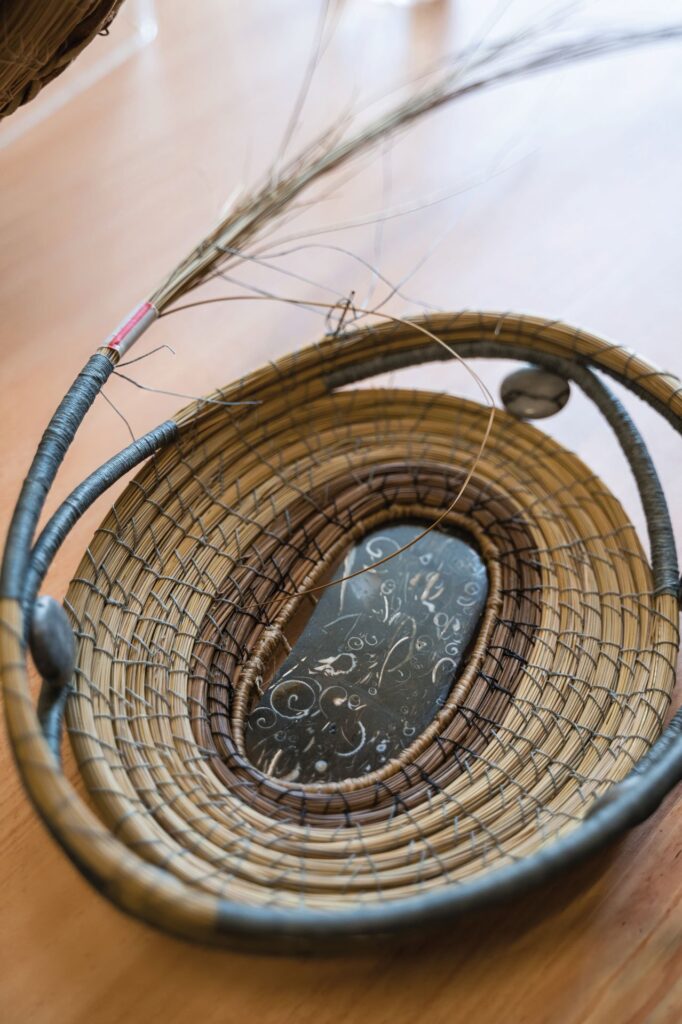
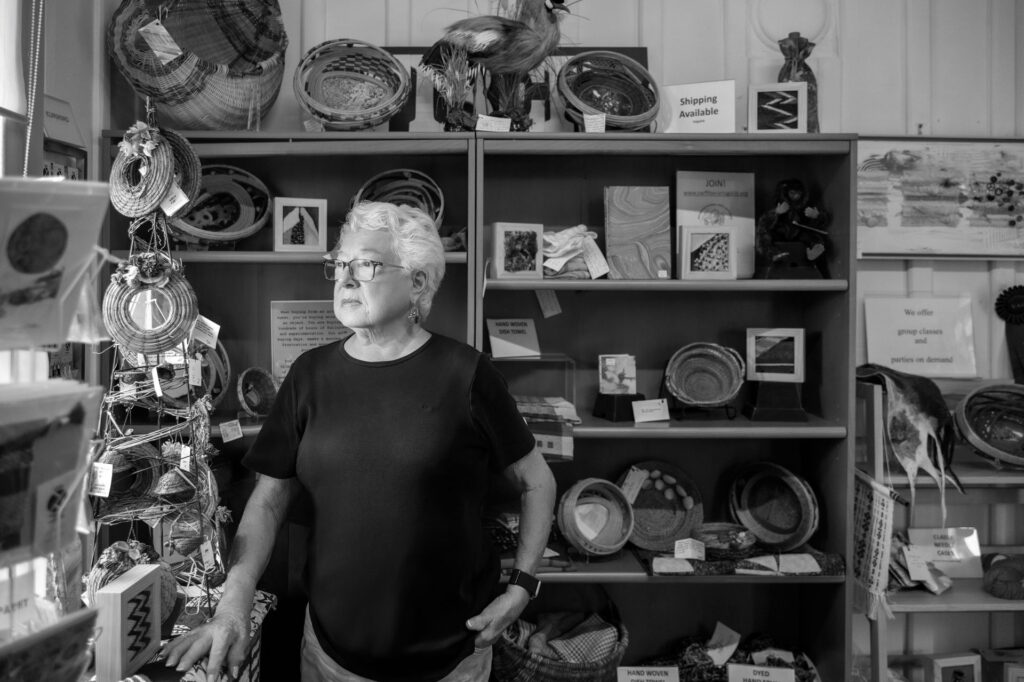
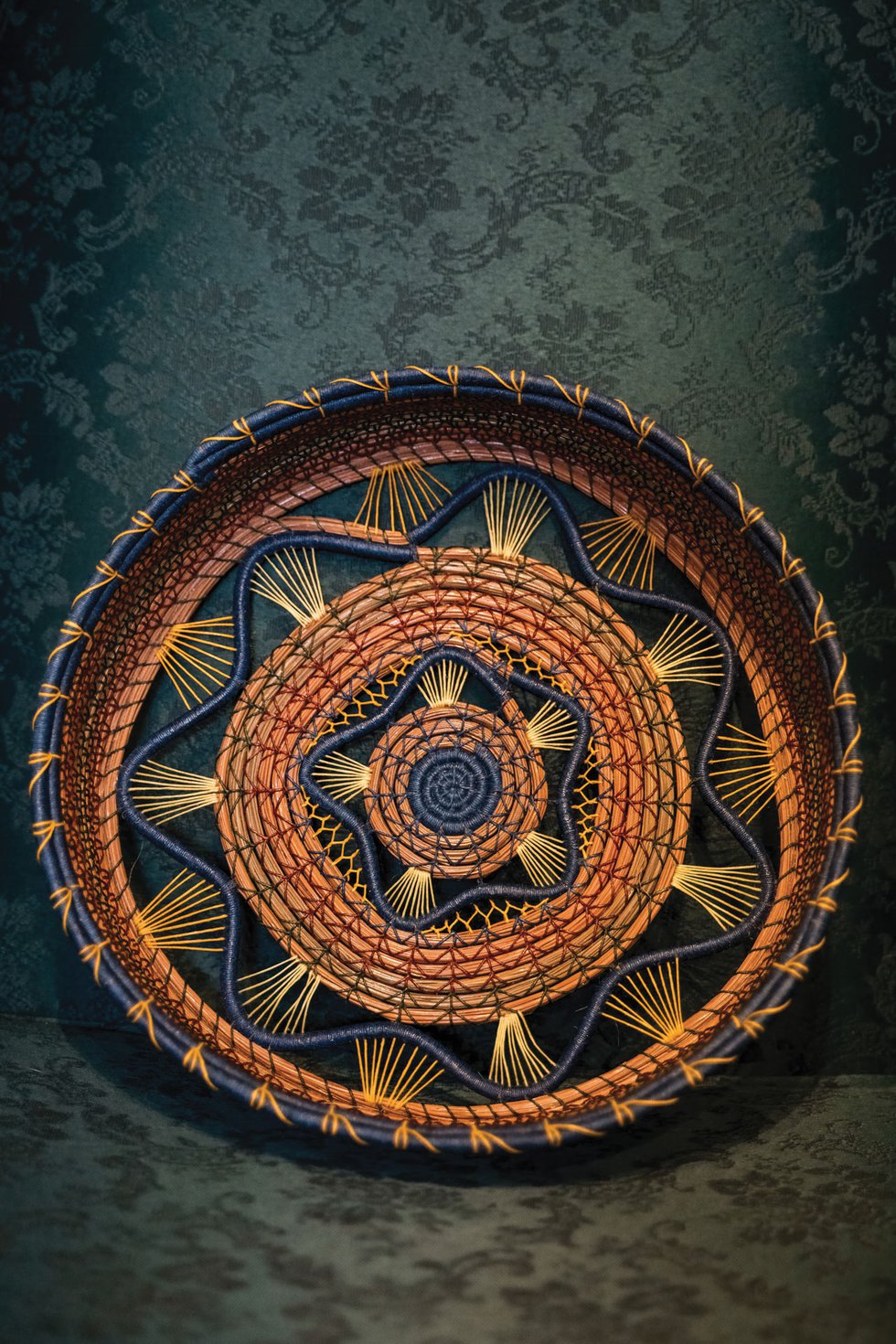
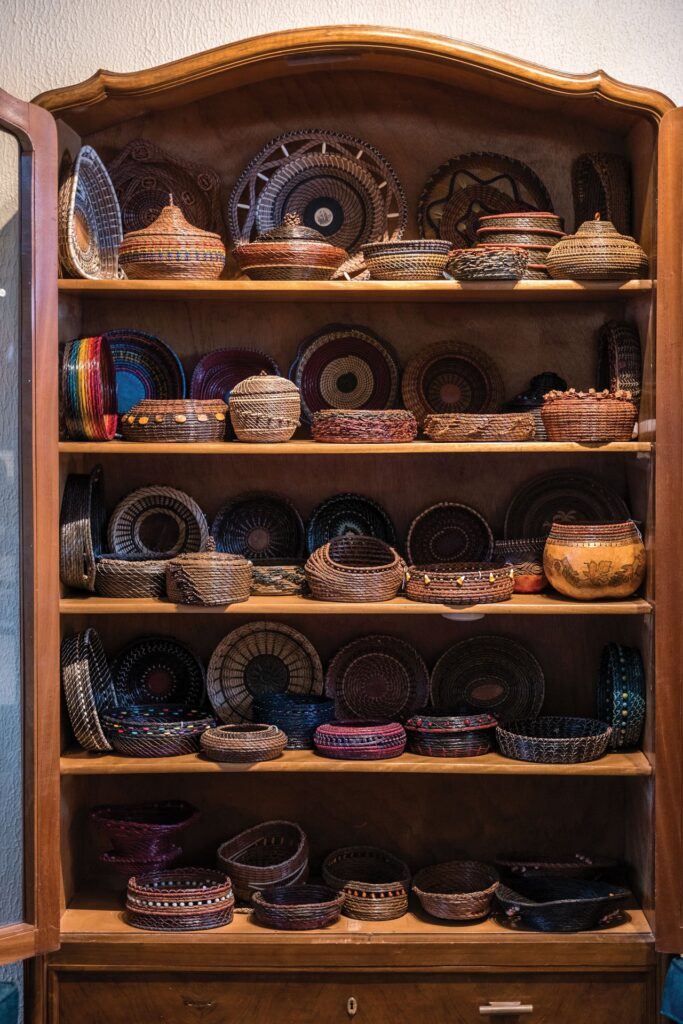
askets line the walls of Punta Gorda’s one-year-old Southwest Florida Fiber Arts Guild. Some have amethyst bottoms; others are woven with beads. Simple, handwritten tags hang from undulating lines of coiled pine needles and muhly grass, denoting the artful vessels’ price, title and materials.
Despite the evident artistry, there’s no signature. But a peek around the corner reveals the sculptural vessels’ maker, a petite woman with a stoic focus and shock of white hair. There, guild vice president Kathryn Erickson muscles walnut staves into a frame for bundled coils and a central fossilized shell. The 80-year-old has been practicing the art of basketry for more than 20 years, but the circular design at hand is only her second wall hanging. “I don’t know how big it’s going to get,” she says matter-of-factly. “I work on them until they tell me, ‘I’m done.’”
In Southwest Florida, a quiet class of basketry artists practices the craft on living room couches, in guilds and clubs, during downtime at their day jobs, and at markets and fairs. The most skilled local weavers hold years of experience, inventing techniques, stitches and patterns to craft impossibly complex sculptures beautiful enough for display, yet functional enough to carry home a garden harvest. Their creations take days, if not months, to complete, from foraging and processing materials to coiling and stitching.
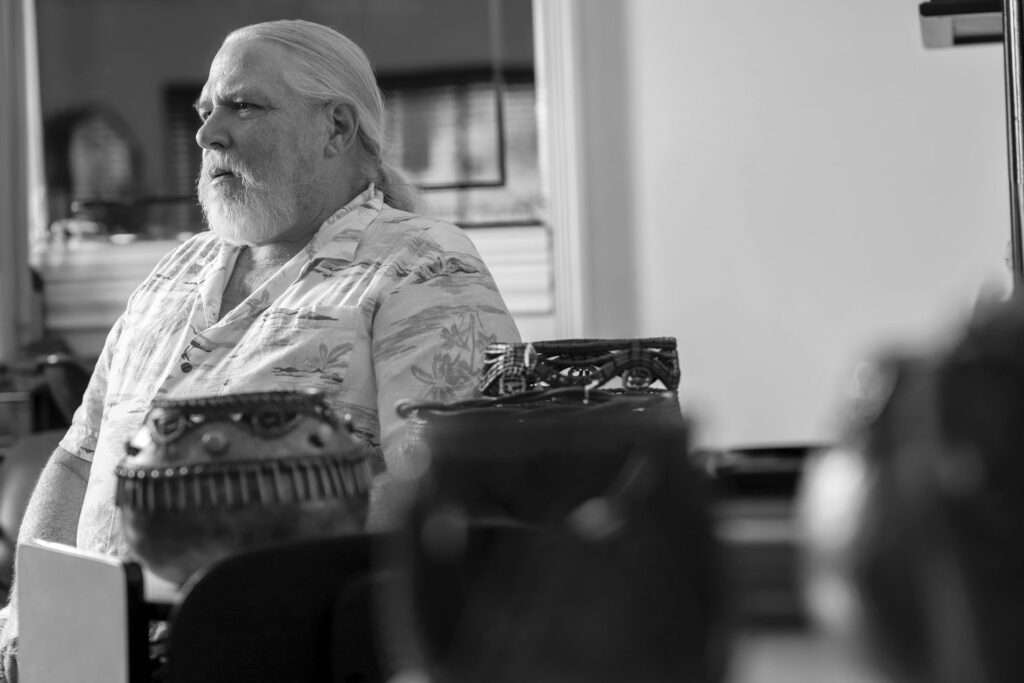
Bonita Springs pine needle coiler Tom Firth melds traditional and unexpected materials, like mismatched jewelry and dried gourds.
Still, until recent years, the art world saw basketry—and fiber arts more broadly—as little more than a hobbyist enterprise, better suited to clubs and craft fairs than gallery exhibitions and museum displays. Years ago, Kathryn and her cohorts had to lobby local arts centers for fiber arts programming and fight for their place among exhibits dominated by paintings. “It’s a craft. That’s a nasty word,” she says with a sarcastic glint. That attitude seems to be changing. Over the last decade, American art hubs like Los Angeles and New York City have embraced fiber arts, coaxing smaller arts agencies to broaden their programming. Some point to the COVID-19 pandemic as the catalyst for the rise in craft arts. Others take a broader view, crediting the reclamation of stereotypical ‘women’s work’ that emerged as part of the second wave of feminism.
Regardless of the genesis of the genre’s popularity boom, the catalyst of individual creation rings true—somewhere along the line, a woman with knotted hands paved the way. She would speak in family recipe terms, explaining the art, not the science: Use a thread about this thick to connect your bundles; soak the reeds until they look right.
Nancy Weeks—known for her 15-year-old Woven Wonders stall filled with colorful, New England-style baskets at Third Street Farmers Market—learned first from a long line of family fiber artists who introduced her to the art of weaving, then from a Cape Cod teacher who applied the technique to basketry. “I think it was passed down for generations,” she says. Sanibel coiler and instructor at BIG ARTS, Gisela Damandl, was taught by a longtime Pennsylvania basketeer more than 40 years ago. Now, she devours books on modern basketry and travels the country visiting shows for inspiration—explorations that have led her to experiment with media like imported seagrass.
For Bonita Springs-based pine needle coiler Tom Firth, mentorship came from a woman he never actually met. A hairstylist of more than five decades, Tom started tinkering with pine needle baskets about seven years ago when he saw a friend’s creations. “She invited me to join the Brookdale Basketeers,” he says. “It was a group started here a long time ago by an old woman in Bonita, and I unfortunately started seeing them about four months after this woman had died at nearly 100 years old.” Though the two never met, he pored over interviews and memories shared about the club’s matriarch, and in turn, the club poured back into him—not as formal teachers, but as models of what was possible.
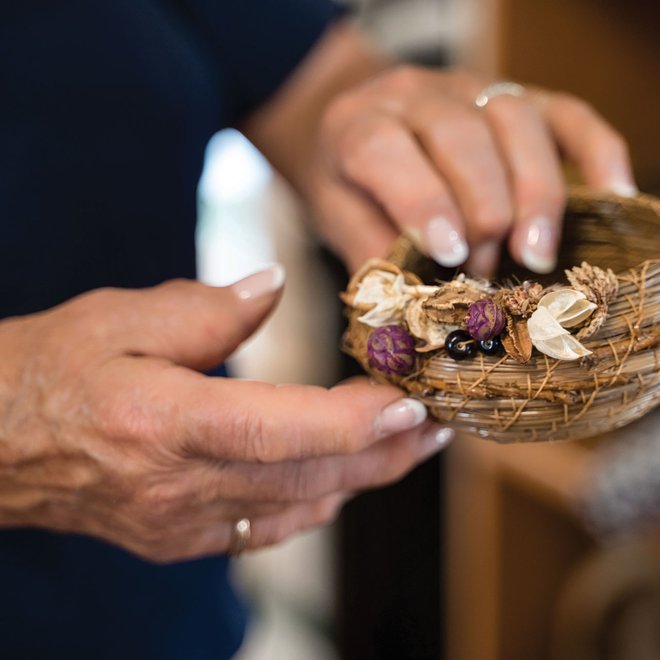
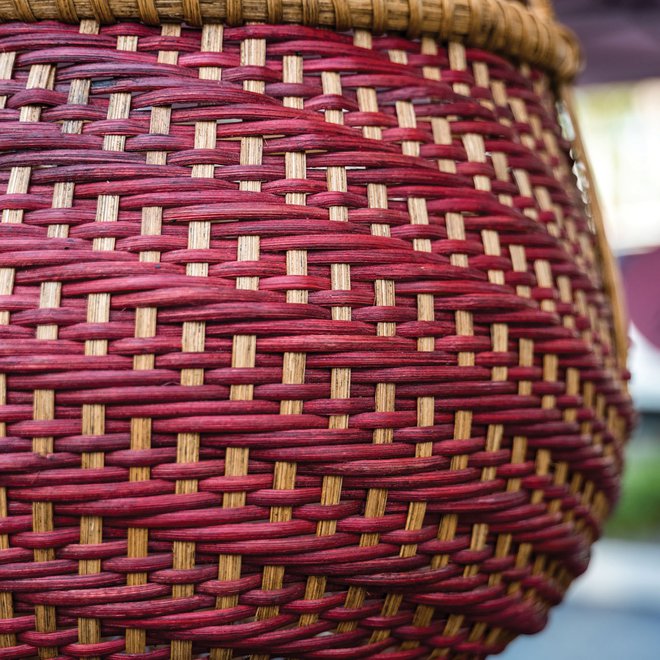
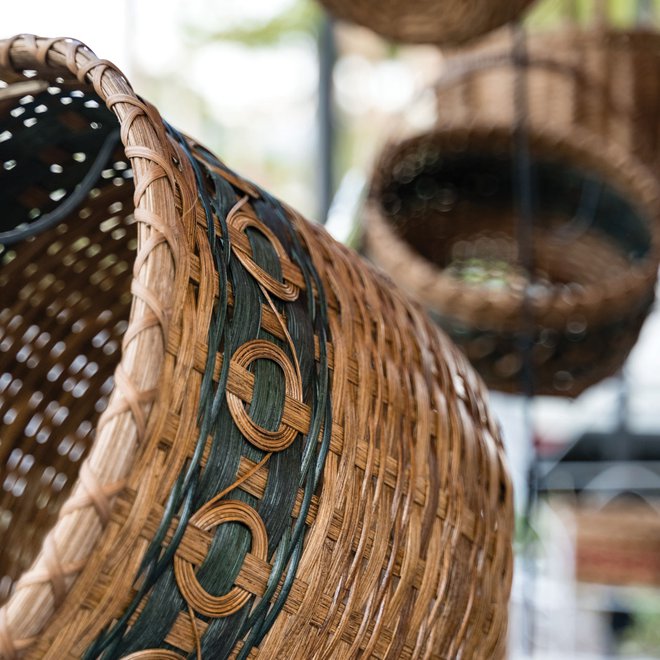
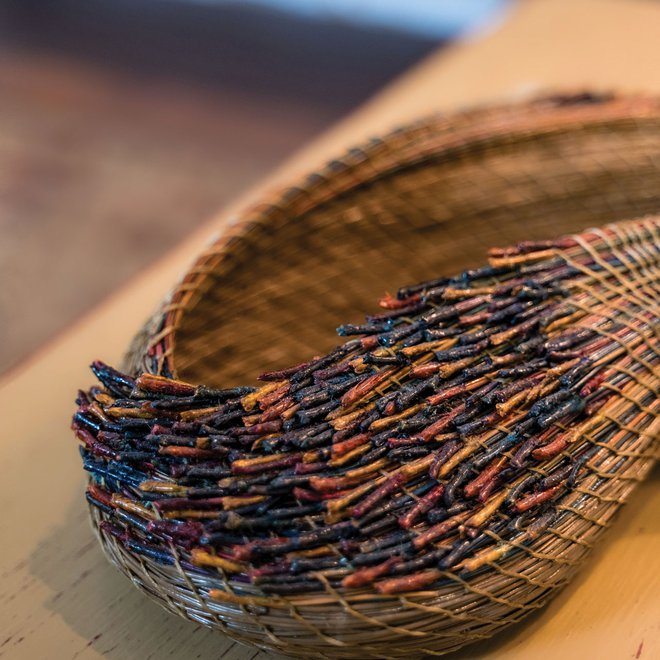
As Tom learned the pine needle coiling technique—a process of bundling the slender fibers and stitching them together in an ascending circular pattern—he began to experiment with a wider range of materials. Dyed needles, walnut slices and antique brooches sourced from his travels through the United Kingdom make regular appearances, as do dried gourds, which form the base of some of his most avant-garde vessels. In one, thick bundles of rich, amber needles seem to defy gravity, weaving in and out of three large holes in the gourd’s sides. In others, alcohol-based ink creates a splotchy, watercolor-like finish on gourds with yawning openings flourished by rippling coils.
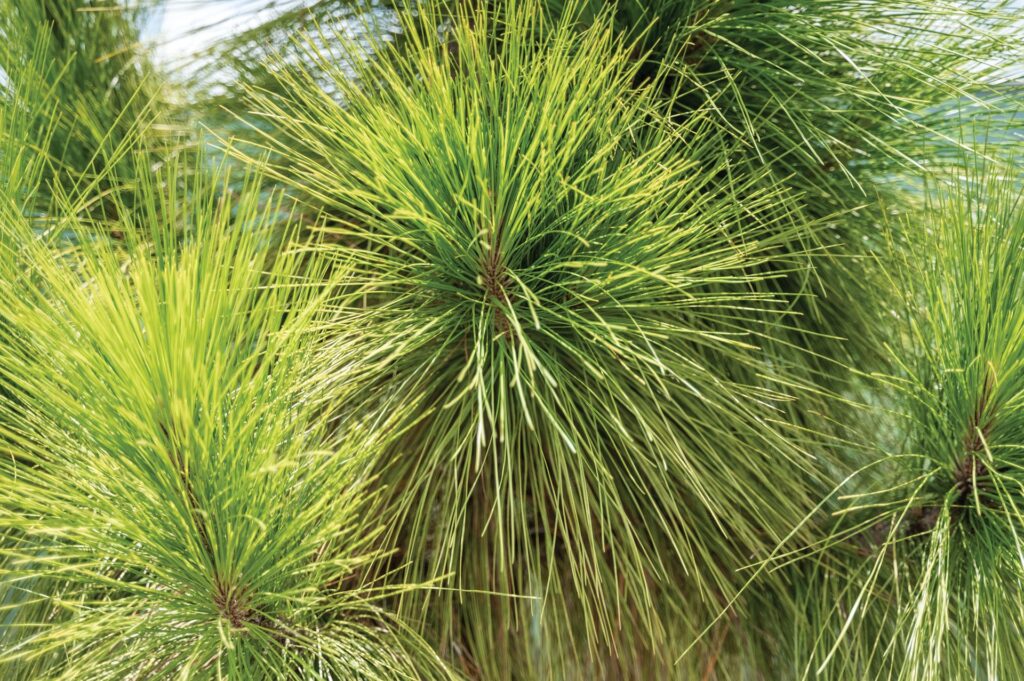
Like Kathryn, who keeps a muhly grass patch in her front yard and scours parks for fibers from queen palms, and Gisela, Tom forages the majority of his materials. “I wait until somebody clears a lot or a storm knocks down a branch,” he says. “You grab the whole side of the branch and pull against the grain and pull off 200 needles at one time.” Once gathered, needles must be dried (if used green, they’ll shrink as they dry, loosening the coils and compromising the basket’s structure). “If you dry them in the dark, they dry a lighter color—that takes about a month. If you let them dry on the ground in the sun, they get that pine needle color that’s kind of an orangey brown.”
From drying onward, the consistency among Tom, Gisela and Kathryn’s approaches begins to fade. Tom never soaks his needles (a process used to prevent breakage while bending coils) and only dampens his needles for the most precarious curves. Gisela soaks overnight, but only uses the wetted needles for her first three rows of coiling. For dyeing, Tom simmers his needles in an electric turkey roaster with a touch of glycerin for sheen. “To heck with the glycerin,” Kathryn says. “I tell my students to soak them for 10 minutes with fabric softener—just dampen them.”
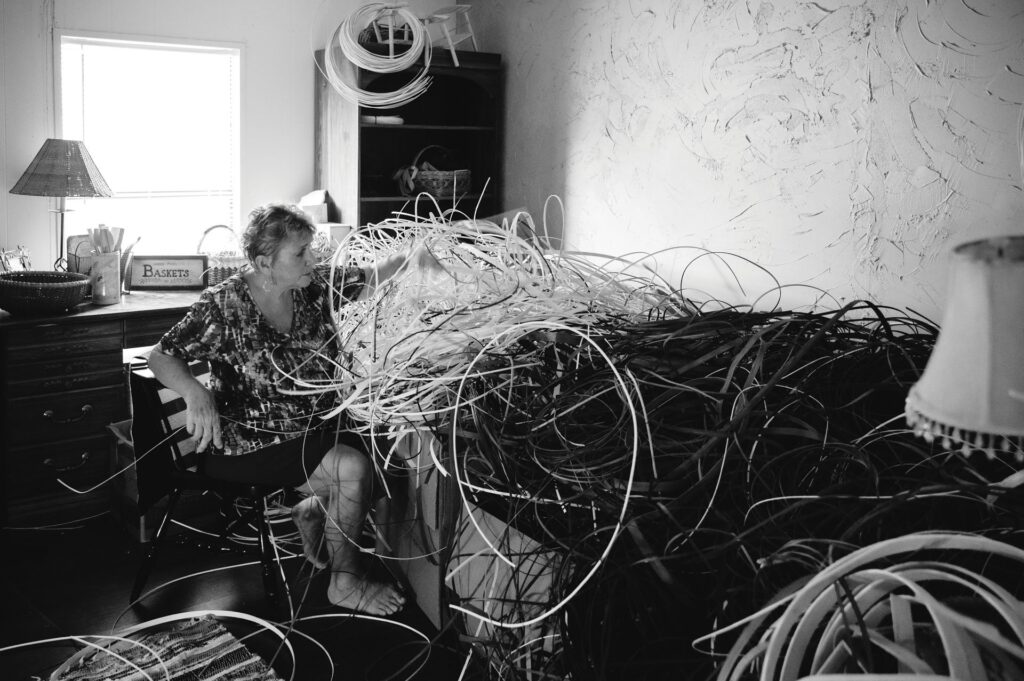
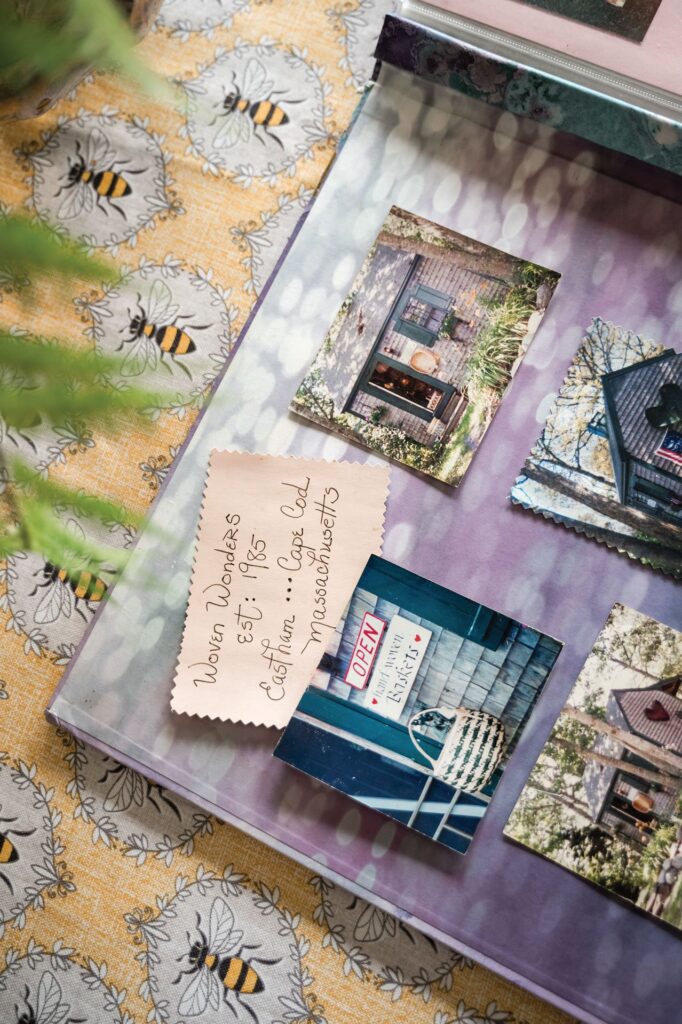
Nancy takes a different approach altogether. Rather than following the region’s dominant coiling technique, the 71-year-old Neapolitan weaves imported oak reeds one over the other. Home-dyed reeds (“I cook them on the stove and make a mess,” she says with a laugh.) fold into intricate patterns—some taught, others adapted through years of trial and error. “At the end, I write my name and date with a burning tube on the bottom. I blowtorch the hairs off [the reeds] and stain them with Minwax, either natural or golden oak,” she says. Her creations range from simple Easter baskets—like those made for her children and grandchildren—to complex, leather-bound backpacks and vessels with swirling handles muscled together over weeks of work.
“There have been a few where I’ve gotten frustrated and thrown across the room and went back to later,” she says. After 40 years making baskets, those frustrations still happen, but only when she pushes herself to try something new. A recent commissioned project—a woven staircase rail at Naples’ Patina Collection—tested her mettle, but the results are eye-catching. For Nancy, it was just one more way to shine a light on the craftsmanship created locally and often overlooked.
Like Tom at the Bonita Springs Farmers Market, Nancy weaves baskets live at her stall. “I do it because they need to know who’s making the baskets. Sometimes I’m weaving, and they still ask,” she says, chuckling. “Each of my baskets is a work of art made by me and only me.”