Daniel Minter: To Be Aware – Interview with
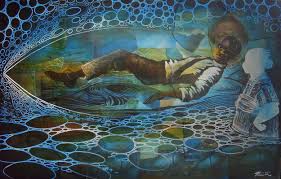
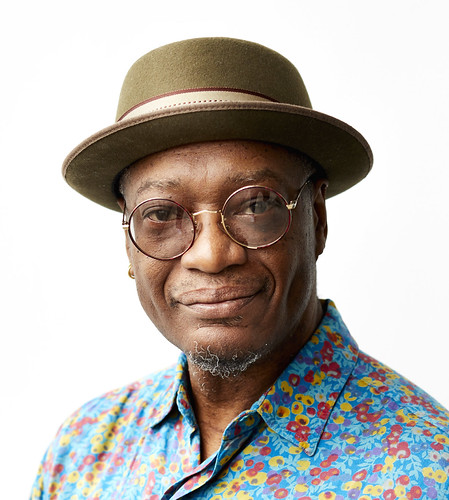
Daniel Minter is an acclaimed artist known for his work in painting and assemblage. His practice consistently engages themes of displacement and diaspora, the ordinary and extraordinary dimensions of Black life, spirituality within the Afro-Atlantic world, and the ongoing construction of meaning around the idea of home.
Minter has exhibited extensively at major institutions, including the Portland Museum of Art, Seattle Art Museum, Tacoma Art Museum, Bates College Museum of Art, the Center for Maine Contemporary Art, Bowdoin College Art Museum, and the Northwest African American Art Museum, among many others. He is the recipient of the prestigious Joyce Award and the Caldecott Medal (both in 2021). In addition, Minter has illustrated more than fifteen children’s books, many of them award-winning, including titles that received the Coretta Scott King Illustration Honor. He was also commissioned in 2004 and 2011 to design Kwanzaa stamps for the U.S. Postal Service.
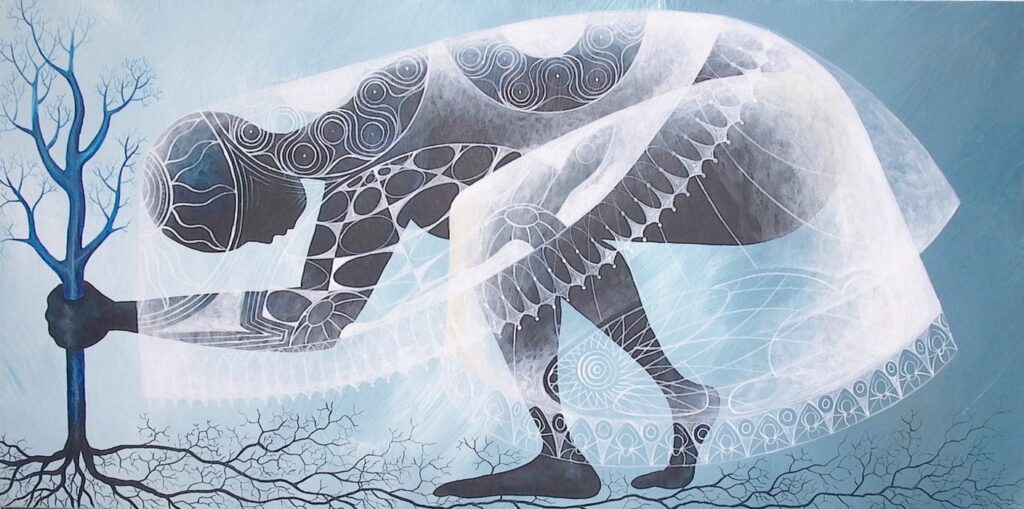
For over fifteen years, Minter has worked to raise awareness of the forced removal in 1912 of an interracial community on Malaga Island, Maine. His research-based and community-engaged work on the subject emerged through sustained collaboration with descendants, archaeologists, anthropologists, and scholars. This dedication played a pivotal role in the island’s designation as a public preserve.
Minter is the co-founder of Indigo Arts Alliance in Portland, Maine, a nonprofit organization dedicated to cultivating the artistic development of people of African descent. To date, the organization has hosted more than twenty-eight Black and Brown artists from around the world.
Born in Georgia, Daniel Minter is based in Portland, Maine. He is a graduate of the Art Institute of Atlanta and holds an Honorary Doctorate of Arts from Maine College of Art & Design.
Please consider supporting this project with a monthly contribution at https://www.lightsoutgallery.org/donate
Transcript
Intro
The way I feel when I’m working—that’s a good question. I need to think about that before I really answer it. If I want to answer it truthfully, I could make something up, but if you want a true answer, I need to think about it. Because when I’m working, I’m not so concerned about how I’m feeling. It’s almost as though I’m simply trying to be a good conduit.
I know that when I’m not a good conduit, I feel frustration. But when I am being a good conduit, I’m not exactly sure how to describe what I feel. What I really want to channel is my ancestors.
I really want to speak for them, or I want them to know that I know of their existence. I want them to know that they have projected into the future, their being.
Projecting Into the Future
I try to do that in my work. I don’t know whether it happens or not, and I don’t know what that looks like in reality. I only know how I imagine it, and I try to incorporate something of that into almost everything that I do.
Hopefully, by the time I’m done with my work—and when I say done, I mean when I join the ancestors—I will have contributed something that is older than I am, and something that can project into the future.
The Ancestors
We see multiple worlds at once. African Americans see multiple worlds simultaneously. Everything we look at, we see more than one layer. It’s key to our survival to be aware of that. That is one of the reasons I always make that stare, that seeing, to denote that all is seen.
I don’t really think of them as portraits. They are people who are familiar, but some of them are actual ancestors.
Zora Neale Hurston
The one over there in the green hat is Zora Neale Hurston. Her writing was about the people in her community, the people around her, and she expanded that community to include the African diaspora.
She went to school to study anthropology in order to learn more about her people, because in anthropological studies we were routinely ignored and belittled. We were only viewed within the realms of eugenics, and anthropology was often used to support those ideas.
She wanted to study the culture that we practiced and lived by. She was not really respected as an anthropologist. She died very poor. Her papers and works were almost discarded, and many of them were.
But she had a huge impact on people who came a generation after her. Alice Walker was influenced by her. Toni Morrison’s work was influenced by Zora Neale Hurston. But she never got to see any of that.
I want her to know that her work was impactful on me, that her work made a difference in my life, in the way I view the world, the way I view the people around me, my community, and the value I place on it.
That piece of Zora functions as a work about ancestors, but they are not portraits. Even though it looks like her, it’s not a portrait.
Art
I started doing artwork before I started school. I drew and made things. I always knew that this was a huge part of the way I connected to the world and understood it. I’ve always felt that this was my most effective way of communicating.
I grew up in south Georgia, in a very small town. People had an appreciation that this was what I did, and that was part of how they knew who I was—through the things I made. People in that community always knew that about me, and I’ve always appreciated that.
I went from drawing with charcoal from the fireplace to drawing in the dirt outside. I didn’t see those things as very different. What mattered was making the mark. The only reason I’m not doing that is if something is keeping me from it. Otherwise, I’m always drawing, carving, making something, or thinking about it.
Process and Observation
The things I gravitate toward most are the things I don’t recognize at first, or things that surprise me. When I walk through the woods, the shapes of certain branches attract me. Even a particular sound may attract me.
I enjoy that simple novelty—a shape that can be multiple things, a shape that needs context to be understood. A shape can change with the addition of other objects or ideas.
You need the power of another word to activate the first word. You need modifiers and adjectives to add clarity and emphasis. There is an abundance of material everywhere you go. All you have to do is walk outside. There are branches, trees, dirt—there is always material to work with.
What is not plentiful is time.
Advice to news artists
When the work is being shown, I have to stop working and get it up there. That changes things, because people coming to see it have certain expectations of the work and of me. I have to prepare. I have to stop the growth of the work while it’s being exhibited.
I’ve been doing this since before I started school. I don’t attribute the way I think about art to school. I attribute it to the way I grew up and to my community. That’s where this way of thinking came from.
Going to school didn’t change it. I didn’t lose it.
My advice to a young artist might sound dated, but I believe that any young person who wants to be an artist has to spend time with people outside their age group if they want to learn how to interpret the world around them.
Those people are always there. If you ignore them, your view of the world will be flawed. If you can’t communicate with them, your communication will be flawed. I feel lucky that I had people in my life from different generations. They helped me understand what I want to do with my artwork.
Source: Lightsoutgallery.org & Danielminter.net
Lights Out Gallery
“We are young, passionate, feet-on-the-ground dreamers, inviting creative spirits and angelic muses to guide us so Maine may always be the artiest, most lovable place in America. Amen.”
Founded in 2019 by friends and collaborators Reed Stone McLean, Daniel Sipe, and Karlë Woods, Lights Out Gallery has worked tirelessly to promote art in Maine. Incorporated as a 501c3 nonprofit in 2021, the organization’s mission centers on expanding what is possible in Maine as a contemporary arts destination in conversation with regional, national, and international arts. Lights Out has pursued its mission through the work of documenting and exhibiting the work of Maine artists, and by building a rural community arts center that is rapidly becoming a regional hub for art and artists.
✷ 10 Tannery Street, Norway, ME 04268
✷ [email protected]
✷ 207.227.0159