Jacob Lawrence: Chronicler of the Great Migration and the Black American Experience
Jacob Lawrence stands as one of the most significant American artists of the twentieth century, a painter whose dynamic compositions and bold use of color transformed the visual narrative of Black American life. Born in 1917 in Atlantic City, New Jersey, Lawrence came of age during the Harlem Renaissance’s waning years, yet his artistic vision would extend far beyond that movement’s parameters, creating a body of work that documented struggle, perseverance, and the ongoing quest for dignity and justice in American society.
Lawrence’s artistic education began in the vibrant cultural environment of Harlem, where he studied at the Harlem Art Workshop under the guidance of Charles Alston. This formative period exposed him to the intellectual and creative ferment of Black cultural production, where artists, writers, and thinkers were actively engaged in defining and celebrating Black identity. Unlike many of his contemporaries who traveled to Europe to study classical techniques, Lawrence remained rooted in the American experience, developing a distinctive visual language that drew from multiple sources: the flat, decorative patterns of folk art, the bold colors of Mexican muralists, and the geometric abstractions of modernism.
What distinguished Lawrence most profoundly was his commitment to narrative painting at a moment when abstraction dominated the American art world. While Abstract Expressionism captured critical attention in the 1940s and 1950s, Lawrence insisted on figuration and storytelling, believing that art should communicate directly with viewers about matters of social and historical consequence. This was not a rejection of modernism but rather a synthesis—Lawrence employed modernist techniques in service of representational storytelling, creating works that were simultaneously formally innovative and deeply accessible.
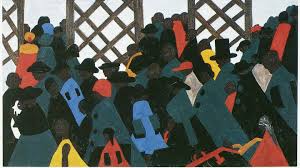
The Migration Series, completed in 1941 when Lawrence was just twenty-three years old, represents his most celebrated achievement and one of the masterworks of American art. This series of sixty tempera paintings chronicles the Great Migration, the mass movement of African Americans from the rural South to the industrial North between 1916 and 1970. Lawrence’s approach to this monumental subject reveals his genius: rather than attempting epic scale or photographic realism, he distilled each moment into essential forms and gestures. His figures are angular and simplified, his compositions spare yet dynamic, his palette restricted yet extraordinarily expressive.
The paintings in the Migration Series function both as individual works and as chapters in a larger narrative. Lawrence understood intuitively that migration was not a single event but a process—a series of decisions, departures, journeys, and arrivals, each laden with hope and hardship. In panel after panel, he depicted crowds at train stations, families in transit, workers in factories, and communities forming in new urban spaces. The series does not romanticize its subject; Lawrence included images of race riots, inadequate housing, and continued discrimination in the North, presenting migration as a complex phenomenon driven by both aspiration and desperation.
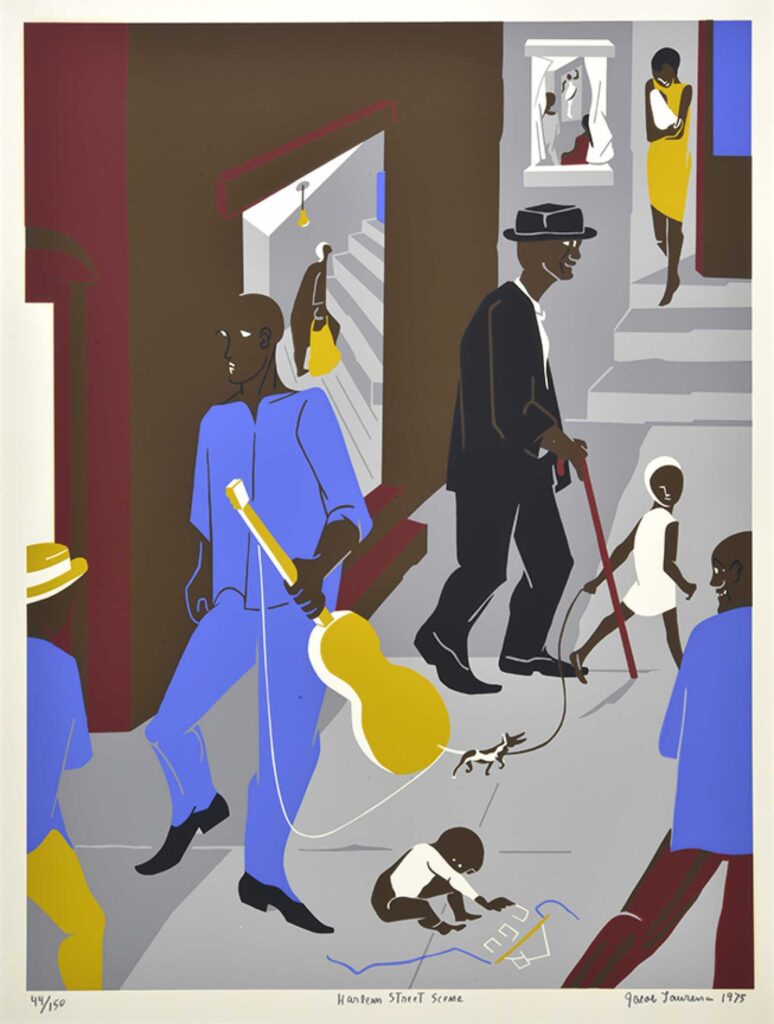
Lawrence’s technique in the Migration Series and throughout his career demonstrates remarkable discipline and intentionality. He worked with tempera paint, a medium that dries quickly and produces flat, matte surfaces. This choice reinforced the graphic quality of his compositions and allowed him to build up layers of color with precision. His palette, often dominated by browns, ochres, reds, and blues, evoked both the earthiness of Southern landscapes and the industrial grays of Northern cities. The limited color range created visual unity across works while allowing for surprising chromatic variations.
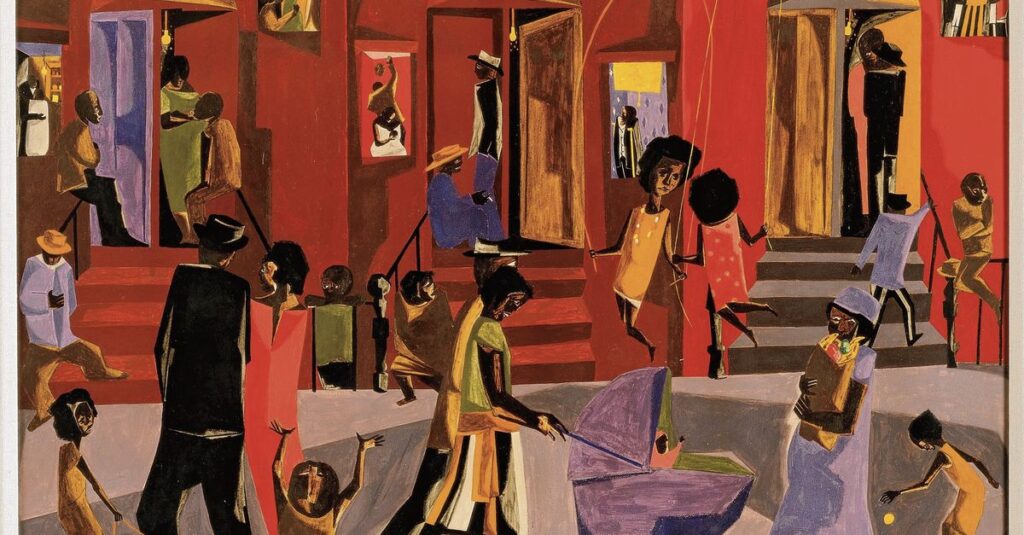
The compositional strategies Lawrence employed reveal his sophisticated understanding of pictorial space. He frequently used high viewpoints, flattened perspectives, and rhythmic repetition of forms to create visual tension and movement. Diagonal lines suggest dynamism and instability, while vertical and horizontal elements provide structure and stability. Empty spaces in his compositions carry as much weight as filled ones, creating a sense of isolation or absence that speaks to themes of displacement and loss.
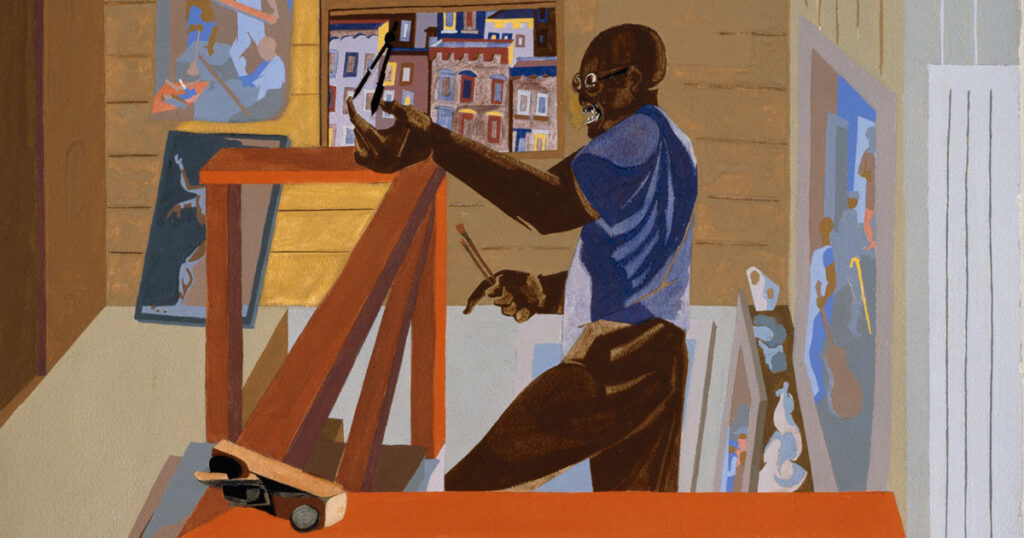
Beyond the Migration Series, Lawrence continued to explore African American history and contemporary life through several other narrative sequences. The War Series, created during his service in the Coast Guard during World War II, documented the experiences of Black servicemen. The Struggle series, begun in the 1950s, examined defining moments in American history from the perspective of those fighting for freedom and equality. His later work included depictions of builders, craftsmen, and workers, celebrating the dignity of labor and the creativity inherent in manual work.
Lawrence’s commitment to education and community engagement distinguished him from many artists of his generation. He taught at numerous institutions, including the New School for Social Research, Pratt Institute, and the University of Washington, where he spent the final decades of his career. He believed that art should be accessible and that artists had a responsibility to share their knowledge and skills. This pedagogical impulse reflected his own gratitude for the mentorship he received in Harlem and his conviction that artistic talent flourished in supportive communities.
The question of how to situate Lawrence within art historical categories has occupied critics and scholars for decades. Some have emphasized his connection to Social Realism and the politically engaged art of the 1930s, while others have highlighted his formal innovations and alignment with modernist aesthetics. Lawrence himself resisted easy categorization, insisting that his work was simply about the American experience. Yet this apparent modesty conceals a radical claim: that Black American life was not a marginal subject but a central chapter in the nation’s story, and that depicting this life with honesty and beauty was an act of historical documentation and cultural affirmation.
Lawrence’s influence on subsequent generations of African American artists cannot be overstated. He demonstrated that one could be simultaneously modern and engaged with community, formally sophisticated and narratively direct, deeply rooted in Black cultural traditions and part of broader American artistic conversations. Artists as diverse as Romare Bearden, Faith Ringgold, Kerry James Marshall, and Kehinde Wiley have acknowledged their debt to Lawrence’s example, even as they have pursued their own distinctive visions.
What makes Lawrence’s work endure beyond its historical moment is its fundamental humanity. His paintings never reduce individuals to types or symbols; even in their stylized forms, his figures retain dignity, agency, and particularity. He understood that history was made not by abstract forces alone but by individual choices and collective action. The men and women in his paintings are striving, working, moving, hoping—always in motion, always engaged in the difficult work of survival and self-determination.
Jacob Lawrence’s career spanned more than six decades, concluding with his death in 2000. Throughout this long and productive life, he remained remarkably consistent in his artistic vision while continuing to grow and experiment. His work has been celebrated in major museums and acquired by prestigious collections, yet it has also reached broad public audiences through reproductions, textbooks, and public murals. This dual achievement—critical recognition and popular accessibility—fulfilled Lawrence’s belief that art should speak across boundaries of class, education, and background.
In assessing Lawrence’s legacy, we must recognize that he fundamentally altered how American art engages with history and identity. He proved that paintings could be both beautiful and instructive, that modernist form could enhance rather than obscure narrative content, and that the Black American experience was a subject worthy of sustained artistic attention and formal innovation. His work challenges the false dichotomy between aesthetics and politics, demonstrating that serious engagement with social realities can produce art of enduring formal power.
Jacob Lawrence painted what he knew and what mattered to him, trusting that specificity would lead to universality. In chronicling the journeys, struggles, and aspirations of Black Americans, he created a visual record that speaks to anyone who has experienced displacement, sought opportunity, or fought for justice. His art reminds us that history is not a settled account but an ongoing story, and that the work of understanding our past remains essential to imagining our future. In this sense, Lawrence’s paintings are not merely historical documents but living testaments to resilience, creativity, and the enduring power of the human spirit.