Raquel Munera. The Children of the Homeland
By Milagros Bello, PHD
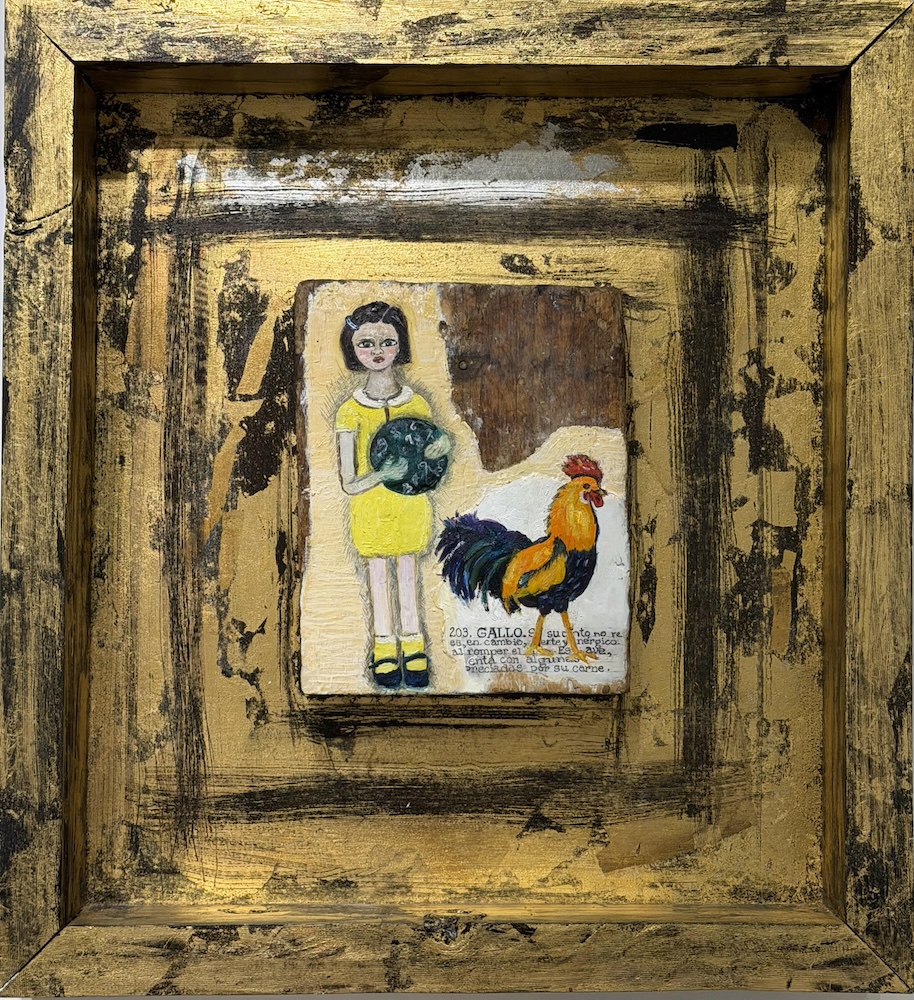
Raquel Múnera’s work unfolds as a territory of suspended memory in which childhood ceases to function as a site of innocence and instead emerges as a zone of historical, affective, and symbolic friction. Her scenes, deliberately frontal and stripped of anecdote, operate as images arrested in time—resembling pedagogical plates salvaged from school archives or votive prints preserved as relics. Their apparent formal simplicity—close to a naïve or primitive aesthetic—does not signal candor but rather a strategy of reduction. By emptying the image of narrative and simplifying gesture, Múnera intensifies the conceptual weight of each figure, allowing the composition to operate as a form of critical condensation.
The child figures that populate these works appear rigid and hieratic, devoid of emotional theatricality. Their direct gazes and static postures generate a sense of estrangement that disrupts any sentimental reading. These are not psychological portraits but iconic presences of inscription where pedagogy, natural history, ecological loss, and cultural displacement intersect. Childhood thus becomes an archival device, a site where the taxonomic remnants of progress, science, and modernity are preserved and exposed, indexes that have been classified, domesticated, or extinguished.
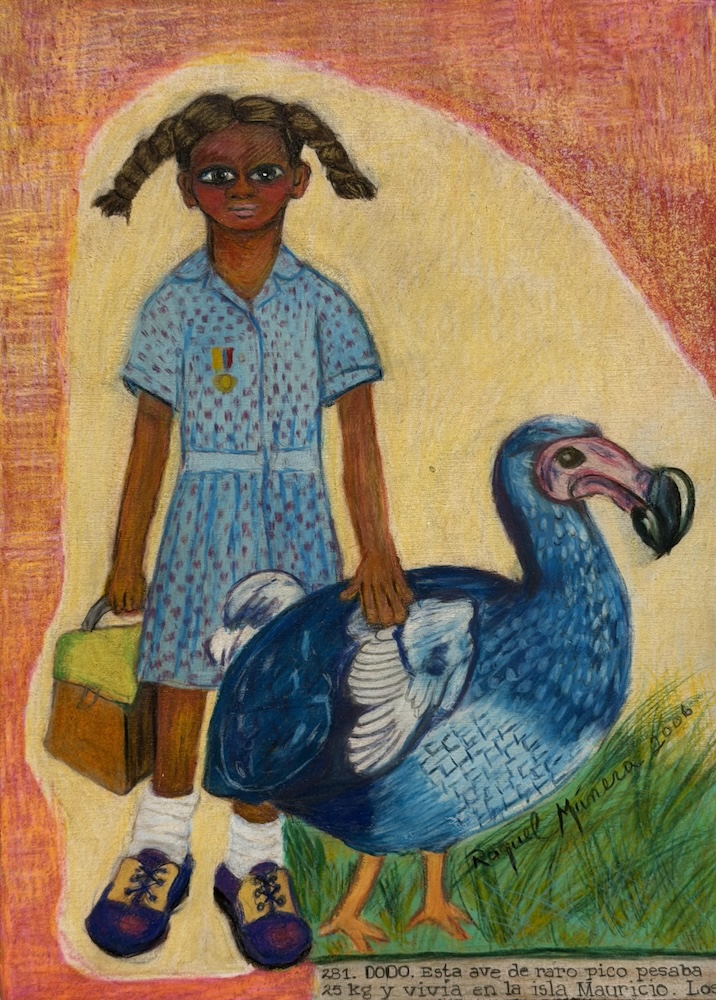
Across the works, the relationship between the girl and the animals is central. Birds associated with domestic imaginaries coexist within symbolic equivalences that link vulnerability and disappearance. The animal functions as a historical allegory rather than as a narrative accompaniment. What prevails is a quiet coexistence through which internal memory and the reconstruction of childhood are subtly reactivated.
Objects associated with knowledge—globes, textual fragments, encyclopedic references, suitcases, school insignia—reinforce the taxonomic systems that organize and inventory the world. These elements evoke cartographies of knowledge and educational dispositifs that promise order while simultaneously containing experience. The image frequently assumes the logic of the vitrine or the museum relic, where memory is encapsulated and preserved as a specimen.
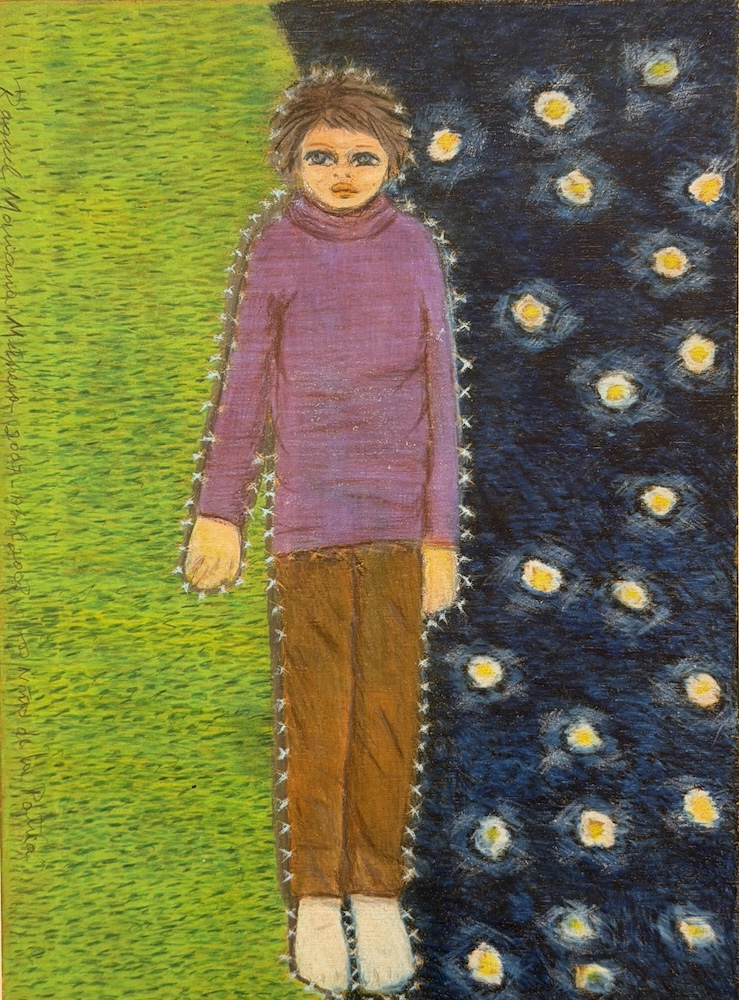
Formally, Múnera employs flat backgrounds, radical chromatic divisions, and abrupt cuts across the pictorial field that fracture any illusion of continuity. These contrasting surfaces—organic fields of color set against dark or cosmic planes—place the body in a state of perceptual suspension, opening an ontological questioning of the image itself. The subject does not inhabit space but appears suspended within it, held in an atemporal hieratic stillness.
Múnera ultimately articulates a poetics of the remnant and of dislocation. Her images function as resonant fields where the intimate and the political overlap silently. Childhood, animals, and pedagogical objects become vestiges of larger ecological, colonial, and cultural systems that have left enduring marks on collective memory. Each work presents a quietude charged with internal vibration—an apparently stable scene through which one nonetheless senses the subtle tremor of what has been displaced, forgotten, or extinguished.
Within this tension between formal candor and symbolic density, the artist offers a subtle yet incisive reflection on the fragility of life, the construction of knowledge, and the ways in which history becomes sedimented within bodies.
Milagros Bello, PhD
Curator
January 2026