
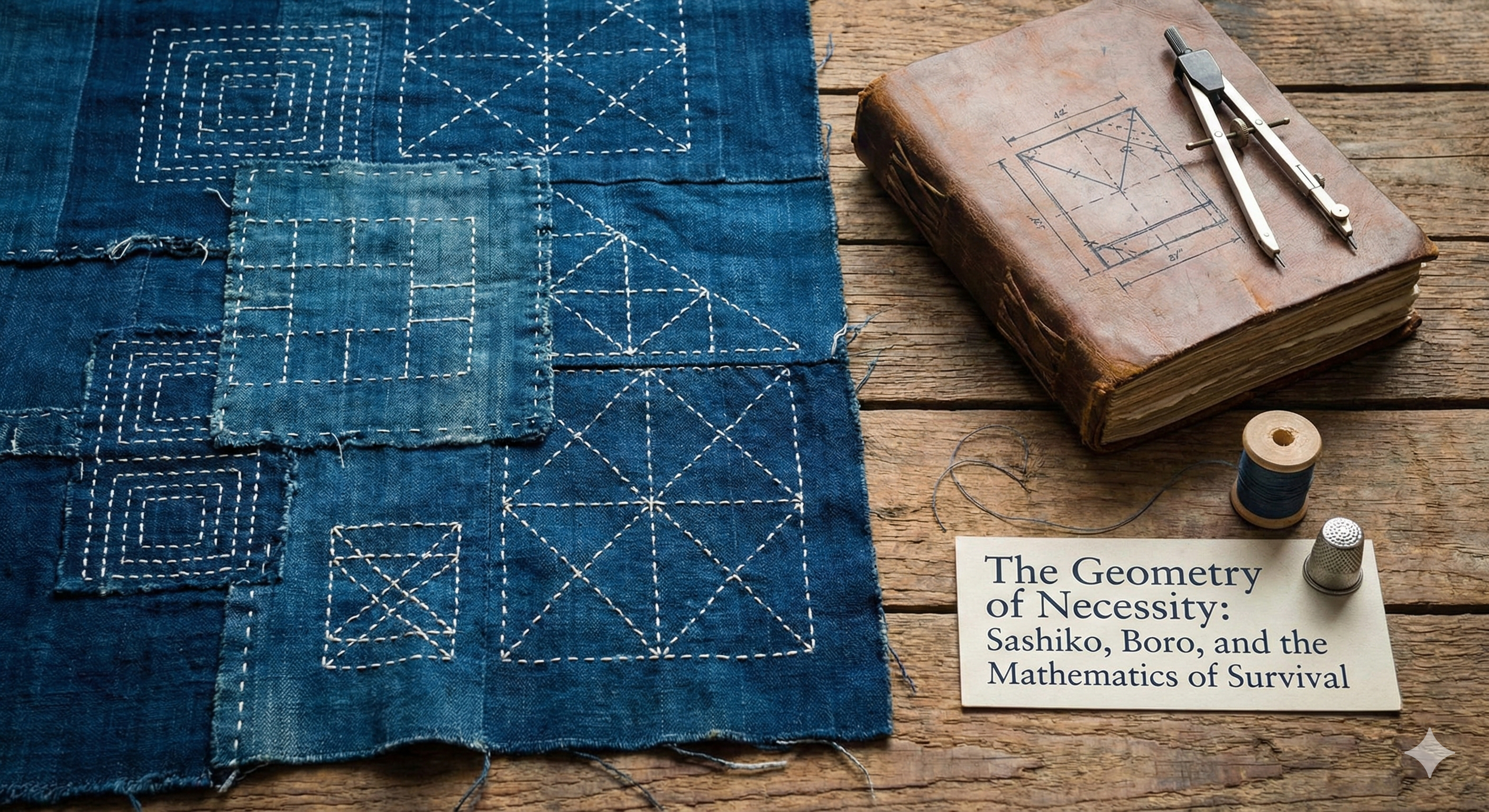
The Geometry of Necessity: Sashiko, Boro, and the Mathematics of Survival
I. The Little Stab That Became a Philosophy
“Little stab.” “Little pierce.”
This is how the Japanese named their most elemental stitch—sashiko. Not “embroidery,” not “decoration,” not even “reinforcement.” Just the honest description of a needle entering fabric. Stab. Pierce. Repeat.
If Impressionism taught us to see light as it truly appears—broken, shimmering, composed of a thousand subtle gradations—then sashiko teaches us to see labor as it truly exists: one small gesture, accumulated into meaning.
Consider the Impressionist brushstroke. Monet’s water lilies are not smooth illusions but visible accumulations—dab after dab of paint, each stroke discrete, each contributing to a whole that exceeds the sum of its parts. The painting shows how it was made. The process remains visible in the product.
Sashiko operates by identical principle. Each stitch is visible. Each “little stab” declares itself. The running stitch—the most elementary needlework technique—becomes, through repetition and intention, a grammar of survival.
White thread on indigo. The simplest contrast. The clearest signal. Here is where the needle entered. Here is where human attention intervened between cold and warmth, between whole and broken, between useless and essential.
II. The Radical Honesty of Pattern
In Western decorative traditions, ornament often conceals structure. Baroque embellishment hides the wall beneath. Rococo flourishes disguise the chair’s joinery. Beauty as camouflage.
Sashiko inverts this relationship. Pattern reveals function.
The geometric designs of sashiko—seigaiha (ocean waves), asanoha (hemp leaf), shippo (seven treasures), bishamon (armor pattern)—are not applied decoration. They are structural necessity made elegant.
When you reinforce fabric with running stitches, you create lines. When you need to reinforce fabric in multiple directions—to distribute stress, to prevent tearing along grain lines, to hold layers together—you create grids. Diagonal reinforcement creates diamonds. Radiating reinforcement creates stars.
The patterns of sashiko are the mathematics of durability.
Asanoha, the hemp leaf pattern, is composed of triangles radiating from hexagonal centers. This is not merely pretty—it’s engineering. The hexagonal structure distributes tension evenly across the fabric, the same principle that makes honeycomb architecture supremely efficient. Hemp fiber itself is among the strongest natural textiles. The pattern named after hemp performs like hemp.
Bishamon, named after the god of warriors, resembles interlocking armor scales. Again: not metaphor, but mechanics. Each diagonal line intersects with others, creating a mesh that cannot be pulled apart from any single direction. The fabric becomes, quite literally, armored.
Where Western art criticism might ask, “What does this pattern symbolize?”—sashiko answers: “It symbolizes nothing. It functions.”
And yet, precisely because it functions so honestly, it becomes beautiful. This is the aesthetic principle that Impressionism gestured toward but never fully articulated: beauty as the visible evidence of attention.
III. Boro: The Fabric That Remembers
If sashiko is the stitch, boro is what happens when stitching becomes biography.
“Boroboro”—tattered, ragged, worn to shreds. From this word of collapse comes boro, the fabric of resurrection.
Here is how boro happens:
A garment tears. You patch it with scrap fabric—perhaps from a garment that wore out earlier, perhaps from a different garment entirely. You stitch the patch in place with sashiko. The garment continues its life.
Another section wears thin. Another patch. More stitching.
Years pass. The patches themselves develop holes. You patch the patches. You stitch over old stitching.
Decades pass. The original fabric is barely visible. What you wear now is a sedimentary geology of repairs, each layer marking a different moment of decision: This is still worth saving.
Boro is time made visible.
IV. The Mathematics of Scarcity
To understand boro, you must understand the economy that created it.
In pre-industrial Japan, particularly in the rural north, cotton was precious. Indigo-dyed cotton was an investment representing months of labor: growing or acquiring the cotton, spinning thread, weaving fabric, cultivating indigo plants, extracting dye, dyeing the cloth through repeated immersions.
A single garment might represent a year’s surplus resources.
Under such conditions, disposal is not an option. Replacement is not an option. There is only continuation—the extension of utility through whatever means available.
This is where geometry enters as salvation.
You cannot create new fabric, but you can reorganize existing fabric. Scraps too small to be useful individually can be joined into useful wholes. The sashiko stitching that joins them doesn’t just hold pieces together—it creates a new structure, a meta-fabric whose strength comes not from unbroken material but from the multiplication of connections.
Think of it as network theory before networks had a theory. Each stitch is a node. Each intersection of threads is a connection. The more connections, the more redundancy. The more redundancy, the greater the resilience. Even as individual threads break, the network persists.
Boro is distributed systems architecture performed with needle and thread.
V. The Aesthetic of Accumulation
Monet painted the same haystack twenty-five times, capturing how light transformed it across seasons and hours. Each painting was discrete, but together they formed something new: a meta-work about the nature of seeing itself, about how the “same” subject is never the same.
Boro performs this principle in textile form.
Each repair session is an intervention—a moment when the wearer (or the wearer’s family) assessed damage and responded. The fabric becomes a record of these interventions. You can read it chronologically if you understand the archaeology:
- Deepest layers: earliest repairs, often most carefully matched to original fabric
- Middle layers: expedient repairs, using whatever was available, patches growing larger as desperation increased
- Upper layers: repairs to repairs, stitching over stitching, no longer attempting to match anything, only to continue
This is not deterioration. This is elaboration.
The visual complexity of a mature boro textile far exceeds what any single designer could plan. It has the organic intricacy of a Pollock drip painting, but where Pollock’s gestures happened in minutes, boro’s gestures accumulated over generations.
Boro is slow-motion action painting, measured in lifetimes.
VI. You Can Do Sashiko Without Creating Boro
This distinction matters.
Contemporary sashiko, as practiced in workshops and sold in boutiques, is often purely decorative. White geometric patterns on new indigo fabric. Beautiful. Skillful. But fundamentally different from its origin.
This is sashiko as style—the visual language separated from the material conditions that created it.
It’s analogous to the difference between Impressionism painted en plein air in response to actual light, versus Impressionism as a commodity style, reproduced in studios because the market demands works “in the manner of Monet.”
There’s nothing inherently wrong with this. Style has its own validity. But we must be honest about what’s been transformed.
Decorative sashiko says: “I appreciate the aesthetic of necessity.”
Functional sashiko says: “I am performing necessity.”
The former is nostalgia. The latter is survival.
VII. You Cannot Have Boro Without Sashiko
But here’s where the relationship becomes profound:
Boro requires sashiko. Without the stitching, you just have torn fabric and loose scraps. The stitch is what transforms fragments into coherence, chaos into structure.
Sashiko is the force that prevents collapse.
This is not decorative. This is existential.
Every boro textile is a record of refusal—the refusal to accept that something broken must be discarded, that something worn must be replaced, that value exists only in the new and the whole.
The sashiko stitching is visible precisely because it wants to be seen. It announces: “Here was a hole. Here was weakness. Here is where attention intervened. Here is where care insisted on continuation.”
In Western textile conservation, the goal is often invisibility—repairs should blend seamlessly, making the garment appear “as new.” Boro rejects this entirely. The repair is not shameful. The repair is the point.
The history of breakage becomes the aesthetic itself.
VIII. Geometric Patterns as Meditation
Return to the patterns. Seigaiha, asanoha, shippo, bishamon—and dozens more, each with its own logic, its own structural purpose, its own visual rhythm.
To execute these patterns requires entering a state of consciousness that Impressionist painters would recognize: the dissolution of time into pure attention.
A single asanoha motif might contain hundreds of stitches. A garment covered in seigaiha represents thousands. Tens of thousands. Each stitch the same length, the same tension, maintaining the pattern’s integrity across hours, days, weeks of work.
This is meditation as thermodynamics—the transformation of time and attention into structure and warmth.
The running stitch itself becomes a mantra. Pierce, pull, pierce, pull. The needle finds its rhythm. The mind finds its silence. The pattern emerges not from planning but from the accumulated consequence of consistent gesture.
Sashiko is drawing with thread, but the drawing is also engineering, and the engineering is also prayer.
IX. The Visible Mending Movement: Nostalgia or Resistance?
Contemporary interest in boro and sashiko raises difficult questions.
When affluent consumers in wealthy nations practice visible mending, are they engaging in genuine material ethics—or performing poverty aesthetics from a position of security?
The answer is: yes.
Both can be true. And the contradiction is productive.
Because even if your repairs are not economically necessary, the practice itself trains attention. It slows consumption. It creates relationship with objects. It makes visible the labor embedded in textiles—not just your own labor of mending, but the invisible labor of production.
When you spend three hours reinforcing a torn jacket, you begin to understand why fast fashion is priced as it is: because no one is spending three hours on anything. The price reflects not the absence of labor but the systematic devaluation of labor.
To practice sashiko in the 21st century is to perform a thought experiment: What if my clothes were precious?
And once you’ve performed that experiment, it becomes harder to treat them—and by extension, the people who made them—as disposable.
X. The Geometry of Enough
The patterns of sashiko are finite. Thirty, forty, fifty traditional patterns, each with variations, but ultimately a limited vocabulary.
This is not poverty of imagination. This is the opposite: the deep refinement of a limited set of solutions to essential problems.
Western decorative traditions often pursue novelty—new patterns, new styles, new techniques every season. Sashiko pursues perfection within constraint.
The asanoha pattern is perfect. Not in the sense that it cannot be improved, but in the sense that it completely solves the problem it addresses. Further innovation is unnecessary. The pattern has reached its ideal form.
This is the aesthetic of enough—the recognition that some problems have sufficient solutions, and that endlessly seeking new solutions might be pathology rather than progress.
Sashiko says: This pattern works. It has worked for three hundred years. It will work for three hundred more. Let us perfect our execution rather than alter our approach.
This is profoundly anti-capitalist. Capitalism requires perpetual novelty, planned obsolescence, the constant replacement of the adequate with the “improved.” Sashiko requires nothing new. Only attention. Only time. Only the willingness to stab fabric, again and again, in patterns that honor the wisdom of those who came before.
XI. Boro as Chronicle
Every boro textile tells a specific story, but the story is encoded in a language most of us can no longer read.
An expert can examine a boro garment and extract:
- Geographic origin (regional pattern preferences, local indigo variations)
- Economic status (quality of base fabric, size of patches, frequency of repair)
- Historical period (evolution of commercial fabric availability)
- Family dynamics (whose clothing was scavenged for patches, whose labor performed the mending)
The garment becomes archaeological site, social document, economic record, family archive.
And all of this encoded information exists because someone cared enough to stitch. The alternative was naked cold, or the allocation of precious resources to replacement. The stitching is evidence of calculation: This repair is worth the time. This garment is worth saving.
Boro is the literature of the unliterate—history recorded by those who leave no other written record.
XII. The Pattern That Holds Everything Together
You can do sashiko without creating boro—you can stitch decorative patterns on whole fabric for beauty alone.
But you cannot have boro without sashiko, because the stitching is what prevents the whole assemblage from flying apart into constituent rags.
This relationship is the key to everything.
Sashiko is the force of intention. Boro is what happens when intention accumulates over time.
One is the gesture. The other is the consequence of repeated gesture.
One is the brushstroke. The other is the painting.
One is the moment. The other is duration.
Coda: What Persists
The Impressionists painted light, which is to say, they painted time—the specific quality of a specific moment, never to be repeated.
Sashiko stitches fabric, which is to say, it stitches time—the extension of utility across moments, the insistence that the past can persist into the future through care.
Both practices make the same argument: Pay attention. This moment matters. Record it.
For Monet, recording meant paint on canvas.
For the boro stitcher, recording meant thread through fabric.
Both leave evidence of seeing. Both transform ephemeral experience into material persistence.
The difference is that Monet’s paintings hang in museums, protected and preserved, viewed but not used.
Boro textiles were worn until they could be worn no more, used until they disintegrated, kept alive until the last possible thread gave way.
And then, when they finally failed, they were not mourned.
They were cut into smaller patches, to repair other garments, to continue in fragment what they could no longer continue as whole.
This is the final pattern of sashiko: nothing ends. Everything transforms. The stitch continues.
Turn off the screen. Pick up a needle. Find something worn, something torn, something precious enough to save.
Stab the fabric. Make your little pierces. Follow the geometry of necessity.
Let your repairs show.
Because what you’re stitching is not just fabric.
You’re stitching time.