Cultural Trends I’m Watching at the Beginning of 2026
Quick thoughts on the forces shaping art this year.
Ben Davis author
I spent the last week holed up in a hotel trying to work on a book and mainly failing. It’s very hard to focus right now. This is the first piece I’m posting in 2026, so I thought I would post quick thoughts on a bunch of trends and topics that are disconnected—things that are on my mind, that I think are worth commenting on, that are significant when it comes to the pieces that make up the overall vibe, but that I am worried I won’t have enough time to draw out in full.
I’m going to go from the very serious to the trivial. Here we go.
The Chaotic Style. I keep hearing that we are stuck in time and that the present doesn’t have a signature style. But Year 1 of Trump 2 had a very distinct, very chaotic set of cultural coordinates that time-stamps it: It’s A.I. slop, esoteric Nazi dog whistles, and internet trolling, mashed together with appeals to Americana, Classic Western Art, and gaudy luxury. The PragerU-sponsored talking A.I. portraits of the Founding Fathers in D.C. that I wrote about last year are a perfect example (though it must be said that, melted as they are, they are among the less noxious outputs in this vein). There’s a disturbing energy produced by internet-brained alt-right stuff whipped together with meme-ified symbols of tradition and taste. I’m sure there will be a lot of art about this, of some kind.

Graphic promoting the 2025 Fall of Freedom initiative.
Post-Antiwokeness? Last year’s Fall of Freedom initiative, hoping to get cultural institutions to do a day of programming on authoritarianism in November, ended up pretty muted—and it was a small ask to begin with. Now, the Trump administration is laying siege to the Twin Cities, touching off several foreign conflicts, destabilizing the economy, and censoring cultural institutions. The alt-media cultural figures who supported Trump and made him look affable have turned on him. The mounting unpopularity of this increasingly non-metaphorical culture war has only made the attacks from on high more feral. At some moment the plates are going to slip under the pressure, and there’s going to be a new cultural earthquake. Just what that would or should or will look like, I don’t know, given the cynicism that the #Resistance era of culture now invites. Some courage and ingenuity will be needed.
The Palestine Exception Lives On. From the New York Times and the Democratic Party to Artforum and the Whitney ISP, almost all liberal establishment institutions have bled credibility with young and politically engaged audiences over their failures relating to the immense carnage in Gaza over the last three years. As suggested by the very title of Omar El Akkad’s 2025 bestseller, One Day, Everyone Will Have Always Been Against This, you might expect there to be a too-late outpouring/correction. Yet even given the sea change in U.S. opinion that has left “older Republicans as the sole American demographic firmly behind Israel,” according to the Brookings Institution, I still see only a small opening, because more than any other political issue, the divides on this one pass through the center of the U.S. art audience, and political art is always most eager to confront the audience that it doesn’t have.
Beyond Slop Criticism. The tech class’s decision to align with MAGA, combined with their cheerfully apocalyptic rhetoric about generative A.I., has really colored reception of this technology, which threatens massive social disruption even if judiciously introduced. We need serious and informed criticism of the stakes. Which also means, however, that the criticism of A.I. is going to have to decouple from the criticism of “slop.” The accusation that “A.I. will never make good art” gets tangled up with all the many, many other economic, political, ethical, and environmental questions about A.I. People are literally falling in love with A.I. companions. I think we can put to rest the question of whether A.I. can make stuff that moves people. To begin to talk about the real problems—which include among them what it even means to focus on “human” creation in this context (and to advocate for that)—we can’t let the “slop” word stand in for the whole critique, satisfying as it is.

Installation of Cady Noland’s new show at Gagosian. Photo by Annie Armstrong.
The Hammons-Noland Meta. The “meta,” in video-gaming, means the most effective style of play, which shifts as a game gets updated and players innovate strategies. For the recent social-media era, the older artists who represented the “art meta”—the key role models—have been Cindy Sherman and Yayoi Kusama, representing the “artist as invented persona” mode and the “artwork as social-media set” mode. But there’s a lot of fatigue with that kind of visibility; people are bricking their phones and talking about deinfluencing. I’ve been thinking that the canonical figures who might represent a new “meta” to cohere around are Cady Noland and David Hammons: artists who deliberately cultivated opacity and inaccessibility as a style choice. If I were teaching in an art school, I’d be assigning David Hammons’s classic interview on the value of misdirection (or maybe just Martin Herbert’s book on artists’ “strategies of retreat,” Tell Them I Said No). The Noland show at Gagosian last year was an interesting event: kind of a dud, in that it read as a rehash of all her themes, yet fascinating in that her reclusiveness and refusal to offer any explanation meant that fans were still willing to stick around to try to mine all its details for meaning. Which is exactly the climate that needs to exist for art to function as art, and not just content.
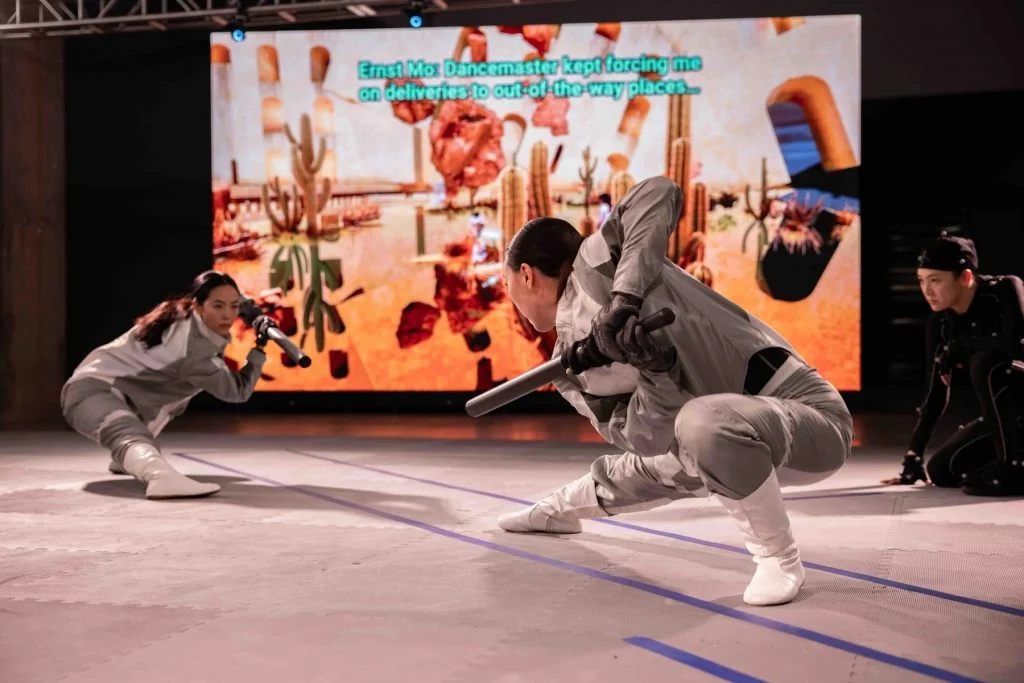
Asia-Futurism, Again. Critic Dawn Chan’s term “Asia-Futurism” is 10 years old, and what with the current #2016 trend and all, I think its probably ready for another big push. In fact, it’s not nostalgia: It sits at the intersection of a lot of cultural vectors: a desire to respond (mainly implicitly) to the xenophobia of the present climate; a sense of palpable decline of an American future; museums’ pivot to futurist themes as tech becomes such a dominant cultural force; the appeal to younger audiences via adjacency to K-pop and anime. Ayoung Kim (who was a highlight of Performa, and has a show at MoMA PS1) and Lu Yang (currently at Amant Foundation) both feel like artists for this moment.

Cover of Anna Sampson’s book Other Intimacies.
Kinky Sex. One bet I had for last year is that there would be a focus on sex and kink. My thinking was: A background conversation about how mainstream culture had become desexualized would meet the reaction to political correctness, and bounce off the feminist debate about “kink shaming,” thus finding some kind of outlet. This seemed a simple triangulation, providing a sense of forward cultural movement while also fitting the contours of the terrain. Here are the signs: the “indie sleaze” revival (mostly just chatter), Man’s Best Friend, and The Housemaid, but also artist Mindy Seu’s lecture-performance A Sexual History of the Internet, photographer Anna Sampson’s Other Intimacies, and artist Sarah Meyohas pivoting to the erotic art-house short film Medusa.
Jolie-laide Figuration. This one really is me thinking out loud, but something I am looking out for. The current mega-mainstreaming of cosmetic surgery, looksmaxxing, and A.I.’s conjuring of virtual people from distillations of what’s popular have created a climate where a generic attractive look is more aggressively dominant than ever. I’m looking out for forms of figuration that accentuate the flaws, tics, and quirks that give actual faces and bodies character. Neither the push toward unreal beauty standards nor the celebration of unconventional beautyin art are new; but just as one intensifies, you would expect more from the other.

Installation view of “Jeremy Frey: Woven” at the Art Institute of Chicago. Courtesy The Art Institute of Chicago, photography by Jonathan Mathias
Betting on Baskets. Ceramic and glass art have had major and escalating cachet in museums. Textiles and quilting have also been a main trend recently as part of a general heightened emphasis on craft as art, a largely positive collateral effect of reconsidering who and what had been left out of the traditional histories (I talked about this with curator Elissa Author in 2024). I don’t expect any of this to go away, but these trends are years old now, and the aperture might open on other craft fields with deep benches of creators who haven’t gotten their dues. Maybe there’s a basket wave? Jeremy Frey’s creations, for one, are hard to deny. He won a “Genius” grant last year.
…Vinyl? I keep meaning to write about this, but also I can’t decide about it. I’ll probably never have time to get around to it, given everything. So, I’ll put it here. There has been a vinyl record revival since 2020, tapping into nostalgia for physical media. Museums (MASS MoCA), non-profits (White Columns), and galleries (Corbett vs. Dempsey) have started putting out vinyl recently. Painter Peter Doig made vinyl records central to his current “House of Music” exhibition at the Serpentine in London. This is very hipster, very trivial, yeah, but the vinyl vogue seems to naturally connect with what art institutions have—or hope—to offer as their comparative advantage in this moment: kind of retro but in a way that feels newly relevant, physical and also durational… Interesting or not?