“When Is a Wall a Wall?”
New World Symphony at 15: John Adams, Stéphane Denève, and a living tribute to Frank Gehry
Written By Olga Garcia-Mayoral
Saturday, January 17, 2026, 7:30 PM • Michael Tilson Thomas Performance Hall, New World Center
On Saturday night at the New World Center, the 15th-anniversary celebration unfolded like a beloved letter—to a hall, to a city, and to the artists who imagined both. The evening honored the building’s architect, the late Frank Gehry, with an all–John Adams program led by Adams himself and New World Symphony Artistic Director Stéphane Denève. It felt at once intimate and historic: a gathering in a house still charged with the spirit of its designer and the audacity of the music it was built to hold.
In the atrium, “NWS at 15” traced the arc from Gehry’s early sketches to performance highlights; inside, a newly donated Gehry sculpture—once a working maquette and later a companion in the living room of Michael Tilson Thomas (MTT) and Joshua Robison—stood with tender purpose. Gehry’s handwritten riddle on its reverse, “When is a Wall a Wall?”, now reads as both architectural koan and curatorial prompt: where does a boundary end and a passage begin? It was the right question for a program about thresholds—between past and future, stage and city, pulse and breath.
Two conductors, one portrait
The concert drew a clean line through Adams’s catalog without smoothing away its variety. Adams conducted The Chairman Dances (Foxtrot for Orchestra) and the new piano concerto After the Fall with soloist Víkingur Ólafsson; Denève took the helm for I Still Dance and Doctor Atomic Symphony, the latter paired with a video tribute to MTT and Robison.
Denève waved off the notion that an evening shared by two conductors needed a single interpretive “house style.” “There are pieces from different epochs, and each has its own sound world,” he told me before the performance. “John prides himself on doing every piece as its own genre—à la Stravinsky. We didn’t chase one ‘coherence’; the coherence is that it is all music by one genius.”
Adams, after rehearsal, was wry about conducting his own work. He still makes tiny changes, he said, but they’re mostly practical. “This particular hall has a very generous stage, but not a lot of seats—sometimes a fortissimo can make your teeth chatter,” he admitted. “I’ve occasionally told them to play a little softer.” More revealing was what he said about listening to Denève rehearse Doctor Atomic Symphony: “It sounds counterintuitive, but sometimes even the composer doesn’t realize certain things are in the music. It takes a great conductor like Stéphane to reveal it.”
“The Chairman Dances”: a foxtrot with a human face
It’s easy to play The Chairman Dances as a motor; harder to make it dance. Adams’s own beat was elastic enough to let a phrase tilt or smile without losing carriage. The woodwinds chattered in bright consonants; the strings found a spring in their bow that suggested the body rather than the machine. If there was an embedded message, it was that irony is not the only form of modernism. Joy, too, can be contemporary.
“After the Fall”: Ólafsson’s spark, Adams’s engine
Composed for Ólafsson, After the Fall is the latest chapter in Adams’s extended conversation with the piano. He doesn’t play the instrument himself (“I grew up in a house without a piano; I played clarinet,” he reminded me with a laugh), yet the writing sits under the hands with a physical logic that jazz pianists would recognize. “I listen to a great deal of jazz piano—Bill Evans, Chick Corea, Herbie Hancock, Keith Jarrett,” he said. “That kind of playing—spontaneous, very American gestures—feeds my imagination.”
If there’s a thread he hopes audiences follow through Chairman and After the Fall, it’s the pulse. “I was very influenced by Reich and Glass—their clear use of pulsation—and of course by pop and jazz,” he said. “There’s a strong sense of pulse in almost all of my music. I think that’s a very American trait.”
In performance, Ólafsson’s touch made the piano flicker between steel and silk, while Adams’s beat kept the surrounding latticework taut. The New World Fellows handled the concerto’s tricky hinge-points with a kind of collected daring; the result felt like architecture in motion—sweeping lines, yes, but also the stubborn integrity of load-bearing walls.
“I Still Dance”: an ode to energy—and friendship
Adams titled his 2019 piece after a line from Joshua Robison. “I asked him if he still did ballroom dancing,” Adams recalled. “He said, ‘Oh, I still dance.’ I took that answer as a title.” Then he smiled at the mischief of the muse. “Once I started, the piece didn’t turn out to be a dance at all. It’s a toccata in a minor key—powerful, massive. I always feel like apologizing to Michael and Josh that I didn’t actually give them a dance. But they appreciated it; Michael gave a wonderful premiere.”
Denève framed the work as honoring. “We wanted to elevate a private dedication into an ode to resilience,” he said. The newly created video counterpointed rather than illustrated: a slow-moving collage beginning with a photograph of MTT and Robison; within their silhouettes, scores and dances appeared—glimpses of motion as life force. “They have been dancing all their time—giving movement, giving energy,” he said. At the close, live images of the Fellows folded into the sequence, a gesture Denève described as continuity: “Their baby is the New World Symphony, and it will continue. When they cannot dance, others will dance.”
The music ends, not ends—dynamic falling away, a small high note repeating like a heartbeat. “To be continued,” Denève called it. So did the audience: the silence after the last note felt like an intake of breath that didn’t want to be exhaled.
“Doctor Atomic Symphony”: searing, not saturated
Denève’s reading of Doctor Atomic Symphony was narrative without being literal, letting its crisis ecology speak in orchestral terms: anxiety spirals, moral stasis, the surge of terrible resolve. The famous Mahlerian lament from the opera—Oppenheimer’s “Batter my heart”—arrived near the end not as balm but as human residue, sung now by brass and strings. “I have a passion for narrativity,” Denève said, showing me his score covered in text cues. “I wrote out the poetry—every line, even a German translation once—so the players understand the words behind the sound.”
Technically, the victory was one of restraint within Gehry’s bright, intimate acoustic. “Our hall is quite alive,” Denève said. “We worked all week, so brass and percussion don’t cover strings and winds, and still go for extreme dynamics.” He described the final passacaglia as carefully “voiced like polyphony,” overlapping brass triads like shingles so the air seems to carry its own resonance. Climaxes were searing but legible; bass lines grounded the panic instead of bloating it; piccolos cut air without shredding it. You could sense the week of calibration he described—less here, more there, now together breathe—until the orchestra’s engine had torque rather than mere horsepower.
The hall that listens back
Gehry’s room remains the third protagonist. Its intimacy tempts saturation; its brightness rewards clarity. Adams hears the room’s virtues and limits, too. “I Still Dance is almost too big for this hall,” he told me. “It’s a toccata on steroids—very powerful and massive—, and it needs some room. But it’s still thrilling in here.”
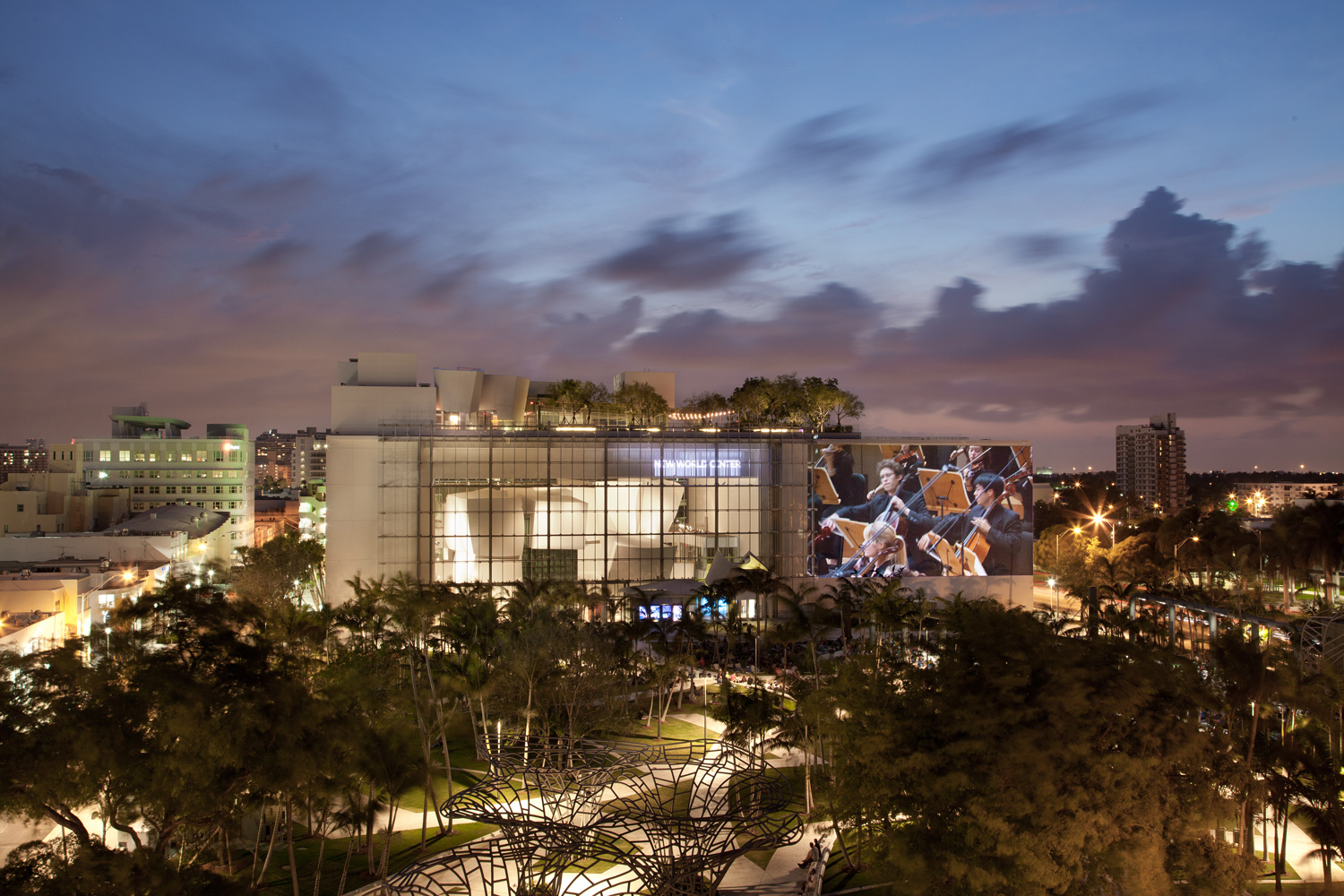
Beyond the doors, the WALLCAST® broadcast extended the celebration to SoundScape Park with newly upgraded audio. Denève, not a gearhead by his own account, still noticed the leap: “It feels even more immersive and warm—outside now sounds closer to inside.”
Fellows as protagonists
Perhaps the most moving constant of the night was the Fellows’ ownership of the sound. Adams, who has coached and conducted at NWS for decades, never treats them like students. “You don’t talk down to these players,” he said. “They’re really good. The luxury here is more rehearsal time than most professional orchestras; you can drill deeper.” The payoff was audible—subdivisions that locked without fear, attacks that brought an American brightness without going hard, chamber instincts inside a big orchestra frame.
Denève spent time this week on rhythm as rhetoric. “There is such an American groove in John’s music,” he told me. “The rhythms are tricky. First, we make them accurate; then we give them a shape—we connect the rhythm in a singing way.” You could hear that in the way fast notes phrased like speech and in the confidence of the percussionists, who felt more like a drum set with a hundred arms than a row of separate stations.
Architecture as instrument, city as audience
Gehry’s hall—like Disney Hall in Los Angeles, its West Coast cousin—invites risk: surround screens to play with, platforms to populate, a civic porch that can become a concert plaza in an instant. “There’s so much potential to light things differently, put the audience in different configurations,” Denève said, already dreaming aloud about more projects that use the multiple “cells” around the stage. The space’s scale—welcoming, not cavernous—helps the institution try without apology. Not everything needs to be maximal to feel meaningful.
And then there’s the city. The WALLCAST® outside, with upgraded energy-efficient audio, turned SoundScape Park into a kind of companion auditorium. It’s one of Gehry’s many gifts to Miami that the building’s skin is also its instrument. The idea that a world-class performance inside can become a free neighborhood ritual outside remains radical in its simplicity.
The maquette that came home
The newly installed Gehry sculpture on the second floor, a preliminary study saved from oblivion by MTT and Joshua and now returned to NWS, carried the night’s quietest charge. It’s a reminder that buildings begin as conversations; that the line between sketch and space is as porous as the one between score and sound; that objects can hold time. “When is a Wall a Wall?” Gehry scrawled. Perhaps: when it keeps out weather. But not when it keeps out people. The maquette’s new life inside the house it once imagined feels exactly right.
What we carry forward
Both maestros kept their eyes on tomorrow as much as yesterday. Adams, amused and moved by the generational span in front of him, spoke of the Fellows’ “vitality and pleasure” and the hope it gives him for the future of his pieces. Denève, asked what seed he wants to plant for the next 15 years, answered without hesitation: keep the repertoire alive—relevant to the world outside—while predicting the future by commissioning the right people. He sees voice, opera, and storytelling as growth lanes; he sees digital content as a tool, not a destination; he sees live music as a kind of medicine. “The purity of being together in silence,” he said, “listening to people vibrating something in the air—this will be more and more valued.”
The night proved the point. In a hall that still feels brand new, honoring a friend who made rooms sing, New World Symphony offered Miami a portrait of an American original—and a sketch for the years ahead. If Adams’s music asked us to feel the engine of pulse, Gehry’s question asked us to rethink the edges of our listening. Walls can hold us; they can also open. On this night, they did both.
If you’d love to watch the WALLCAST®, you may do so via this link: https://www.nws.edu/events-tickets/wallcast-concerts-and-park-events/
Omnia vincit amor: et nos cedamus amori — to my dear friend, A.E.S.