The Virtuoso of Visibility: Kerry James Marshall’s Painting Style and Mastery of the Western Canon
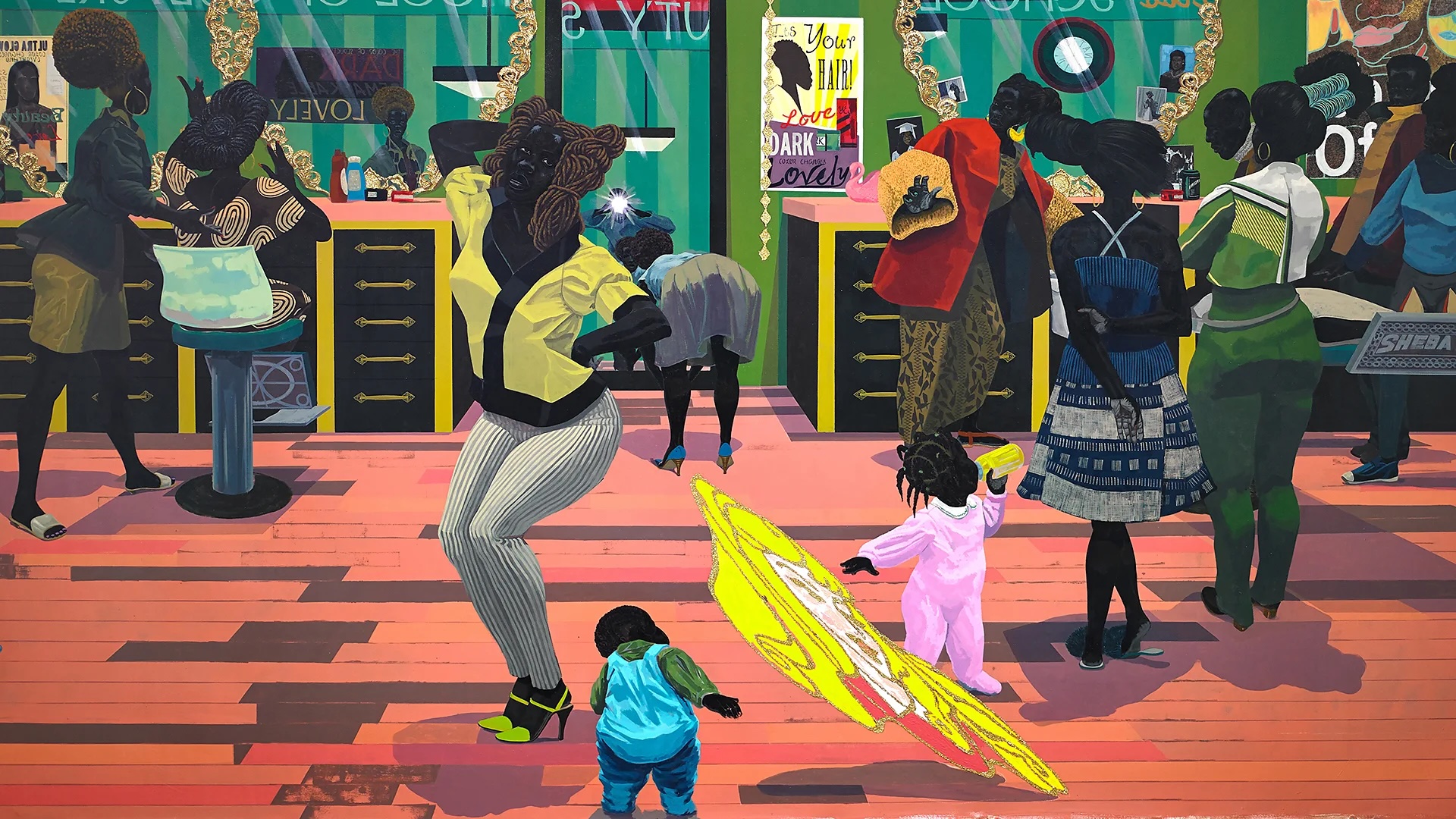
Kerry James Marshall is engaged in an ongoing dialogue with six centuries of representational painting, creating what he calls a counter-archive that brings Black figures into the Western pictorial tradition. Born in Birmingham, Alabama in 1955, at the start of the American Civil Rights movement, and later moving to the Watts neighborhood of Los Angeles just before the 1965 Watts riots, Marshall’s work combines a painterly realism within elements of collage, pattern, and environment that employ similar pictorial strategies to the grand tradition of history painting albeit with a distinct connection to the Black Arts movement.
As art historian Carroll Dunham observed in Artforum in 2017, there are no other American painters who have taken on such a project—one that simultaneously occupies a position of belonging within the grand narrative of Western art while fundamentally challenging and expanding its boundaries. Marshall is a virtuoso of landscape, portraiture, still life, history painting, and other genres of the Western canon since the Renaissance. The artist can, quite literally, do anything within the vocabulary of Western painting, and he deploys this mastery strategically to assert the centrality of Black subjects in art history.
Technical Mastery: The Chromatic Complexity of Black
The Evolution of Marshall’s Signature Black
In 1980, Marshall began working in the figurative style for which he is best known today. Inspired in part by Ralph Ellison’s novel Invisible Man (1952), his Black subjects are barely indistinguishable from the black background of the canvas. This marked a pivotal shift in his practice that would define his career trajectory.
Marshall started by working with three black pigments that can be bought in any paint store: ivory black, carbon black, and Mars black. He took these three signature black colors and started to mix them with cobalt blue, chrome-oxide green, or dioxazine violet. The result, which is only completely visible in the original paintings rather than in reproductions, represents Marshall’s extraordinary technical achievement in making black fully chromatic.
In a revealing interview, Marshall explained his sophisticated approach to creating volume and modeling within his black figures:
“If you looked at the palette I was using you’d think, ‘Well, that’s black, black and black next to each other.’ And they don’t look so different. But when I use them in a painting next to each other, the differences become more apparent. Because the iron oxide black is inherently red. And if you stack that on top of carbon black, it obviously looks red. Or I’ll mix in cobalt blue, a chrome oxide green, an earth tone like raw umber or yellow umber. What I’m doing is changing the temperature, from cool to warm and warm to cool. And I use those to do what functions as modelling in the figures, even though I’m not doing modelling in the classical sense, I’m simply creating a set of patterns that help to give the figures some volume”.
As Marshall has said, “if you say black, you should see black.” While his blacks are complex, Marshall rarely attempts to depict the browns of real skin tones. This is a deliberate conceptual and aesthetic choice. As Marshall himself explains, when you say Black people, Black culture, Black history, you have to show that, you have to demonstrate that black is richer than it appears to be. It’s not just darkness but a color.
Taking literally the application of a single adjective to plural complexions, he accentuates the “blackness” of the skin by pigments such as iron oxide, magnifying, in scenes with rich colours, the notion and representation of “black beauty”. His figures are at once individual characters and examples of an emphatic Blackness, real and rhetorical, and as such, provoke wider questions about the idea of Black figures in art.
Dialogue with Renaissance Masters and Old Master Techniques
Learning from the Canon to Transform It
Marshall’s relationship to the Old Masters is neither one of simple imitation nor rejection, but rather a sophisticated engagement that involves deep understanding followed by strategic deployment. As Marshall has reflected, one of the senses you get from the work of old masters is that the work was based on their knowledge of some things that they seemed to know and used that knowledge to construct pictures. He was always intrigued by what it was they knew that allowed them to make those kinds of pictures.
“I’ve always been interested in unfinished underpaintings, like Leonardo’s St Jerome in the Wilderness – that’s how I learned how paintings were constructed, from those sorts of works”. This statement reveals Marshall’s pedagogical approach to studying Renaissance and Baroque masters—not through finished, polished surfaces but through understanding the underlying construction and technique.
Marshall’s ambition has always been to achieve an expertise and proficiency to match the Old Masters whose paintings hang on museum walls, for his paintings to pass muster alongside the revered classics that make up the canon – because that, precisely, was the only way to contest the canon, to rewrite the master narrative of Western art history and pay attention to black subjects who were mostly marginalised or invisible.
Renaissance Compositional Strategies
Renaissance artists added new elements: human emotions and contemporary settings. For example, Masaccio set the biblical scenes in his frescoes in the streets of Northern Italy and dressed his figures in contemporary clothing. Similarly, Michelangelo represented the biblical hero David preparing to go into battle with Goliath by giving him the body of an ancient Greek or Roman sculpture of a god, but added a human reaction—an expression of anticipation and determination with a penetrating gaze and a furrowed brow.
Marshall employs analogous strategies in his work. His paintings reference Renaissance compositional structures while inserting Black figures into scenarios that historically excluded them. In his Vignette series, Marshall composes scenes reminiscent of Renaissance depictions of Adam and Eve, with nude figures surrounded by foliage, trees, butterflies, and birds. However, his figures are strong and Black, and his male figure wears a necklace in the shape of the African continent, perhaps suggesting the location of the Garden of Eden in Africa. For Marshall, introducing these elements into the classical theme asserts the importance of these figures in the story of humankind.
Much like the Renaissance artists would adopt the poses of ancient sculpture to demonstrate their knowledge of their predecessors, Marshall’s Portrait of Nat Turner with the Head of His Master (2011) borrows the contrapposto pose of Donatello’s sculpture of the biblical hero David after he had slain the giant Goliath. Marshall was likely equating Nat Turner to the young David who, against all odds and expectations, saved his people. In this way, Marshall reclaims Nat Turner as a civil rights hero and a figure of monumental historical significance.
Traditional Academic Techniques
Marshall studied at the Otis Art Institute in Los Angeles, and the influence of his drawing instructor Charles White, an artist known for his social realist murals, can be seen in Marshall’s conjunction of expert draftsmanship with unconventional materials and Old Master techniques such as grisaille.
An underpainting is the initial layer of colour, usually brown, that allows a painter to work out the structure and relationship of tones across a composition. Though considered a traditional, academic technique, Marshall uses it here to depict an underappreciated reality. In Untitled (Underpainting) (2018), a diptych depicting parallel views into a museum, where tour guides are giving talks to school groups, the painting is essentially monochrome, done in shades of umber like an unfinished Renaissance piece that never had top colours added. This work simultaneously demonstrates Marshall’s command of traditional academic techniques while commenting on pedagogy and who has access to art education.
Genre Mastery: Landscape, Portraiture, Still Life, and History Painting
The Garden Project and Landscape Painting
It’s in the “Garden Series” that Kerry James Marshall began to evolve the dense, ultra-dark black bodies that would become one of his most vital contributions to Black art and the broader contemporary art world. These works engage with the pastoral tradition of landscape painting, referencing works such as Manet’s Luncheon on the Grass or its origin point, Titian’s Pastoral Concert.
The Garden Project paintings depict housing projects not as sites of urban decay but as potential Edens—spaces of beauty, community, and possibility. Marshall transforms the genre of landscape painting, traditionally associated with idealized rural scenes and aristocratic leisure, into a medium for representing Black urban communities with dignity and complexity.
Portraiture: Challenging Conventions of Beauty and Representation
Marshall’s strategy was three fold. First, as a young artist he decided to paint only black figures. He was unequivocal in his pursuit of black beauty. His figures are an unapologetic ebony black, and they occupy the paintings with a sense of authority and belonging. Second, Marshall worked to make a wide variety of images populated with black people. This led him to make exquisite portraits, lush landscape paintings, everyday domestic interiors, and paintings that depict historical events, all featuring black subjects as if their activities were completely and utterly normal.
In his portrait practice, Marshall engages directly with art historical conventions. His untitled painting of a female artist at work (2009) presents a Black woman painter holding a palette before a paint-by-numbers canvas. By replacing the traditional white male with a Black woman, Marshall is proposing that our ideas about art making need to change, and that the barriers for acceptance need to be let down. This work comments on questions of mastery, amateurism, and who is granted the status of “artist” within Western art discourse.
Marshall’s portraiture also addresses the classical tradition of mythological subjects. In his depiction of Venus, Marshall challenges the classic perception of a goddess as a white woman with long flowing hair. As Marshall admits, he himself had not considered that a black woman could be considered a goddess of love and beauty, but with this painting he proves its possibility. He challenges conventional European aesthetics while also incorporating African patterns in the background, referencing the Harlem Renaissance movement to incorporate traditional African aesthetics into African-American art.
Still Life: Vernacular Culture and Symbolic Objects
Marshall brings the same technical sophistication and conceptual rigor to still life painting, a genre often considered minor within the hierarchy of academic painting. His still life works frequently incorporate objects laden with cultural and symbolic significance—records, books, beauty products, and other items from Black vernacular culture. These objects are rendered with the same meticulous attention to surface, texture, and light that characterizes Dutch Golden Age still life painting, yet they speak to contemporary African American experience.
History Painting: Memorialization and Cultural Memory
Marshall is best known for his richly worked large acrylic paintings on unstretched canvas that investigate modern African American vernacular existence. His approach to history painting is perhaps his most ambitious engagement with the Western canon. Traditionally, history painting depicted mythological, religious, or significant historical events and occupied the highest position in the academic hierarchy of genres.
Marshall’s Souvenir series (1997-1998) exemplifies his transformation of history painting for contemporary purposes. The four Souvenir paintings commemorate African American icons who made invaluable contributions to American culture and died in the 1960s. Set in a middle-class domestic interior, Souvenir IV memorializes musical pioneers, including John Coltrane and Billie Holiday, whose faces appear as celestial presences above the black-and-white living room.
These works combine the scale and ambition of grand history painting with vernacular imagery and domestic settings. Marshall has said that when he finished paintings like “The Lost Boys,” he was very proud, feeling they were the type of paintings he’d always wanted to make: “It seemed to me to have the scale of the great history paintings, mixed with the rich surface effects you get from modernist painting”.
Material and Technical Innovations
Acrylic on Unstretched Canvas
Marshall is best known for his richly worked large acrylic paintings on unstretched canvas. This choice of material and presentation method is significant. By leaving his canvases unstretched and attaching them directly to the wall, Marshall creates a presence that is both monumental and intimate. The works have a banner-like quality that references both Renaissance frescoes and contemporary installation art.
The use of acrylic paint, rather than oil, allows Marshall to work at the large scale many of his compositions demand while maintaining the ability to layer and build complex surfaces. Acrylic’s quick drying time and flexibility have enabled Marshall to develop his distinctive approach to surface texture and pattern.
Collage, Pattern, and Mixed Media Elements
Marshall’s work combines a painterly realism within elements of collage, pattern, and environment. Many of his paintings incorporate collaged elements—glitter, printed patterns, textiles—alongside painted passages. This hybrid approach allows Marshall to reference both high art traditions and vernacular aesthetic practices.
The use of glitter in works like the Souvenir series adds a dimension of popular culture and craft practices to paintings that otherwise employ sophisticated academic techniques. Comic book imagery, graphic design elements, and references to popular media sit alongside passages of painterly virtuosity, creating a visual language that is both erudite and accessible.
Scale and Ambition
Marshall typically works on a monumental scale, with many paintings measuring over eight feet in height or width. This scale is strategic, placing his works in dialogue with the grand history paintings found in major museums. The scale demands that viewers encounter his Black subjects with the same physical and psychological impact they would experience before a Rubens, a David, or a Delacroix.
The Counter-Archive: Conceptual Framework and Strategy
Mastery as Resistance
Marshall concentrated on painterly mastery as a fundamental strategy. By mastering the art of representational and figurative painting, during a period when neither was in vogue, Marshall produced a body of work that bestows beauty and dignity where it had long been denied.
This strategic deployment of mastery is crucial to understanding Marshall’s painting style. In an art world that had largely moved beyond traditional painting toward conceptual art, installation, video, and other contemporary media, Marshall’s commitment to painting was itself a radical gesture. But it was mastery specifically—not merely competence—that Marshall pursued, because only through indisputable technical excellence could he assert the right of Black subjects to occupy the same cultural space as the Madonnas, saints, nobles, and mythological figures that populate Western art museums.
Marshall himself articulated this clearly: “If you look at the historical narrative of art, we have to deal with the idea of the old masters, and in the pantheon of the old masters there are no black old masters. If I can’t perceive within myself enough value in my image or the image of black people, to construct a desire to represent that image as an idea than that’s my problem to solve. The inability to solve that problem is a failure of imagination. It matters that my paintings are uncompromising in terms of the presentation of their blackness.”
The “Lack in the Image Bank”
Marshall’s mastery as an artist has radically changed what he calls “the lack in the image bank” by foregrounding Black subjects in his paintings. This phrase—”the lack in the image bank”—refers to the historical absence of images of Black people in positions of beauty, dignity, complexity, and centrality within Western visual culture.
Marshall addresses this lack not through protest or negation but through abundance and affirmation. He creates images that could have existed, should have existed, within the Western tradition but did not—filling museums’ walls with the faces and bodies that were systematically excluded for centuries.
Visibility and Representation
At the center of Marshall’s oeuvre is the critical recognition of the conditions of invisibility long ascribed to Black figures in the Western pictorial tradition, and the creation of what he calls a “counter-archive” that brings them back into this narrative.
The concept of the counter-archive is central to understanding Marshall’s project. Rather than creating an entirely separate tradition of Black art, Marshall inserts Black subjects into the existing structures, genres, and conventions of Western painting. His counter-archive exists in dialogue with—not in opposition to—the canonical works of European art history. By demonstrating that Black subjects can occupy any genre, any compositional structure, any level of technical sophistication, Marshall expands the canon from within.
Stylistic Range and Versatility
From Abstraction to Hyperrealism
While Marshall is primarily known for his figurative work, his practice demonstrates remarkable stylistic range. Early in his career, he worked with collage and abstraction. His mature work moves fluidly between modes of representation, from the silhouetted figures of his early 1980s paintings to the highly detailed, spatially complex compositions of his recent work.
Marshall’s technical versatility allows him to reference different historical periods and styles within a single painting. A composition might combine Renaissance spatial construction with modernist flatness, baroque drama with minimalist restraint, naturalistic detail with symbolic abstraction.
References Across Art History
Kerry James Marshall’s paintings, in addition to being big and beautiful to behold, are packed with a wide range of references, such as Renaissance painting techniques, medical diagrams, Motown tunes. His visual vocabulary draws from an extraordinarily wide range of sources: Italian Renaissance frescoes, Dutch still life painting, French Rococo pastoral scenes, German Expressionism, American Social Realism, Abstract Expressionism, Pop Art, and contemporary graphic design.
This eclecticism is not postmodern pastiche but rather demonstrates Marshall’s command of the entire history of Western art. Like the Renaissance masters who synthesized classical, medieval, and contemporary sources, Marshall integrates multiple historical styles in service of his contemporary project.
Influence and Legacy
A New Standard of Excellence
Marshall’s mastery of representational and figurative painting serves to bestow his Black figures with a beauty and dignity they have long been denied, a project later taken up by American artist Kehinde Wiley, who similarly references the old masters in his paintings and portraits of contemporary Black individuals.
Marshall’s influence extends far beyond his immediate aesthetic impact. He has fundamentally changed conversations about representation, mastery, and who belongs in museums. Younger artists including Kehinde Wiley, Mickalene Thomas, Jordan Casteel, and Titus Kaphar have all acknowledged Marshall’s influence in opening space for ambitious figurative painting centered on Black subjects.
Institutional Recognition
A retrospective exhibition of Marshall’s work, Kerry James Marshall: Mastry, was assembled by the Museum of Contemporary Art, Chicago in 2016, and traveled to the Metropolitan Museum of Art in New York and the Museum of Contemporary Art in Los Angeles. In 2025, a major survey titled Kerry James Marshall: The Histories opened at the Royal Academy of Arts in London, marking the largest survey of his work outside the United States.
Marshall is included in numerous public collections including the Art Institute of Chicago; Birmingham Museum of Art; the Crystal Bridges Museum of American Art; Harvard Art Museum; Los Angeles County Museum of Art; the Ludwig Museum, Cologne; the Metropolitan Museum of Art; the Museum of Contemporary Art, Chicago; the Museum of Modern Art; the National Gallery of Art, Washington, DC; San Francisco Museum of Modern Art; the Studio Museum in Harlem; the Tate Modern, London; the Whitney Museum of American Art; and the Yale University Art Gallery.
This institutional recognition represents not merely personal success but validation of Marshall’s larger project: demonstrating that paintings of Black subjects deserve to hang alongside acknowledged masterpieces of Western art.
Conclusion: A Virtuoso’s Mission
Kerry James Marshall is indeed a virtuoso of landscape, portraiture, still life, history painting, and other genres of the Western canon since the Renaissance. His technical mastery is indisputable—from his revolutionary approach to rendering black skin tones with chromatic complexity to his command of Renaissance compositional strategies, from his sophisticated use of traditional academic techniques like underpainting and grisaille to his ability to work across multiple genres and scales with equal facility.
But Marshall’s virtuosity is never merely technical. As he told art historian Benjamin H. D. Buchloh, “I do see myself that way. As a strategy, as a technique, I try to know as much as possible about the operation, construction, and appearance of art so that I can be more precise in the way I deploy whatever seems most effective for the project.”
The project, ultimately, is one of visibility, dignity, and historical correction. For more than 35 years Marshall’s paintings have taken as their subject the representation of black figures – how they have been marginalised within the Western pictorial tradition, reduced to bit players within the mainstream narrative of art history. Through consummate technical skill deployed with conceptual precision, Marshall has created a body of work that simultaneously honors and transforms the Western canon, demonstrating that Black subjects can occupy every genre, every compositional structure, every level of aesthetic achievement.
Marshall’s painting style is characterized by chromatic sophistication in rendering black skin tones, dialogue with Renaissance and Baroque compositional strategies, mastery of traditional academic techniques, genre versatility spanning landscape to history painting, innovative use of materials including acrylic on unstretched canvas, integration of collage and mixed media elements, monumental scale, dense layering of art historical and cultural references, and strategic deployment of technical virtuosity in service of expanding representation.
This is an artist who studied the Old Masters not to imitate them but to understand precisely how they constructed power, beauty, and permanence on canvas—then deployed those same techniques to illuminate lives that traditional galleries rendered invisible. The artist can, truly, do anything—and in doing so, he has changed what painting can be and who it can represent.
References
English, Darby. (2019). To Describe a Life: Essays at the Intersection of Art and Race Terror. Yale University Press.
Godfrey, Mark et al. (2025). Kerry James Marshall: The Histories. Royal Academy of Arts.
Haq, Nav; Enwezor, Okwui; Roelstraete, Dieter; Vermeiren, Sofie; Marshall, Kerry James. (2013). Kerry James Marshall: Painting and Other Stuff. Ludion, Uitgeverij.
Maclean, Mary. (2018). “Kerry James Marshall: Mastry, The Met Breuer, New York, 25 October 2016–29 January 2017.” Journal of Contemporary Painting, 4(2), 405–410.
Marshall, Kerry James. (1994). Kerry James Marshall: Telling Stories: Selected Paintings. Cleveland Center for Contemporary Art.
Marshall, Kerry James; Powell, Richard J; Ghez, Susanne; Alexander, Will; Harris, Cheryl I; Walker, Hamza. (1998). Kerry James Marshall: Mementos. Renaissance Society at the University of Chicago.
Marshall, Kerry James; Sultan, Terrie; Jafa, Arthur. (2000). Kerry James Marshall. Harry N. Abrams.
Museum of Contemporary Art Chicago. (2016). Kerry James Marshall: Mastry [Exhibition catalogue].
Rowell, Charles H., and Kerry James Marshall. (1998). “An Interview with Kerry James Marshall.” Callaloo, 21(1), 263–72.
Whitehead, Jessie L. (2009). “Invisibility of Blackness: Visual Responses of Kerry James Marshall.” Art Education, 62(2), 33–39.
Photo: Kerry James Marshall/ Courtesy of the artist/ Jack Shainman Gallery, New York