
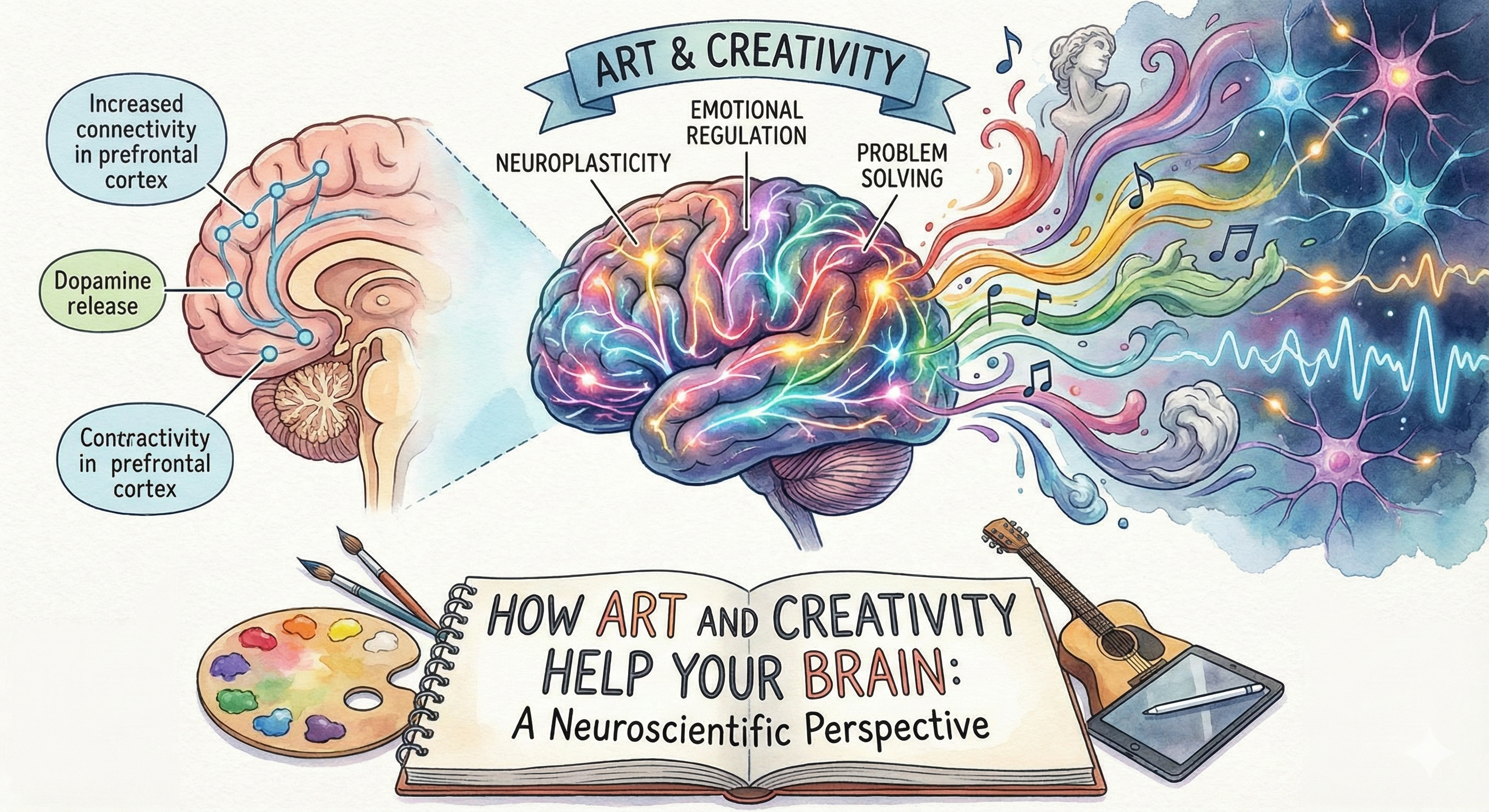
How Art and Creativity Help Your Brain: A Neuroscientific Perspective
The relationship between art and the human brain has evolved from philosophical speculation to rigorous scientific inquiry. Over the past two decades, advances in neuroimaging technologies such as functional magnetic resonance imaging (fMRI), electroencephalography (EEG), and functional near-infrared spectroscopy (fNIRS) have allowed researchers to observe in real-time how artistic engagement affects brain structure and function. Art therapy neuroscience research suggests that engaging with art prompts simultaneous physiological and psychological shifts, leading to transformative change in adaptive human functioning.
The emerging field of neuroaesthetics, first coined in the late 1990s by Semir Zeki, renowned neuroscientist and professor at the University College of London, examines how art impacts humans cognitively, emotionally, and physically. This interdisciplinary field provides fascinating insights into the specific brain processes related to viewing and analyzing art while also determining why certain works or styles evoke specific emotional responses. The evidence suggests that art is not merely aesthetic decoration but a fundamental tool for brain health, emotional regulation, and cognitive enhancement.
How Art Helps You Know Yourself
Self-Referential Processing and Identity
The default mode network, once associated solely with daydreaming, is now linked to many different functions core to human connection and well-being. These include personal identity, sense of meaning, empathy, imagination, and creativity as well as embodied cognition, which allows us to place ourselves in a piece of artwork and make us feel what the artist was feeling.
The medial prefrontal cortex (mPFC) activity in the default mode network may play a role not only in spontaneous thoughts and self-referential mental activity but also foster a sense of personal identity and lay the foundation for long-term goal pursuit. Research demonstrates that when individuals engage in creative arts, this network becomes activated in ways that promote self-awareness and self-reflection. Additional research shows that the DMN or imagination phase of creativity engages the mPFC, and this engagement is related to openness to experience, increased resilience, and increased emotional awareness.
Visual Self-Expression and Discovery
For example, someone might draw a storm to represent anxiety, or use fragmented collage pieces to symbolize grief. These metaphors act as containers, helping individuals externalize what they feel inside without needing to explain it in words. This capacity for symbolic expression opens the door to deeper insight and meaning-making. As individuals reflect on the images they’ve created, they may begin to recognize patterns, themes, or emotional truths that were previously hidden. A recurring color might reveal a persistent mood, or a chosen symbol might point to a core belief or need.
Research on art therapy acknowledges the importance of emotional aspects in therapy. Studies of art therapy show the artistic process involves evaluating personal behavior patterns, deeply exploring emotional content, and reflecting upon the artistic processes. The act of creating art provides a unique window into one’s inner world, making implicit knowledge explicit and allowing for greater self-understanding.
Processing Your Emotions Through Art
The Neuroscience of Emotional Processing
Neuroscience studies indicate that artistic creation activities significantly activate the prefrontal cortex and limbic system, areas closely associated with emotional processing and regulation. The limbic system, which governs emotional responses, becomes engaged during creative activities in ways that allow individuals to shift from reactive states to reflective ones.
The art-based emotional processing model refers to art creation as articulating visual emotional expression alongside and as a mediator of verbal expression. Art-based emotional processing may especially benefit individuals with difficulty communicating their experiences by enabling them to recognize and understand their emotions. This is particularly significant because a gradual approach to revealing implicit emotional content, enabled by artmaking, may assist indecisive, hidden, or unrecognized emotions in becoming available for explicit expression, potentially improving emotional processing.
Emotion Regulation and the Brain
This systematic review examined the neuroanatomical basis of emotion regulation and creative engagement to determine whether they share common underlying neuronal mechanisms. Researchers found consistent activation of the medial prefrontal cortex and amygdala during creative engagement, suggesting that these regions are involved in both adaptive emotion regulation and creative processes. These findings support the hypothesis that creative arts may engage similar neural networks as those used in emotion regulation, offering a neuroscientific basis for the observed benefits of creative therapies in enhancing emotional intelligence and facilitating emotional processing.
Experiencing art is a self-rewarding activity, irrespective of the emotional content of the artwork. Research suggests that adopting a distanced perspective in art reception may produce positive emotional state and pleasure, irrespective of the emotional content of the artwork. This psychological distance allows individuals to process difficult emotions safely, making art a powerful tool for emotional regulation and healing.
How Art Lowers Stress
Cortisol Reduction Through Art-Making
One of the most robust findings in art and neuroscience research concerns the stress-reducing effects of artistic engagement. A Drexel University study found that 75 percent of participants’ cortisol levels lowered during their 45 minutes of making art. Cortisol, the body’s primary stress hormone, plays a crucial role in the stress response system, and elevated cortisol levels are associated with numerous negative health outcomes.
Although researchers from Drexel’s College of Nursing and Health Professions believed that past experience in creating art might amplify the activity’s stress-reducing effects, their study found that everyone seems to benefit equally. This finding is particularly significant because it suggests that the stress-reducing benefits of art-making are universal and do not require artistic expertise.
The study involved 39 adults, ranging from 18 to 59 years old, who were invited to participate in 45 minutes of art-making. Materials available to the participants included markers and paper, modeling clay and collage materials. There were no directions given and every participant could use any of the materials they chose to create any work of art they desired. This open-ended approach to art-making may be particularly effective for stress reduction because it allows for genuine self-expression and creative freedom.
Viewing Art and Stress Reduction
The stress-reducing effects of art extend beyond creation to viewing as well. A study undertaken by King’s College London measured the real-time physiological responses of 50 participants aged 18-40 who viewed masterpieces at The Courtauld Gallery in London. The results showed that cortisol—the body’s primary stress hormone—fell by an average of 22% among the participants who viewed the original artworks, compared with 8% for those who saw reproductions.
Furthermore, levels of pro-inflammatory cytokines (stress-related proteins) dropped by nearly a third in the gallery group. This finding is particularly significant because chronic inflammation is associated with numerous health problems, from cardiovascular disease to depression. Dr. Tony Woods, researcher at King’s College London, noted that art had a positive impact on three different body systems—the immune, endocrine, and autonomic systems—at the same time, describing this as a unique finding.
A scoping review of 14 primary studies found that 13 of the 14 studies on self-reported stress reported reductions after viewing artworks, and all of the four studies that examined systolic blood pressure reported reductions. The consistency of these findings across multiple studies provides strong evidence for the stress-reducing effects of viewing art.
Mechanisms of Stress Reduction
Research shows that even short art experiences can reduce cortisol. When cortisol stays high, it can affect everything from mood and irritability to increasing blood pressure and sugar levels. The reduction in cortisol through artistic engagement helps to calm the body’s entire stress response system, allowing for better emotional regulation and physical health.
The autonomic nervous system controls things we don’t have to think about, like breathing, heart rate, and digestion. When we’re anxious or overworked, the sympathetic side of this system, often called “fight or flight,” takes over. Art helps to shift the balance back toward the parasympathetic nervous system, promoting relaxation and recovery.
Deep Focus: Art and Flow States
The Psychology and Neuroscience of Flow
Mihaly Csikszentmihályi and others began researching flow after he became fascinated by artists who would essentially get lost in their work. Artists, especially painters, got so immersed in their work that they would disregard their need for food, water and even sleep. Flow is the mental state in which a person performing some activity is fully immersed in a feeling of energized focus, full involvement, and enjoyment in the process of the activity.
Flow is described as a state of optimal performance denoted by smooth and accurate performance with an acute absorption in the task to the point of time dissociation and dissociative tendencies. Remarkably, a 10-year longitudinal study showed people in flow states were 500% more productive.
Neural Mechanisms of Flow in Art
A new neuroimaging study from Drexel University’s Creativity Research Lab is the first to reveal how the brain gets to the creative flow state. The findings reveal the creative flow state involves two key factors: extensive experience, which leads to a network of brain areas specialized for generating the desired type of ideas, plus the release of control – “letting go” – to allow this network to work with little or no conscious supervision.
The transient hypofrontality hypothesis considers flow as an altered state of consciousness caused by the temporary downregulation of the prefrontal cortices. The default mode network, which is the explicit system of the awareness of thought and self-consciousness, shows lowered activity during flow. This reduction in self-consciousness is what allows artists to become completely absorbed in their work.
Studies have shown that individuals engaged in creative arts experience reduced activity in the brain’s default mode network (DMN), which is responsible for self-referential thoughts and distractions. In other words, art trains the brain to stay present, a skill that translates to improved focus in other areas of life.
Neurochemistry of Flow
During flow, the brain releases an enormous cascade of neurochemistry. Large quantities of norepinephrine, dopamine, endorphins, anandamide, and serotonin flood our system. All are pleasure-inducing, performance-enhancing chemicals with considerable impacts on creativity. Both norepinephrine and dopamine amp up focus, boosting imaginative possibilities by helping us gather more information. They also lower signal-to-noise ratios, increasing pattern recognition or our ability to link ideas together in new ways. Anandamide, meanwhile, increases lateral thinking—meaning it expands the size of the database searched by the pattern recognition system.
Cultivating Focus Through Art
Scientific studies show that engaging in visual arts activates multiple brain regions responsible for attention control, sensory processing, and motivation. When you paint or draw, your brain recruits the prefrontal cortex (which manages executive functions like focus and decision-making), the motor cortex (which controls hand movements), and the visual processing centers (which help interpret colors, shapes, and spatial relationships).
This complex interaction of brain areas means that painting isn’t just a passive activity – it’s a cognitive workout. Long-term artistic practice has been shown to improve cognitive flexibility and observational skills. In a study conducted with university students, those who practiced visual arts for three months demonstrated enhanced creative thinking and refined perceptual abilities, both of which contribute to improved attention spans.
What Kind of Art Should You Try?
The Universal Benefits of Art-Making
The good news for those interested in exploring art for brain health is that expertise is not required. Girija Kaimal, assistant professor of creative arts therapies at Drexel University, noted: “It wasn’t surprising because that’s the core idea in art therapy: Everyone is creative and can be expressive in the visual arts when working in a supportive setting. That said, I did expect that perhaps the effects would be stronger for those with prior experience”—but they weren’t.
The research suggests that what matters most is engagement, not skill level. Materials available to participants included markers and paper, modeling clay and collage materials. There were no directions given and every participant could use any of the materials they chose to create any work of art they desired. This freedom of choice and expression appears to be key to the therapeutic benefits.
Different Media, Similar Benefits
A study using functional near-infrared spectroscopy (fNIRS) technology found that coloring, doodling and drawing all showed significant bloodflow in the section of the brain related to feeling rewarded. For three minutes each, the participants colored in a mandala, doodled within or around a circle marked on a paper, and had a free-drawing session. During all three activities, there was a measured increase in bloodflow in the brain’s prefrontal cortex.
Researchers employed fNIRS technology to compare the effect of different mediums on the brains of 26 healthy subjects. They found dorso- and ventro-lateral prefrontal cortex stimulation; areas that contribute to emotional regulation and response inhibition, regardless of the medium selected. This suggests that the specific art medium matters less than the act of creative engagement itself.
Viewing Art Matters Too
For those who may not feel comfortable creating art, simply viewing art offers significant benefits. The research revealed that neither personality traits nor emotional intelligence influenced responses to viewing art. This suggests the health benefits are universal. Whether viewing, creating, or discussing art, humans gain numerous benefits from engaging with art on a cognitive, emotional, and even physical level.
Imagining a More Hopeful Future
Art, Imagination, and Prospection
The medial prefrontal cortex activity in the default mode network may play a role not only in spontaneous thoughts and self-referential mental activity but also foster a sense of personal identity and lay the foundation for long-term goal pursuit. This connection between art-making, the default mode network, and future-oriented thinking suggests that artistic engagement can help individuals envision and work toward positive futures.
The capacity to imagine alternative possibilities is fundamental to hope and resilience. Through art, individuals can visualize scenarios, work through problems creatively, and develop a sense of agency about their futures. Some researchers now believe that art has played a major role in our evolution as it helps us to prepare for and navigate problems. The act of making art requires our brains to solve problems, envision possible outcomes, make decisions and attribute meaning. This enhances the predictive abilities of our brains and helps us to build resilience in our daily lives.
Creativity and Cognitive Flexibility
Creativity is currently viewed as a highly complex function that requires several skills. It is thought to require both novelty, the process of generating something new, and usefulness, which indicates an evaluative process. This suggests that, rather than there being a single “creativity module” in the brain, distributed networks of brain regions may be necessary to generate original and useful ideas.
The ability to think creatively—to generate novel solutions and imagine alternatives—is crucial for navigating an uncertain future. Art cultivates this cognitive flexibility by training the brain to see multiple possibilities, make unexpected connections, and think outside conventional patterns.
Activating the Reward Center of the Brain
The Neuroscience of Reward in Art
The reward system releases feel-good brain chemicals like dopamine, serotonin, and oxytocin that trigger sensations of pleasure and positive emotions. We see these pleasure centers light up in the brain when we are both creating and beholding the arts or engaged in aesthetic experiences.
A Drexel University study found that coloring, doodling and drawing all showed significant bloodflow in the section of the brain related to feeling rewarded. During all three activities, there was a measured increase in bloodflow in the brain’s prefrontal cortex, compared to rest periods where bloodflow decreased to normal rates. The prefrontal cortex is related to regulating our thoughts, feelings and actions. It is also related to emotional and motivational systems and part of the wiring for our brain’s reward circuit.
Dopamine and Artistic Engagement
Recent research has shown that making art by hand can activate the reward pathway and increase dopamine release while reducing cortisol. The brain will associate crafting with pleasure and will motivate us to repeat that behavior. In essence, the act of making art itself creates a positive chemical shift in your brain.
Access to an intact knowledge and conceptual semantic systems, healthy neural connectivity, and normal levels of neurotransmitters such as dopamine, are likely essential for creativity. The dopaminergic system plays a crucial role not only in the experience of pleasure but also in motivation, learning, and the reinforcement of behaviors.
Studies show that when we create a piece of art, blood rushes to the brain’s medial prefrontal cortex, the reward center of our brain. Making art also sends dopamine flooding through our nervous system. This neurochemical response helps explain why artistic activities can be so inherently rewarding and why people often describe art-making as intrinsically motivating.
The “Liking” and “Wanting” Systems
Berridge and colleagues have drawn a distinction between “liking” and “wanting.” Liking seems to be instantiated in the nucleus accumbens shell and the ventral pallidum mediated by opioid and GABAergic neurotransmitter systems. By contrast, the mesolimbic dopaminergic system, which includes the nucleus accumbens core, might mediate wanting, and cortical structures such as the cingulate and orbitofrontal cortex contribute to further conscious modulations of these liking and wanting experiences.
This distinction is important for understanding aesthetic experience. Art activates both the “liking” system (immediate pleasure) and the “wanting” system (motivation and anticipation), creating a complex reward experience that goes beyond simple hedonic pleasure.
The Broader Neural Networks of Artistic Creativity
Distributed Brain Networks
Review of the current evidence from artists with brain damage suggests that artistic talent, skill and creativity are supported by wide brain areas, and are greatly resistant to brain damage. This suggests that art engages distributed neural networks rather than being localized to a single brain region.
Recent functional neuroimaging evidence based on non-artistic behavior in healthy volunteers points to greater left hemisphere involvement in creativity. However, the likely answer with regards to the cerebral hemispheres is that both are functional in exceptional creativity, but with each hemisphere contributing a different facet, yet little understood, to the creativity process.
Visual Processing and Aesthetic Response
The basics of color information are processed within the visual cortex. A visual area known as V4 is critical in determining whether colors are deemed constant under varying lighting conditions. Associations linked to the limbic system integrate to bring an emotional component to color perception. Color’s impact on mood can vary considerably. For example, red is typically associated with strong emotions such as excitement or anger, while blue evokes tranquility.
Research shows that engaging with dynamic stimuli (like art) activates several regions of the brain. What distinguishes art from other visual stimuli? Art has an innate ability to engage multiple neural pathways, tapping into cultural contexts and emotional intricacies in a far more intentional (and, therefore, profound) manner than other visuals.
Neuroplasticity and Long-Term Benefits
Training the Brain Through Art
Any kind of creative activity engages our problem-solving abilities and pushes us to see the world in new ways. This helps develop neuroplasticity, the brain’s ability to make and organize synaptic connections. As your brain gets faster at making these connections, your cognitive abilities and problem-solving skills increase.
Neuroplasticity—the brain’s ability to reorganize itself by forming new neural connections—is fundamental to learning and adaptation. Artistic engagement appears to be particularly effective at promoting neuroplasticity because it engages multiple sensory, motor, and cognitive systems simultaneously.
When you repeatedly practice entering a flow state, your brain undergoes significant changes that make accessing flow easier and more natural over time. The neuroscience of flow reveals that each time you experience flow, you strengthen neural pathways associated with focus, motivation, and creativity. This process, known as neuroplasticity, means that your brain is constantly reorganizing itself to make the flow state more accessible.
Art and Memory
In 2008, the Dana Foundation released study results from a consortium of researchers who independently investigated the arts from the perspective of cognitive neuroscience. A report titled Learning, Arts, and the Brain summarized studies showing tight correlations between arts training and improved cognitive capacity and academic performance. Memory was a significant variable in a study linking music rehearsal with memory retention, and in another study linking acting with memory improvement through the learning of skills to manipulate semantic data.
While these studies focused on performing arts, the principles apply broadly to visual arts as well. The integration of visual, motor, and conceptual processing involved in creating art appears to create particularly strong memory traces.
Clinical and Therapeutic Applications
Art Therapy and Mental Health
Antonio Damasio, a noted neurologist studying the neural systems which underlie emotion, decision making, memory, language, and consciousness at the Brain and Creativity Institute at the University of Southern California says, “Joy or sorrow can emerge only after the brain registers physical changes in the body.” He continues: “The brain is constantly receiving signals from the body, registering what is going on inside of us. It then processes the signals in neural maps, which it then compiles in the so-called somatosensory centers. Feelings occur when the maps are read and it becomes apparent that emotional changes have been recorded”.
This embodied understanding of emotion helps explain why art therapy can be so effective. A number of pioneering research-to-practice initiatives have launched in the US and around the world, paving the way for a shift from theory to impact. Nearly two decades ago, clinicians and staff members at the University of Florida (UF) Health Shands Hospital proposed something revolutionary for patient care, introducing therapeutic arts to transform the hospital experience.
Art for Trauma and PTSD
The incidence of traumatic brain injury (TBI), post-traumatic stress disorder (PTSD), and depression are on the rise in the military. Creative Forces: NEA Military Healing Arts Network is a partnership of the National Endowment for the Arts (NEA), the Department of Defense, and the Department of Veterans Affairs that includes creative arts therapists in a team approach to help heal service members and veterans dealing with combat trauma.
Through advances in technology and imaging, researchers now know that trauma can disrupt the speech-language region of the brain (Broca’s area), making it difficult for those with PTSD to verbalize and process their experiences. Art therapy provides an alternative, non-verbal pathway for processing traumatic experiences.
Practical Implications and Recommendations
Making Art Accessible
The research clearly demonstrates that the benefits of artistic engagement are accessible to everyone, regardless of skill level or previous experience. Girija Kaimal noted: “This shows that there might be inherent pleasure in doing art activities independent of the end results. Sometimes, we tend to be very critical of what we do because we have internalized, societal judgements of what is good or bad art and, therefore, who is skilled and who is not”.
The key is to approach art-making with openness and without harsh self-judgment. Remember, the goal isn’t to create masterpieces every time – it’s to enjoy the process. Let go of perfectionism and simply embrace the joy of making something with your own hands. Your brain (and dopamine levels) will thank you.
Integrating Art into Daily Life
Given the robust evidence for art’s benefits to the brain, integrating artistic activities into daily life should be considered a form of mental health hygiene, similar to exercise or adequate sleep. This could include:
- Keeping art supplies readily available for spontaneous creative expression
- Visiting art museums and galleries regularly
- Engaging in simple activities like doodling, coloring, or sketching
- Exploring different art media to find what resonates personally
- Creating dedicated time for focused creative work
Creating art has numerous positive benefits for our moods and our brains. It doesn’t matter what your skill level or age is or what type of art you are making. Even the act of looking at art can boost our learning abilities and improve our mental health. The science is clear: making art makes you smarter and happier.
Conclusion: Art as a Fundamental Human Need
The neuroscientific evidence accumulated over the past two decades paints a compelling picture: artistic engagement is not a luxury but a fundamental contributor to brain health, emotional well-being, and cognitive function. From reducing stress hormones and activating reward pathways to facilitating deep focus and emotional processing, art engages multiple brain systems in ways that promote overall health and resilience.
The enormous variety of art created in human societies throughout the world expresses a multitude of ideas, experiences, cultural concepts, creativity and social values. The arts form a communication system between artist and viewer, represented in a manner not afforded by language alone. This unique capacity of art to communicate, heal, and transform may explain why artistic expression has been a universal feature of human cultures throughout history.
Art doesn’t just complete a room, but it helps our bodies find balance. It slows our heart rate, steadies our breathing, and lowers stress hormones. It can even support the immune system and ease pain. That’s why integrating art into healthcare spaces matters so much. Beyond beauty and design, art is an integral part of how we heal.
As research in neuroaesthetics continues to advance, we gain ever more detailed insights into the mechanisms by which art affects the brain. These insights not only validate what artists have long known intuitively—that making and experiencing art is profoundly beneficial—but also provide a scientific foundation for integrating art more fully into education, healthcare, and daily life. The evidence is clear: engaging with art in any form is one of the most comprehensive “workouts” we can give our brains, strengthening neural networks, regulating emotions, reducing stress, and opening pathways to creativity and hope.
References
Beaty, R. E., et al. (2018). Robust prediction of individual creative ability from brain functional connectivity. Proceedings of the National Academy of Sciences, 115(5), 1087-1092.
Bolwerk, A., et al. (2014). How art changes your brain: Differential effects of visual art production and cognitive art evaluation on functional brain connectivity. PLoS ONE, 9(7), e101035.
Csíkszentmihályi, M. (1990). Flow: The Psychology of Optimal Experience. Harper & Row.
Czamanski-Cohen, J., & Weihs, K. L. (2023). Reduction and processing through art therapy: Emotion-focused visual art therapy. Journal of the American Art Therapy Association.
Dietrich, A. (2004). Neurocognitive mechanisms underlying the experience of flow. Consciousness and Cognition, 13(4), 746-761.
Gonen-Yaacovi, G., et al. (2013). Rostral and caudal prefrontal contribution to creativity: A meta-analysis of functional imaging data. Frontiers in Human Neuroscience, 7, 465.
Kaimal, G., Ray, K., & Muniz, J. (2016). Reduction of cortisol levels and participants’ responses following art-making. Art Therapy: Journal of the American Art Therapy Association, 33(2), 74-80.
Kaimal, G., et al. (2017). The expressive therapies continuum: A framework for using art in therapy. Routledge.
Kounios, J., et al. (2024). Neural correlates of the flow state during jazz improvisation. Neuropsychologia.
Kringelbach, M. L., & Berridge, K. C. (2009). Towards a functional neuroanatomy of pleasure and happiness. Trends in Cognitive Sciences, 13(11), 479-487.
Nakamura, J., & Csíkszentmihályi, M. (2014). The concept of flow. In Flow and the Foundations of Positive Psychology (pp. 239-263). Springer.
Pelowski, M., et al. (2017). Move me, astonish me… delight my eyes and brain: The Vienna Integrated Model of top-down and bottom-up processes in Art Perception (VIMAP) and corresponding affective, evaluative, and neurophysiological correlates. Physics of Life Reviews, 21, 80-125.
Ulrich, M., et al. (2016). Neural correlates of experimentally induced flow experiences. Neuroimage, 86, 194-202.
Vessel, E. A., et al. (2012). The brain on art: Intense aesthetic experience activates the default mode network. Frontiers in Human Neuroscience, 6, 66.
Woods, T., et al. (2025). Physiological impacts of viewing original artworks in gallery settings. King’s College London Research Reports.
Zaidel, D. W. (2014). Creativity, brain, and art: Biological and neurological considerations. Frontiers in Human Neuroscience, 8, 389.
Zeki, S. (1999). Inner Vision: An Exploration of Art and the Brain. Oxford University Press.