
Threads of Tradition: Boro, Sashiko, and Hokusai’s Textile Legacy
The textile history of Japan is a complex tapestry where necessity, aesthetics, and philosophy interweave to create something much deeper than simple clothing. In the techniques of boro and sashiko, and in the artistic representations of Katsushika Hokusai, we find three distinct yet related expressions of how Japanese culture has elevated the everyday to the category of art.
Boro: The Beauty of the Mended
Boro is not simply a textile technique, but a visual testimony of rural Japanese life during the Edo and Meiji periods. The word “boro” literally translates as “rags” or “tatters,” but this humble designation conceals a practice of profound cultural significance. In the poorest regions of Japan, particularly in the north, where cotton was scarce and precious, families mended their garments again and again, creating layers upon layers of patches that transformed a simple kimono or futon into a textile archive of generations.
What makes boro extraordinary is precisely its initial lack of artistic pretension. These garments were not created to be beautiful according to traditional canons, but to last. Mothers mended their families’ work clothes using whatever scraps were available, creating accidental compositions of indigo in different tonalities, geometric patterns juxtaposed without apparent plan, and textures that told the story of years of use and repair. However, in the twentieth century, designers and collectors began to recognize in these utilitarian pieces an accidental aesthetic that resonated deeply with Japanese concepts such as wabi-sabi (the beauty of the imperfect and transitory) and mottainai (respect for resources and rejection of waste).
Sashiko: Stitches of Resistance and Beauty
If boro is the result, sashiko is the method. This embroidery technique with white running stitches on indigo fabric developed in parallel as a way to reinforce and repair textiles. The term sashiko means “little stitches,” but its aesthetic impact is monumental. The traditional geometric patterns of sashiko—seigaiha (waves), asanoha (hemp leaves), shippo (seven treasures)—are not merely decorative; each carries symbolic meanings related to protection, prosperity, and connection with nature.
What is fascinating about sashiko is how it transforms necessity into meditative ritual. Each stitch, executed with precision and regularity, requires concentration and patience. The women who practiced sashiko were not only repairing clothes; they participated in an act of care that strengthened the social fabric as much as the textile. In the darkness of the northern winter, by the light of oil lamps, these white stitches on deep blue created constellations of family dedication.
Hokusai and the Representation of the Textile World
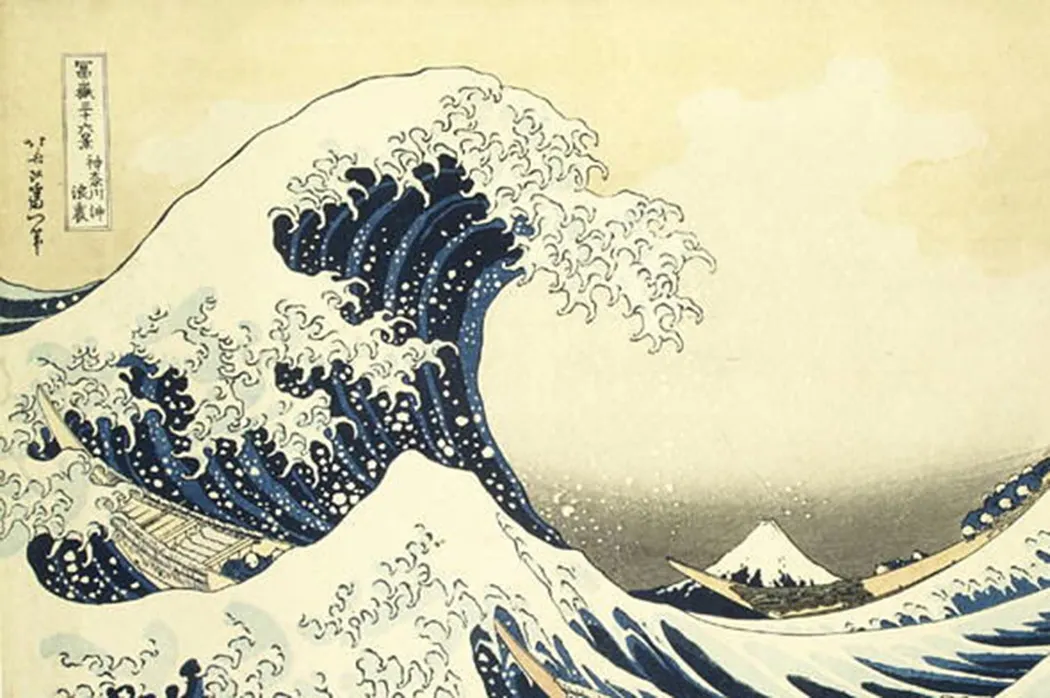
Katsushika Hokusai (1760-1849), though more celebrated for his landscapes and the iconic “Great Wave off Kanagawa,” devoted considerable attention to everyday Japanese life, including the world of textiles. In his ukiyo-e prints, Hokusai captured weavers, dyers, and cloth merchants, documenting the techniques and social importance of textile production. His representations of patterns on kimonos show an intimate understanding of textile design, from the elaborate brocades of courtesans to the simpler garments of peasants.
What connects Hokusai with boro and sashiko is his democratization of beauty. Just as Hokusai found artistic dignity in the representation of common workers and everyday scenes, boro and sashiko elevate the domestic labors of repair to valid aesthetic expressions. Hokusai painted Mount Fuji from thirty-six different perspectives, suggesting that beauty exists in all angles of observation; similarly, boro invites us to see beauty in the worn, mended, and used.
Hokusai Textiles: Art in Modern Fabric
“Hokusai textiles” primarily refer to modern products, fabrics, and accessories that reproduce the iconic works of the Japanese ukiyo-e master Katsushika Hokusai, with “The Great Wave off Kanagawa” being the most popular image. These products range from cotton fabrics for crafts to fashion items and interior decoration.
Types of Hokusai Textiles and Imagery:
Furoshiki (Wrapping Cloths): Very common are cotton Furoshiki cloths (approximately 48×48 cm or up to 104×104 cm) featuring The Great Wave design. They are used for wrapping gifts, decorating walls, or as versatile accessories.
Fabric by the Yard: Available in 100% cotton, often imported from Japan, featuring wave patterns (sometimes with gold details) or combinations with tigers and mountains. They are ideal for quilting, garment making (shirts, skirts), and decoration (cushions).
Tapestries and Decoration: Wall tapestries, often in polyester, displaying views of Mount Fuji.
Fashion and Accessories: Handbags, handkerchiefs, scarves, and canvas aprons (such as the Maekake apron) that incorporate Hokusai’s works.
Silk Textiles: Luxury versions exist, such as silk fabrics with wave designs inspired by Hokusai.
Characteristics and Uses:
Style: Japanese Ukiyo-e art (Pictures of the Floating World).
Themes: The Great Wave off Kanagawa, Thirty-six Views of Mount Fuji, and maritime patterns.
Materials: Primarily cotton, but also linen and silk.
Quality: Many products come from specialized manufacturers in Kyoto, highlighting the durability of cotton and the vibrancy of colors.
These textiles allow Hokusai’s classical art to be brought into everyday use, both in fashion and in the home, creating a bridge between the historical appreciation of his work in prints and a contemporary material engagement with his aesthetic vision. Modern Hokusai textiles thus represent a new chapter in the ongoing story of Japanese textile arts—one where historical artistry is democratized through accessible, functional objects that anyone can incorporate into their daily lives.
Philosophical Confluence
These three cultural manifestations share an underlying philosophy that contrasts markedly with Western notions of perfection and newness. In the world of boro and sashiko, value increases with use; the most precious garments are those that show the most repairs, the most layers of family history. The mend is not concealed but celebrated. The white stitches of sashiko deliberately stand out against the indigo, proudly announcing: “This was broken and I repaired it.”
This aesthetic of material honesty resonates with Zen concepts of acceptance and presence. There is no pretense that the garment is new or perfect; it is what it is, with all its history visible. In contrast to contemporary disposable culture, where the old is hidden or eliminated, boro proclaims: “This has lived and remains valuable precisely because of it.”
Interestingly, modern Hokusai textiles occupy a different space in this philosophical landscape. While boro and sashiko emerged from scarcity and necessity, Hokusai textiles represent abundance and choice—the ability to surround oneself with beauty through reproduction. Yet they share a common thread: the belief that art belongs in everyday life, not confined to museums or galleries. Whether through the humble patch of a boro garment or a furoshiki printed with The Great Wave, Japanese textile culture insists that the utilitarian and the beautiful need not be separate.
Contemporary Relevance
In recent decades, contemporary designers have rediscovered these techniques, incorporating them into haute couture and sustainable design. Japanese brands like Kapital have built entire identities around the boro aesthetic, while global textile artists practice sashiko as a form of creative meditation and statement against fast fashion culture.
This revitalization is not mere nostalgia. In an era of climate crisis and excessive consumption, boro and sashiko offer alternative models of relationship with material objects: repair instead of replace, value history over novelty, find beauty in imperfection. They are practices that reconnect manual making with emotional meaning, transforming clothing from anonymous commodity to personal narrative.
Meanwhile, Hokusai textiles serve a different but complementary purpose in contemporary life. They make museum-quality art accessible and tactile, allowing people to interact daily with masterpieces. A furoshiki wrapping a lunch becomes a moment of aesthetic appreciation; a cushion with wave patterns brings the power of the ocean into a living room. In this way, Hokusai textiles democratize art appreciation while honoring the Japanese principle that beauty should permeate all aspects of life.
Conclusion
Boro, sashiko, and the art of Hokusai—whether in his original prints or modern textile reproductions—remind us that true cultural wealth does not always reside in palaces and temples, but in the working hands that weave, mend, and create beauty from necessity, and in the homes where art is lived with rather than merely observed. These Japanese textile traditions teach us that each stitch can be an act of resistance against waste, each mend a declaration of love, and each worn garment a map of lives lived with intention.
In a world that constantly pushes us toward the new and disposable, perhaps the most valuable lesson from these traditions is simply this: what is broken can be beautiful, what is worn deserves to be honored, and the hands that repair perform work as artistic as those that create from scratch. And in our modern age, we can also honor the past by bringing its greatest artistic achievements into our daily lives, transforming functional objects into carriers of cultural memory and aesthetic joy.