Color and Perception: The Subjective Experience of Light
Color does not exist in the physical world in the same way we experience it. What we call “color” is actually a sophisticated construction of our brain, an interpretation of different wavelengths of light that impact our retina. This reality raises one of the most fascinating questions in neuroscience and philosophy: do we all experience color in the same way?
The Physics of Color
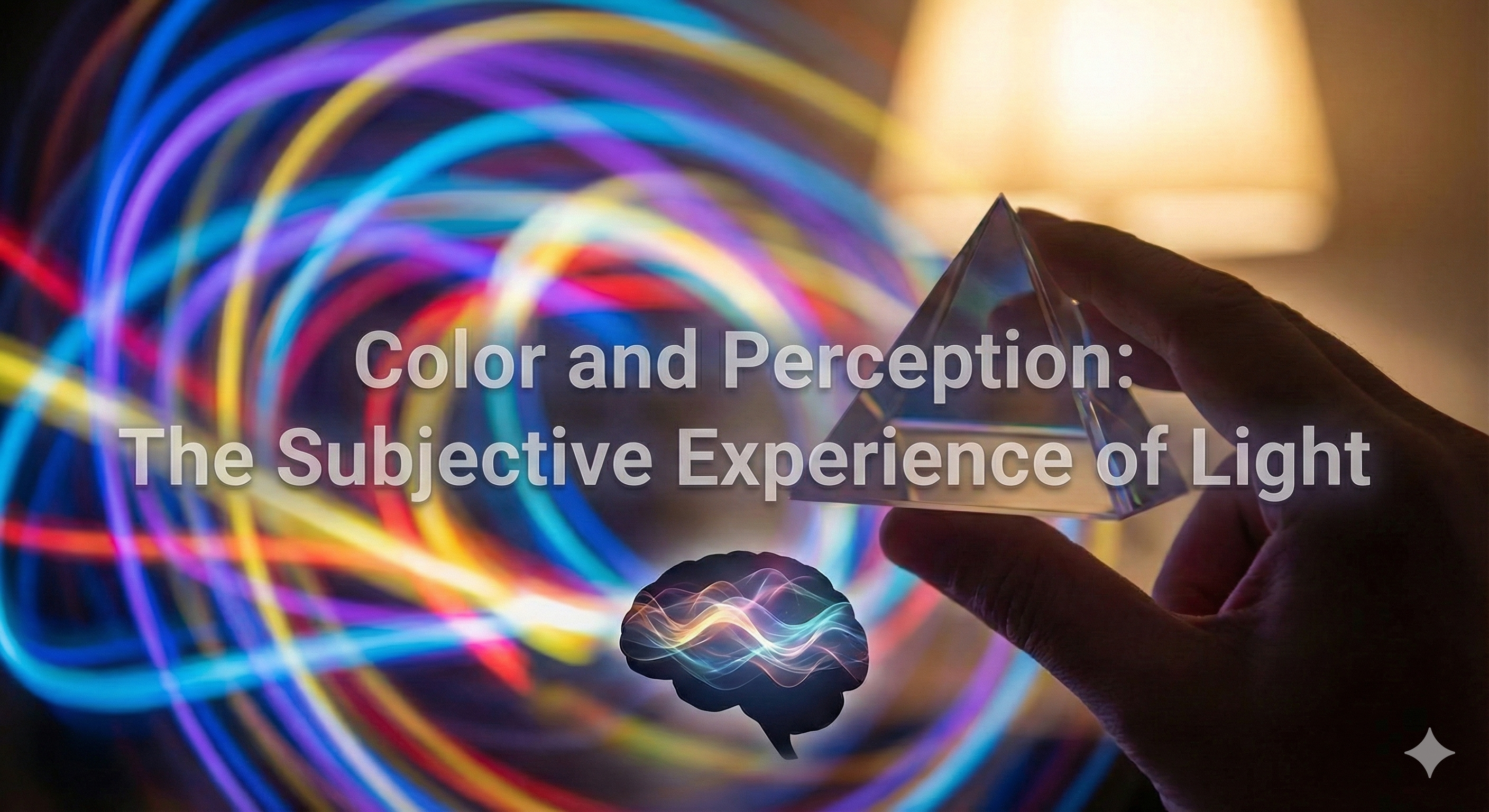
When sunlight passes through a prism, it breaks down into the visible spectrum we know as a rainbow. Each “color” corresponds to a specific wavelength: red has longer waves (approximately 700 nanometers), while violet has the shortest (around 380 nanometers). But these numbers have no color in themselves; they are simply electromagnetic frequencies traveling through space.
The Mechanism of Perception
Our eyes contain specialized cells called cones, of which we have three types. Each type is sensitive to different wavelength ranges: one responds primarily to red, another to green, and another to blue. When light enters our eye, these cones activate in different combinations and degrees, sending electrical signals to the brain. It is in the visual cortex where the real magic happens: the brain interprets these patterns of neural activation and creates the conscious experience of color.
Variations in Perception
Not all people perceive color identically. Color blindness, which primarily affects men, results from deficiencies in one or more types of cones. People with deuteranomaly, the most common form, have difficulty distinguishing between reds and greens. But even among people with “normal” color vision, there are subtle variations in perception.
A particularly intriguing phenomenon is tetrachromacy, a condition in which some people, primarily women, possess a fourth type of cone. These people can theoretically distinguish up to 100 million different colors, compared to the million perceived by a typical person. For a tetrachromat, a sunset is not simply orange and purple, but a symphony of hues that the rest of us cannot even imagine.
Context is Everything
Color perception is profoundly contextual. The same hue can appear completely different depending on the colors surrounding it, a phenomenon known as simultaneous contrast. The dress that divided the internet in 2015, which some people saw as blue and black while others swore it was white and gold, demonstrated how our brain makes assumptions about ambient lighting that dramatically affect our perception of color.
Cultural and Linguistic Influences
The way we categorize and name colors is also shaped by our culture and language. Some languages have dozens of words for different shades of what we would simply call “blue,” while others do not linguistically distinguish between what we call “blue” and “green.” Research suggests that these linguistic differences can influence how we perceive and remember colors, although the debate about the extent to which language shapes perception continues.
The Philosophical Problem of Qualia
This brings us to one of the deepest enigmas of consciousness: the problem of qualia. How can I know if my subjective experience of red is the same as yours? We might agree to call the same wavelength of light “red,” but the internal experience, the “redness” of red, could be completely different for each of us. This problem illustrates the gap between objective description and subjective experience, a chasm that science has not yet fully bridged.
Conclusion
Color reveals the collaborative nature of perception. It is not simply something that is “out there” in the world, waiting to be discovered. It is an active construction, an interpretation that our brain creates from raw sensory data. This reality does not make color any less real or less important; on the contrary, it reminds us that conscious experience is one of the most extraordinary phenomena in the universe. Every time we admire a rainbow or choose paint for a room, we are participating in an incredibly complex neural process that transforms electromagnetic waves into the rich palette of experiences that color our lives.