
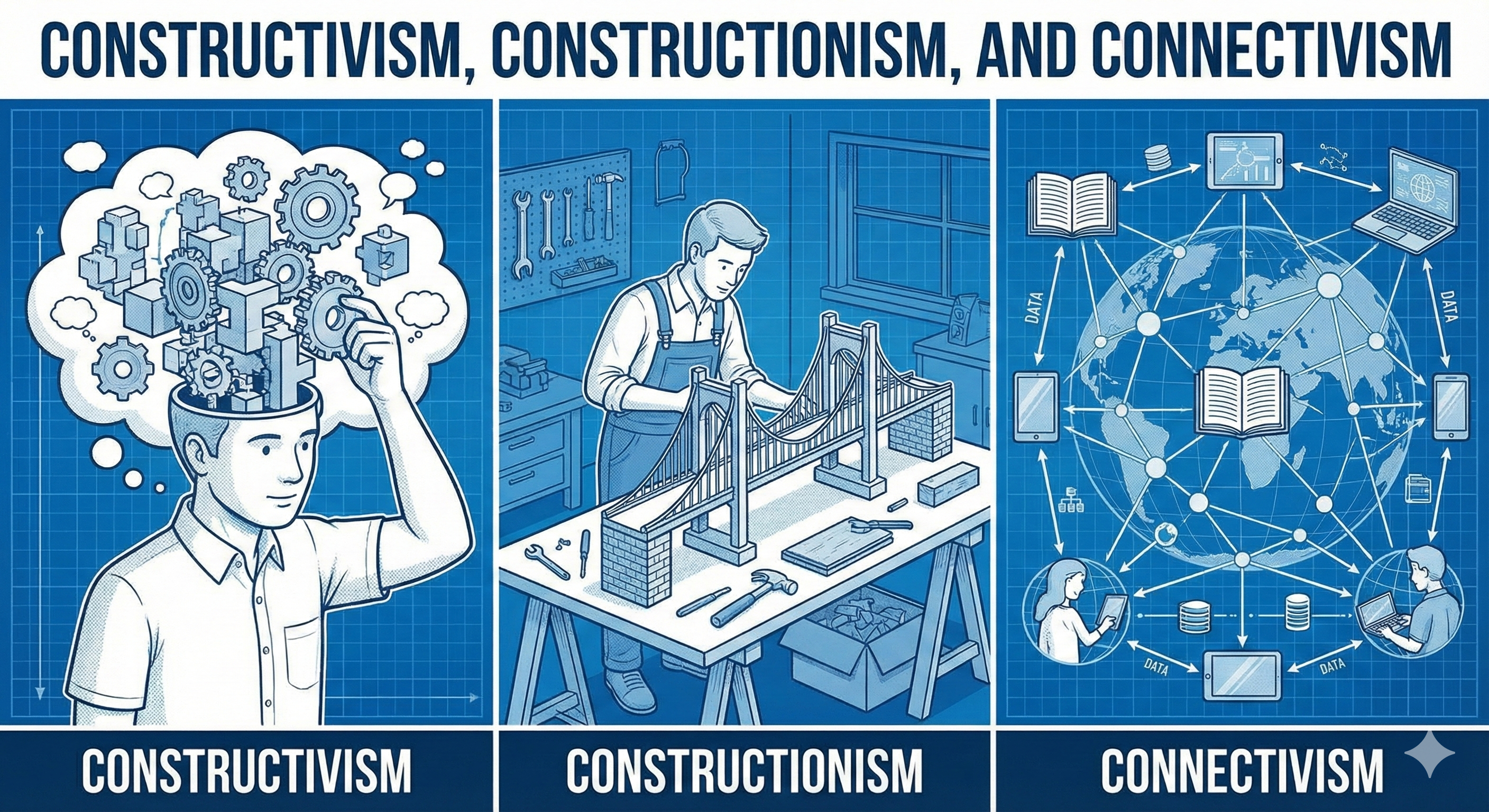
Constructivism, Constructionism, and Connectivism: Three Perspectives on Learning and Art
The words sound similar, but they represent three distinct and fascinating concepts that have shaped both artistic movements and educational philosophy. While Constructivism revolutionized the art world in early 20th-century Russia, Constructionism and Connectivism emerged decades later as influential theories about how people learn. Understanding these three concepts reveals not only the evolution of artistic thought but also profound insights into human creativity and knowledge acquisition.
Constructivism: The Revolutionary Art Movement
Constructivism emerged in 1915 as an early twentieth-century art movement founded by Vladimir Tatlin and Alexander Rodchenko, transforming the landscape of modern art with its radical vision. This wasn’t merely an aesthetic choice—it was a complete reimagining of art’s purpose in society.
Origins and Philosophy
The movement took root during a period of tremendous social upheaval. Following the Russian Revolution, Constructivist art aimed to reflect modern industrial society and urban space. The artists rejected traditional notions of art as decorative or purely expressive, instead embracing functionality and industrial materials.
Vladimir Tatlin was crucially influenced by Pablo Picasso’s cubist constructions, which he saw in Picasso’s Paris studio in 1913. However, Tatlin took these ideas further, creating completely abstract works assembled from industrial materials like metal, wood, and glass. His proposal for the Monument to the Third International (Tatlin’s Tower) became emblematic of the movement’s ambitions—combining machine aesthetics with dynamic components to celebrate modern technology.
Artistic Principles
Constructivism was defined by several key characteristics:
Geometric Abstraction: Artists employed simple geometric forms—circles, squares, rectangles, and lines—that could be drawn with utilitarian instruments like compasses and rulers. This wasn’t about self-expression but about systematic construction.
Industrial Materials: Rather than canvas and oil paint, Constructivists worked with materials of the modern age: steel, glass, plastic, and wood. These materials were analyzed for their value and fitness for use in mass-produced images and objects.
Functional Purpose: Perhaps most radically, Constructivists believed art should serve social purposes. A 1923 manifesto in their magazine Lef proclaimed that the material formation of the object should substitute for aesthetic combination, treating objects as products of industrial order like cars or airplanes.
Artist as Engineer: Constructivists reconceived themselves not as romantic creators but as technicians and engineers solving modern problems through visual means.
Influence and Legacy
The movement’s impact extended far beyond Russia. Due to Soviet opposition to aesthetic radicalism, the group dispersed, with Gabo and Pevsner moving to Germany and then Paris, while later Gabo brought Constructivism to England and the United States. The movement profoundly influenced the Bauhaus school in Germany, the De Stijl movement in the Netherlands, and countless designers, architects, and artists throughout the 20th century.
Constructivism’s visual language—bold geometric forms, limited color palettes, dynamic compositions—became the defining style of the early Soviet state and continues to influence graphic design, architecture, and visual communication today.
Constructionism: Learning Through Making
Shifting from the art studio to the classroom, Constructionism represents an entirely different concept: a learning theory developed by mathematician and educator Seymour Papert in the 1980s. While the similarity in names is purely coincidental, both share an emphasis on construction and creation.
Theoretical Foundations
Papert built upon Jean Piaget’s Constructivism, but distinguished his approach through emphasis on learning through creation of tangible artifacts. While Piaget focused on how learners internally construct knowledge, Papert emphasized that learning is most powerful when people actively create external, shareable objects.
The theory emerged from Papert’s observations of different learning environments. While visiting a Massachusetts junior high school, he was struck by the engagement he witnessed in an art class where students carved soap sculptures, which contrasted sharply with what he observed in traditional math classes. This inspired his vision of learning as a process of making meaningful things.
Key Principles
Learning by Making: Constructionism holds that learning is most effective when part of an activity where the learner constructs a meaningful product. This could be a computer program, a physical model, a piece of art, or any artifact that embodies understanding.
Concrete over Abstract: Papert criticized education’s rush from concrete experiences to abstract concepts. He believed learners should work with tangible, manipulable materials that allow them to develop intuitive understanding before moving to abstraction.
Social Construction: Unlike Piaget’s focus on individual cognitive development, Papert emphasized the social nature of learning. Learners engage in conversations with their own or other people’s artifacts, and these conversations boost self-directed learning and facilitate construction of new knowledge.
Public Entities: Constructionism stresses creating “public entities”—things that can be shown, shared, discussed, and revised. The process of making ideas tangible and communicable deepens understanding.
Practical Applications
Papert’s most famous application of Constructionism was the Logo programming language, developed in the 1960s, which allowed children to create and control graphics through code. This wasn’t just about teaching programming—it was about giving children powerful tools to explore mathematical and computational thinking.
When LEGO launched its Mindstorms Robotics Invention System in 1998, based on work from Papert’s research group, it received permission to use the ‘Mindstorms’ name from Papert’s 1980 book. The collaboration between LEGO and MIT’s Media Lab became one of the most visible implementations of Constructionist principles.
Contemporary educational movements like maker spaces, project-based learning, and design thinking all draw heavily from Constructionist theory. The emphasis on students as active creators rather than passive recipients of information has reshaped educational practice worldwide.
Connectivism: Learning in the Network Age
The most recent of our three concepts, Connectivism emerged in the early 2000s as a response to fundamental changes in how we access and process information in the digital age.
The Digital Age Learning Theory
Connectivism was first introduced in 2004 by George Siemens on a blog post, later published as an article in 2005, and expanded through work by both Siemens and Stephen Downes. The theory addresses a reality that earlier learning theories couldn’t fully capture: learning in an age of information abundance, digital networks, and rapid technological change.
According to connectivism, learning is more than internal construction of knowledge—what we can reach in our external networks is also considered to be learning. In this view, knowing where to find information becomes as important as possessing information.
Core Principles
Siemens articulated eight foundational principles:
- Learning rests in diversity of opinions: Multiple perspectives enrich understanding
- Learning is a process of connecting: We learn by linking specialized information sources
- Learning may reside in non-human appliances: Databases, algorithms, and digital systems hold knowledge
- Capacity to know more is more critical than current knowledge: Learning how to learn matters most
- Maintaining connections is essential: Networks require nurturing for continual learning
- Seeing connections between fields is a core skill: Interdisciplinary thinking becomes crucial
- Currency is the intent: Accurate, up-to-date knowledge is the goal
- Decision-making is learning: What we know today might change tomorrow due to the constantly changing information climate
Nodes and Networks
Connectivism uses network theory concepts to explain learning. A “node” represents any source of information—a person, organization, database, or online community. “Links” are the connections between nodes, forming pathways for information flow. Learning occurs through creating, maintaining, and traversing these networks.
Siemens tends to focus on social aspects of connectivism while Downes focuses on non-human appliances and machine-based learning, but both emphasize that knowledge is distributed across networks rather than contained solely within individuals.
Practical Implementation
The first practical demonstration of Connectivism came in 2008 when Siemens and Downes created “Connectivism and Connective Knowledge,” a Massive Open Online Course (MOOC) that enrolled over 2,000 participants worldwide. This course didn’t just teach about connectivism—it embodied connectivist principles by allowing participants to engage through blogs, forums, wikis, and social media.
In contemporary learning environments, Connectivism manifests through:
- Social learning platforms that enable peer-to-peer knowledge sharing
- Digital communities organized around shared interests
- Collaborative tools that connect learners across geographical boundaries
- Learning management systems that function as knowledge ecosystems
- Professional networks that facilitate continuous learning
Comparing the Three Concepts
While these three “isms” share superficial similarity in name, they represent fundamentally different domains and ideas:
Constructivism (Art Movement):
- Domain: Visual arts, architecture, design
- Time Period: 1915-1930s
- Focus: Revolutionary approach to art-making using industrial materials and geometric forms
- Goal: Create functional art that serves society and reflects industrial modernity
- Legacy: Influenced modern design, architecture, and graphic communication
Constructionism (Learning Theory):
- Domain: Education, cognitive development
- Time Period: 1980s-present
- Focus: Learning through creating tangible, shareable artifacts
- Goal: Empower learners to construct knowledge through making meaningful objects
- Legacy: Shaped maker education, project-based learning, and educational technology
Connectivism (Learning Theory):
- Domain: Digital education, networked learning
- Time Period: 2000s-present
- Focus: Learning through forming and traversing networks of information
- Goal: Prepare learners to navigate knowledge distributed across digital networks
- Legacy: Informed MOOCs, social learning platforms, and online education design
Intersections and Synergies
Despite their differences, these concepts share intriguing parallels:
Creation and Construction: Both Constructivism and Constructionism emphasize making as central to their practice—whether creating functional art objects or educational artifacts.
Breaking Traditional Boundaries: All three challenged established norms. Constructivism rejected traditional art-making; Constructionism challenged conventional teaching methods; Connectivism questioned individualistic views of knowledge.
Social Dimension: Each recognizes the social nature of their domain. Constructivist artists saw art as serving society; Constructionism emphasizes sharing and discussing creations; Connectivism positions learning as fundamentally networked and social.
Tools and Technology: While Constructivism embraced industrial materials and tools, Constructionism and Connectivism both leverage digital technology to transform their respective practices.
Contemporary Relevance
In today’s world, elements from all three concepts remain remarkably relevant:
Constructivist aesthetics continue to influence contemporary design, from user interfaces to architectural projects. The movement’s emphasis on functionality, clarity, and geometric form resonates with modernist and minimalist design sensibilities.
Constructionist approaches align perfectly with contemporary emphasis on STEM education, making culture, and project-based learning. As educators seek to develop creativity, critical thinking, and problem-solving skills, the principle of learning-through-making has never been more pertinent.
Connectivism addresses the realities of learning in an information-saturated world. As remote work, online education, and digital collaboration become normative, understanding how to form, maintain, and leverage networks for learning is essential.
Final Conclusion
Constructivism, Constructionism, and Connectivism—three distinct concepts united by coincidental linguistic similarity—each revolutionized its respective domain. From the art studios of revolutionary Russia to contemporary classrooms and digital learning environments, these frameworks have shaped how we think about creation, learning, and knowledge.
Constructivism taught us that art could be functional and serve society through geometric clarity and industrial honesty. Constructionism revealed that learning deepens when we make tangible things that embody our understanding. Connectivism reminds us that in a networked world, knowing how to access and connect information becomes as important as storing it internally.
Together, these three concepts offer complementary insights: the power of construction, the value of making, and the importance of connection. Whether we’re creating art, facilitating learning, or navigating the digital information landscape, these principles continue to guide and inspire innovative practice.