Paint Brushes for Oil, Acrylic, and Watercolor Painting: Choosing the Right Tools for Each Medium
The three major painting media—oil, acrylic, and watercolor—each have distinct physical properties that demand specific brush characteristics for optimal results. Oil paint’s thick, buttery consistency requires brushes that can push and manipulate heavy pigment. Acrylic paint’s quick-drying nature and variable viscosity calls for resilient bristles that maintain their shape under repeated use. Watercolor’s fluid, translucent washes need soft, absorbent brushes that hold and release diluted pigment with precision. Understanding these relationships between paint properties and brush design helps artists build an effective toolkit and achieve the results each medium can offer.
Oil Painting Brushes: Built for Body and Texture
Oil painting brushes are engineered to handle paint at its thickest and most substantial. Traditional oil painting involves applying layers of pigment suspended in linseed or other oils, creating mixtures that range from thick impasto to thinner glazes. The brushes must be robust enough to move this heavy material across canvas without collapsing or losing their shape.
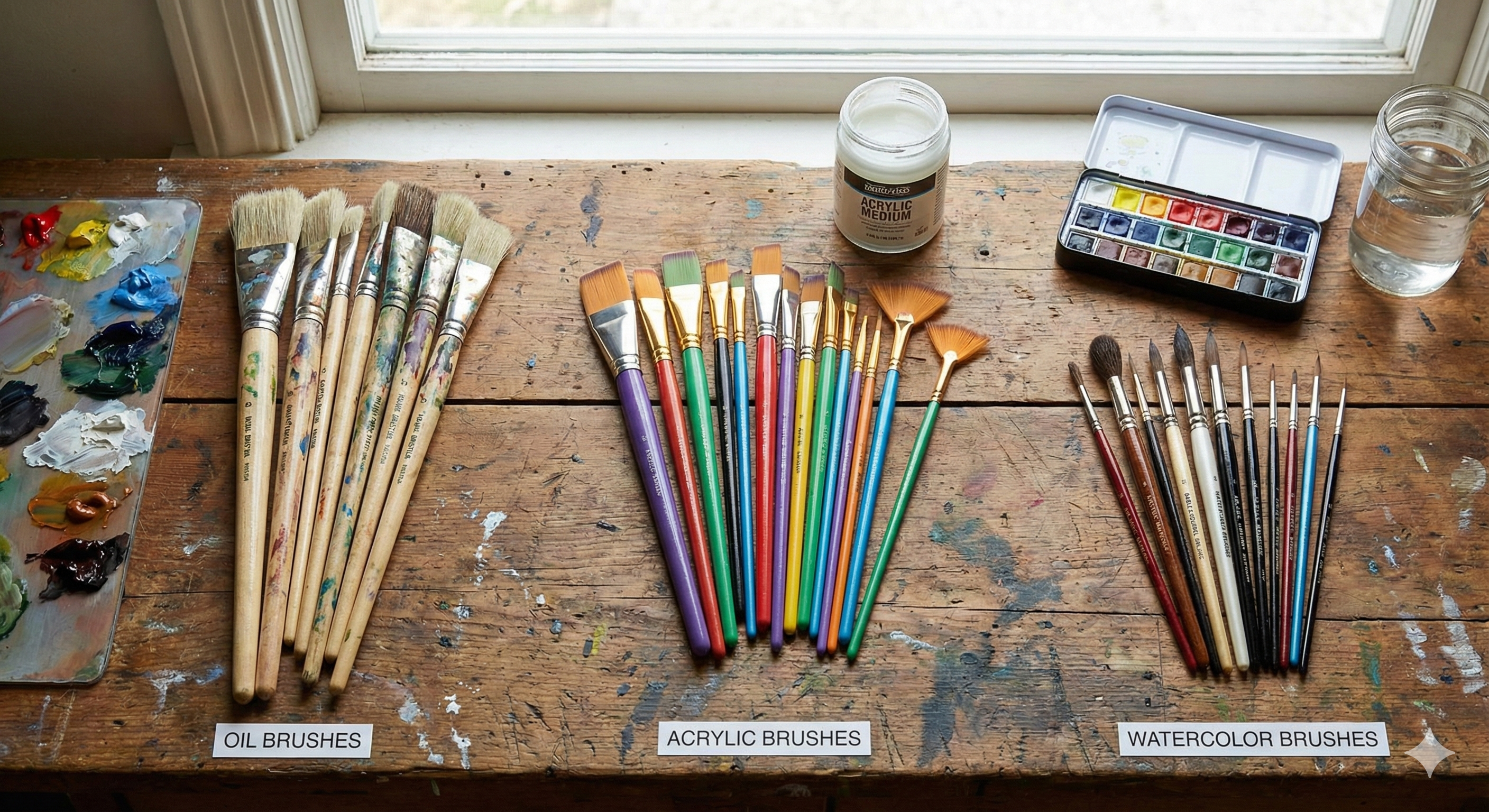
Natural hog bristles have been the standard for oil painting for centuries, and for good reason. These coarse, stiff fibers possess natural strength and a slightly rough texture that grips oil paint effectively. The bristles’ natural flagged tips—split ends at a microscopic level—help distribute paint evenly while creating the characteristic textured brushstrokes many oil painters prize. Hog bristle brushes can withstand the physical demands of moving thick paint and scrubbing color into canvas weave. They create visible, expressive marks that become part of the painting’s surface character.
High-quality synthetic brushes designed for oil painting offer a viable alternative, especially for artists seeking animal-free options or working in educational settings where budget matters. Modern synthetic bristles for oil painting are manufactured to mimic the stiffness and resilience of hog bristle while offering greater consistency from brush to brush. They maintain their shape well, clean more easily, and can be more affordable while delivering performance that rivals natural bristles for many applications.
Oil painting brushes typically feature long handles, usually twelve to fifteen inches or more. This extended length serves multiple purposes beyond simple reach. Long handles allow artists to work at arm’s length from the canvas, providing better perspective on the overall composition rather than focusing too closely on isolated details. This distance encourages looser, more confident brushwork and helps artists see relationships between colors and forms more accurately. The handle length also provides leverage, making it easier to apply pressure when working with thick paint or covering large areas.
The brushwork itself becomes part of oil painting’s visual language. The stiff bristles leave traces of their passage—ridges, grooves, and directional marks that catch light and create surface interest. This visible texture, whether subtle or pronounced, distinguishes oil painting from smoother media. Choosing brushes that complement your desired surface quality, from heavily textured impasto to smoother, more refined passages, becomes an essential part of developing your artistic voice.
Acrylic Painting Brushes: Engineered for Resilience
Acrylic paint presents unique challenges that have driven brush innovation. This relatively modern medium, developed in the mid-twentieth century, combines aspects of both oil and watercolor while introducing characteristics all its own. Acrylics dry quickly through evaporation rather than oxidation, can be used thick like oils or thin like watercolors, and when dry form a tough, water-resistant plastic film. These properties demand brushes that can handle both consistency extremes while surviving the medium’s harsh nature.
Synthetic bristles reign supreme for acrylic painting. Materials like taklon, a high-grade synthetic fiber, offer the perfect combination of strength, resilience, and what brush manufacturers call “snap”—the ability to return quickly to the bristle’s original shape after bending. This spring-like quality proves essential when working with acrylics, as the paint’s body and quick-drying nature constantly test the brush’s structure. Quality synthetic bristles maintain their shape stroke after stroke, neither splaying outward nor clumping together as inferior brushes do.
Natural bristles perform poorly with acrylics for several reasons. The water content in acrylic paint causes natural hairs to absorb moisture, becoming soft and losing the firmness needed to control the medium. More critically, dried acrylic paint is notoriously difficult to remove completely, and its plastic nature can destroy natural bristles’ delicate structure. Natural hair brushes used with acrylics often become permanently damaged after just a few uses, making them an impractical choice despite their effectiveness with other media.
The resilience of synthetic brushes for acrylics extends beyond their performance with paint. They withstand aggressive cleaning, which becomes necessary given acrylic’s tendency to dry quickly on bristles. They tolerate the solvents and soaps sometimes needed to remove stubborn dried paint. They maintain consistent performance through hundreds of painting sessions when properly cared for, offering long-term value that justifies investment in quality synthetic brushes.
Like oil painting brushes, acrylic brushes typically feature long handles. Artists working on canvas or board benefit from the same perspective advantages and leverage that oil painters enjoy. The handle length facilitates working on vertical surfaces like easels while maintaining comfortable posture and viewing distance. For studio painting where the artist stands or sits at a comfortable distance from the work, long handles feel natural and support effective technique.
Acrylics’ versatility means these brushes must perform across a range of consistencies. Used straight from the tube, acrylics approach the thickness of oil paint, requiring brushes that can push substantial material. Thinned with water or medium, acrylics become fluid enough for watercolor-like techniques, asking the same brushes to handle delicate washes. Quality acrylic brushes navigate this spectrum effectively, demonstrating the engineering sophistication behind modern synthetic bristle design.
Watercolor Painting Brushes: Designed for Absorption and Release
Watercolor painting operates on entirely different principles from oil or acrylic work. The paint itself is transparent pigment bound with gum arabic, always diluted with water to varying degrees of transparency. Success in watercolor depends on controlled wetness—managing how much water-diluted paint the brush holds and how it releases that liquid onto absorbent paper. Brushes for watercolor prioritize softness, absorbency, and the ability to form fine points or edges for precise work.
Natural sable brushes represent the traditional pinnacle of watercolor brush quality. Sable hair, particularly from the tail of the Kolinsky sable (actually a type of weasel), possesses remarkable properties. The hairs are exceptionally soft yet springy, returning to their shape after each stroke. They absorb substantial amounts of water while maintaining their form. Most notably, quality sable brushes come to extremely fine points when wet, allowing for detailed work despite the brush’s overall size. A large sable round might hold enough diluted paint for broad washes yet still create delicate lines with its pointed tip.
The cost of genuine Kolinsky sable brushes reflects both the material’s rarity and its superior performance. A single quality sable brush can cost as much as an entire set of synthetic alternatives. For professional watercolorists and those who can justify the investment, sable brushes offer unmatched responsiveness and longevity. A well-maintained sable brush can serve an artist for decades, developing a familiar feel that becomes integral to their working method.
Modern synthetic watercolor brushes have evolved dramatically, with premium synthetics approaching natural sable’s performance at a fraction of the cost. High-quality synthetic watercolor brushes made from fine nylon or taklon fibers form good points, hold reasonable amounts of water, and perform admirably for most watercolor techniques. While connoisseurs might detect differences in how synthetic bristles release water compared to natural sable, many artists work exclusively with synthetics and achieve excellent results. For students, hobbyists, and those building initial collections, synthetic watercolor brushes offer outstanding value and performance.
Watercolor brushes traditionally feature shorter handles than those used for oil or acrylic painting. This design reflects watercolor’s typical working position—artists usually sit close to their paper, which lies flat or at a slight angle on a table or drawing board. Short handles provide maximum control for the precise, detailed work watercolor often demands. The brush becomes an extension of the hand in a more direct way than with longer handles, facilitating the delicate touch watercolor techniques require.
The shapes common to watercolor brushes serve the medium’s specific needs. Round watercolor brushes are fundamental, used for everything from broad washes to fine details depending on their size. Flat watercolor brushes create distinctive rectangular strokes useful for architectural elements or geometric shapes. Mop brushes, with their large, soft, rounded shapes, excel at applying even washes across large areas. Rigger or liner brushes, featuring long, thin bristles, create the continuous fine lines needed for branches, rigging on ships, or delicate botanical details.
The Crossover Question: Can Brushes Serve Multiple Media?
The dream of a universal brush collection that serves all media appeals to practical and economic sensibilities. In practice, some overlap exists, though compromises inevitably arise when asking one tool to serve multiple distinct purposes.
High-quality synthetic brushes represent the most versatile option for artists working across multiple media. Premium synthetics, particularly those marketed as multi-media or featuring advanced fiber technology, can perform credibly with watercolor, acrylic, and even some oil painting techniques. They won’t match specialized brushes’ performance in each medium, but they offer respectable results across the board. For artists exploring different media, building an initial collection of quality synthetic brushes in various shapes and sizes provides the flexibility to experiment without investing in separate brush sets for each medium.
Acrylic brushes transition to oil painting reasonably well. Their synthetic bristles handle oil paint’s body effectively, and the stiff resilience that serves acrylics works similarly with oils. Artists can confidently use their acrylic brushes for oil painting, though they should dedicate specific brushes to each medium rather than switching back and forth. Once a brush has been used with oils, cleaning it thoroughly enough for water-based acrylics becomes difficult, and residual oil can contaminate acrylic paint.
Oil painting brushes perform poorly for watercolor, however. Their stiffness, designed for moving heavy paint, proves far too coarse for watercolor’s delicate washes and details. Using an oil painting brush for watercolor would be like writing calligraphy with a housepainting brush—technically possible but missing the point entirely. The stiff bristles don’t absorb water effectively, won’t form the points needed for detail work, and create harsh, uncontrolled marks on delicate watercolor paper.
Watercolor brushes can technically be used with thinned acrylics, though this practice risks damaging these often-expensive tools. Acrylic paint, even when diluted, maintains its tendency to dry into a tough plastic that can ruin the delicate structure of fine watercolor brushes. Artists who work in both media typically maintain separate brush collections to preserve their watercolor brushes’ condition and performance.
Building a Practical Brush Collection
For artists beginning to assemble their toolkit or those looking to work across media, a thoughtful approach balances versatility with specialization. Start with quality synthetic brushes in fundamental shapes—rounds in small, medium, and large sizes, flats of varying widths, and perhaps an angled brush. These form the core of a functional collection suitable for acrylic painting and decent for watercolor work.
As you develop preferences for particular media, invest in specialized brushes that elevate your work in that direction. If oil painting becomes your focus, add natural bristle brushes that create the texture and handle the paint body this medium offers. If watercolor captures your attention, gradually acquire sable or premium synthetic watercolor brushes that bring out the medium’s subtle beauty. If acrylics remain your primary medium, expand your synthetic brush collection with shapes and sizes that support your evolving techniques.
Consider brush care as integral to building a collection. Properly maintained brushes last exponentially longer than neglected ones. Clean brushes thoroughly after each session, using appropriate cleaners for your medium. Store them properly to maintain bristle shape. Rotate through your collection rather than relying on a few favorites until they wear out. Quality brushes represent an investment that pays dividends through years of reliable performance.
The relationship between painter and brush becomes intuitive with experience. You’ll develop preferences for certain brushes for specific tasks, reaching for familiar tools that feel right for the mark you want to make. This personal relationship with your tools represents part of painting’s deeper satisfaction—the harmony between intention, tool, and result that transforms technique into expression.
The Path Forward: Choosing Wisely for Your Practice
Understanding brush characteristics for different media empowers better choices, but actual use teaches more than any guide can convey. Purchase a few quality brushes rather than large sets of mediocre ones. Experiment with how different bristle types interact with your chosen medium. Pay attention to which brushes feel responsive in your hand and which produce marks that match your vision. Notice how brush size, shape, and bristle stiffness affect your work’s character.
The market offers overwhelming options, from student-grade brushes costing pennies to handcrafted artisan brushes priced like precious tools. The sweet spot for most artists lies somewhere between these extremes—professional-grade brushes from reputable manufacturers that offer excellent performance without extreme cost. These brushes reward the investment by maintaining their quality through extensive use, making them more economical than cheap brushes that quickly deteriorate.
Your brush collection will evolve with your practice. Techniques you explore will suggest new brush types to try. Frustrations with existing brushes will clarify what characteristics matter most for your work. Over time, you’ll accumulate favorites that become extensions of your artistic vision, tools so familiar they disappear from conscious thought, leaving only the direct connection between what you envision and what appears on canvas or paper. This journey from confusion to confidence, from basic understanding to intuitive mastery, represents part of every artist’s development—and having the right brushes for your chosen media accelerates that growth considerably.