Cubism: The Radical Break That Reshaped Modern Art
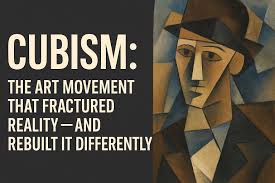
In the early 20th century, art underwent a seismic shift. The Expressionists had already begun dismantling illusionism, but Cubism—spearheaded by Pablo Picasso and Georges Braque—tore down the walls of traditional representation entirely. With Cubism, art was no longer bound by a single point of view. It became an intellectual exercise, a visual puzzle, a revolutionary investigation into form and perception.
The seeds of Cubism were planted by Paul Cézanne, who urged painters to “treat nature by the cylinder, the sphere, and the cone.” Picasso and Braque took this notion and ran with it, abandoning the conventional perspective to depict multiple vantage points at once. Their question was radical and deceptively simple: Isn’t it more truthful to show all sides of an object simultaneously?
At its core, Cubism was an interrogation of space—how a three-dimensional world could be compressed onto a two-dimensional canvas. The movement evolved in two distinct phases:
- Analytic Cubism (1908-1912): This was the first, more cerebral iteration of Cubism, where Picasso and Braque dissected objects into interlocking planes and monochromatic tones. The goal was to provide a “total view” of a subject, a concept that meant fracturing the subject into geometric fragments yet maintaining its structural integrity, thereby presenting a comprehensive and multi-dimensional representation.Synthetic Cubism (1912 onward): This phase shifted towards construction rather than deconstruction. It saw the birth of collage, as artists introduced found materials—newspaper clippings, wallpaper, and even sand—into their compositions.
While Picasso and Braque resisted complete abstraction, Robert Delaunay pushed Cubism into new territories with Orphism, a dynamic fusion of color and movement. Meanwhile, the Section d’Or, a group of avant-garde painters and critics, played a significant role in solidifying Cubism’s place in the modernist canon. Their historic 1912 exhibition at the Galerie La Boétie in Paris was a pivotal moment, marking the movement’s acceptance and recognition in the art world.
By 1914, as war loomed over Europe, Cubism again morphed into Crystal Cubism, characterized by bold geometric planes and a return to a cleaner, more structured aesthetic. It was a period of refinement, where the chaos of early Cubist explorations gave way to an almost architectural clarity.
Today, the echoes of Cubism are still visible in everything from contemporary abstraction to digital design. The movement dismantled centuries of artistic convention and reassembled it into something new. Its influence can be seen in the abstract forms and fragmented perspectives of contemporary art, as well as in the geometric shapes and layered compositions of digital design—proving that art is not just about seeing but about rethinking what we see.